When Your Arms Are Too Short…


As someone who grew up with myopia (nearsightedness), I never imagined that my reading vision would fail me.  Yet I have spent the last four years holding menus at arm’s length to make it easier to read the food selections.  Within the past year, I adopted the habit of grabbing my reading glasses first thing in the morning when I grab my phone.  Do you know why?  Because my close-up vision has become so dim that if I dare to construct a social media post without my glasses, I end up finding typos on my caption or hashtags.  I’ve even gotten to the point where I wear my glasses when sitting at the computer and reading a considerable amount of material, because it reduces eye strain.  

The end result is that I either grab glasses, or wish that my arms were longer.  I also wish that restaurants filled with romantic ambience would scrap the low light conditions in favor of slightly brighter light which would make it possible for all but the most elderly and vision-challenged to see.  

Presbyopia (the age related stiffening of the lens of the eye, which interferes with its ability to contract and diffract the light) has reared its ugly head and taken up residence permanently in my daily life.   And despite the fact that I had the knowledge base to realize that presbyopia would color my life after the age of 50, I am still surprised at how sudden and noticeable the vision changes have been.  

I went from not being able to see the big E on the Snellen eye chart from my childhood into my late 40’s, to struggling to read receipts in my 50’s and wondering,  “Is that a 6, or an 8?”, or, “Is that a 3 or a 5?”  It’s pretty frustrating.  There have been instances in which I have picked up products with the intention of reading the product ingredients, but I often cannot read them at all.  

What’s really strange is that it makes me feel a bit disconnected from the world, since once sense is noticeably dulled. Who else feels that way as a result of having age-related loss of near vision?

People Who Say These 5 Words Have Very Low Emotional Intelligence

Please check out the post at:

https://www.msn.com/en-us/lifestyle/mind-and-soul/people-who-say-these-5-words-have-very-low-emotional-intelligence/ar-AAyz0K5?ocid=spartanntp

I have copied and pasted the article here for you for convenience.

Who agrees with Bill Murphy’s assessment? Who disagrees?

Most people would probably agree with both Bill Murphy and Justin Bariso, and bristle when someone makes the statement, “I know how you feel.” No one truly knows how you feel, because your experience is unique and important. Such a statement does nothing to communicate empathy, but instead alienates the listener. Remember that sharing your particular experience in an effort to comfort the other person detracts from his or her own experience. It’s best to either keep your mouth shut, or just say, “I’m sorry that happened.” Be an ear to bend, not a barometer by which the other person must measure his or her own troubling experience.

By Bill Murphy Jr. of Inc.

They mean the exact opposite of what you think. But only emotionally intelligent people understand why.

The words hit me like a hurricane: “I know how you feel.”

They’re right there on pages 80 and 81 of my colleague Justin Bariso’s new book about emotional intelligence. They’re simple words, and real–and yet as Justin writes, they’re also absolutely the wrong thing to say to those who confide in you with their problems or fears.

These situations are tough, sometimes. You’ve been trusted. You want to develop rapport. You want to act the way somebody with real emotional intelligence would act.

You want to help.

Yet, rather than creating a connection, “I know how you feel” and other phrases like it build a wall between you and the other person.

The phrase suggests that you don’t truly understand what the other person feels at all. (Really, how could you?) It suggests that you feel the need to turn the conversation toward your experience, not his or hers, and that ultimately you don’t really care about that person’s concerns after all.

In other words, this five-word phrase sends a message that’s 100 percent the opposite of what you intend.

So don’t say, “I know how you feel.” Here’s what to do instead.

Shift vs. support

If you’ve read this far, I suspect you really do care about people. But like me perhaps, you don’t always realize the true effects of your words.

The solution, as sociologist Charles Derber suggests, and Celeste Headlee summarizes, is to gauge your responses in real time, and ask yourself whether you’re offering a “shift response” or a “support response.”

What’s the difference?

A shift response involves an attempt to guide the conversation toward your life experiences, and away from the experiences of the person you’re ostensibly listening to and perhaps even trying to help.

A support response sets aside your ego, and instead keeps the focus on the other person’s feelings and experience.

Conversational narcissism

A few examples will make this very clear. In each case below, just imagine that a friend or colleague opens a conversation with the highlighted statement. Then think about how each response would make him or her feel.

1. “My boss doesn’t respect me.”

Shift response: “I went through the exact same thing last year. I wound up leaving and finding a better job.”

Support response: “I’m sorry to hear that. What makes you feel that way?”

2. “If I could just get organized, I’d have the world on a string.”

Shift response: “I know–I have the same problem.”

Support response: “What do you think stops you from being organized?”

3. “I’m so sad since my breakup.”

Shift response: “You just need to get back out there and start dating again.”

Support response: “What do you think stops you from being able to move forward?”

Derber calls the whole phenomenon, at least the part in which well-meaning people shift the discussion to their own experience, “conversational narcissism.”

Is that a $20 phrase to describe a $1 problem? Maybe. But it does make it clear.

“I can imagine…”

As Justin puts it in his book, the successful strategy to communicate effectively and leverage emotional intelligence requires avoiding phrases like these:

“I know exactly how you feel.”

“I’ve been through this before.”

“I completely understand; or, I get it.”

And replacing them instead with things like the following:

“I’m sorry that happened.”

“I can imagine how you may feel.”

“Thanks for sharing this. Tell me more.”

Actually, I might take issue even with “I can imagine how you may feel.” But we’ll leave it in.

Just remember that the whole point here is to acknowledge how hard it is to really put yourself in someone else’s shoes, and instead make clear that you have empathy.

You’re trying to understand–even as you acknowledge that full success might not ever be possible. The true connection that you’re both looking for comes with the well-communicated attempt.

Looking For Fitness, Wellness, and Life Inspiration?


If you are looking for that fire which will encourage you to reach out towards your fitness, wellness and life goals, then be sure to tune into the motivating, inspiring podcasts at https://micro.fit/ where the motto is, “For big results, think small”. That’s right…small changes in your lifestyle can create dramatic results in your life!

I am honored to be one of the featured podcasters for this wonderful app! My podcast runs on Fridays, so be sure to check it out each week for new topics and fresh perspectives on life balance, goal setting, motivation and fulfillment.

Click on this link to access the podcast page directly:

https://micro.fit/podcasts

Of Orifices and Zero Freedom

As a physician, I have had the incredible honor and privilege of studying every part of the human body, to the most minute detail. I have hovered over cadavers which were fileted and displayed for they eyes of inquisitive medical students, and scrubbed in on colon resections, open heart surgery, neurosurgery, cataract removal, etc. During my first month of internship as a newly minted physician, I massaged a dying heart with my gloved hands (no, the patient didn’t survive). I have also delivered over 40 infants via vaginal and Cesarean methods, and have pronounced the demise of patients in the wards. In fact, there are many stories I have collected over the years, some incredibly sad, some disgusting, some frightening, and some infuriating, but all true, and all part of my experience as a doctor.

I knew full well that by signing up for an education in medicine, I would be subjected to disgusting, morbid, frightening things, and that I would face mortality on a regular basis. However, after several years of working in family practice, I began to notice that I wasn’t thrilled with the fact that I examined orifices of every kind on a very regular basis. Whether it was a nostril, a mouth, an ear canal, an anus, a urethral meatus (layman’s term pee-hole), or vagina I had to examine, I was never thrilled about it, and the orifices below the belt were certainly much more bothersome to address. My intense dislike of such examinations, combined with the tedium of primary care and the low insurance reimbursement for services and procedures provided, caused me to retreat from primary care and focus more on the areas I had more interest in, namely, physical medicine, cosmetic dermatology, and anti-aging medicine, all of which are much cleaner and which do not require me to conduct examinations on private parts.

Another feature of primary care which made me cringe was the intense demand on a practitioner’s time. The only time it ever seemed reasonable for me to literally lose sleep night after night as a physician was when I was in training. At this point, there is no way you could convince me that such a thing is healthy, and I refuse to sign up for that. I won’t give up weekends to take on three stacked 12-hour work shifts, and I will not give up the few holidays I celebrate (Thanksgiving, Christmas Eve, Christmas Day, New Year’s Eve, and New Year’s Day) in order to work. As it is, I give up other major holidays to work, but since the work I perform on those holidays is in bodybuilding and fitness, I don’t mind it at all.

I love being a physician, and I find it incredibly rewarding to make a positive impact on my patients. However, I will not sacrifice balance in my life, or the freedom to pursue my other interests, in order to prove to society what a good physician I am. I don’t believe for a second that running oneself into the ground working as a physician ever sends a positive message to others. I don’t ever want to be the kind of doctor who is saddled with so many chart notes to write that an entire weekend is devoted to completing them. Not for me.

Lasty, I think it’s so strange that society still assumes that doctors are supposed to give their time and knowledge at a moment’s notice, on demand, yet I don’t see those same demands placed on people in other industries. I can’t tell you how many times I have been in a brief conversation with a complete stranger, who dares to ask me a medical question as soon as my profession is revealed. I swear, one of these days I am going to get a t-shirt made that says, “THE DOCTOR IS OFF-DUTY RIGHT NOW…NO MEDICAL QUESTIONS PLEASE”!

Our New Security Blanket

Think about the one thing which is constantly at your side, namely, your phone.

You rely on that small, handheld computer to keep your life in order, so much so that misplacing it sends you into an instant panic. Your LIFE is on that phone, dammit, and if you were to lose it, you would hate to imagine how much its loss would disrupt your life. I am willing to bet that you carry your cell phone everywhere, even into the restroom, which is why cell phones harbor some of the nastiest germs which are found on inanimate objects these days.

Your thumbs assert their special evolutionary spot in the animal kingdom by constantly texting, liking posts, scrolling, and sweeping to the left or right. Unfortunately, that also means gamekeeper’s thumb, an injury to a tendinitis in thumb ligaments is all to common now.

Your relationship with your phone is so tight that you will stare into it even while at dinner with friends, and it will tempt you to fuss with it while driving, despite the dangers associated with driving and texting.

I have a suggestion for you if you are so attached to your phone that it has become a security blanket. Why not leave it at home while you run to the gym? How about leaving it on your desk at work while you use the restroom? Leave it face down on the table when you are having dinner with friends. Avoid looking at it once you have crawled into bed. It won’t be the end of the world if you put your phone down every once in a while.

When Your Mind Won’t Wind Down


Where Is The Off Switch?

Have you ever been so wound up with thoughts or concerns that your brain refused to allow you to fall into blissful sleep? As long as your emotions are influenced by excessive amounts of stress, the pressure will continue to spark anxiety which will continue to rob you of sleep, even if your body is completely wiped out. A vicious cycle of insomnia not only prevents the body from getting the restorative sleep it needs, it can contribute to depression or panic disorder.

People are so busy these days that it can be a challenge to check off everything on to-do lists, so it is rather common to see folks working right up until bedtime. However, if you are having problems turning off your thoughts at night, you must break this habit and allow yourself to calm your mind in preparation for sleep. That means you need to avoid activities like housework, checking emails, paying bills, or any other activity which keeps your mind active, for at least an hour before your usual bedtime.

Anxiety and Sleep

What fuels the mind and makes it work overtime in the majority of cases is anxiety. The bed is supposed to be a place for sleep, yet many individuals lie in bed with thoughts spilling over, and are unable to get the thoughts to cease because they provoke anxiety. The chances of solving any problems while trying to fall asleep are slim, so the constant worrying only serves to interrupt much-needed sleep. Honestly, how often have you been able to solve an issue you were worried about, after you crawled in bed? Your mind will be better equipped to solve any issues which plague you if you shut off your thoughts and allow the restorative benefits of sleep to take over.

Go To Paradise

Try redirecting your thoughts by practicing guided imagery. While lying in bed, close your eyes and imagine a beautiful place, such as a tropical paradise. Breathe slowly and evenly, while imagining hearing the waves crash on the beach, and feeling the sand and the warmth of the sun. You can even play ambient sounds of the ocean to help you visualize the scene. This relaxation technique can be extremely effective in not only shutting off the endless chatter in your brain, but also in getting you to fall asleep.

If you are concerned that ideas or concerns will pop into your head in the middle of the night, keep a notebook and a pen next to your bed. Once you write something down, put the notebook away and let it go. Remember that it really can wait until tomorrow.

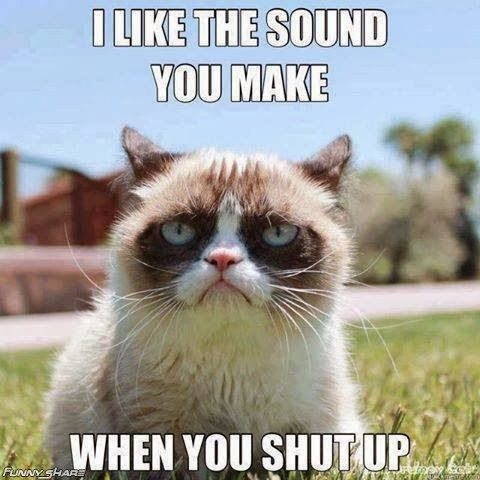
Shut Up, I’m Trying to Concentrate! (Revised Repost)

I-like-the-sound-you-make-when-you-shut-up

There are times when I need absolute silence in order to concentrate. Since I spend a lot of time at home writing, I deal with the constant challenges of coming up with new material, and allowing the creative process of writing to develop. Perhaps the most distracting thing I face when I am trying to focus is NOISE. Whether the noise is from people talking to each other, exercise equipment banging against the floor, car horns blaring, cats playing, doors opening or closing, or people constantly trying to talk to me, any noise except music will get me to the point where I get close to losing it. I am well aware of the fact that I suffer from misophonia, and have dealt with it since med school days, when I had to wear earbuds whenever I sat for exams.

I recently read that a group of psychologists at Northwestern University discovered that highly creative people tend to be more sensitive to noise than the average person. I digested this information with relish, since I certainly hope the fact that I can be easily annoyed by noise when I am in a creative mode is indicative of creative genius, or at least something close! The assertion that creative types are more easily distracted by noise is demonstrated by great novelists like Proust, who apparently would sequester himself in his small apartment, donning earplugs and drawing the blinds while he wrote.

Cat shutting dog up

Basically, I think the general rule of thumb should be that if someone tells you to pipe down, and the person is clearly trying to focus, then SHUT UP!

How Technology May Be Saving Aging Brains

Our brains are precious cargo which govern all that we do. One of the most mystifying things about these organic motherboards is that they are constantly changing and adapting to our environment, even as we continue to age. Of course, that also means that as we age, we can experience a decline in function.

Now that we are deeply immersed in a major technological age, our very sensitive noggins are also being shaped by the endless stimulation by iPhones, smartphones, computer interfaces, Mp3 players, Bluetooth, even self-driving vehicles. The speed at which technology is evolving is so rapid these days, that it is almost impossible to keep up, but somehow, our gray matter will be affected, either positively or negatively, by these advancements. Most scientists have begun to believe that the impact is mostly positive.

There is a new generation of young people who have little to no clue about what it might be like to play outside and to enjoy the fresh air, because they would much rather play video games, surf the internet, or dig around in the world of social media. The trade-off is that these millenials tend to have faster decision-making skills and can also navigate through the newer computer interfaces and platforms with great ease.

There’s actually a term coined for the generation which has been exposed to computers and cellular phones since birth: digital natives. Their brain circuitry actually differs from older individuals who haven’t had the same lifelong exposure to tech gadgets. There’s a possibility that older brains may get a similar benefit from using the high-tech devices which are so ubiquitous these days. Dr. Small from UCLA performed a study which examined older individuals who had some experience searching online, and discovered that those individuals did indeed have more activity in the decision making portions of the brain than subjects who had never searched online before. Since the brain alters its neural connections with each experience, it makes sense that our inner wiring will change, even as we age.

Afraid You’ll Succeed?

This is a reposted article which I wrote a while back.

Have you ever considered the possibility that you are standing in your own way when it comes to achieving success in your life? Yes, you heard me right. You might not have even known that there was such a thing as a fear of success, and if not, you probably aren’t aware of how a fear of success can sabotage your efforts at getting ahead and put you on a short course to failure.

Though we may crave success deeply and feel driven to set specific goals to get us there, we may cripple ourselves by harboring a feeling that we don’t deserve to have success, or we may question our own abilities. Self-defeating thoughts like, “What if I fail?”, or “Maybe I don’t deserve to be successful” may fester in one’s mind. However, some people entertain an even more frightening thought which is “What if I succeed?” and may be so paralyzed by that fear that they talk themselves out of pursuing a goal which gives them purpose, joy and passion. Suddenly, the lure of success sours in the face of one’s own fears.

The fear of success is more powerful than the fear of failure because the former can trap individuals into established patterns which are comfortable and which prevent the movement and growth necessary to achieve success. The road to success, after all, is unpredictable and forces people out of their comfort zones. It demands tireless efforts which at times may be stalled by roadblocks, and those obstacles may stack up or appear at critical times when the temptation to give up is immense. As daunting as such challenges are in the pursuit of success, they must be overcome if the goal is to be attained.

A fear of success can manifest as procrastination, whereupon projects may be put on hold and excuses made about why there is no time to complete them. Feelings of guilt may take hold if you happen to attain a certain level of success which eludes your peers, friends or family. You may worry that success will in some ways change you and your environment. Though you may lament your current situation and crave big changes that would serve as markers of success, you might find the idea of all those changes incredibly distressing.

The road to success is also often a lonely one in which you may feel lost, perhaps because others may not understand your journey, or because you may be traveling in uncharted waters with no one to lead the way or guide you. There may be haters who try to derail you from your master plan, which is usually a good sign since it is an indication that you are doing something which is perceived as a threat to your competition. You might also think that once you become successful, somehow that success won’t be sustainable and that the proverbial coach will turn back into a pumpkin.

Success will usually put a spotlight on you and you will get attention. Some of you may believe that the attention is great, but when all eyes are on you, scrutinizing every move you make, you may find that it is incredibly distressing. Success comes with responsibilities which may frighten and intimidate you, and you may feel incredible pressure to prove your worth as a result of that boost in visibility. Contrast that with being ensconced in a comfortable pattern which provides a predictable environment, and you can see why so many people chicken out and drop their big goals. Once you achieve your goal and become a success, the goal you were chasing after becomes irrelevant because the beast has been vanquished. The taste of victory may be sweet, but life may lose its meaning and purpose in the aftermath of such an accomplishment.

There are a number of things you can do to maintain your enthusiasm and focus while carving a path to success:

Keep sight of your goals and purpose – Not only is it important to write down specific goals so that you have a blueprint of how you will achieve success, it is also essential to review those goals regularly to make sure that you stay on track and remember the purpose which drives your efforts. I recommend reviewing your master goals list at least once a week.

Gain knowledge – If you sense that your knowledge base is lagging, invest in educational pursuits which will add credibility and push you towards your goals faster. For example, talk to experts in the field you are trying to excel in, read books on pertinent subjects and take courses. Remember that your heroes can eventually become your rivals if you learn from them and pattern your behavior after them.

Become inspired by the people who believe in you – Chances are that you have people around you (spouse, family members, coworkers, fans) who completely believe in you, are inspired by you, and want to see you succeed. Though you may feel pressure to succeed and a sense of obligation as a result of this, you can focus on the enthusiasm which they have for you and allow it to wash over you and motivate you.

Keep a gratitude journal – It can be so easy to complain about one’s situation and play the victim when things aren’t going as planned, but such behavior only does harm when trying to stay motivated in achieving goals. Shift the focus instead onto all the wonderful things, people and other blessings you have in your life and allow them to fortify your resolve to move forward.