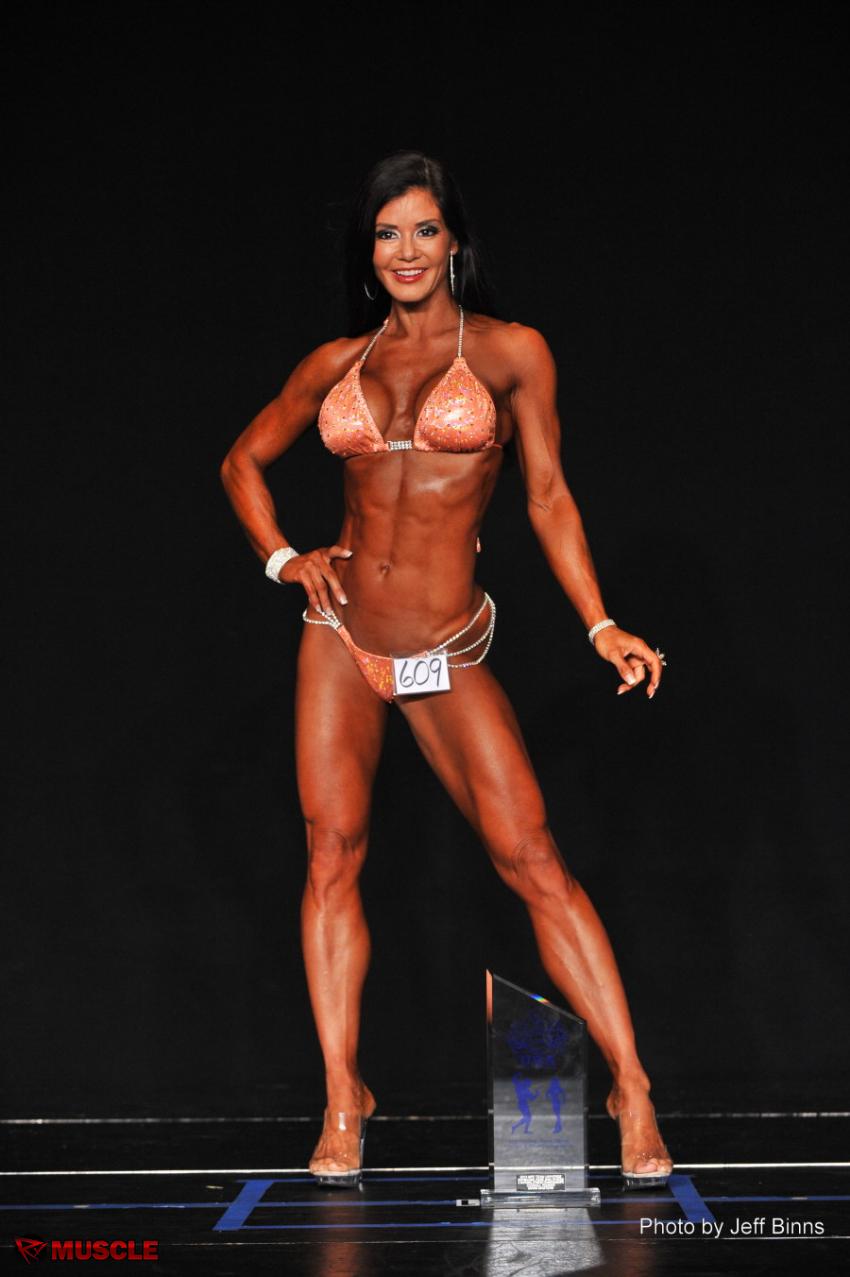
NPC Team Universe July 6, 2013. The day I earned my PRO CARD!
The first time I heard the phrase that serves as this article’s title, I remember how it resonated with me. I come from a single-parent household and remember seeing how my mother struggled on a very limited income. Somehow she always managed to get by, though I remember every meal being stretched with large servings of Japanese white rice. In fact I remember being quite puzzled the first time I visited a classmate’s house and was served soup without a hunk of rice floating in it. I thought everyone was poor and had to stretch every meal. There were times my mom would splurge and bring home lamb shoulder chops, which I would eat very slowly so that I could prolong the sheer joy of eating such a delectable meat. My mother believed that education was the most important thing and was determined to keep me in private school despite the fact that it meant forgoing many creature comforts. We lived in an old apartment with many donated furnishings. I couldn’t have a car when I was sixteen so my mom and I shared her car. But I was truly happy, and knew that my mom gave me the most love and encouragement a parent could possibly provide.
My mother encouraged me to pursue all my interests, which ranged widely from medicine to illustration, modeling, fashion design, acting, music and foreign languages. She believed in me, made me feel like I was unstoppable, and also made sure my goals were challenging enough for me. Instead of choosing something from the list to pursue, I decided I wanted to tackle them all. I remember my mother struggling financially during my senior year of high school. She didn’t have the money for tuition, so she borrowed it from her siblings so that she could keep me in the same school I had been at for eight years. Her determination to keep me in the same school enabled me to graduate from high school at the age of sixteen at the same place I had established relationships and developed a comfort level. During that time I was able to design an entire clothing line for a company, study several foreign languages, learn to play the guitar, dabble in graphic design, act in several pilots and commercials, and do all kinds of modeling. I had no idea at the time that the pressure to achieve great things set the stage for an eating disorder.
The precipitating event which pitched me into full-blown anorexia nervosa was a rape at the age of nineteen. The event was violent, traumatic, and for whatever reason, I would see my attacker’s face every time I looked in the mirror. I never understood why this kept happening but was so tortured by this that I set about making him disappear. For me this meant starving myself and taking laxatives, which I did for close to a year. I felt fat (which at 5’5” and 103 pounds, was clearly not the case), unattractive, ashamed, and frightened. I was relentless about making this man’s face disappear, which fueled my starvation attempts. At my lightest I got down to 85 pounds and felt like I was in hell. Right around that point I recall an acquaintance telling me that at the age of 20 I looked like a 40 year-old. He was a celebrity fitness trainer and seemed to know a great deal about human performance, so his words jolted me. But I still didn’t see the point he was trying to make.
A couple of weeks later a good friend visited me and took a number of candid photos and sent copies to me. When I looked at the photos, I finally saw the children’s size 12 jeans hanging on my skeletal body, and for the first time I truly saw how emaciated and unhealthy I looked. It was like a slap in the face. Why would I do this to myself? I had hit rock bottom and it was time to turn my life around. As soon as I realized what I was doing to myself, I threw away the laxatives, started eating regularly, began weight training and declared a major in exercise science. During my studies I also decided to enter a Japanese-American beauty pageant and won the title for my region, fulfilling a dream I had since childhood. I had finally healed from the rape and from my eating disorder.
Shortly after that, I obtained my bachelor’s degree and began training clients as a fitness trainer.
For many years I worked as a trainer while also working as an optometric technician and a personal assistant to a stand-up comic. I wanted to keep my life as varied as possible because I had such diverse interests and talents. After a few years I realized that my childhood interest in medicine as a career was still very much alive, so at the age of 30 I applied to medical school. To my surprise, I was accepted, whereupon I began my medical training. During those years I became very discouraged and resentful of the fact that the balance in my life was disrupted so violently. However, I got through it all, somehow cramming in the plethora of medical terms that medical students must learn during their training. There were three things which helped me to endure the rigors of training: 1) my mother’s belief that I could accomplish anything I set my mind to, 2) the joy of helping patients, and 3) my exercise regimen.
I got such a rush from knowing I had made a patient feel more comfortable and understood why the Hippocratic oath is, “First, do no harm”. I felt great empathy for patients and learned I had a bedside manner which set patients’ minds at ease. Throughout all my training, including internship when I would work over 100 hours in a week, I was so determined to keep up with my exercise that I would drag myself to the gym 3 or 4 days a week and train, knowing I would feel better afterwards. Regular exercise kept me balanced, allowed me to have time for myself and also gave me extra energy to power through the most grueling days in the wards. Perhaps I wasn’t in competition shape, but I was in very decent shape at that time, and that was fine with me. I was certainly in much better shape than my colleagues because I never made excuses to keep me from going to the gym.
Being fit and engaging in regular exercise was always essential for me. It has always been there, like a good friend, keeping me aware of the magical instrument of my body, helping me to remain focused throughout all the challenges in my life. I had no idea that my relationship with fitness would be taken to the next level when I attended the NPC California State Bodybuilding, Figure and Bikini Championships in May of 2009. While sitting there watching the bikini competitors strut their stuff, I was approached by two people who encouraged me to compete in the bikini division. I pondered this idea for a couple of days. I was fast approaching my 43rd birthday. I had been laid off from my job as an outpatient physician and thought this would be the perfect “bucket list” item. Why not? I could say that I got onstage in front of hundreds of people in essentially my underwear.
I decided to register for the NPC Los Angeles on July 18th, 2009. I was completely clueless about how to prep my body for the competition and remember frantically looking up information online for tanning, suits and accessories. I remember being backstage before prejudging and thinking I was a complete fool for buying an off-the-rack suit, for sponging on my tan, and for having no clue about how to do my hair and makeup for stage. I still thought I would compete that day and just check off that “onstage in underwear in my 40’s” box, writing it off as an interesting experience in my life.
What happened instead was that I was bitten by the bug. My desire to reach a personal best, coupled with the inspiring energy of being surrounded by like-minded individuals, fueled me and helped me get over my stage fright. Any shred of shyness I may have had prior to that day melted away. I was also amazed by how many competitors had overcome eating disorders, molestation, obesity, disability, cancer and other major medical issues. I decided to do a second show and was shocked when I placed first in master’s bikini. It gave me the drive and determination to keep hanging another carrot in front of me and transform my body. I was given a platform by which I could reach a personal best which I had never reached before. And best of all, I could look at my 40-something body and say, “now this body could rival that of a 20-something!”
I ended up competing in 7 regional events, 14 Pro-qualifiers, and once I attained IFBB Professional Status in July of 2013, I competed in four Pro events. I became more polished in my presentation and learned something from every contest, whether it had to do with posing, tanning, suits, makeup, etc.
What I realize now as an IFBB Bikini Pro and fitness professional is that the transformation a competitor experiences is far more than physical. It is mental, emotional and spiritual. My spiritual journey has been encouraging, empowering and insightful. Through whatever challenge life throws my way, I now know I have the strength to overcome them all. What’s more, the fire in the belly that drives me to keep getting onstage to be scrutinized heavily by judges gives me concrete goals which lend great focus to what I want to achieve in life. I want to keep getting better and better, and am aware of that goal every time I hit the gym. I want to achieve the pinnacle of fitness and success. We are all infused with great strength because we can create goals and REACH them.