
I love the sass I threw out in this image! Taken at the NPC USA’s, July 2010
I love the sass I threw out in this image! Taken at the NPC USA’s, July 2010
It was a brilliant move on the part of the NPC and IFBB to establish new competitive divisions within the last four years, as it expanded the competitor pool and boosted the appeal of stepping on the competitive stage. However, each new division has gone through growing pains as the judges have struggled to establish specific criteria with respect to ideal proportions and muscularity. The added fact that some individuals have stepped onstage with little to no prep has confused some competitors with respect to what is expected within a division.
As an NPC Bikini competitor I have seen the Bikini Division undergo countless permutations since its inception in 2009. Personally, I have been told to become softer, lose mass, increase mass, stop working my abs, resume working my abs, etc., as the division’s standards went through their permutations. This year it seems that the burgeoning Bikini Division along with the recent crop of IFBB Bikini Pros has propelled the division to an ideal which appears to reward a slightly higher degree of muscularity. To some extent it seems that this is the direction in which Men’s Physique is travelling. However, there are a number of Men’s Physique competitors who without question had previously competed in Bodybuilding (as is the case with some former Figure competitors who have since made the transition to Bikini) and who are currently being penalized for having more muscle mass. Certainly there must be some clear distinction between each division, but the degree of subjectivity which enters a competition can make determining class winners a somewhat tricky undertaking.
Now that Men’s Physique is in its second year, with a growing list of IFBB Pros who have graced the stage with such status, the confusion about what judges are looking for seems to have lessened somewhat. Clearly an excessive degree of muscle mass is not being rewarded, and instead a well-conditioned, highly sculpted frame with an appreciable V-taper and deep abdominal crosscuts is the most highly sought ideal. It seems apparent that the well-conditioned “fitness model” look, perhaps with slightly more muscle mass in the pecs, delts and abs, has defined Men’s Physique and that those who ride the fine line between this division and Bodybuilding are being advised to deflate somewhat. This being said, being ripped on competition day is acceptable provided a competitor is not beefy or thick-waisted. There has also been considerable discussion regarding the lack of focus on the lower extremities and the assumption that quad development is of no importance since any quad sweep or hamstring development is completely covered by the regulation board shorts which are worn.
There has been an interesting parallel between the comparison of Men’s Physique to Bodybuilding versus comparisons of the Bikini division to other women’s divisions. With the exception of the deeply cut abs in Men’s Physique competitors, muscle separation is generally frowned upon in both Bikini and Men’s Physique. In addition, neither Men’s Physique athletes nor Bikini athletes are meant to sport an extreme degree of muscle mass. After all, both of these divisions are meant to celebrate the ideal bodies one could imagine emerging from the ocean on a balmy beach day, with tiny waistlines on both genders, broad shoulders and chests with chiseled abs on the men, and perky posteriors and shapely legs on the ladies. These ideals are generally considered more appealing and more attainable to the average person, and as a result, have contributed greatly to the surge in popularity of both divisions.
The Men’s Physique division is still the new kid on the block and will endure more growing pains as the division’s pro ranks increase. However, as with all other divisions, the competitors who rise to the top will help to define the aesthetic ideal, hopefully bringing about more consistency within the division. It is a very exciting time.

No odd surgery or up here. Just clean eating, hard training, focus and determination. From IFBB North American this past Labor Day weekend.

Candice Perfect and me at the end of a very long night handing out trophies!
As a physician I meet new people constantly and have mastered the art of setting a patient’s mind at ease. I am amenable to chit-chat when 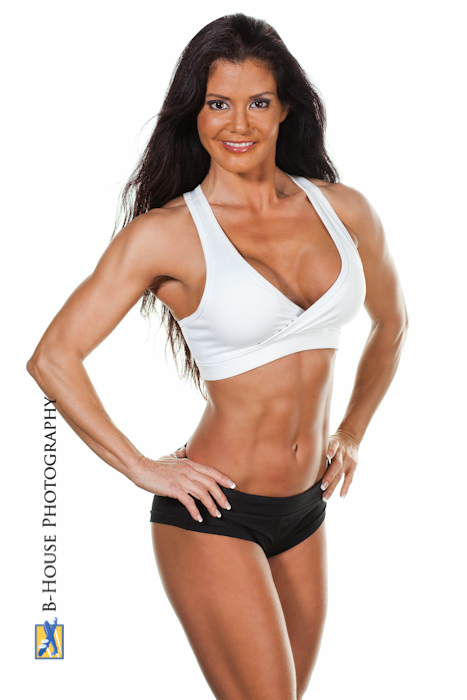 running errands and enjoy engaging in conversations with strangers while at social events. However, when I am at the gym, I automatically shift into a “don’t mess with my flow” mode which has left other gym members with the distinct impression that I am some sort of ice queen.
I have made numerous attempts over the years to train with friends and at the conclusion of every one of those training sessions have resolved to avoid such scenarios at all costs. Thus in my estimation having a training partner has a completely ergolytic effect on my regimen. Though I recognize the utility in having a supportive human by one’s side to encourage one more rep, such commentary from a pep squad only serves to distract me and in some cases raise my ire.
I have spent my entire life as an aggressive self-starter. Without such drive I would never have endured the rigors of medical school and residency. As an NPC national Bikini champion I have consistently pushed myself to reach a personal best, which has been no easy task given the demands of my career and life in general. I stroll into a gym with my equipment and my regimen for the day like a thoroughbred horse lining up at the gate, blinders in place, ready to charge towards the finish line at full speed. It certainly doesn’t help that I am usually in an incredible rush to get to the office or a meeting and must keep moving from movement to movement. You can imagine how I respond to the weekend warrior who decides to wipe the drool from his chin and ask me while I am in the middle of a set how he can get his abs to look like mine. So the mere thought of spending my entire gym session hyperaware of my time constraints while trying to work in on gym equipment with a training partner is more anxiety-provoking than a trip to the dentist.
If you and your training partner are completing staggered supersets, I suppose you could yell words of encouragement at each other. If there is sufficient equipment for two side-by-side setups, or if you are engaging in plyometrics, it is possible that you may both train simultaneously. However, if you are taking turns on equipment, especially if you are using different weights for each set, a thirty-second rest could easily broaden into 60, 90, 120 or more seconds as you load or re-rack or perhaps have a good laugh about the Facebook post one of you just saw on your cell phone.
With all that said, I realize that some individuals thrive in a workout regimen which includes a training partner. After all, a supportive and upbeat buddy could consistently push you beyond what you believe you are capable of with respect to strength, power and endurance. If this is what your training partner possesses, and this person is easily able to surrender the cell phone along with idle chat for the duration of the workout, you are quite lucky indeed.
I admit that abdominals are my favorite of all the body regions to train and have been for my entire adult life. In fact I cannot think of a single time that I balked when it was time in my training split to work my abs. This makes designating a particular abdominal exercise as my favorite especially challenging for me, since I consider very move to be a valuable component of an abdominal routine.
After having evaluated the level of motivation I have during each abdominal exercise, I have determined that my top abdominal move is the decline bench crunch. If you have not performed this exercise before (and yes, I realize that many of you are already familiar with this move), I would highly recommend that you incorporate decline bench crunches into your routine. Decline bench crunches are excellent at targeting the rectus abdominis and hip flexors due to the increased range of hip flexion which occurs on a decline bench.
Adjust a decline bench so that it is at a 30 to 45 degree angle (the more advanced you are, the greater the angle you can use). Sit on bench with your feet hooked under the rollers and lie back on the pad with your arms folded across your chest. Exhale as you bring your head, shoulders and back off the pad, coming to a full sit up position, then return slowly to start position. You can perform 12 to 20 reps per set, 3 to 5 sets, but I will admit that when I do decline bench crunches, I perform 5 to 6 sets of 30 reps. If you crave an extra challenge, extend your arms overhead while you perform this move.
Decline bench crunches can also be performed with a twisting motion at the top of the move, recruiting the obliques and serratus anterior.
Those of you who are really looking to punch up this exercise can perform a weighted variation of this move in which you hold a dumbbell behind your head, hold a plate on your chest, or pull on a cable during the exercise.
After incorporating decline bench crunches into your training split, don’t be surprised if people begin noticing your washboard abs!

June 2012 Shoot
Those of us who compete are well aware of the critical importance of following specific meal plans which are designed to optimize lean muscle mass and promote fat loss. However, these meal plans, especially during cutting phases, can be extremely restrictive. In our quest for attaining the ideal physique for whatever division we compete in, we may find ourselves in a spiral of obsessive nose-to-the-grindstone adherence to foods we may have grown to abhor, intertwined with strong temptation to deviate from the plan and indulge in forbidden foods, only to berate ourselves afterwards for doing so. After all, we are only human, and after weeks or months of eating clean, we may be so exasperated with daily servings of asparagus, tilapia, chicken breast, and sweet potatoes that our emotional food triggers may kick in and undermine our contest prep efforts.
With orthorexia, there is an unhealthy fixation on clean foods and one’s moods are dictated by how rigidly a clean diet is maintained. So how is this different from what competitors do in the weeks leading up to a competition? The mentally healthy approach is to regard food simply as fuel and to dismiss any emotional association with particular items. I have been witness to and a participant in the fantasizing of forbidden foods in a manner akin to lustful, sexual craving. I have heard competitors talk backstage at length about all the foods they were planning to indulge in immediately following their final visit onstage for the night.
What I find interesting about such food fixations is how they are distinguishable from anorexic behavior. When I was 19, I battled anorexia, dropping to 85 pounds on a 5’5’’ at my lightest. With anorexics, they have a clear and complete aversion to calorie-rich foods and have successfully turned off any interest or cravings for such items, whereas with bulimics, orthorexics and many healthy competitors in contest prep mode, coveting indulgent foods is rather commonplace. Among all these groups, there is a propensity for obsessive and compulsive behaviors. One may argue that such obsessions and compulsions are a vital component of contest prep and that without such tendencies a competitor will lack the focus necessary to succeed.
It seems apparent that competitors as a general rule are dangerously close to that fine line which separates a healthy relationship with food from orthorexia. I remember quite well how rigid I was about the food I ate when I was anorexic and even kept a daily food journal in which I wrote down the calories and fat grams of every food substance ingested. I also recall how horrified and ashamed I was of myself when I would reluctantly consume a food I regarded as fattening.
Over 20 years later, I have a healthy relationship with food and for the most part regard it as fuel. Yet I am immersed in the world of contest prep and like many other competitors will balk and grumble about the clean foods I must eat. There are times when the mere thought of eating another spear of asparagus seems like the most disgusting activity in the world. On the rare occasion that I find myself in a restaurant, I find it an alien concept to peruse a menu and actually be able to order whatever I want from any part of the menu. There are also times during which my metabolism is in hyperdrive and I could eat almost nonstop for the duration of the day.
Here’s the thing: if I indulge in something that is not part of a contest prep meal plan, I don’t flog myself. Rather, I allow myself to enjoy the rare treat and move on. If you find yourself wallowing in extreme anxiety and prolonged guilt over ingesting a food item which is on the banned list, beware. This could signify the beginning of a food-related psychopathology.

A favorite image from a couple of years ago…wearing my favorite color too!
 dr. stacey naito's blog