Banishing Arm Jiggle

Many women complain of upper arm jiggle but do not know how to firm up this area.  There are a number of targeted exercises which you can perform which will help to firm up the muscles in the area, thus tightening up the region.  Here is a regimen which uses a combination of equipment, so if you do not have access to weights, simply perform the exercises which use only your body weight as resistance.  This regimen is also designed to be performed in supersets, so you will do one set of an exercise, then move immediately to the next exercise, then the next until a complete superset is performed.  Once a superset is completed, rest for 30 seconds, then start your next superset.  If you perform this routine one to two days per week, you should see some improvement in your arms after a few weeks.

Triceps fo BlogSUPERSET #1 (Perform 4 complete supersets)

OVERHEAD TRICEP PRESS – This can be performed with a dumbbell or kettlebell.  You will hold a dumbbell in both hands with elbows bent so that the weight drops behind your head.  Make sure to keep your elbows as close as possible so that they are near your head during the movement.  Press weight overhead so that it is directly over your head with elbows extended (but don’t lock them out!).  Return to start.  Repeat for 12 to 15 repetitions.

CABLE TRICEP PUSHDOWNS – Stand at a cable station with a high pulley and attach a straight bar.  Place hands so that palms are face down and pressing on bar, elbows bent at 90 degrees.  Push bar down until elbows are extended, then return to start.  Repeat for 15 repetitions.

SKULLCRUSHERS WITH EZ CURL BAR – Lie face up on bench, holding EZ curl bar with hands slightly closer than shoulder width apart.  Bar should be held directly above you at chest level with elbows extended.  Lower bar by bending elbows until hands touch your forehead, then extend elbows.  Repeat for 15 repetitions.

BENCH DIPS – Place heels of hands on bench with body facing away, elbows close to body and extended, and feet in front of you about shoulder width apart.  Bend elbows to 90 degrees as you flex at the hips and sink down almost like you are sitting.  Extend elbows and hips back to starting position using only your arms to propel you up (no help from your legs!).  Repeat for 15 repetitions.

SUPERSET #2 (Perform 4 complete supersets)

CABLE TRICEP ROPE PRESSES – Stand at a cable station with a high pulley and attach a rope handle.  Grasp ends of rope with palms facing each other and elbows bent at 90 degrees.  Pull rope down and turn palms down while slightly pulling ends of rope out as elbows are extended.  Return to start.  Repeat for 15 repetitions.

DUMBBELL TRICEP KICKBACKS – Hold dumbbell in one hand with palm facing body elbow bent at 90 degrees.  Bend forward slightly at hip, holding onto incline bench for support with other hand.  Keeping elbow close to body, extend elbow so that dumbbell is now behind you.  Return to start.  Repeat for 20 repetitions.

CABLE TRICEP REVERSE GRIP PUSHDOWNS – Stand at a cable station with a high pulley and attach a straight bar.  Place hands so that palms are face up and  elbows bent at 90 degrees.  Pull bar down until elbows are extended, then return to start.  Repeat for 15 repetitions.
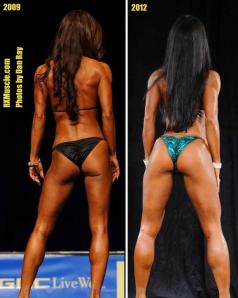
Another Great Post from Siouxcountry.com! Comparison Booty Shots From 2009 and 2012

Liked · 2 hours ago

On your timeline · Hide

PROGRESS!

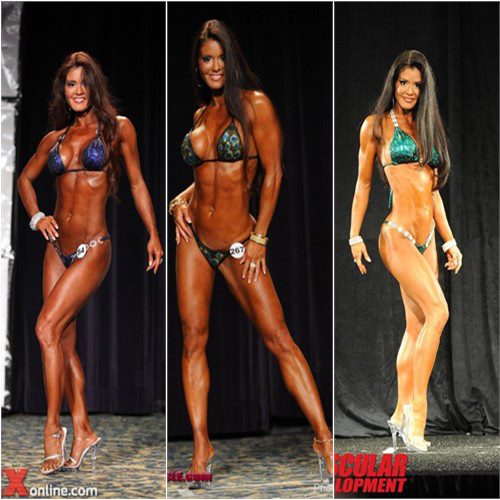
Masters bikini competitor Stacey Naito didn’t place at her first National show in 2009. Three years later she looked her best at the 2012 IFBB North American where she placed 7th in her open class and won her masters class! Well done Stacey! Her page……… Stacey Naito National NPC Bikini Champion ………More before and after photos on…….. Siouxcountry.com

Photo credit: Dan Ray / RXMuscle.com — with Stacey Naito.


2009 to 2012 Comparison

How To Select Athletic Shoes

With all the brands, types and styles of athletic shoes that exist these days, it may be challenging to figure out which ones to buy.  As a response to the questions I get about this, I have compiled a list of tips to help you navigate through the choices out there and select footwear that is ideal for the type of activity you plan to engage in. 

Select shoes appropriate for your feet.  Most of us know whether we have narrow, medium width or wide feet, but do you know what type of arch you have?  A good way to assess this is to do what is called a “wet test”. To do this, you will need a piece of brown paper like the type that is used for brown paper grocery bags.  Wet the bottom of your foot, step onto the paper (make sure to put your full weight on that foot) and trace your footprint.  If you have a print with little to no curve on the inside edge, you have flat feet and your feet tend to roll inward (overpronation).  This type of foot needs a shoe which gives good support to prevent movement.  If your footprint shows a large empty space in the inside edge and there is a narrow connection between your heel and forefoot, you have high arches and tend to turn outwards (supination).  This type of foot needs a soft and cushioned midsole.  If your footprint is somewhere in-between, you have a neutral arch and should choose a shoe with a mix of support and cushioning.

If you wear an orthotic, bring it.  You should also bring the socks that you usually wear when engaging in whatever activity you are buying the shoes for.  I have heard of people who have made the mistake of fitting shoes to their feet when wearing socks that are either thicker or thinner than what they are accustomed to wearing, which results either in the hassle of making an exchange or return or the pain of wearing ill-fitting shoes.

Shop later in the day.  During the course of the day, feet will expand, which means they will be their largest towards the evening.  When determining the fit of a shoe, it is important to take this into consideration and fit to your feet when they are their largest to avoid disfomfort.

Make sure shoes are comfortable and enable the movements your sport requires.  While athletic shoes should be comfortable while standing in them, it is also a good idea to engage in jumping, lateral movements or whatever foot motions mimic the types of movements you will do while wearing the shoes.  Take note of any shifting or discomfort.

Buy a pair of shoes that fit well.  There should be about ½ inch between the front of your big toe and the end of the shoe.  A quick guide which you can use is your thumb.  When you lift off with your heel, the shoe should not slip off the heel at all.  You should be able to wiggle your toes while wearing the shoes, but the shoe should also feel secure around your foot.

Don’t go cheap!  I see a lot of people grab athletic shoes that are on clearance which aren’t the best fitting or the best constructed shoes for them.  This is not to say that you can’t find a decent pair of athletic shoes on sale, but try not to head straight for the bargain bin when you are searching for shoes.  Your main objective should be to find a well-constructed pair of shoes which fits your foot well and is designed for the activity you will use them for. 

Replace shoes before they completely fall apart.  I always find it amusing when I see guys at the gym wearing shoes that are tattered.  I wish I could just ask them, “If you care about your conditioning so much, why do you neglect your feet which are bearing all the weight and pressure you put on them during your routine?”   Most people can expect to replace their shoes every six months, or until they begin to notice that the shoe feels less supportive or develops areas which are uncomfortable.  Another gauge is to check the back of the sole frequently and to replace the shoes once that area begins to appear worn out. 

Buy shoes which are task-specific and expect to have multiple pairs.  Not all shoes are created alike.  A cross-training shoe is designed for midfoot support and has tread which enables lateral movements.  A walking shoe, in contrast, is rather rigid and is designed to minimize foot movement.  Running shoes are quite flexible but are also built with extra cushioning to absorb the high impact of the foot-strike on the pavement. 

If you exercise frequently, purchase several pairs.  If you get in the habit of rotating through your shoes, you will allow your shoes to air out between uses and will also extend the wearability of your shoes since you will be alternating through your collection.  I currently have eight pairs of athletic shoes in rotation and make sure to wear the type of shoe which is appropriate for the activity I plan to do on a particular day.  For example, I wear my running shoes when I plan to do high intensity intervals on the treadmill, and I have other shoes designated as my plyometrics shoes, my leg day shoes and my general lifting shoes. 


This was posted by SiouxCountry.com yesterday!! WHOOT WHOOT!!

Like This PageLiked · 5 hours ago

On your timeline · Hide

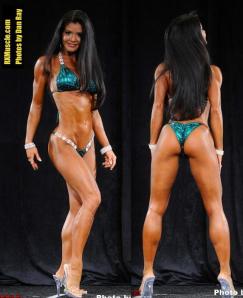
AWESOME! Stacey Naito in her mid 40s has been competing in bikini at the National level for a few years. At 46 years young she looked her best yet at the 2012 IFBB North American. Placing 7th out of 30 women in her open class & 1st in her masters class! Her page……….. Stacey Naito National NPC Bikini Champion …..More photos of women that compete on…… Siouxcountry.com Photo credit: Dan Ray / RXMuscle.com — with Stacey Naito.

 Post on SiouxCountry 12.11.12

Why You Should Do The Exercise You Hate

I cannot stand doing lunges.  They wipe me out, my glutes get sore immediately, and I sweat like a pig when doing them.  Even so, I make sure to incorporate lunges of every kind in my workout on a regular basis.  Why would I torture myself by doing such a thing?  Because lunges are incredibly effective in lifting and rounding out the booty, toning the legs, and improving balance and coordination.

Here are the types of lunges which I perform:

Front Lunges

Reverse Lunges

Diagonal Lunges

Diagonal Walking Lunges

Front Walking Lunges With Pulse

Round-The-Clock Lunges (front lunges, diagonal lunges, side lunges and reverse lunges done in supersets)

Lunge Pulses with Smith Machine

Lunge Jumps

Swing Lunges

The only lunge type I will not do is switch lunges, the reason being that they aggravate my knees and right hip so severely that I spend several days limping after doing them.

It is important to listen to your body and refrain from any moves that aggravate an injury.  Aside from that, however, you are doing your body a favor if you resolve to perform the exercises that you may dread.  This is especially true if you are working towards improving a specific body region.  Focus on the results you will enjoy after diligently performing targeted moves that will address problem areas.  I can tell you from personal experience that I was able to transform my rear end significantly as a result of doing the lunges I have always hated.  I may not like doing lunges, but I LOVE what they do for my body.

If you have an exercise which you cannot stand, perform it earlier in your routine so you can get it done and move on to exercises you may enjoy more.  I cannot tell you how relieved I am when I finish my lunges!