Healthy Substitutions – A Good Start For Beginners

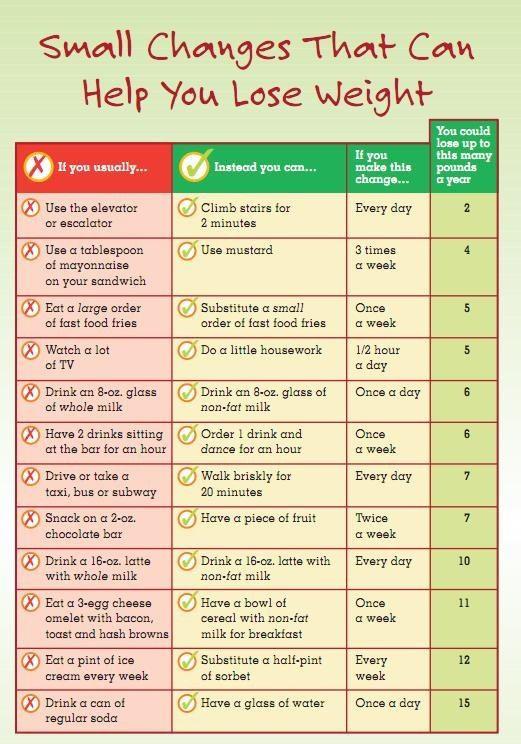
Healthy SubstitutionsI think this chart is a decent one.  However, these substitutions should serve as the BEGINNING of a full lifestyle overhaul.  Many of the substitutions listed here are not considered healthy enough for the long term, such as the small order of fast food fries.  If you are ordering fries three days a week, substituting a large order with a small one is NOT a truly healthy change.  As far as I am concerned, fries should be avoided with the exception of the RARE indulgence.  As an example, I am a huge fan of french fries and have absolutely no self-control around them.  Because of this, I only allow myself to eat french fries a couple of times per YEAR.
I am also not a huge fan of most dairy products (Greek yogurt excluded) because of the way such products are processed.  So a substitution with nonfat milk is not the best over the long haul.

The key with following the suggestions in this chart is to move in a progressively health-conscious direction so that it becomes easier over time to adopt truly healthy habits.

Switch Up Your Training For Maximum Results!

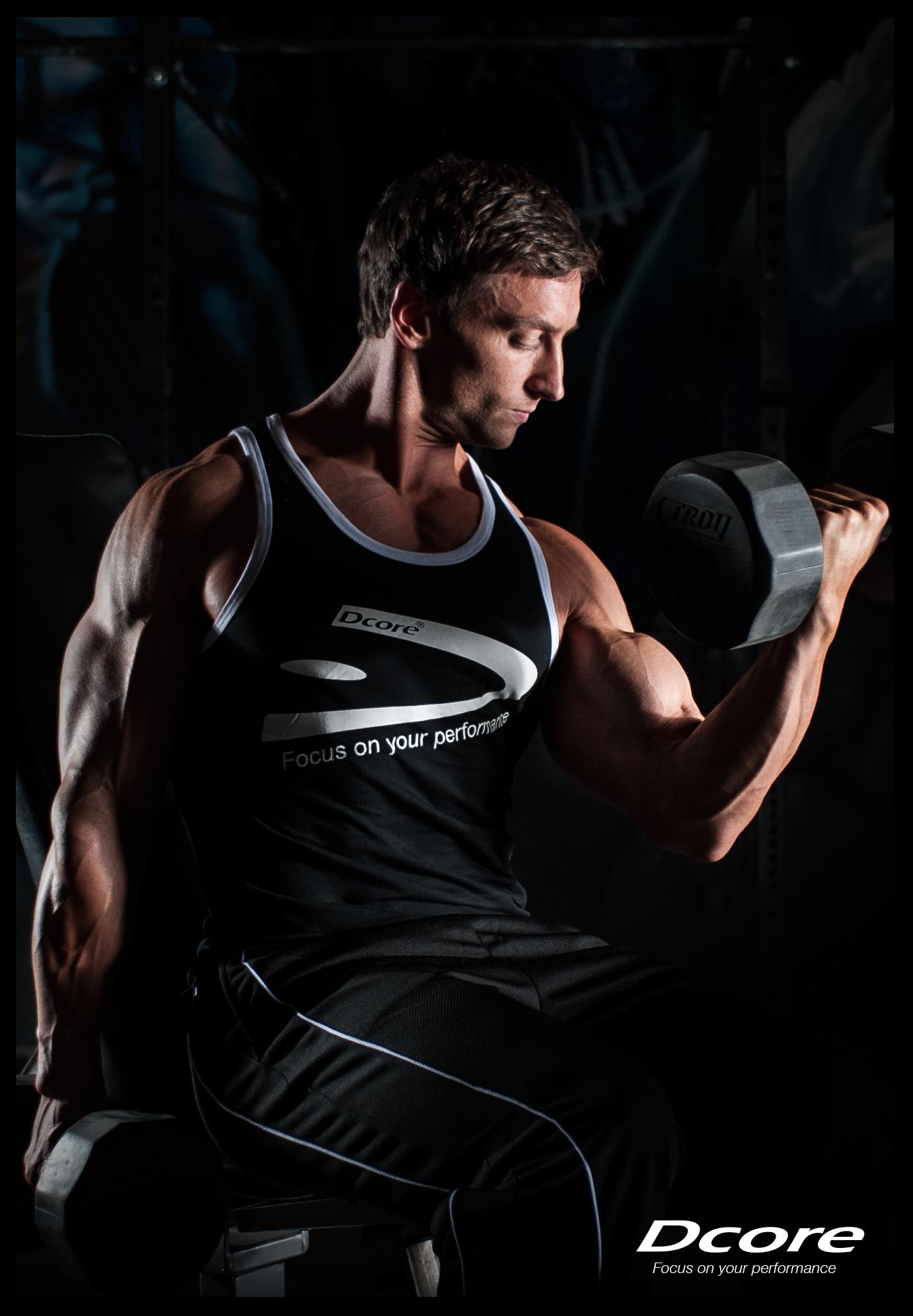
Ian Lauer IFBB Pro in Dcore Fitness Apparel

Ian Lauer IFBB Pro in Dcore Fitness Apparel

Perhaps you have become accustomed to a certain training split, and you perform the same leg routine every leg day, the same chest routine every chest day, etc. You think you hit it hard but you aren’t seeing the changes you are working so desperately to attain. Fact is, the body will adapt to a weight lifting regimen that never changes. You may notice that when you train you are almost going through the motions.

It’s time to switch up your regimen!
If you change your routine every few weeks you are more likely to obtain the results you seek. The key is to challenge yourself by making your workouts harder, either by changing the number of sets, the number of repetitions, rest periods between exercises, weights used, types of exercises, number of training sessions per week or the types of exercises you perform. When you do this you force your body to adapt to exercise.

Simply by changing only one of these variables each week, you can bring about great gains in your workout regimen.

Number Of Sets: You can increase the number of sets you perform during a workout.

Repetitions: If you use a heavier weight, you will perform fewer repetitions. The rule of thumb is that the last couple of repetitions should be somewhat difficult to complete.

Rest Periods: A good rest range between sets is 30 to 60 seconds, which you can switch up.

Weights Used: You will increase the weight you lift on days when you are performing fewer repetitions per set. Use lighter weights on the days when you perform a higher number of repetitions. Make sure that the weight used is one that is slightly difficult to lift during the last couple of repetitions in your set.

Number Of Sessions: If you are looking to make greater changes in your legs, then incorporate two to three leg sessions per week which are separated by at least 24 hours in between each leg session. During those 24 hours you can train in an upper body portion of your split. If you want to make greater gains in your upper body, the same principles can be applied.

Types Of Exercises: You can increase the number of activities for a muscle group during a week in which you want more of a challenge. If you usually use machines, switch to free weights. If you use barbells (e.g. for a chest press), switch to dumbbells. If you usually use dumbbells, switch to a cable. Another thing I LOVE which will really offer a challenge in a workout is to add in plyometric moves such as jump squats and straddle bench jumps. I especially love incorporating plyometrics in a superset with other leg exercises.

Pyramids:
Pyramids are GREAT for maximizing muscle growth. You will be worn out from pyramids which is a good thing if you really want to grow muscle. With pyramids you will increase the weight lifted with each successive set while reducing the number of reps. What this does is engage all the muscle fibers thoroughly. Here is a typical pyramid for an average man performing an incline dumbbell chest press:

Set 1: 25 repetitions with 30 pound dumbbells
Set 2: 20 repetitions with 35 pound dumbbells
Set 3: 15 repetitions with 40 pound dumbbells
Set 4: 12 repetitions with 45 pound dumbbells
Set 5: 10 repetitions with 50 pound dumbbells
Rest 30 seconds between sets.

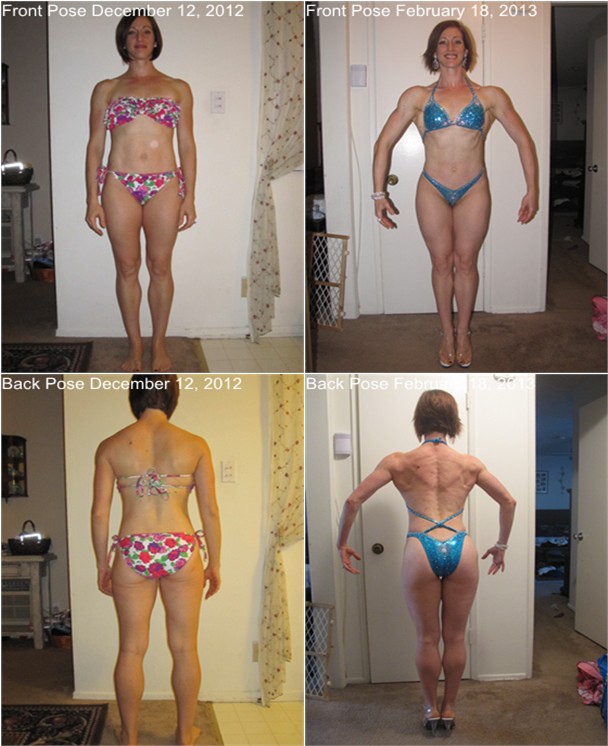
So Very Proud Of My Client Alli Salibian – This Is After 8 Weeks Of Prep With Me

Alli

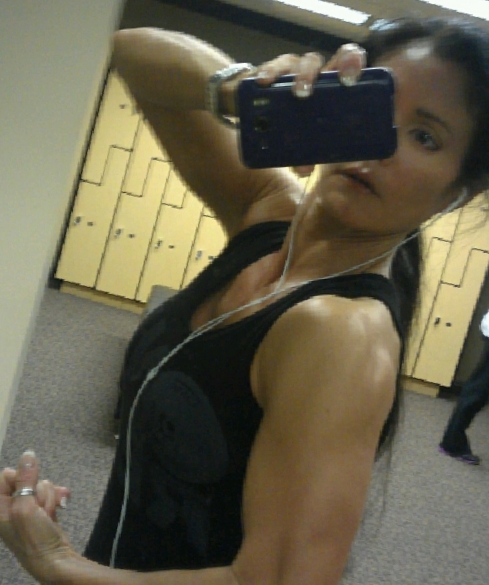
My client Alli began training with me on December 17th, 2012 for an NPC contest which will be held on April 13th, 2013. These images show her one week before she began contest prep and how she looked on February 18th after 8 weeks of dedicated training and prep. She will compete in both Open and Masters Figure. This woman is tremendous and I am so very proud of her! She has stuck with her meal plan and training despite having two small children and a very full life. Talk about inspiring!

How To Split Your Weight Training Routine To Avoid Overtraining

BetterBodyWeightExerciseWith the New Year here, many people have either thought about embarking on or have already begun a weight training program in an effort to either shed excess pounds or improve their overall level of fitness. However, many people have little to no clue about how to split up their routines in order to maximize results while also avoiding overtraining.

Probably the best advice I can give to most people (with competitors the stark exception) is to train no more than four days per week. I also recommend that you weight train for one to two consecutive days, take a rest day, then resume weight training after the rest day. Competitors who are accustomed to hard training are on intense regimens which often include only one or two days of rest per week, which is part of the reason why they are more prone to overtraining.

If you are brand new to weight training, or have been away from it for many years, I recommend a three day full body split in which you will work the entire body during each workout. A good sequence is Mondays, Wednesdays, and Fridays, as is a Tuesday, Thursday, and Saturday sequence. This ensures at least one day of rest between workouts.

Three Day Full Body Split:

Monday – Full Body
Tuesday – OFF
Wednesday – Full Body
Thursday – OFF
Friday – Full Body
Saturday – OFF
Sunday – OFF

For those who are more accustomed to working out with weights, I recommend a four day split in which the upper and lower body are worked on separate days with at least one day of rest afterward. An example would look like this:

Intermediate Upper/Lower Four Day Split:

Monday – Upper Body
Tuesday – Lower Body
Wednesday – OFF
Thursday – Upper Body
Friday – Lower Body
Saturday – OFF
Sunday – OFF

Another variation is to split each upper body and lower body workout further so that different muscle groups are worked on different days:

Intermediate Upper/Lower Four Day Split Variation:

Monday – Chest, Shoulders, Triceps
Tuesday – Quads, Calves
Wednesday – OFF
Thursday – Back, Biceps
Friday – Hamstrings, Glutes, Abs
Saturday – OFF

If there is enough interest, I can provide sample routines which fall within the above split schedules. Simply post a comment on this post so that I know you are interested.

New Contest Prep Site Launched! Please Check Out CutCurves.com!

If you are ann NPC Bikini or Figure competitor, or you are THINKING about competing, please check out my newly launched contest prep site! I have a full menu of services, so if you just need assistance on posing, or if you need comprehensive coaching, I am here for you ladies! If you are new to competing, it is important to realize that a lot of details go into looking your best onstage:

PROPER TRAINING FOR YOUR BODY TYPE AND THE DIVISION
PROPER AND STRUCTURED MEAL PLAN
PROPER SUPPLEMENTATION
PROPER SUIT CUT AND COLOR
PROPER ACCESSORIES
APPROPRIATE STAGE MAKEUP
WELL APPLIED SPRAY TAN

On top of this there are countless other details which are easy to overlook if you are already overwhelmed with the pressure of competing.

I will guide you through the entire process so that you won’t need to worry about those little details. Programs are delivered via email so you do not need to live locally in the Los Angeles area.

http://cutcurves.com

You Truly ARE What You Eat

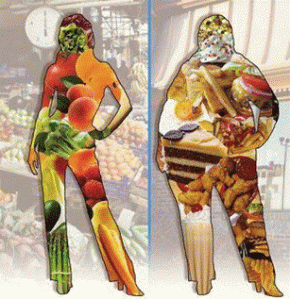
you-are-what-you-eatIt’s no secret that fast foods are unhealthy and artery-clogging, but there are impostors which sit on grocery shelves and have people believe they are healthy due to phrases like “Low Fat”, “Good for you”, “Fit ____”, and the list goes on.  I encourage my patients to read EVERY label on food containers while perusing the grocery store shelves and aisles and to become aware of preservatives, sugar, hydrogenated oils, artificial flavors and artificial colorings.

A good general rule to follow is if there are more than five ingredients on a food label, or if there are a bunch of big terms which seem alien and strange to you, chances are that the item has questionable nutritional value and should be avoided.  Over the last few years I have developed such an aversion to packaged foods that as soon as I see a food item in a bag, box or can, I tend to avoid it.

An interesting thing begins happening to people when they completely eliminate sugars and processed foods from their diets.  They experience increased energy, clearer skin, fewer aches and pains, and lower body fat.   If someone has been eating clean for a while and decides to have a sinful treat like pizza, a fast food burger, chips, cake or cookies, he or she will notice a detrimental effect on energy, aches and pains may return, and stubborn pockets of body fat will become more noticeable.  I have seen this in myself and cannot stand it.  What always occurs with me after I have had a couple of glasses of wine, a piece of cake, or greasy foods is that my digestion is completely thrown off whack and I feel sluggish and achy.  In other words, these heavier foods make me feel heavy and tired, while clean, light, fresh foods make me feel energized.

I understand that it can be challenging to find the time to eat whole foods each day, but I am telling you that it is well worth it if you intend to take control of poor eating habits and possibly even reverse disease processes in your body.  Give it a try…you will probably love it.

THE NO-EQUIPMENT FULL BODY WORKOUT ROUTINE

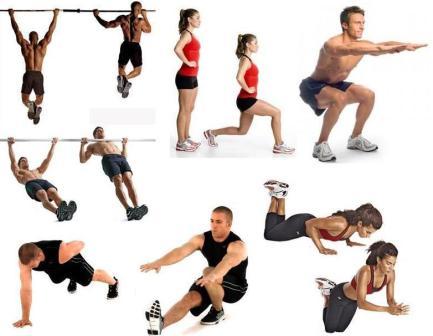
Pushup ImagePeople frequently ask me how they can exercise when they do not have gym memberships and also do not have any exercise equipment whatsoever, so I have designed the following full body routine with these people in mind.  There is no equipment needed for this workout, but you should expect to break a sweat and work out intensely with this routine!

THE ROUTINE:

Squat into Side Leg Raise:  stand with feet shoulder width apart.  Squat down so that you are sitting back behind your heels with your back perpendicular to floor (if you need support, hold onto the back of a chair for balance).  Come up from squat position, raising right leg straight out to side as you straighten up.  Bring leg back to floor and return to squat position, then raise left leg straight out to side.  Keep squatting then raising one leg out to side, alternating legs.   Perform 10 to 12 repetitions.

Do not rest, but go immediately to:

Jump Squat:  Get into squat position with feet slightly wider than shoulder width apart.  Jump up, then return quickly back to squat position without resting.  Perform 20 repetitions.

Do not rest, but go immediately to:

Front Lunges:  Stand with feet close together.  Take a big step forward so that back knee almost touches floor and front knee is bent at a 90 degree angle.  Make sure knee does not go beyond your toes.  Pause for 3 counts, then return to start.  Repeat with other leg.  Perform 15 repetitions.

* Repeat above sequence four more times for a total of five complete supersets.

Mountain Climbers:  Start in pushup position with arms straight.  From this position, lift right foot off floor and move right knee to chest.  Return to starting position and repeat knee to chest move with other leg.  Continue without stopping, alternating legs.  Perform 15 repetitions.

Do not rest, but go immediately to:

Wall Pushups:  Stand facing a wall with hands shoulder width apart on wall and your arms parallel to the floor. Place feet together about two feet away from the wall. Bend at the elbows and bring your chest toward the wall.  Perform 15 repetitions.

* Repeat above sequence four more times for a total of five complete supersets.

Dips:  Facing away from a sturdy chair, hands palms down on edge of chair and place legs straight out in front of you with heels on floor.  Lower body to floor by bending elbows (keep elbows in and pointed straight back during movement) until butt almost touches floor, then return to start.  Perform 10 repetitions.

Do not rest, but go immediately to:

Back Pushups:  Start position is similar to traditional pushup, but place your forearms on the ground with your fingers touching, forming a triangle with your elbows. Bend at hip until butt is up in the air, with your torso and legs forming an upside down V. Slowly lower your chest toward your hands by bending at the elbows. Perform 15 repetitions.

* Repeat above sequence four more times for a total of five complete supersets.

Traditional Pushups:  If you have problems supporting your weight on your toes, place knees on floor during movement.  Perform 10 repetitions.

Do not rest, but go immediately to:

Arm Circles:  Hold arms straight out to sides so that they are parallel to floor, palms down.  Rotate arms in a circular motion from front to back at an approximately 12 inch diameter.  Perform 20 repetitions, then switch motion so that you are rotating from back to front and perform another 20 repetitions.

Do not rest, but go immediately to:

Supermans:  Lie face down on floor with arms straight out in front of you.  Raise your arms while slightly extending the spine and raising your chest off the floor while also raising your legs off the ground so that both your arms and legs are several inches off the floor.  Hold raised position for a count of five, then return to start.  Perform 10 repetitions.

* Repeat above sequence three more times for a total of four complete supersets.

Calf Raises:  Stand on a step so that your toes and balls of feet are on step and your heels drop below level of step.  Hold onto something sturdy and raise up so that you are on your toes.  Return to start.  Perform 20 repetitions.

Do not rest, but go immediately to:

Toe Taps:  Stand with feet about six inches apart.  Raise up on toes and tap one foot, then the other, as if running in place while on your toes.  Make sure to remain on your toes during the entire set.  Perform 25 repetitions.

* Repeat above sequence three more times for a total of four complete supersets.

Planks:  Start position is similar to traditional pushup, but place your forearms on the ground with your fingers touching, forming a triangle with your elbows.  Make sure your torso and legs form a straight line with no arching, bending or sagging.  Hold this position for 30 to 60 seconds, then relax.

* Perform four sets of this exercise.

Vertical Leg Crunches:  Lie on floor and extend legs straight up in air with knees crossed.  Place hands behind head for support.  Contract your abdominal muscles to lift your shoulder blades off the floor so that chest moves towards feet without moving legs.  Lower and repeat.  Perform 12 to 15 repetitions.

* Perform three sets of this exercise.