Working For Free – REPOST

bloggers-working-free

Have you ever completed a work project which offered no compensation except for a pat on the back? If so, did it bother you? It should have. By agreeing to slave away (pun definitely intended here) at an assignment with full awareness that you would receive absolutely no monetary compensation, you just devalued yourself.

I am not talking about volunteer work, or favors which you offer to do for a family member or friend. I am also not talking about getting your feet wet by taking on a task in an unfamiliar area so that you can gain valuable experience. I am instead referring to situations in which you are asked to provide your knowledge, expertise and service in an area in which you excel, and are coaxed into it with the promise that it’s a one-time favor, or that there will be compensation sometime in the future, only to discover that the promise was in fact a lie.

As a result of my abiding loyalty to companies, friends, family, and pets, I am the type of person who never leaves. You can count on me, and I honor my word. One of my faults is that I assume that other people are the same way, and even when I can plainly see that I am being taken advantage of, I often still hang on. This type of behavior spilled over into the world of medicine, wellness and fitness for a while, but a couple of years ago, I cut off all of the companies and individuals who got too much of a good thing for too long, essentially my time, services and knowledge for free.

In one situation, one company asked me to provide professional services on a monthly basis, stating that it would be unpaid to start out with, but that compensation would be given after a few months. Next thing I knew, I had provided those services free of charge for eighteen months! When I fired a warning shot, essentially stating that I no longer wanted to work for free, the company responded by inferring that the “exposure” I was receiving from them was payment enough. The funny thing is, I didn’t need the exposure, nor was this company in a position to help me. I merely agreed to the arrangement as a temporary favor to them, sort of a good faith move. All it ended up doing was getting me stuck in a monthly obligation which I got zero benefit from doing. Once I realized this, I severed ties immediately. Though I used very professional and polite language, it felt so good to tell them that I was done being an indentured servant. No longer did I have to put their assignments in my calendar, or resent the fact that each one of those assignments chewed up a good hour or two of my time.

More recently, I agreed to complete an assignment for free simply because I found it intriguing, and I had a small pocket of time in which to complete the assignment. I also felt that it was a good way to introduce my skill set to the company. However, I made it very clear that the assignment was isolated, and that if the company wanted my services in the future, I would only consider paid assignments.

Time is money, and because I hold a medical degree and a bachelor’s degree, am a board certified physician, and have worked in the fitness industry for three decades, I have value which deserves proper compensation. Would you like to work for free, especially if it is in an area in which you have expertise? Let’s face it, we all need to find a way to bring money in. We have skills, we have knowledge, and we deserve to get a financial return for services rendered in our chosen work environment.

If you are the type of person who has a tendency to take on more than your schedule can handle, perhaps it’s time to evaluate your obligations and see if any of them are a threat to your self-worth. If they are unpaid, uncontracted, require your skills in an area in which you are considered an expert, and are contributing to a decline in your quality of life because they are a time burden, then you should consider dropping those obligations.

Don’t Let Fear Rule You

Stacey Naito Japanese Warrior

We can often be our own worst enemies, laying sabotage upon our own best efforts. The basis of such subterfuge is our own fear-based collection of thoughts, and can be more damaging than any efforts made by others to trip us up. What’s the solution? Banish your fears!

Before you allow that monstrous pull of trepidation pull you into the muck, get into the habit of replacing every single negative and self-defeating thought you have with a positive, hope-filled one.

Yes, every single one.

Perhaps you are doubting your ability to complete a massive work project, and you find yourself grappling with the feeling that you won’t be able to complete it in time, or that you will do a shoddy job because you feel rushed. Instead of feeding that insecurity, tell yourself:

I CAN do this. I WILL do this.

Do this repeatedly until it begins to sink in. Allow your positive thoughts to take up space in your mind, so much so that they push out the negativity.

The last thing you should ever do is to knock yourself down. Someone who is bound and determined to succeed quickly learns how to push away negativity from haters, and never allows a bad day to destroy the success plan which is in place. Successful people have a can-do, will-do attitude which has very little to do with overall intelligence, talent, or opportunity.

So stop beating yourself up, push away the haters, and go for your goals!

Keeping Pace With A Crazy Schedule

George Kontaxis shoot

The last few weeks have been NUTS. I am talking about day after day of so many shifts in my schedule and demands on my time, that I am torn in many different directions, and cannot focus on a darned thing. When this kind of chaos ensues, I begin to lose items, certain basic vocabulary terms escape me, and I feel like I am rushing by everything and everyone, like a bullet train zooming through a bustling cityscape.

For the life of me, I can’t find a gray tank top which I had recently purchased and put…somewhere. I honestly can’t remember where. This isn’t like me, because I am VERY organized, to the point of having all of my clothing organized by color, sleeve length, etc. So why can’t I find that gray top?

I literally run around in my bedroom, grabbing for clothes, rushing, trying to keep up with the stressful demands of being in so many places all the time. It’s starting to get old. Forget about having time to read a book, or watch a TV show, because by the time the dust settles from the crazy days I have been flying through, the notion of blissful sleep is so seductive that I don’t want to do anything else.

What keeps me from unraveling is the consistency I demand with my eating habits and my workouts. I am not joking about this. Despite the insane schedule I have been juggling lately, I still weight train six mornings each week. I attend lyra class one to two evenings during the week. My meals consist of clean foods like chicken breast, salmon, tilapia, green beans, asparagus, brown rice, quinoa, avocado, almonds, oats, and Greek yogurt. I have been drinking plenty of alkaline water. I have also been consistent about consuming MitoXcell every morning (I LOVE this supplement and intend to post more about it when I get a chance to breathe!), and I also take my regular supplements (like turmeric, CoQ10, folic acid, etc.) daily. My energy levels have been decent, and my mood has been generally great, with only a couple of stark exceptions.

There are two days next week which I have designated as clean up and organization days, and I desperately need them. During those days, I will perform the deep cleaning throughout most of the house which the housekeeper always neglects, I will reorganize cabinets and drawers, clean up the garage and patio, and find that gray top!

Make Your Goals BIG Ones

big-goal-mountain-steps1

We should all have goals which we set for ourselves, because they make us grow as individuals. We may fall a bit short on reaching our goals at times, but the journey and struggle involved in pursuing our passions keep us moving forward. That is why I honestly believe that we need to set big goals, with clearly defined blueprints which keep us focused on the finish line.

A timeline ensures that your intentions are filled with purpose, and keeps you from falling into irrational, delusional thinking. It isn’t unreasonable to reach for the stars, because you never know what you may accomplish over time. Let’s say your ultimate goal is to be the leader in your industry. Perhaps you have just launched a start-up company in which you began making products at home, and you strive to be the industry leader. Why not have that as your end goal? Who’s to say that you can’t attain the pinnacle of success in your business? There are countless businesses which started out in the same way, out of a kitchen with a shoestring budget, and which are now huge successes.

Read on to learn more about businesses which started out very small, and are now considered industry leaders:

Burt’s Bees – This company has become a huge name in natural skin care products, but it started out in an abandoned one-room schoolhouse. Burt Shavitz and Roxanne Quimby founded Burt’s Bees in Maine in 1984, and rented an abandoned schoolhouse to make candles with the excess beeswax from Shavitz’s honey business. Quimby also began crafting homemade skin care products from the wax. Burt’s Bees became incorporated in 1991, and by 2007, it was bought out by Clorox for $925 million.

The Yankee Candle Company – This company was the brainchild of an enterprising teen named Michael Kittredge, who created his first scented candle in his Massachusetts home with melted crayons. By 1975, the first store opened, and the business spread thoughout Massachusetts. There are currently over 500 stores across the United States, and a wholesale network of over 20,000 stores is in place.

Apple – The vision of Steve Jobs, Steve Wozniack and Ronald Wayne resulted in the trio establishing a business in 1976 out of a garage space in Cupertino, California. The Macintosh line was introduced in 1984, causing their business to explode. Apple has established its unquestionable foothold on the world of technology with revenues of over $14 billion yearly.

Google – Another brilliant trio created this household name in 1998 in a garage in Menlo Park, California, indexing web pages, and developing their search algorithm. The following year, they moved into what is now known as the Googleplex. Today, Google has made an indelible mark on the world of technology.

Mattel – Though Mattel is known as a toy maker giant, it had humble beginnings in the 1940’s making picture frames. Ruth Handler began taking wood scraps from the wood used in making those frames and crafted doll furniture from them. The doll furniture was so popular among customers that the company decided to shift their focus to toys, and by 1959, introduced a doll which they called Barbie.

Now that you have some inspiration, now is the perfect time to dream big and reach for the stars! Good luck, and may great success ensue!

Powerful Women

This is a repost of a recent article on MSN Money which showcased 13 newcomer women who made it onto the list of the richest self-made women in the United States. The original article can be found by clicking the link here, but I have also copied and pasted the body of the article so you can read about these extraordinary women here.

http://www.msn.com/en-us/money/savingandinvesting/13-newcomers-named-richest-self-made-women-in-us/ar-BBtKKOC?ocid=spartandhp

13 newcomers named richest self-made women in US

Forbes’ second annual definitive tally of America’s wealthiest, most successful self-made women includes 60 trailblazers – 10 more than last year – who have crashed ceilings through invention and innovation. These women, who are worth a combined $53 billion, have created some of the nation’s best known brands, such as Gap, Spanx, Proactiv and Vera Bradley. A number of them have also helped build some of the most successful companies in tech, including Facebook, eBay and Google, while still others got rich entertaining millions through their music, books or TV shows.

These women have achieved unparalleled success through invention and innovation to create their own fortunes. ABC Supply’s Diane Hendricks (No. 1) tops the list with a net worth of $4.9 billion, followed by Oprah Winfrey (No. 2), worth $3.1 billion. The Gap’s Doris Fisher and Founder & CEO of Epic Systems, Judy Faulkner, are tied for No. 3, both worth $2.4 billion. Elizabeth Holmes, Founder & CEO, Theranos, who was No. 1 on the list in 2015, misses the cut this year due to recent investigations involving Theranos and information indicating that the company’s revenues are less than originally projected.

With sold out arenas, billion-dollar companies and best-selling books under their belts, 13 newcomers joined the ranks of America’s Richest Self-Made Women in 2016. Big names (Celine, Barbra, Taylor) and big brands (Nasty Gal, Vera Bradley, Douglas Elliman) define the group who cracked this year’s $250 million cutoff, and together have a combined net worth of $5.65 billion.

GAIL MILLER

Net worth: $1.6 billion

Rank: 11

How she did it: The only newcomer who is also a billionaire, most of Miller’s wealth stems from basketball team the Utah Jazz. She purchased it with her late husband in 1986 for $22 million. It’s now worth $875 million.

CAROLYN RAFAELIAN

Net worth: $700 million

Rank: 22

How she did it: The Alex and Ani founder launched her Rhode Island-based bangle-maker in 2004. In 12 years, she’s grown revenues to an estimated $500 million and operates 65 stores around the country.

CELENE DION

Net worth: $380 million

Rank: 37

How she did it: Dion has sold over 220 million albums in her career, but the bulk of her net worth ($260 million) comes from the Las Vegas residency she began in 2003.

BARBRA STREISAND

Net worth: $370 million

Rank: 38

How she did it: Happy days are here again! With a career full of hits and accolades spanning sixty years, Streisand has had a No. 1 album every single decade she’s been in showbiz and is the best-selling female musician of all time.

JESSICA ALBA

Net worth: $340 million

Rank: 42

How she did it: Alba launched The Honest Company in 2012. Just three years later, she was featured on the cover of Forbes’ Self-Made Women’s issue with a $200 million estimated net worth from her stake in the nontoxic-household-goods-startup. The actress-turned-entrepreneur did not make the $250 million net worth cutoff for the list in 2015, but secured her spot on this year’s list when her 20% stake in the company shot up last August after raising $100 million at a $1.7 billion valuation.

NANCY ZIMMERMAN

Net worth: $320 million

Rank: 46

How she did it: Launching her career buying currency options on the floor of the Chicago Mercantile Exchange, Zimmerman later made her way to Goldman Sachs to run their interest rate options group. She left Goldman to co-found Boston-based Bracebridge Capital in 1994. It’s grown to $10 billion in assets under managements and is now the largest in the world run by a woman.

DANIELLE STEEL

Net worth: $310 million

Rank: 48

How she did it: Steel joined fellow romance novelist Nora Roberts on the list this year proving sex, and lust, really does sell. She’s written 129 books and sold more than 650 million copies in her career.

PATRICIA MILLER and BARBARA BRADLEY BAEKGAARD

Net worth: $300 million (Miller); $270 million (Baekgaard)

Rank: 49 (Miller); 54 (Baekgaard)

How they did it: Queens of quilted prints, Miller and Baekgaard founded Vera Bradley in 1982, sewing bags in Baekgaard’s basement and selling their first ones in gift shops. There are now 139 company stores and with products sold in another 2,700 retailers around the country. Vera Bradley IPO’ed six years ago and has a $590 million market cap.

SOPHIA AMORUSO

Net worth: $280 million

Rank: 53

How she did it: The original #GirlBoss, at 22 Amoruso started her online retailer Nasty Gal. Ten years later her company is raking in $300 million in sales, Forbes estimates. She also released her memoir “GirlBoss” in 2014 and it became a bestseller. Amoruso has since expanded the #GirlBoss brand to radio and TV.

DOROTHY HERMAN

Net worth: $270 million

Rank: 54

How she did it: Overcoming a tragic adolescence, Herman got her start as a real estate broker for Merrill Lynch on Long Island. By 2003, she’d bought New York City brokerage Douglas Elliman. It’s now the country’s fourth-largest brokerage firm and the largest in New York City.

TONI KO

Net worth: $260 million

Rank: 57

How she did it: In 1999 Ko started NYX Cosmetics aiming to sell department-store quality makeup at drugstore prices. The company did $4 million in sales in the first year alone. She sold to L’Oreal in 2014 for $500 million and has since moved on to launch a new sunglasses line in early 2016.

TAYLOR SWIFT

Net worth: $250 million

Rank: 60

How she did it: Coming in at the last spot on this year’s list, Swift’s earnings shot up with her transition from country music starlet to worldwide pop star, raking in the most from last year’s 1989 tour that earned $250 million.

In case you want to know how these women made it to list, read on for the methodology employed…

Methodology: Members of the 2016 list needed a minimum of $250 million in net worth to make the cut. To compile net worths, Forbes valued private companies by speaking with an array of outside experts and conservatively comparing the companies with public competitors. In cases in which women started businesses with, and still share with, their husbands, Forbes assigned them half of that combined wealth.

Forbes calculated the stakes in public companies using stock prices from May 13. For entertainers, they based estimates on net lifetime earnings. Real estate, art and other assets were also factored in where applicable. To be eligible for this list, women had to have substantially made their own fortunes and be U.S. citizens or longtime residents. Forbes attempted to vet these numbers with all list entrants.

Working For Free

bloggers-working-free

Have you ever completed a work project which offered no compensation except for a pat on the back? If so, did it bother you? It should have. By agreeing to slave away (pun definitely intended here) at an assignment with full awareness that you would receive absolutely no monetary compensation, you just devalued yourself.

I am not talking about volunteer work, or favors which you offer to do for a family member or friend. I am also not talking about getting your feet wet by taking on a task in an unfamiliar area so that you can gain valuable experience. I am instead referring to situations in which you are asked to provide your knowledge, expertise and service in an area in which you excel, and are coaxed into it with the promise that it’s a one-time favor, or that there will be compensation sometime in the future.

As a result of my abiding loyalty to companies, friends, family, and pets, I am the type of person who never leaves. You can count on me, and I honor my word. One of my faults is that I assume that other people are the same way, and even when I can plainly see that I am being taken advantage of, I often still hang on. This type of behavior spilled over into the world of medicine, wellness and fitness for a while, but I have recently done a 180 and have cut off all of the companies and individuals who got too much of a good thing for too long.

In one situation, one company asked me to provide professional services on a monthly basis, stating that it would be unpaid to start out with, but that compensation would be given after a few months. Next thing I knew, I had provided those services free of charge for eighteen months! When I fired a warning shot, essentially stating that I no longer wanted to work for free, the company responded by inferring that the “exposure” I was receiving from them was payment enough. The funny thing is, I didn’t need the exposure, nor was this company in a position to help me. I merely agreed to the arrangement as a temporary favor to them, sort of a good faith move. All it ended up doing was getting me stuck in a monthly obligation which I got zero benefit from doing.

I am not trying to toot my horn, but time is money, and because I hold two degrees, am a board certified physician and have worked in the fitness industry for three decades, I have value which deserves proper compensation. Would you like to work for free, especially if it is in an area in which you have expertise? Let’s face it, we all need to find a way to bring money in. We have skills, we have knowledge, and we deserve to get a financial return for services rendered in our chosen work environment.

As a result of my decision to rid myself of any unpaid assignments or other elements in my life which were eroding my sense of self-worth, I finally severed the ties with the company I mentioned above. Though I used very professional and polite language, it felt so good to tell them that I was done being an indentured servant. No longer did I have to put their assignments in my calendar, or resent the fact that each one of those assignments chewed up a good hour or two of my time.

If you are the type of person who has a tendency to take on more than your schedule can handle, perhaps it’s time to evaluate your obligations and see if any of them are a threat to your self-worth. If they are unpaid, uncontracted, require your skills in an area in which you are considered an expert, and are contributing to a decline in your quality of life because they are a time burden, then you should consider dropping those obligations.

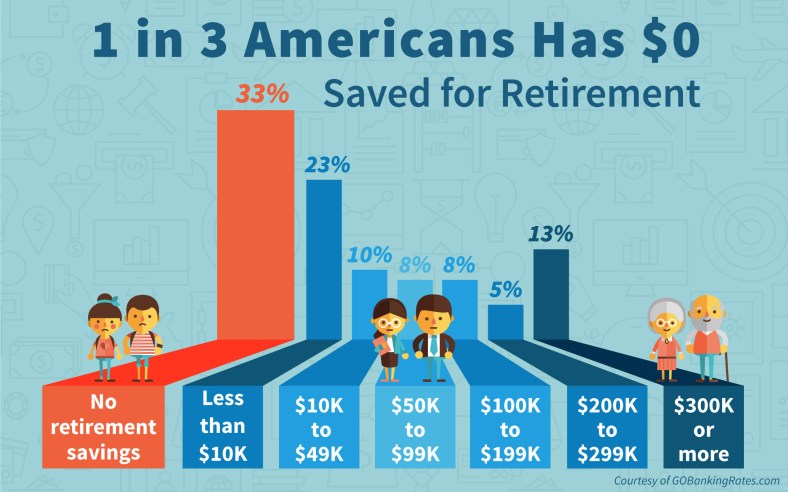
1 in 3 Americans Has $0 Saved for Retirement

I recently came across this article and was shocked by the statistics. In an effort to make people aware of the importance of saving for retirement, I am reposting Elyssa Kirkham’s article below.

To see the original article, please go to: http://www.gobankingrates.com/retirement/1-3-americans-0-saved-retirement/
main_overall
By Elyssa Kirkham March 14, 2016

Saving for retirement is not an area of financial strength for Americans. Too often, meeting the financial demands of today means delaying, diminishing or simply never starting to save for tomorrow.

“There are plenty of obstacles Americans claim are in their way when it comes to saving for retirement: credit card debt, student loan debt, low wages, the need to save for a child’s college education, and the list goes on,” said Cameron Huddleston, Life + Money columnist for GOBankingRates. “Although all of these things can put a strain on our budgets, they don’t necessarily make it impossible to save for retirement.”

GOBankingRates asked Americans how much money they have saved for retirement and found that most people are behind on their retirement savings. These survey findings also provide a helpful benchmark against which readers can compare their own retirement savings balances and progress.

Survey: How Much Americans Have Saved for Retirement

The GOBankingRates survey was conducted as three Google Consumer Surveys, each targeted at one of three age groups: millennials, Generation Xers, and baby boomers and seniors. Each age group was asked the same question, “By your best estimate, how much money do you have saved for retirement?” Respondents could select one of the options as displayed below:

Less than $10K
$10K to $49K
$50K to $99K
$100K to $199K
$200 to $299K
$300K or more
I don’t have retirement savings.

GOBankingRates analyzed the survey results to reveal key insights into how Americans of all ages are saving for retirement. Whether due to various economic factors or not correctly prioritizing finances, many people are not on track to have enough money to cover their expenses during retirement.

56% of Americans Have Less Than $10,000 Saved for Retirement
Most Americans are falling short of the amount of savings required for a comfortable retirement ― if they are saving at all. The most common responses to the question of what people have saved for retirement across all age groups are “I don’t have retirement savings” and “less than $10K,” breaking down as follows:

One-third of Americans report they have no retirement savings.
23 percent have less than $10,000 saved.
Survey: 1 in 3 People Has $0 Saved for Retirement

This lack of savings indicates that just getting started on retirement planning is a significant obstacle for many people. This difficulty can be due to a lack of education on the importance of retirement savings, said Kristen Bonner, the GOBankingRates research lead for this survey. “Americans might also be feeling as though their employer match ― or lack of ― is not enough to make it worth it to open an account, as well the growing trend of changing jobs every couple years and not wanting to deal with rolling over funds from one account to another,” Bonner said.

It’s not all bad news, however:

After “less than $10K,” the most common balance Americans have saved for retirement is “$300K or more.”
A significant 13 percent of Americans’ retirement savings balances are in the top bracket.
“The fact that so many Americans do have $300,000 or more saved for retirement goes to show just how easily the amount of money in your retirement fund can grow over time if you are dedicated to contributing regularly,” Bonner said.


Women More Likely Than Men to Have No Retirement Savings

The gap between men’s and women’s retirement savings is cause for concern for anyone planning for retirement. It’s as much as 26 percent, according to the 2015 Gender Pay Gap in Financial Wellness report from financial education company Financial Finesse. Overall, GOBankingRates’ survey findings show that women are significantly less likely to be sufficiently saving for retirement:

Women are 27 percent more likely than men to say they have no retirement savings.
Two-thirds of women (63 percent) say they have no savings or less than $10,000 in retirement savings, compared with just over half (52 percent) of men.
Survey: Retirement Savings Gap Reveals How Far Behind Women Are

The gap between men’s and women’s retirement savings widens as balances get higher: Whereas men and women are about as likely to have $10,000 to $99,000 saved for retirement, men are twice as likely as women to have savings balances of $200,000 or more.

One reason women fall behind is the gender pay gap. “Women cannot save as much for retirement because they are not earning as much,” Bonner said, citing 2015 U.S. Census Bureau data that shows women earned $0.79 for every $1 men earned in full-time positions. Families trying to prepare for retirement need to factor such deficits into their financial plans.

“Women also are more likely to have gaps in employment to raise children and might not be contributing to retirement accounts during those periods when they’re not working,” Huddleston said.

Women’s retirement savings needs are also greater than men’s. “Women not only need to catch up with men but they also need to save more because their medical costs tend to be higher in retirement,” Huddleston said. Women are also more likely to live longer, increasing their chances of outliving retirement funds.

To make up for anemic earnings and plan for their higher retirement costs, women need to be proactive and save aggressively. “Financial experts typically recommend saving 10 percent to 15 percent of your annual pay, so women should aim for that higher percentage to close the retirement savings gap,” Huddleston said.

Retirement Savings Correlate Closely to Age

Retirement savings are closely tied to savers’ stages of life. For young people just starting their careers, simply saving at all could be a sufficient goal, while those nearing retirement will likely want to have at least a few hundred thousands of dollars in their retirement accounts.

GOBankingRates conducted this survey in three different parts aimed at specific generational age ranges ― millennials ages 18 to 34, Gen Xers ages 35 to 54, and baby boomers and seniors ages 55 and over ― to get an accurate picture of how Americans’ savings differ by life stage:

Millennials are 40 percent more likely to not have retirement savings than Gen Xers and 50 percent more likely than people age 55 and over.
About half of Gen X is making a significant effort to save for retirement ― 48.2 percent have saved over $10,000, including 26.7 percent who have saved $100,000 or more.
Boomers and seniors are 85 percent more likely than Gen Xers to have $300,000 or more in retirement accounts and 4.6 times more likely than millennials to have saved this amount.
Survey: Comparison of How Much Millennials, Gen Xers, Boomer and Seniors Have Saved for Retirement

3 of 5 Millennials Have Started a Retirement Fund
As the youngest group surveyed, millennials are the least likely to have substantial retirement savings. Three in four (72 percent) of millennials have saved less than $10,000 or nothing at all.

Survey: Majority of Millennials Are Saving for Retirement

Additional findings show how millennials’ retirement savings reflect their life stage:

42 percent of millennials indicated they have no retirement savings.
The number of millennials with no retirement savings yet is 52 percent for younger millennials ages 18 to 24 but a more reasonable 36 percent for older millennials ages 25 to 34.
The most common balances that younger millennials have saved are “less than $10K,” at 30 percent, and “$10K to $49K,” at 11 percent.
Older millennials are twice as likely as younger millennials to have saved $10,000 to $49,000, at 14 percent versus 7 percent, respectively.
Related: Retirement Planning Checklist for Millennials

Overall, fewer millennials are saving for retirement than should be, but many millennials’ retirement savings are actually on track, especially among the those ages 25 to 34. For this group, saving now and saving regularly will make all the difference.

“The earlier you start saving, the easier it is ― really,” Huddleston said. “Thanks to the power of compounding, if you start regularly setting aside even small amounts as soon as you start working, you could easily have enough for a comfortable retirement.”

Saving as little as 5 percent of your income can make a big difference long term, Bonner added. “Make sure to always take advantage of any employer matches, and automatically transfer funds from your paycheck to your retirement fund so that you do not even think of that money as disposable income,” she said.

Gen X Still Playing Catch-Up on Retirement After Great Recession
Survey: Most Gen Xers Are Behind on Retirement Savings

Although some Gen Xers are hitting their retirement savings goals, just over half (52 percent) still have less than $10,000 in retirement savings. A big contributor to this low amount could be the Great Recession, which hit Gen X the hardest, costing members of this generation 45 percent of their net wealth on average, according to The Fiscal Times. This loss was a major setback for a generation that is saddled with a wide range of financial obligations, from mortgages to aging parents and children entering adulthood.

Younger Gen Xers are falling further behind on retirement savings than their older counterparts, who are twice as likely to have retirement savings with high balances:

Both younger Gen Xers (ages 35 to 44) and older Gen Xers (45 to 54) are equally as likely to not have a retirement account, at 31 percent.
Among younger Gen Xers who have a retirement account, most have lower balances of less than $50,000.
Older Gen Xers’ balances reflect good starting contributions that could earn considerable compound interest over time:

An impressive 40 percent of older Gen Xers have managed to save $50,000 or more in retirement accounts.
Over half of those older Gen Xers in that 40 percent have balances of $200,000 to $299,000 (7 percent) or $300,000 or more (15 percent).
“These figures are encouraging,” Huddleston said, “but this generation still could be setting aside a lot more if they actually want to have a comfortable retirement.”

Only 1 in 4 People Age 55 and Over Has More Than $300K Saved
As respondents get older, the gap between the savers and the save-nots widens. Although a larger portion of people age 55 and over report high-balance retirement funds, there remains a significant subgroup that has little to no retirement savings:

About 3 in 10 of respondents age 55 and over have no retirement savings.
26 percent report retirement savings with balances of under $50,000, an amount that is insufficient for people nearing retirement age.
Over half (54 percent) of people age 55 and over have balances far behind typical retirement fund benchmarks for their age group.
Survey: Nearly 30% of Boomers and Seniors Have No Retirement Savings

Some of those 55 and over who lack savings might not need them, Huddleston pointed out. “[They] might be among the dwindling group of Americans who will get a pension and will benefit from having an employer who set aside retirement funds for them.”

More likely, however, those without retirement savings couldn’t or didn’t make saving for retirement a financial priority. “Without savings of their own, they’ll have to rely solely on Social Security,” Huddleston said. Baby boomers most often cited Social Security as their expected primary source of retirement income (35 percent), according to a 2015 report from the Transamerica Center for Retirement Studies, whereas Gen Xers and millennials expected retirement accounts like 401ks or IRAs to be their main source of retirement income.

On the other end of the spectrum, many baby boomers and seniors have successfully socked away substantial savings in retirement accounts:

26 percent of baby boomers nearing retirement (ages 55 to 64) report healthy retirement savings with balances of $200,000 or more.
31 percent of seniors at or above the retirement age (65 and over) have balances of $200,000 or more.
“Those who have saved more than $300,000 have clearly made saving for retirement a priority and want a more comfortable lifestyle in retirement than what Social Security benefits will afford them,” Huddleston said.

About 75% of Americans Over 40 Are Behind on Saving for Retirement
Using this survey data as a snapshot of Americans’ retirement savings progress ― or lack thereof ― GOBankingRates sought to get a better look at how many people are actually on track to retire comfortably. To do so, GOBankingRates compared survey responses to key retirement savings benchmarks based on a savings rate of 5 percent of income and checkpoints sourced from J.P. Morgan Asset Management, as well as Census Bureau data on median incomes by age range. Based on those data sets, GOBankingRates determined that people of the following ages, representative of the survey age groups, are on track or behind at the following rates:

Age Median Income Retirement Savings Benchmark Percentage on Track Percentage Behind
24 $34,605 Started a retirement fund 48% 52%
30 $54,243 $16,272.90 33% 67%
40 $66,693 $100,039.50 20% 80%
50 $70,832 $212,496.00 22% 78%
60 $60,580 $260,494.00 26% 74%

A little less than half of people ages 18 to 24 are on track simply by having started a retirement fund. Among the people just a few years ahead of them, around age 30, significantly more ― two-thirds ― are already behind on saving for retirement.

Younger people are in the best position to recover if they’ve fallen behind because they have more time to use compound interest to their advantage. “Those who are in their 20s and 30s with $10,000 or less in retirement savings still have time to catch up if they make saving a priority,” Huddleston said.

For those age 40 and over, however, the picture is bleaker: Among those in their 40s and 50s, four in five savers have balances that fall behind the benchmarks for their age groups, which means only about 20 percent are on track for retirement. Among those 60 and over, about a quarter have sufficient retirement savings, but the other 74 percent are still behind.

“The real problem is procrastination,” Huddleston said. “People naturally tend to focus on the bills that are due today ― and the things they want now ― and assume they’ll have time to save for retirement later. But, before you know it, 20 or 30 years have passed; you’re approaching retirement age but you don’t have enough saved to retire.”

How to Catch Up If You’re Behind on Retirement Savings

With less time to save as each year passes, these older age groups need to reevaluate their financial priorities. The large majority of Americans age 40 and over who are behind on retirement savings can potentially catch up or compensate for their anemic retirement accounts by making changes to their savings plans now.

1. Stick to a Routine
The first step is to start saving regularly. Consistent savings, even in just small amounts, is the best way to ensure a retirement fund is growing. “Day to day, it might not seem as if the balance in your 401k or IRA is increasing significantly, but 10, 20, 30 years from now, your future self will be thanking you,” Bonner said.

If money is put into high-yield accounts or invested wisely, compound interest on small savings can help produce a sizable nest egg. “If you wait until you’re 40 or so to start saving, you’d have to save three or four times as much ― or more ― each month to accumulate the same amount as those who start saving earlier,” Huddleston said.

2. Prioritize Changes That Have Long-Term Benefits
Upping retirement savings contributions is also necessary to catch up. People age 50 and over can make catch-up contributions of $6,000 to a traditional 401k, for example, in addition to the regular $18,000 annual 401k contribution limit, according to the IRS.

Those nearing retirement can also help prepare for retirement by reducing spending and paying down debt, which will trim monthly expenses and enable them to stretch their savings further once they retire.

3. Save Like You’ll Retire Tomorrow
Lastly, those nearing retirement might need to adjust their expectations, Huddleston said. “Older Americans with little saved will have to work a lot harder to set aside more and likely will have to work longer ― or never fully retire,” she said.

Many Americans do not recognize retirement savings should be an urgent priority in their lives, according to Bonner. “The trending attitude today is to ‘enjoy life to the fullest,’” she said. “However, even though retirement seems far away to many people, and they think that there is still plenty of time to begin saving, Americans must make their future selves a priority and take all necessary steps to set themselves up for a comfortable financial future.”

People who view retirement as something that is just around the corner can help themselves stay on top of their retirement contributions so that they don’t fall behind. By keeping retirement at the top of the financial priority list, it can become less of a far-off dream and more of a soon-to-be reality.