Goals and Intentions

Source: 123rf
Image ID : 133535055
Copyright : pitinan

Every single year since 1996, I have sat down at the end of the year and reviewed my goals list for that year to find out what I was able to accomplish. The end of the year is also a great time to compile a new goals list for the upcoming year. I have been writing out yearly goals for over 20 years, and firmly believe that this habit has been instrumental in helping me to attain some of my biggest aspirations.

These aren’t New Year’s resolutions, they’re intentions, dreams, carrots which I hang in front of me and keep in my line of sight throughout the year. They encompass business strategies, personal goals, career development, finances, home environment, love relationships, friends, family, and health.

Source: 123rf
Image ID : 97561567
Copyright : voyata

If you aren’t already in the habit of writing out goals for the year, I encourage you to do so. When you define what it is you want in your life, you manifest powerful energy which helps to bring those wishes to fruition. Make sure to write your goals in a notebook or binder, rather than typing them on a computer or smart phone. The mechanical act of putting pen to paper triggers areas of the brain responsible for creativity and thinking, and forces us to slow down and digest what it is we are writing.

At then end of the year, you can scan your list to see what you accomplished and what might need to be modified and put on the next list. In a typical year, I check off about 80% of my goals.

Don’t be afraid to dream big and use your imagination! The sky’s the limit!

I Miss Soul Train

From the time I was a kid, I remember watching Saturday morning cartoons, all the while anticipating the treat which would come after cartoons were over. The Soul Train theme song would play, and I would settle in for an hour of some of the best music around. I continued this pattern through my early 20’s, and would plan my Saturday around Soul Train, carving out time to watch like the faithful fan I always was. At the 45 minute mark, the Soul Train dance line would form, and I would be glued to the television set, watching all the moves, and looking at all the cool outfits. The Dance Line began as a couples line, then by the 1980’s, it morphed into singlets and the occasional group of dancers moving across the dance floor:

The first Soul Train episode aired on October 2, 1971, and the show ran through March of 2006. That’s 35 years and 1,117 soul, dance, R and B, and funk-filled episodes. Thanks to creator and host Don Cornelius, Soul Train brought black culture into America’s homes, broke down barriers, and wowed people like me. Don Cornelius would close out every episode with a sweeping thrown kiss and a wish to the viewers for “love, peace, and SOUUUUUUUULLLL”, a uniting and loving gesture which became a signature for the show.

For those of you who loved Soul Train as much as I did, you’ll get kick out of the following video, in which former Soul Train dancers share their experiences of being on the show:

Here are two video compilations, one which features the top ten female Soul Train dancers, and the other which showcases the top ten male Soul Train dancers:

I don’t want children — stop telling me I’ll change my mind | Christen Reighter

I absolutely love this TED Talk by Christen Reighter, who talks about the resistance she met with when attempting to obtain approval for tubal ligation. There are two statements in particular which struck me:

“I’ve always believed that having children was an extension of womanhood, not the definition.”

“I believe that a woman’s value should never be determined by whether or not she has a child, because that strips her of her entire identity as an adult unto herself.”

The resistance which Ms. Reighter encountered during her consultations for tubal ligation was unfounded in both my opinion as a woman, and also as a physician. It’s astonishing how medical colleagues refused to hear her argument for the ligation, and how her primary doctor kept insisting that she would change her mind at some point. What infuriates me even more was that the doctors abused medical paternalism, infusing their own beliefs about what a woman might be feeling about the idea of motherhood, and essentially stripping this woman of her rights.

Similar to what Christen Reighter believes, I have never bought into the lie that it has been my duty as a woman to have children. I have always bristled when people would try to pressure me to start a family. I have received this pressure from my family and feel that this is appropriate, but I have also been pressured by friends, patients, acquaintances and complete strangers. What is with the intense societal pressure to create progeny?

I have never experienced anything more than a brief and passing curiosity about the idea of having a child, and now that I am post-menopausal, I no longer have to concern myself with it. I don’t feel that I am incomplete or less of a woman because I chose not to have a mini-me. I essentially chose to be childless for a number of reasons, and I had the right to make that decision regardless of what anyone else thought.

Bravo to Christen Reighter for proclaiming her strong beliefs and standing her ground.

A Great TED Talk On Clutter

“Clutter is postponed decisions.” – Barbara Hemphill

I absolutely love this brilliant quote by Barbara Hemphill which Kerry Thomas mentions in this TED Talk video, because it is completely true. No matter what type of clutter plagues you, it may be impeding you in a profound way from living a free and peaceful life.

I hate physical clutter and fight it all the time by conducting purges throughout the year. But physical clutter is only one type of clutter, and Ms. Thomas breaks down the different types into the following:

Physical
Mental
Emotional
Digital
Spiritual

Although I feel that I have a good handle on physical clutter in my environment, the other categories are more challenging. I control digital clutter by going through my email inboxes on a daily basis, consolidating images and deleting old text messages on my phone. I also think I have a decent handle on spiritual clutter because I meditate daily, take meditation and yoga courses, and also practice breathwork. I try to forgive those who upset me, and I also make sure to avoid toxic people.

The areas where I get hung up (and I suspect many others do) is with mental and emotional clutter. Ms. Thomas states that mental clutter consists of fears one might have, and it also could stem from the judgmental words of others, while emotional clutter consists of negative thoughts and behaviors. The thing is, I have fears which keep my mind racing, and I also fall into the trap of negative thinking from time to time, especially when I am in the middle of a crisis. So by no means am I completely free of clutter. However, I constantly strive to clear up anything which is depressing me or slowing me down.

It’s incredibly liberating to get rid of items which are damaged, unused, or worn, and it’s also wonderful to let go of all the mental blockades to happiness and freedom. One thing I always try to remind myself is that worrying about things will never bring about a solution. The only thing worry ends up doing is eroding one’s demeanor and sparking anxiety.

I suggest that you think about the different areas in which clutter might be adversely affecting your life, and adopt behaviors which counteract such clutter.

Rapunzels Are In Vogue

source: 123rf.com
Image ID : 81849095
Copyright : subbotina

Super long hair is in fashion these days, so much so that ladies who are unable to grow their hair as long as they want have been sporting extensions to produce the desired long locks. It’s been interesting hearing people comment on my hair, which I had decided to grow out again, because people who haven’t known me for long think it’s a new thing. Well, it’s not. I have always sported extremely long hair past my waist since I was a young child, and at one point in my 20’s, my hair was so long that not only would I sit on the ends, but other people sitting next to me would accidentally pin me down, and I would have to ask them to release my hair.

The longest my hair ever got was in 1991…

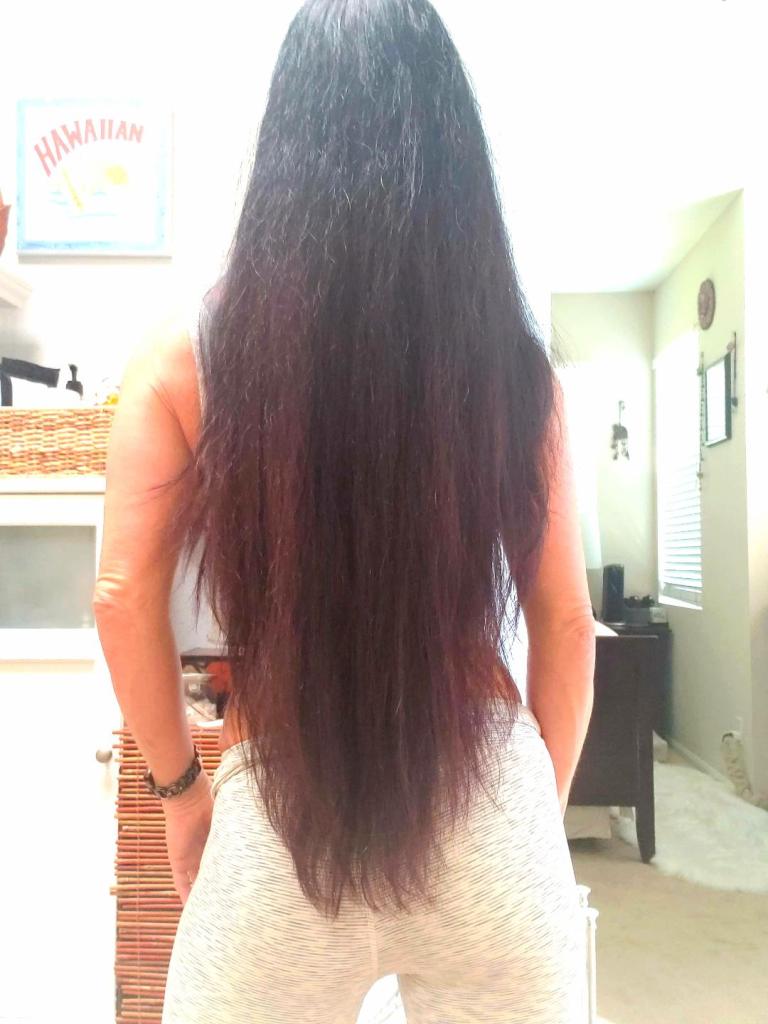
I know it sounds strange, but to me, my hair at this point almost seems short,compared to that time in the early 90’s when my hair was at its longest. Here’s where my hair was length-wise in June, and then in August of this year:

My hair in June 2019

By August 2019, my hair was this long, and this was even after a trim!

I still look at images of women with crazy long hair (past the gluteal fold), and find some appeal in it, but I honestly don’t know if it would drive me nuts to carry around such a long span of keratin everywhere. Let’s face it, long hair gets in the way, it’s heavy, it makes the nape of the neck hot during the summer, and caring for long hair requires some extra effort to keep it looking its healthiest. I’m not even sure my hair would reach the same length where I had it in 1991, but I suspect I’d get so sick and tired of the maintenance that I would opt for a shorter, more manageable length.

source 123rf.com
Image ID : 96202263
Copyright : Sergii Vorobiov

I will say that women with very long hair do stand out. Long hair is special, it’s beautiful, and not everyone can rock a Rapunzel-length mane. I think anyone with beautiful, healthy hair who wants to grow it out should do it, even if they later decide that sporting a scarf of hair isn’t for them.

source: 123rf.com
Image ID : 90512289
Copyright : YAUHENI HASTSIUKHIN

There is also a fair amount of versatility with long hair. It can be coiled into an elegant updo, crafted into a half-up, half-down hairstyle which is fashionable and pretty, swept up into a ponytail, braided, or left loose and free. In addition, long hair makes a handy shawl or scarf if one is caught in brisk weather without a sweater or coat. Believe me, I have used my hair as insulation from cold air many times over the years!

source: 123rf.com
Image ID : 84565803
Copyright : victoriash

Lastly, there is something so romantic about very long hair. Women with uber long hair aren’t afraid to express themselves as women. A sharp contrast to pixie hair styles, long hair evokes tremendous femininity. What’s strange, though, is how oppressed the literary character Rapunzel was. She was held captive by a witch in a tower, and her only hope of escape was to find a rescuer who would have to climb up her incredibly long hair to rescue her. Eventually Rapunzel cuts her hair, which apparently symbolizes cutting ties with a maternal figure. Wow, heavy stuff.

I suspect that I will sport extremely long hair, at least waist-length, for as long as I live. I’ve spent the majority of my life with long hair as part of my signature style, and I don’t plan to change that style by chopping my strands.

Seated Stretches To Energize You

Source 123rf.com
Image ID : 25045947
Copyright : Andriy Popov

If you work at a desk job, you probably don’t think much about stretching your body and recharging it, but it’s one of the best things you can do for your body and your spirit.

Though I think it’s always best to step away from your desk to increase circulation, stretch, and reset your mind, I know that isn’t always an option. So here are a few stretches which you can do while sitting at your desk. I challenge you to perform these stretches right now as you read this blog post so you can see how easy and quick they are.

NECK CIRCLES:
Inhale, then exhale while dropping your chin to your chest.
As you slowly inhale, rotate your head to the right, bringing your right ear near your right shoulder and stretching the muscles on the left side of your neck.
Keep rotating until your neck is fully extended and pause, then rotate your head while slowly exhaling so that your left ear is now near your left shoulder and you feel a stretch in the muscles on the right side of your neck.
As your chin reaches your chest, finish your exhalation and pause.
Continue in this manner for 5 complete revolutions, then switch directions and perform 5 complete revolutions. Bring head to neutral and take a deep inhale, then slowly exhale.

SHOULDER SHRUGS
With arms at sides, inhale, then raise both shoulders near ears and hold for a count of 5.
Forcibly exhale through open mouth while quickly dropping shoulders.
Repeat 4 more times.

GRIP AND RELEASE
Make fists with both hands, holding for a count of 10.
Spread fingers out wide, holding for a count of 10.
Repeat sequence 2 more times, then shake hands out for several seconds.

OPEN HEART
With bent elbows, reach behind your lower back and clasp your hands together.
Aim to keep your palms together at all times.
Move the shoulder blades together.
Then straighten the elbows.
See if you can lift your arms up, away from your back.

NOTE: If this move is too difficult for you, hold onto a towel or belt, then pull arms outwards to add tension, then lift your arms.

Are There Really 52 Genders?

Back in the day, the topic of gender boiled down to biology, defined by one’s sex chromosomes. XX, and you were female, XY, and you were male. Chromosomal disorders such as XO,XXX, XXXX, XXXXX resulted in individuals who possessed female genitalia, while XXY, XXXY, XY/XXY, XYY aberrations resulted in the expression of male genitalia. True hermaphroditism (1), in which both female and male genitals or a hybrid of them exist, is exceedingly rare, so much so that there has never really been a pressing need for a third gender box.

In recent years, however, there has been so much debate and confusion regarding gender versus sexual orientation and identity, that surveys are jumping on the bandwagon to appease to this new crop of outspoken individuals. Biology has abruptly taken a backseat to sexual identity, with all its permutations and definitions. And don’t you dare try to argue biology with the new sexual order, either.

Call me old school, but if we are talking about biology, then there are MALES and FEMALES. For the purposes of the general human population, such genetic definitions accommodate the vast majority of individuals. So if a questionnaire or survey asks someone to check off a GENDER box, it shouldn’t be an insult to a person to mark one of those two boxes. Yet the new millennial order has eschewed biology, turning the query into a chance to declare specific social-sexual preferences. I have never been offended by the standard gender question, and cannot understand how some people insist on applying flawed logic and getting bent out of shape over it.

If gender is such a difficult issue in today’s society, then why do so many couples post gender reveals on social media? It’s either a boy, or a girl, period. Traditionally, when a survey asked for your gender for classification purposes, it wasn’t asking about your bedroom habits. Now it’s a wide open door for people to declare their defiance and independence from a staid society which has been sexually repressed for far too long. It’s suddenly cool when gathering demographic information to inquire about a person’s whole social identity.

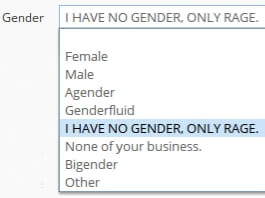
I was prompted to write about this topic when I was asked to complete a profile for a social influencer platform. When I reached the gender section, I saw that it was FIVE PAGES LONG. There were 52 different gender choices. I was stunned. This wasn’t a gender question. This was a social-sexual labels question. And it truly annoyed me. It’s not like I have a problem with the labels, I just have a problem with them being referred to as genders. I also don’t quite understand how transgender people suddenly became so ANGRY at the world.

Honestly, many of the labels are redundant, and one in particular should not be used by the majority of the nonbinary public. Say someone identifies as the following:

AFAB (assigned female at birth)
Female to male
FTM
Trans male
Trans man
Transgender male
Transgender man
Transmasculine
Transsexual male
Transsexual man

Guess what? They all (except for AFAB, which already implies that the individual has rejected their biological origin) say the SAME THING.

Also, anyone who refers to themselves as Two-spirit has no right to use that label unless they truly are members of the indigenous Native American community from which the phrase originated. Here’s the description of “Two-spirit”:

Two-Spirit (also two spirit or, occasionally, twospirited) is a modern, pan-Indian, umbrella term used by some Indigenous North Americans to describe Native people in their communities who fulfill a traditional third-gender (or other gender-variant) ceremonial role in their cultures.

The term two-spirit was created in 1990 at the Indigenous lesbian and gay international gathering in Winnipeg, and “specifically chosen to distinguish and distance Native American/First Nations people from non-Native peoples.” The primary purpose of coining a new term was to encourage the replacement of the outdated and considered offensive, anthropological term, berdache. While this new term has not been universally accepted—it has been criticized by traditional communities who already have their own terms for the people being grouped under this new term, and by those who reject what they call the “western” binary implications, such as implying that Natives believe these individuals are “both male and female”—it has generally received more acceptance and use than the anthropological term it replaced.

“Two Spirit” is not interchangeable with “LGBT Native American” or “Gay Indian”; rather, it was intended, despite being in English, to carry on the traditional meanings of the terms in Indigenous languages for the culturally-specific ceremonial roles that are recognized and confirmed by the Elders of the two-spirit’s ceremonial community. Opinions vary as to whether or not this objective has succeeded. Often incorrectly used as a synonym for “LGBT Native”, the term and identity of two-spirit “does not make sense” unless it is contextualized within a Native American or First Nations framework and traditional cultural understanding. However, the gender-nonconforming, LGBT, or third and fourth gender, ceremonial roles traditionally embodied by Native American and FNIM people, intended to be under the modern umbrella of two-spirit, can vary widely, even among the Indigenous people who accept the English-language term. No one Native American/First Nations’ culture’s gender or sexuality categories apply to all, or even a majority of, these cultures.

Oh, and Two-spirit is NOT a gender per biological standards either.

It’s fine if someone doesn’t want to be pigeonholed into a stereotypical gender description, and identifies as being transgender. In fact, there is legislation which aims to designate X as a gender marker for nonbinary and transgender individuals, and apparently, this option is available on birth certificates issued in the Canadian province of Ontario. However, I rail against the idea that the standard gender question on surveys and other forms must add a whole mess of redundant descriptions of sexual and social behavior.

REFERENCES:

1. A Human Intersex (“True Hermaphrodite”) with XX/XXY/XXYYY Sex Chromosomes
Fraccaro M.a · Taylor A.I.b · Bodian M.b · Newns G.H.b. Cytogenetics 1962;1:104–112
https://doi.org/10.1159/000129719

LAZY: A MANIFESTO – By Tim Kreider

EVERYONE should read this article, written by Tim Kreider. It’s a true eye-opener.

http://www.staystrongsc.com/blog/2017/1/8/lazy-a-manifesto

If you live in America in the 21st century you’ve probably had to listen to a lot of people tell you how busy they are. It’s become the default response when you ask anyone how they’re doing: “Busy!” “So busy.” “Crazy Busy.” It is, pretty obviously, a boast disguised as a complaint. And the stock response is a kind of congratulation: “That’s a good problem to have,” or “Better than the opposite.”

This frantic, self-congratulatory busyness is a distinctly upscale affliction. Notice it isn’t generally people pulling back-to-back shifts in the ICU, taking care of their senescent parents, or holding down three minimum-wage jobs they have to commute to by bus who need to tell you how busy they are; what those people are is not busy but tiredExhausted. Dead on their feet. It’s most often said by people whose lamented busyness is purely self-imposed: work and obligations they’ve taken on voluntarily, classes and activities they’re “encouraged” their kids to participate in. They’re busy because of their own ambition or drive or anxiety, because they are addicted to busyness and dread what they might have to face in its absence.

Almost everyone I know is busy. They feel anxious and guilty when they aren’t working or doing something to promote their work. They schedule in time with their friends the way 4.0 students make sure to sign up for some extracurricular activities because they look good on college applications. I recently wrote a friend asking if he wanted to do something this week, and he answered that he didn’t have a lot of time but if something was going on to let him know and maybe he could ditch work for a few hours. My question had not a preliminary heads-up to some future invitation: This was the invitation. I was hereby asking him to do something with me. But his busyness was like some vast churning noise through which he as shouting out at me, and I gave up trying to shout back over it.

I recently learned a neologism that, like political correctnessman cave, and content-provider, I instantly recognized as heralding an ugly new turn in the culture: planshopping. That is, deferring committing to any one plan for an evening until you know what all your options are, and then picking the one that’s most likely to be fun/advance your career/have the most girls at it — in other words, treating people like menu options or products in a catalog.

Even children are busy now, scheduled down to the half hour with enrichment classes, tutorials, and extracurricular activities. At the end of the day they come home as tired as grownups, which seems not just sad but hateful. I was a member of the latchkey generation, and had three hours of totally unstructured, largely unsupervised time every afternoon, time I used to do everything from scouring The World Book Encyclopedia to making animated movies to convening with friends in the woods in order to chuck dirt clods directly into one another’s eyes, all of which afforded me knowledge, skills, and insights that remain valuable to this day.

The busyness is not a necessary or inevitable condition of life; it’s something we’ve chosen, if only by our acquiescence to it. I recently Skyped with a friend who had been driven out of New York City by the rents and now has an artist’s residency in a small town in the South of France. She described herself as happy and relaxed for the first time in years. She still gets her work done, but it doesn’t consume her entire day and brain. She says it feels like college — she has a circle of friends there who all go out to the cafe or watch TV together every night. She has a boyfriend again. (She once ruefully summarized dating in New York: “Everyone is too busy and everyone thinks they can do better.”) What she had mistakenly assumed was her personality — driven, cranky, anxious, and sad — turned out to be a reformative effect of her environment, of the crushing atmospheric pressure of ambition and competitiveness. It’s not as if any of us wants to live like this, any more than any one person wants to be part of a traffic jam or stadium trampling or the hierarchy of cruelty in high school; it’s something we collectively force one another to do. It may not be a problem that’s soluble through any social reform or self-help regimen; maybe it’s just how things are. Zoologist Konrade Lorenz calls “the rushed existence into which industrialized, commercialized man has precipitated himself” and all its attendant afflictions — ulcers, hypertension, neuroses, etc. — an “inexpedient development,” or evolutionary maladaptation, brought on by our ferocious intraspecies competition. He likens us to birds whose alluringly long plumage has rendered them flightless, easy prey.

I can’t help but wonder whether all this histrionic exhaustion isn’t a way of covering up the fact that most of what we do doesn’t matter. I once dated a woman that interned at a magazine where she wan’t allowed to take lunch hours out, lest she be urgently needed. This was an entertainment magazine whose raison d’etre had been obviated when Menu buttons appeared on remotes, so it’s hard to see this pretense of indispensability as anything other than a form of institutional self-delusion. Based on the volume of my email correspondence and the amount of Internet ephemera I am forwarded on a daily basis, I suspect that most people with office jobs are doing as little as I am. More and more people in this country no longer make or do anything tangible; if your job wasn’t performed by a cat or a boa constrictor or a worm in a Tyrollean hat in a Richard Scarry book I’m not convinced it’s necessary. Yes, I know we’re all very busy, but what, exactly, is getting done? Are all those people running late for meetings and yelling on their cell phones stopping the spread of malaria or developing feasible alternatives to fossil fuels or making anything beautiful?

The busyness serves as a kind of existential reassurance, a hedge against emptiness: Obviously your life cannot possibly be silly or trivial or meaningless if you are so busy, completely booked, in demand every hour of the day. All this noise and rush and stress seem contrived to drown out or over up some fear at the center of our lives. I know that after I’ve spent a whole day working for running errands or answering emails or watching movies, keeping my brain busy and distracted, as soon as I lie down to sleep all the niggling quotidian worries and Big Picture questions I’ve successfully kept at bay come crowding into my brain like monsters swarming out of the closet the instant you turn off the nightlight. When you ty to meditate, your brain suddenly comes up with a list of a thousand urgent items you should be obsessing about rather than simply sit still. One of my correspondents suggests that what we’re all so afraid of is being left alone with ourselves.

I’ll say it: I am not busy. I am the laziest ambitious person I know. Like most writers, I feel like a reprobate who does not deserve to live on any day that I do not write, but I also feel like 4 or 5 hours is enough to earn my stay on the planet for one more day. On the best ordinary days of my life, I write in the morning, go for a long bike ride and run errands in the afternoon, and see friends, read or watch a movie in the evening. The very best days of my life are given over to uninterrupted debauchery, but these are, alas, undependable and increasingly difficult to arrange. This, it seems to me, is a sane and pleasant pace for a day. And if you call me up and ask whether I won’t maybe blow off work and check out the new American Wing at the Met or ogle girls in Central Park or just drink chilled pink minty cocktails all day long, I will say, “What time?”

But just recently, I insidiously started, because of professional obligation to become busy. For the first time in my life I was able to tell people, with a straight face, that I was “too busy” to do this or that thing they wanted me to do. I could see why people enjoy this complaint: It makes you feel important, sough-after, and put-upon. It’s also an unassailable excuse for declining boring invitations, shirking unwelcome projects, and avoiding human interaction. Except that I hated actually being busy. Every morning my inbox was full of emails asking me to do things I did not want to do or presenting me with problems that I had to solve. It got more and more intolerable, until finally I fled town to the Undisclosed Location from which I’m writing this.

Here I am largely unmolested by obligations. There is no TV. To check email I have to drive to the library. I go a week at a time without seeing anyone I know. I’ve remembered about buttercups, stinkbugs, and the stars. I read a lot. And I’m finally getting some real writing done for the first time in months. It’s hard to find anything to say about life without immersing yourself in the world, but it’s also just about impossible to figure out what that might be, or how best to say it, without getting the hell out of it again. I know not everyone has an isolated cabin to flee to. But not having cable or the Internet turns out to be cheaper than having them. And nature is still technically free, even if human beings have tried to make access to it expensive. Time and quiet should not be luxury items. 

Idleness is not just a vacation, an indulgence, or a vice: It is an indispensable to the brain as vitamin D is to the body, and deprived of it we suffer a mental affliction as disfiguring as rickets. The space and quiet that idleness provides is a necessary condition for standing back from life and seeing it whole, for making unexpected connections and waiting for the wild summer lightning strikes of inspiration — it is, paradoxically, necessary to getting any work done. “Idle dreaming is often the essence of what we do,” writes Thomas Pynchon in his essay on Sloth. Archimedes’ “Eureka” in the bath, Newton’s apple, Jekyll and Hyde, the benzine ring: history is full of stories of inspiration that came in idle moments and dreams. It almost makes you wonder whether loafers, goldbrickers, and no-accounts aren’t responsible for more of the world’s great ideas, inventions, and masterpieces than the hardworking.

“The goal of the future is full unemployment, so we can play. That’s why we have to destroy the present politico-economic system.” This may sound like the pronouncement of some bong-smoking anarchist, but it was in fact Arthur C. Clarke, who found time between scuba diving and pinball games to write Childhood’s End and think up communications satellites. Ted Rall recently wrote a column proposing that we divorce income form work, giving each citizen a guaranteed paycheck, which sounds like the kind of lunatic notion that’ll be a basic human right in about a century, like abolition, universal suffrage, and 8-hour workdays. I know how heretical it sound in America, but there’s really no reason we shouldn’t regard drudgery as an evil to rid the world of if possible, like polio. It was the Puritans who perverted work into a virtue, evidently forgetting that God invented it as a punishment. Now that the old taskmaster is out of office, maybe we could all take a long smoke break.

I suppose the world would soon slide to ruin if everyone behaved like me. But I would suggest that an ideal human life lies somewhere between my own defiant indolence and the rest of the world’s endless frenetic hustle. My own life has admittedly been absurdly cushy. But my privileged position outside the hive may have given me a unique perspective on it. It’s like being the designated driver at a bar: When you’re not drinking, ou can see drunkenness more clearly than those actually experiencing it. Unfortunately the only advice I have to offer the Busy is as unwelcome as the advice you’d give to the Drunk. I’m not suggesting everyone quit their jobs — just maybe take the rest of the day off. Go play some see-ball. Fuck in the middle of the afternoon. Take your daughter to a matinee. My role in life is to be a bad influence, the kid standing outside the classroom window making faces at you at your desk, urging you to just this once to make some excuse and get out of there, come outside and play.

Even though my own resolute idleness has mostly been a luxury rather than a virtue, I did make a conscious decision, a long time ago, to choose time over money, since you can always make more money. And I’ve always understood that the best investment of my limited time on earth is to spend it with people I love. I suppose it’s possible I’ll lie on my deathbed regretting that I didn’t work harder, write more, and say everything I had to say, but I think what I’ll really wish is that I could have one more round of Delanceys with Nick, another long late-night talk with Lauren, one last hard laugh with Harold. Life is too short to be busy.

Childhood Quirks

Image ID : 21701963 (123rf.com)
Copyright : Yael Weiss

My mom taught me how to blow bubbles with bubble gum when I was 5 years old, sparking a years-long obsession with gum.  I loved trying different flavors of gum: orange, grape, strawberry, Fruit Stripe (anyone remember this?), lime, bubble gum flavor, you name it.

I was so obsessed with different flavors of gum that I developed a rather odd and disgusting habit which sounds so horrific to me now.  When I found an especially tasty morsel of gum, I would stop chewing it before all the flavor left, then stick the wad on the underside of a small card table I had in my room.  At any given time, I would have between 6 to maybe 10 wads of chewed gum under that table.  When I wanted to experience the flavor of a gum again, I would pry the gum off the underside of the table, then go to the bathroom sink and run the gum under steaming hot water until it softened up.  Once the gum was heated up, I’d pop it in my mouth and chew happily away.

I definitely doubt that the water was hot enough to disinfect the gross little clumps of gum, and I think it’s a miracle that I didn’t become ill from that unsanitary habit!

Is anyone else brave enough to admit to a strange or gross habit they might have had when they were children?