Category Intelligence
A Great TED Talk On Clutter
“Clutter is postponed decisions.” – Barbara Hemphill
I absolutely love this brilliant quote by Barbara Hemphill which Kerry Thomas mentions in this TED Talk video, because it is completely true. No matter what type of clutter plagues you, it may be impeding you in a profound way from living a free and peaceful life.
I hate physical clutter and fight it all the time by conducting purges throughout the year. But physical clutter is only one type of clutter, and Ms. Thomas breaks down the different types into the following:
Physical
Mental
Emotional
Digital
Spiritual
Although I feel that I have a good handle on physical clutter in my environment, the other categories are more challenging. I control digital clutter by going through my email inboxes on a daily basis, consolidating images and deleting old text messages on my phone. I also think I have a decent handle on spiritual clutter because I meditate daily, take meditation and yoga courses, and also practice breathwork. I try to forgive those who upset me, and I also make sure to avoid toxic people.
The areas where I get hung up (and I suspect many others do) is with mental and emotional clutter. Ms. Thomas states that mental clutter consists of fears one might have, and it also could stem from the judgmental words of others, while emotional clutter consists of negative thoughts and behaviors. The thing is, I have fears which keep my mind racing, and I also fall into the trap of negative thinking from time to time, especially when I am in the middle of a crisis. So by no means am I completely free of clutter. However, I constantly strive to clear up anything which is depressing me or slowing me down.
It’s incredibly liberating to get rid of items which are damaged, unused, or worn, and it’s also wonderful to let go of all the mental blockades to happiness and freedom. One thing I always try to remind myself is that worrying about things will never bring about a solution. The only thing worry ends up doing is eroding one’s demeanor and sparking anxiety.
I suggest that you think about the different areas in which clutter might be adversely affecting your life, and adopt behaviors which counteract such clutter.
Why you should make useless things | Simone Giertz
Please check out Simone Giertz’s TED Talk about her experiences with making useless gadgets. She has found a way to express her creativity which is unique, whimsical, and which caught the attention of YouTubers everywhere.
Are There Really 52 Genders?

Back in the day, the topic of gender boiled down to biology, defined by one’s sex chromosomes. XX, and you were female, XY, and you were male. Chromosomal disorders such as XO,XXX, XXXX, XXXXX resulted in individuals who possessed female genitalia, while XXY, XXXY, XY/XXY, XYY aberrations resulted in the expression of male genitalia. True hermaphroditism (1), in which both female and male genitals or a hybrid of them exist, is exceedingly rare, so much so that there has never really been a pressing need for a third gender box.
In recent years, however, there has been so much debate and confusion regarding gender versus sexual orientation and identity, that surveys are jumping on the bandwagon to appease to this new crop of outspoken individuals. Biology has abruptly taken a backseat to sexual identity, with all its permutations and definitions. And don’t you dare try to argue biology with the new sexual order, either.

Call me old school, but if we are talking about biology, then there are MALES and FEMALES. For the purposes of the general human population, such genetic definitions accommodate the vast majority of individuals. So if a questionnaire or survey asks someone to check off a GENDER box, it shouldn’t be an insult to a person to mark one of those two boxes. Yet the new millennial order has eschewed biology, turning the query into a chance to declare specific social-sexual preferences. I have never been offended by the standard gender question, and cannot understand how some people insist on applying flawed logic and getting bent out of shape over it.

If gender is such a difficult issue in today’s society, then why do so many couples post gender reveals on social media? It’s either a boy, or a girl, period. Traditionally, when a survey asked for your gender for classification purposes, it wasn’t asking about your bedroom habits. Now it’s a wide open door for people to declare their defiance and independence from a staid society which has been sexually repressed for far too long. It’s suddenly cool when gathering demographic information to inquire about a person’s whole social identity.
I was prompted to write about this topic when I was asked to complete a profile for a social influencer platform. When I reached the gender section, I saw that it was FIVE PAGES LONG. There were 52 different gender choices. I was stunned. This wasn’t a gender question. This was a social-sexual labels question. And it truly annoyed me. It’s not like I have a problem with the labels, I just have a problem with them being referred to as genders. I also don’t quite understand how transgender people suddenly became so ANGRY at the world.
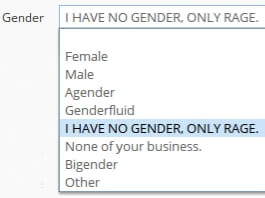
Honestly, many of the labels are redundant, and one in particular should not be used by the majority of the nonbinary public. Say someone identifies as the following:
AFAB (assigned female at birth)
Female to male
FTM
Trans male
Trans man
Transgender male
Transgender man
Transmasculine
Transsexual male
Transsexual man
Guess what? They all (except for AFAB, which already implies that the individual has rejected their biological origin) say the SAME THING.
Also, anyone who refers to themselves as Two-spirit has no right to use that label unless they truly are members of the indigenous Native American community from which the phrase originated. Here’s the description of “Two-spirit”:
Two-Spirit (also two spirit or, occasionally, twospirited) is a modern, pan-Indian, umbrella term used by some Indigenous North Americans to describe Native people in their communities who fulfill a traditional third-gender (or other gender-variant) ceremonial role in their cultures.
The term two-spirit was created in 1990 at the Indigenous lesbian and gay international gathering in Winnipeg, and “specifically chosen to distinguish and distance Native American/First Nations people from non-Native peoples.” The primary purpose of coining a new term was to encourage the replacement of the outdated and considered offensive, anthropological term, berdache. While this new term has not been universally accepted—it has been criticized by traditional communities who already have their own terms for the people being grouped under this new term, and by those who reject what they call the “western” binary implications, such as implying that Natives believe these individuals are “both male and female”—it has generally received more acceptance and use than the anthropological term it replaced.
“Two Spirit” is not interchangeable with “LGBT Native American” or “Gay Indian”; rather, it was intended, despite being in English, to carry on the traditional meanings of the terms in Indigenous languages for the culturally-specific ceremonial roles that are recognized and confirmed by the Elders of the two-spirit’s ceremonial community. Opinions vary as to whether or not this objective has succeeded. Often incorrectly used as a synonym for “LGBT Native”, the term and identity of two-spirit “does not make sense” unless it is contextualized within a Native American or First Nations framework and traditional cultural understanding. However, the gender-nonconforming, LGBT, or third and fourth gender, ceremonial roles traditionally embodied by Native American and FNIM people, intended to be under the modern umbrella of two-spirit, can vary widely, even among the Indigenous people who accept the English-language term. No one Native American/First Nations’ culture’s gender or sexuality categories apply to all, or even a majority of, these cultures.
Oh, and Two-spirit is NOT a gender per biological standards either.
It’s fine if someone doesn’t want to be pigeonholed into a stereotypical gender description, and identifies as being transgender. In fact, there is legislation which aims to designate X as a gender marker for nonbinary and transgender individuals, and apparently, this option is available on birth certificates issued in the Canadian province of Ontario. However, I rail against the idea that the standard gender question on surveys and other forms must add a whole mess of redundant descriptions of sexual and social behavior.
REFERENCES:
1. A Human Intersex (“True Hermaphrodite”) with XX/XXY/XXYYY Sex Chromosomes
Fraccaro M.a · Taylor A.I.b · Bodian M.b · Newns G.H.b. Cytogenetics 1962;1:104–112
https://doi.org/10.1159/000129719
When Your Arms Are Too Short…

As someone who grew up with myopia (nearsightedness), I never imagined that my reading vision would fail me. Yet I have spent the last four years holding menus at arm’s length to make it easier to read the food selections. Within the past year, I adopted the habit of grabbing my reading glasses first thing in the morning when I grab my phone. Do you know why? Because my close-up vision has become so dim that if I dare to construct a social media post without my glasses, I end up finding typos on my caption or hashtags. I’ve even gotten to the point where I wear my glasses when sitting at the computer and reading a considerable amount of material, because it reduces eye strain.
The end result is that I either grab glasses, or wish that my arms were longer. I also wish that restaurants filled with romantic ambience would scrap the low light conditions in favor of slightly brighter light which would make it possible for all but the most elderly and vision-challenged to see.
Presbyopia (the age related stiffening of the lens of the eye, which interferes with its ability to contract and diffract the light) has reared its ugly head and taken up residence permanently in my daily life. And despite the fact that I had the knowledge base to realize that presbyopia would color my life after the age of 50, I am still surprised at how sudden and noticeable the vision changes have been.
I went from not being able to see the big E on the Snellen eye chart from my childhood into my late 40’s, to struggling to read receipts in my 50’s and wondering, “Is that a 6, or an 8?”, or, “Is that a 3 or a 5?” It’s pretty frustrating. There have been instances in which I have picked up products with the intention of reading the product ingredients, but I often cannot read them at all.
What’s really strange is that it makes me feel a bit disconnected from the world, since once sense is noticeably dulled. Who else feels that way as a result of having age-related loss of near vision?
People Who Say These 5 Words Have Very Low Emotional Intelligence
Please check out the post at:
I have copied and pasted the article here for you for convenience.
Who agrees with Bill Murphy’s assessment? Who disagrees?
Most people would probably agree with both Bill Murphy and Justin Bariso, and bristle when someone makes the statement, “I know how you feel.” No one truly knows how you feel, because your experience is unique and important. Such a statement does nothing to communicate empathy, but instead alienates the listener. Remember that sharing your particular experience in an effort to comfort the other person detracts from his or her own experience. It’s best to either keep your mouth shut, or just say, “I’m sorry that happened.” Be an ear to bend, not a barometer by which the other person must measure his or her own troubling experience.
By Bill Murphy Jr. of Inc.
They mean the exact opposite of what you think. But only emotionally intelligent people understand why.
The words hit me like a hurricane: “I know how you feel.”
They’re right there on pages 80 and 81 of my colleague Justin Bariso’s new book about emotional intelligence. They’re simple words, and real–and yet as Justin writes, they’re also absolutely the wrong thing to say to those who confide in you with their problems or fears.
These situations are tough, sometimes. You’ve been trusted. You want to develop rapport. You want to act the way somebody with real emotional intelligence would act.
You want to help.
Yet, rather than creating a connection, “I know how you feel” and other phrases like it build a wall between you and the other person.
The phrase suggests that you don’t truly understand what the other person feels at all. (Really, how could you?) It suggests that you feel the need to turn the conversation toward your experience, not his or hers, and that ultimately you don’t really care about that person’s concerns after all.
In other words, this five-word phrase sends a message that’s 100 percent the opposite of what you intend.
So don’t say, “I know how you feel.” Here’s what to do instead.
Shift vs. support
If you’ve read this far, I suspect you really do care about people. But like me perhaps, you don’t always realize the true effects of your words.
The solution, as sociologist Charles Derber suggests, and Celeste Headlee summarizes, is to gauge your responses in real time, and ask yourself whether you’re offering a “shift response” or a “support response.”
What’s the difference?
A shift response involves an attempt to guide the conversation toward your life experiences, and away from the experiences of the person you’re ostensibly listening to and perhaps even trying to help.
A support response sets aside your ego, and instead keeps the focus on the other person’s feelings and experience.
Conversational narcissism
A few examples will make this very clear. In each case below, just imagine that a friend or colleague opens a conversation with the highlighted statement. Then think about how each response would make him or her feel.
1. “My boss doesn’t respect me.”
Shift response: “I went through the exact same thing last year. I wound up leaving and finding a better job.”
Support response: “I’m sorry to hear that. What makes you feel that way?”
2. “If I could just get organized, I’d have the world on a string.”
Shift response: “I know–I have the same problem.”
Support response: “What do you think stops you from being organized?”
3. “I’m so sad since my breakup.”
Shift response: “You just need to get back out there and start dating again.”
Support response: “What do you think stops you from being able to move forward?”
Derber calls the whole phenomenon, at least the part in which well-meaning people shift the discussion to their own experience, “conversational narcissism.”
Is that a $20 phrase to describe a $1 problem? Maybe. But it does make it clear.
“I can imagine…”
As Justin puts it in his book, the successful strategy to communicate effectively and leverage emotional intelligence requires avoiding phrases like these:
“I know exactly how you feel.”
“I’ve been through this before.”
“I completely understand; or, I get it.”
And replacing them instead with things like the following:
“I’m sorry that happened.”
“I can imagine how you may feel.”
“Thanks for sharing this. Tell me more.”
Actually, I might take issue even with “I can imagine how you may feel.” But we’ll leave it in.
Just remember that the whole point here is to acknowledge how hard it is to really put yourself in someone else’s shoes, and instead make clear that you have empathy.
You’re trying to understand–even as you acknowledge that full success might not ever be possible. The true connection that you’re both looking for comes with the well-communicated attempt.
Looking For Fitness, Wellness, and Life Inspiration?

If you are looking for that fire which will encourage you to reach out towards your fitness, wellness and life goals, then be sure to tune into the motivating, inspiring podcasts at https://micro.fit/ where the motto is, “For big results, think small”. That’s right…small changes in your lifestyle can create dramatic results in your life!
I am honored to be one of the featured podcasters for this wonderful app! My podcast runs on Fridays, so be sure to check it out each week for new topics and fresh perspectives on life balance, goal setting, motivation and fulfillment.
Click on this link to access the podcast page directly:
15 Of The Hottest Doctors On Instagram

https://www.therichest.com/world-entertainment/15-of-the-hottest-doctors-on-instagram/
I am so flattered and honored to be on this list! Thank you Devon Jefferson for including me here.
Check out the hottest doctors on Instagram by clicking on the link above.
Of Orifices and Zero Freedom

Copyright: bialasiewicz / 123RF Stock Photo
As a physician, I have had the incredible honor and privilege of studying every part of the human body, to the most minute detail. I have hovered over cadavers which were fileted and displayed for they eyes of inquisitive medical students, and scrubbed in on colon resections, open heart surgery, neurosurgery, cataract removal, etc. During my first month of internship as a newly minted physician, I massaged a dying heart with my gloved hands (no, the patient didn’t survive). I have also delivered over 40 infants via vaginal and Cesarean methods, and have pronounced the demise of patients in the wards. In fact, there are many stories I have collected over the years, some incredibly sad, some disgusting, some frightening, and some infuriating, but all true, and all part of my experience as a doctor.
I knew full well that by signing up for an education in medicine, I would be subjected to disgusting, morbid, frightening things, and that I would face mortality on a regular basis. However, after several years of working in family practice, I began to notice that I wasn’t thrilled with the fact that I examined orifices of every kind on a very regular basis. Whether it was a nostril, a mouth, an ear canal, an anus, a urethral meatus (layman’s term pee-hole), or vagina I had to examine, I was never thrilled about it, and the orifices below the belt were certainly much more bothersome to address. My intense dislike of such examinations, combined with the tedium of primary care and the low insurance reimbursement for services and procedures provided, caused me to retreat from primary care and focus more on the areas I had more interest in, namely, physical medicine, cosmetic dermatology, and anti-aging medicine, all of which are much cleaner and which do not require me to conduct examinations on private parts.
Another feature of primary care which made me cringe was the intense demand on a practitioner’s time. The only time it ever seemed reasonable for me to literally lose sleep night after night as a physician was when I was in training. At this point, there is no way you could convince me that such a thing is healthy, and I refuse to sign up for that. I won’t give up weekends to take on three stacked 12-hour work shifts, and I will not give up the few holidays I celebrate (Thanksgiving, Christmas Eve, Christmas Day, New Year’s Eve, and New Year’s Day) in order to work. As it is, I give up other major holidays to work, but since the work I perform on those holidays is in bodybuilding and fitness, I don’t mind it at all.
I love being a physician, and I find it incredibly rewarding to make a positive impact on my patients. However, I will not sacrifice balance in my life, or the freedom to pursue my other interests, in order to prove to society what a good physician I am. I don’t believe for a second that running oneself into the ground working as a physician ever sends a positive message to others. I don’t ever want to be the kind of doctor who is saddled with so many chart notes to write that an entire weekend is devoted to completing them. Not for me.
Lasty, I think it’s so strange that society still assumes that doctors are supposed to give their time and knowledge at a moment’s notice, on demand, yet I don’t see those same demands placed on people in other industries. I can’t tell you how many times I have been in a brief conversation with a complete stranger, who dares to ask me a medical question as soon as my profession is revealed. I swear, one of these days I am going to get a t-shirt made that says, “THE DOCTOR IS OFF-DUTY RIGHT NOW…NO MEDICAL QUESTIONS PLEASE”!
Our New Security Blanket

Copyright: oneinchpunch / 123RF Stock Photo
Think about the one thing which is constantly at your side, namely, your phone.
You rely on that small, handheld computer to keep your life in order, so much so that misplacing it sends you into an instant panic. Your LIFE is on that phone, dammit, and if you were to lose it, you would hate to imagine how much its loss would disrupt your life. I am willing to bet that you carry your cell phone everywhere, even into the restroom, which is why cell phones harbor some of the nastiest germs which are found on inanimate objects these days.
Your thumbs assert their special evolutionary spot in the animal kingdom by constantly texting, liking posts, scrolling, and sweeping to the left or right. Unfortunately, that also means gamekeeper’s thumb, an injury to a tendinitis in thumb ligaments is all to common now.
Your relationship with your phone is so tight that you will stare into it even while at dinner with friends, and it will tempt you to fuss with it while driving, despite the dangers associated with driving and texting.
I have a suggestion for you if you are so attached to your phone that it has become a security blanket. Why not leave it at home while you run to the gym? How about leaving it on your desk at work while you use the restroom? Leave it face down on the table when you are having dinner with friends. Avoid looking at it once you have crawled into bed. It won’t be the end of the world if you put your phone down every once in a while.
 dr. stacey naito's blog