Month March 2016
Brows Are In
Suddenly, eyebrows are in, and in a big way.

Those of you who are old enough to remember the caterpillars which framed the eyes of Brooke Shields and Margeaux Hemingway might be cringing at the new trend in brows which Kim Kardashian, Ariana Grande and Cara Delevingne have popularized, better known as #EyebrowsOnFleek. What is fleek? Flawless, perfect. So if you have any interest in new makeup trends, you had better make sure those brows are meticulously groomed and filled in.

Similar to the trend in the early 1980’s, today’s brows are full and thick, but an obsession with drawing in a false silhouette to “shape” the brow has dominated the makeup world. The problem I have with this trend is that it creates a false brow line, rather than accentuating a natural arch. Take a look at this transformation, and you will see what I am talking about.

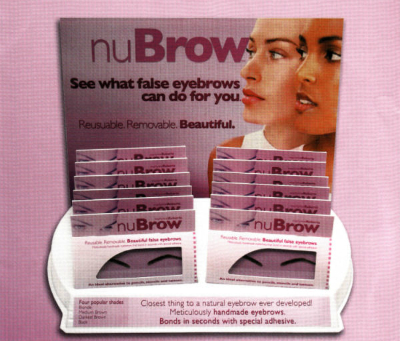
Women these days are encouraged to keep tweezing to a minimum, and let it all grow out, which means that those who have anemic, pencil-thin brows will be forced to use eyebrow waxes, stencils, permanent tattooing, and even faux brows to create the illusion of much fuller brows. Faux brows? Oh yes. There’s something called lace front brows, which are fantastic for people who have gone through chemotherapy or alopecia.
As for me, I plan to work with what Mother Nature gave me. Though I have a sparse area on my left brow, it can easily be filled in with a bit of brow pencil or brow wax. I accentuate my natural arch, and only make my brows look thicker if I have full makeup on with a dark smoky eye. After seeing too many young women with shaped brows which make them look like clowns, I prefer to avoid jumping on the brows-on-fleek bandwagon. It seems to be a trend best suited for the young crowd anyway.
Yes You Are Shrinking

Have you ever noticed that people tend to shrink as they get older? This phenomenon is pretty much unavoidable, but at least we can take steps to minimize the amount of height loss over time.
On a personal note, I hit 5 feet, 5-1/2 inches at my tallest when I was 17, and remained there until I reached the age of 40. Then I noticed a loss of 1/4 inch, putting me at 5 feet, 5-1/4 inches. By the time I began competing in NPC bodybuilding events, I was at 5 feet, 5 inches. Now, at the age of 49, I stand at 5 feet, 4-1/2 inches. Though I will never be as short as my 4 foot 8 inch Japanese grandmother was, I am definitely losing height as I get older.
Numerous research studies have demonstrated that the process of shrinking stature begins as early as our 30’s, with men losing about an inch between the ages of 30 and 70, and women losing twice that amount. The shrinkage continues into our 70’s and 80’s too. There are a number of reasons why we lose height over time:
1. Cartilage which cushions the joints begins to compress and wear down, and in weight-bearing joints like the spine, hips, knees and ankles, results in a loss of stature.
2. The ratio of bone formation versus bone absorption decreases, and the bones become more weak. In women, the loss of estrogen after menopause further decreases the rate of bone formation.
3. Over time, muscle mass gradually decreases, a process known as sarcopenia. This results in a decrease in postural strength and stability.
How can we minimize the rate of shrinkage in height as we age? Here are some guidelines to follow:
– Perform weight-bearing exercise at least three days per week.
– Consume foods rich in calcium and vitamin D.
– Sit up straight!
– Quit smoking.
– Avoid excessive intake of alcohol and caffeine.
– Don’t starve yourself or practice perpetual dieting.
When you visit your primary care provider for your annual checkup, make sure that your height is measured. If you avoid regular checkups, get into the habit of checking your height once a year, either on your birthday or at the beginning of the year so that you have a standard time of year to measure it. According to numerous studies, a loss of 1 to 2 inches within a year correlates with a higher risk of hip and non-vertebral fractures, and should be investigated by a physician.
Emojis Have Taken Over
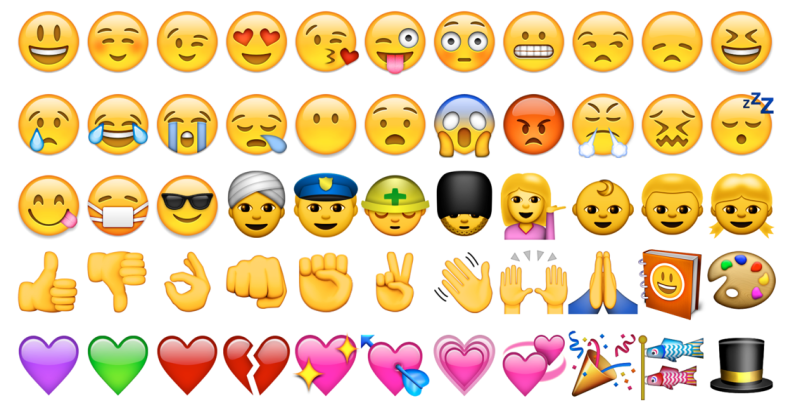
I first saw emojis in my text messages about a year ago, when I finally broke down and downloaded an emoji app. I was tired of seeing the code for the emoji and not the actual pictogram when someone would include an emoji in a text. At first I resisted using them, because I felt that they were kind of silly and sophomore-ish, but I gradually began to use the more basic emojis, like Smiling Face, Red Heart, Purple Heart, and Madly In Love Face. They are pretty fun, and they break up the monotony and tedium of typing in a long string of words. I can sometimes get away without even using the qwerty keyboard on my phone, and only using emojis and the talk-to-text function. In some sense, I think emojis have unlocked the imagination and child within us, since they are so whimsical and fun.
I have to admit that I am not completely familiar with the entire emoji collection which is loaded onto my phone, and I often lack the time to scroll through all the emojis to see what I have. In addition, some emojis are a bit deceiving, so I am concerned about using an emoji to convey something, only to find out later that the emoji conveyed something rather different to the textee. For example, the Weary Cat Face appears far more startled than it does weary, as you can see here:
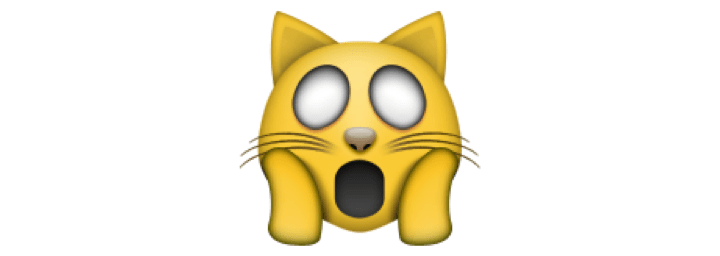
I think I have actually used the Weary Cat Face as a startled cat, and the person who got that emoji assumed I was conveying surprise or shock, rather than the ennui which the official definition of this emoji is meant to express. Does this mean we all have to study the actual meanings of all the emojis we use? That doesn’t seem very spontaneous or fun. In case you have any concern over the emojis you might be using erroneously, you can check the meaning here: http://emojipedia.org/
A fantastic article by Adam Sternbergh was published in the New Yorker Magazine which spoke in great detail about the evolution and significance of emojis. If you are interested in reading it, I have included the link here:
http://nymag.com/daily/intelligencer/2014/11/emojis-rapid-evolution.html
On the one hand, I think it’s wonderful that the brainchild of Shigetaka Kurita (the inventor of emojis) can cross linguistic obstacles and enable people around the world to communicate relatively easily. On the other hand, I am concerned for the fortitude of words, and hope that a collective dumbing-down of society as a whole is not about to expand as a result of the presence of emojis. I groaned when I discovered that a man by the name of Fred Benenson translated the entire tome of Herman Melville’s Moby Dick. If you’re curious to see it, here’s a link to the pdf: http://www.czyborra.com/unicode/emojidick.pdf
Time will tell whether emojis are here to stay.
Six Common Misconceptions About Bodybuilding

In an effort to shed some light on what the sport of bodybuilding is like, I am devoting this blog post to clarifying the most common misconceptions which I hear from people.
Misconception #1: You have to train for many hours every single day to get big. I know very few people who have the time to work out for several hours per day on a daily basis. In addition, if someone lifts heavy for many hours, and does it every single day, that person is overtraining. There are numerous problems with overtraining: 1. gains diminish because the body doesn’t have time to repair itself, 2. injuries tend to occur, and 3. energy levels plummet. If you train with intensity, you should be able to get a GREAT workout which stimulates muscle hypertrophy in as little as 20 minutes.
Misconception #2: Bodybuilders are all meatheads. I know that there are people who assume that bodybuilders are a bunch of angry, dim-witted people. My experience has revealed that such an assumption couldn’t be further from the truth. Many of the best and biggest bodybuilders have careers in non-fitness fields like law, medicine, engineering, and law enforcement, and are considered to be leaders in the community. In addition, many are very well-educated, very friendly and approachable, and have big hearts. So before you assume that a pile of muscle equates with a mean and stupid motherf*&$er, try getting to know a bodybuilder.
Misconception #3: Bodybuilders have zero body flexibility. If you have ever gone to a bodybuilding event and watched bodybuilders, women’s physique competitors, or fitness competitors perform their routines, you will often get to see some of the best athleticism and flexibility around. I have seen male bodybuilders easily perform splits onstage, which is something I haven’t been able to do since my gymnastics days when I was a child! As long as weightlifting is performed slowly and with a complete range of motion, flexibility should not diminish at all. If weight training was so detrimental to flexibility, you wouldn’t see athletes from other sports round out their training by lifting weights. As always, a good stretching regimen can keep muscles and tendons supple.
Misconception #4: If you stop weight training, you will get fat. The only thing that happens when someone stops weightlifting is that the muscles will atrophy and exhibit a soft appearance, similar to a deflated balloon. So it really isn’t fair to pin an increase in storage fat on lack of weight training. Food intake is what tends to fatten up a former bodybuilder who has hung up the weights, because the strict meal plan also falls by the wayside, contributing to an increase in storage fat.
Misconception #5: In order to get big, bodybuilders have to take steroids. This is by far the most controversial misconception. Are there bodybuilders who take steroids? I am sure there are. Do they all take steroids? Absolutely not. As a matter of fact, there are plenty of people in the bodybuilding world who will staunchly defend the gear-free lifestyle. Haters want to hang onto the ridiculous notion that in order to grow appreciable size, there must be some illicit secret to it all. Perhaps if they stopped flapping their gums and hit the weight hard at the gym, they might harvest some muscle of their own.
Misconception #6: Women who train with weights will become very big and muscular. As a woman who lifts pretty heavy and does it up to six days per week, I speak from experience when I say that this is a big, fat lie. I still have curves and look feminine, and my muscles aren’t bursting out of my clothing like a she-Hulk. I have said this many times before, and I will say it again: lifting heavy weights will NOT make a woman overly muscular!
Cuss Words And Why I Like Them

There is tremendous power in profanity, which is part of the reason why I like certain words. I don’t want to give you the impression that I am a complete foul-mouth, but I am certainly not going to lose my mind if the random S-bomb flies out of someone’s mouth or my mouth. I am very careful in certain situations, such as when I am around someone who finds cussing offensive, or when I am conversing with the majority of my patients. But the rest of the time, I don’t hold back at all, and sometimes surprise myself with the long strings of expletives which can tumble out of my mouth when I am all fired up. However, in these instances, I am usually alone in my car or at home, where I feel safe enough to open up a fresh can of obscenities and fling them into the air.
Let’s face it, many people like cuss words because they have personality. Some naughty words are so full of texture that you could almost bite right into them. For example, the word “fuck” has dimension and color to it. It’s lively, energetic, and emphatic, and that is exactly why I dig it. And in most cases, “fuck” is so benign that I honestly don’t think it deserves such a bad rap. Besides, there is something delicious about off-color utterances which supports our propensity for pushing the envelope.
I always find it puzzling that censorship laws still bleep out certain words, yet the context of the scene and dialog usually clearly give away the swear word which was spoken. At least the FCC got hip to what the public can tolerate on late night major network television, and allowed certain words, like “shit” and “asshole”, to let fly on shows like Conan.
What it comes down to is that the “bad words” which have been demonized in our culture are just WORDS. They don’t hurt people unless they are used in a malicious fashion to insult others, such as racial slurs. As long as we avoid words which are inflammatory, or used in a destructive manner, we shouldn’t have to fear them at all.
Why I Love Being Fit
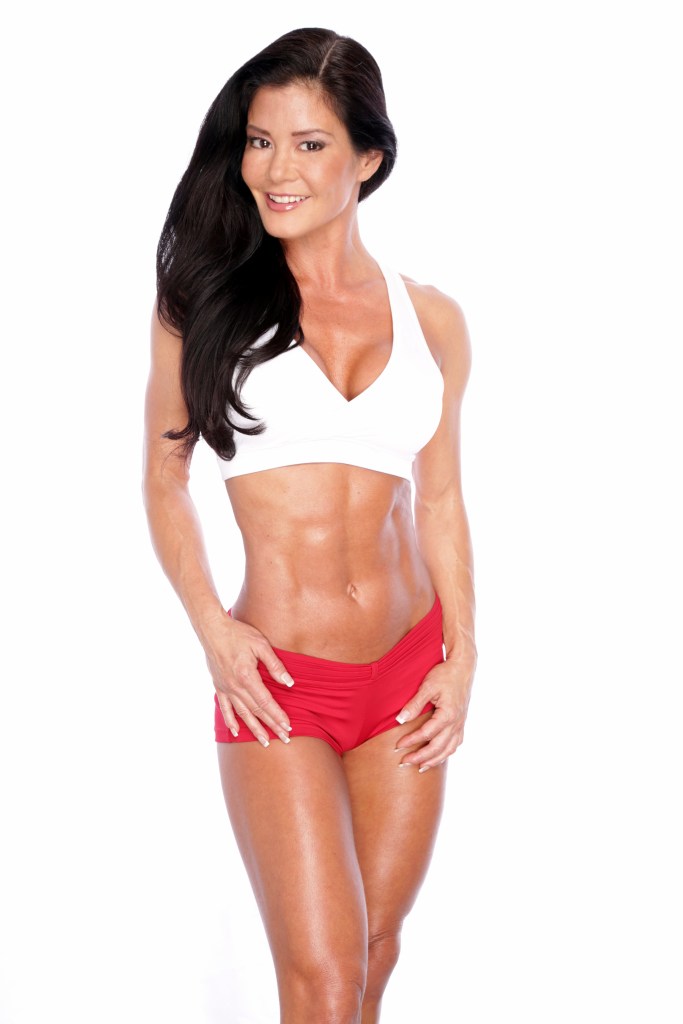
There are so many reasons why I love being fit:
* I love the fact that I can lift up a heavy bag of groceries, and for the most part, lift it confidently without fear of it being too heavy for me.
* I love the fact that I can put on a pair of tight leggings and see my the shape of my quad sweep, hammies, glutes, and calves through the fabric.
* I love being able to put on a sleeveless top and see a nice pop of delt and bicep.
* I love the fact that people notice that I put the work into having a toned physique.
* I love being able to fit into my clothing from high school.
* I love the fact that my bone mineral density at the age of 49 rivals that of someone who is less than half my age.
* I love the fact that I like what I see in the mirror.
* I love the fact that my blood pressure and lipid profile are well within the normal range.
* I love the fact that going into a gym doesn’t intimidate me in the least.
* I love the fact that I don’t ever have a reason to make an excuse about my chronological age standing in the way of me pursuing goals.
* I love the fact that seeing new muscle striations or an intramuscular vein makes me happy.
The take-home message to everyone here is that you are never too old to adopt a fit and healthy lifestyle. There are no limits to what you can achieve!
Why Diets Don’t Work For Weight Loss
Please check out my latest article for Sports Nutrition Supplement Guide! You can access the article directly here:
Of if you prefer to read it here, I have included it below.
*************************************************
If you are like many people, you probably have been led to believe that the only way to effectively lose weight is to practice severe caloric restriction. However, if you are always struggling to lose those last 5, 10, or 15 pounds, and are frustrated because you tend to lose some weight, only to gain all of it back plus some extra fluff, then it is highly likely that you have damaged your metabolism via severe calorie restriction.
There is a very good reason why the weight loss and diet industry is so successful, and why certain well-known weight loss programs keep their customers coming back. Most diet plans doom their clients to failure, because they don’t provide enough caloric fuel to keep the body happy, so it becomes sluggish, and the metabolic rate drops in an effort to make the body more efficient at running on low fuel.
When you consume a very small amount of calories in an effort to create a significant caloric deficit, you can potentially wreak havoc on your metabolism by causing it to slow down. Why does this happen? When there is no food to break down, the body’s furnace slows down and becomes so sluggish that when you actually do eat something, your body is less equipped to break down the food quickly, and instead stores it as fat. Depriving yourself of food also causes sharp drops in blood sugar, robbing you of energy and increasing insulin resistance. Increased insulin resistance over time can precipitate the development of diabetes.
Other consequences of skipping meals include the following:
• Malnutrition – If you do not feed your body regular, balanced meals, it is highly likely that you are depriving it of essential nutrients. Malnourished states can lead to weight gain, poor health and progression of disease over time.
• Poor concentration – This is due to the depletion of glycogen stores which occurs. The brain simply does not have enough fuel to run on, resulting in fogginess.
• Hunger pangs – When you skip meals, you may experience intense feelings of hunger along with anxiety, dizziness or nausea. In addition, such feeling may lead to overeating when you finally sit down to eat something. Loading the body with a large meal is overkill, and leads to poor digestion and absorption as well as increased storage in body fat stores.
Do yourself a favor and practice the following guidelines. If you do, you will be rewarded with a healthy weight for a lifetime.
1. Don’t skip meals.
2. Make sure to eat enough protein to sustain your energy levels and satisfy your hunger.
3. EAT BREAKFAST.
4. Commit to healthy meals.
5. When you turn to snacks, make sure healthy alternatives are available so you aren’t tempted to reach for a nutrient-poor convenience food.
No Wonder Oksana Grishina Keeps Holding Her Titles
Oksana Grishina successfully defended her Arnold title last weekend, to make her two-year consecutive win a threepeat, and it’s pretty obvious why she remains at the top of the heap. I also wouldn’t be surprised if her visits to Arnold Europe and Olympia this year (both of which she has won for the last two years in a row) also culminate in threepeats. Her athleticism, extraordinary physique, and stage presence are truly beyond compare. Check her incredible routine from last Friday:
 dr. stacey naito's blog