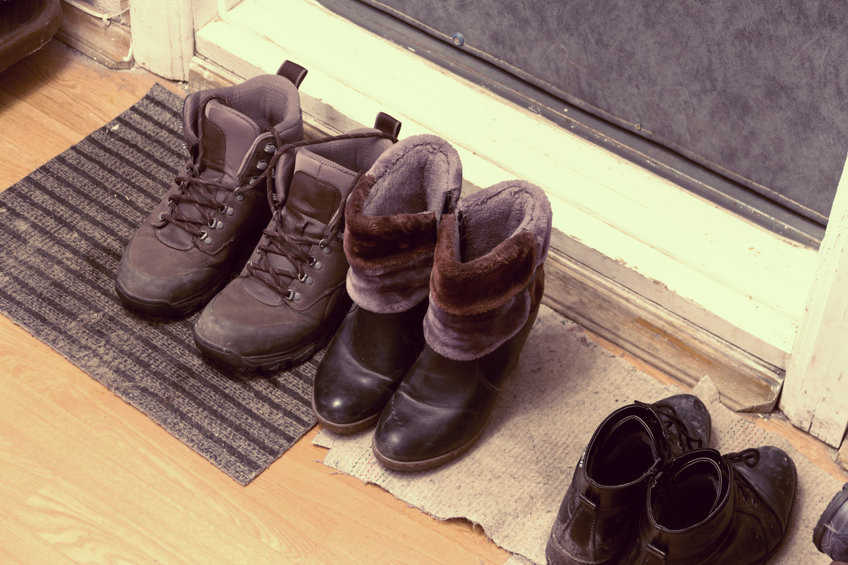
Remove Your Shoes Please!

Copyright: andsst

I grew up in a shoes-off household, which meant that as soon as anyone stepped into my home, they had to remove their shoes and leave them at the front door. Throughout my childhood, I noticed that none of my friends removed their shoes while in their homes, but then again, none of whom were Asian. In stark contrast, I noticed that the habit of removing shoes, sandals, and boots was always followed by my mom’s Asian friends, as well as by my relatives (also Asian) in Hawaii. I soon noticed that the floors in my friends’ homes didn’t feel nearly as clean on my bare feet as the ones in my own apartment, since they didn’t practice the same ritual my Japanese-American mother and I did. What I ended up doing in my friends’ homes was either keep my shoes on, or I would keep my socks on if I was wearing any when I visited them. To be honest, I always felt that it was so much cleaner to be in the habit of removing shoes once entering a residence, and this is something I continue to practice to this day. Since I am also the person who usually cleans the floors, rugs and carpets in my house, I have become a stickler for ensuring that no one enters in shoes which have traversed sidewalks, driveways, lawns which are teeming with all kinds of nasty gunk.

These days, I even go so far as to ask service technicians who enter my home to either remove their work boots, or to wear shoe covers, if they intend to conduct work inside the house. Before you accuse me of being extreme in my desire to keep my abode clean, keep in mind that back in July of 2021, a central air service technician tracked so much dirt and oil into my bedroom that it took me two sessions to remove all the stains from my bedroom carpet. Shortly after that, I ordered disposable shoe covers and have them right at the foyer for convenience.

Copyright: Elenathewise

Even with the shoes-off policy in my home, I still notice dust and dirt on my floors, and since I have pets, there is also the issue of shedding hair which accumulates. The last thing I want is to worry about when I clean the floors every week is chemicals, dog feces, and various microbes being introduced to my house via outdoor footwear. A study conducted by the University of Arizona discovered that 96% of soles of shoes were found to harbor fecal matter, which is picked up from the floors of public restrooms, as well as bird droppings and dog feces from asphalt, concrete, grass and soil. When you wear your shoes inside your house, you are spreading all of that bacteria, most notably E. coli, over all of your floors. Not only do you have to worry about germs, you also need to be aware of how many chemicals we track into our homes with our shoes, from gasoline which we pick up while pumping gas at a gas station, to carcinogenic chemicals which are used on lawns, and the list goes on.

Why not improve your indoor environment with a simple step and implement a no-shoes policy when you are inside your house? You’ll be rewarded with a cleaner home and will decrease your exposure to potentially harmful substances.


Leaky Gut

food-allergy-leaky-gut-inflammation
If you suffer from sudden food sensitivities, aching joints, digestive upset, fatigue or weight gain, you may be suffering from leaky gut, which is also referred to as increased intestinal permeability. Leaky gut is characterized by the opening of pores in the small intestine, resulting in undigested food particles, bacteria, and toxins traveling to the bloodstream. The presence of these substances in the bloodstream triggers an immune response, whereby the body builds antibodies to the foreign substances but also attacks itself, creating food allergies and autoimmune disorders.

You are probably wondering how something like this occurs and if you are at risk. Let’s look at the main causative factors leading to leaky gut syndrome:

1. Chronic constipation – If you are usually constipated, toxins will often build up in stool, irritating the intestinal lining and causing inflammation, which then causes the pores in the small intestine to expand. In severe cases, Crohn’s Disease, irritable bowel syndrome,or colitis can occur.

2. Chronic stress – The immune system really takes a beating when subjected to chronic stress. If the immune response is compromised, pathogenic bacteria can cause widespread inflammation in the intestines, and leaky gut is a common result.

3. Dysbiosis – This is an imbalance between beneficial and harmful bacteria which can result from antibiotics or poor diet. Inflammation develops, causing the pores to widen.

4. Toxins – We are exposed to many thousands of toxins, but the worst offenders are found in our water supply, pesticides, and in certain medications.

leaky-gut
What Is The Solution If You Have A Leaky Gut?

I have several dietary recommendations for treating a leaky gut.

1. Glutamine – I am already a big fan of glutamine in general, but especially for those who suffer from leaky gut. This amino acid has specific activity in the intestine, and restores healthy soft tissue in the region. Over time, regular supplementation with glutamine has a protective effect against intestinal disease. I tend to be fairly aggressive with glutamine and recommend 6 to 8 grams per day, or more if you engage in frequent exercise.

2. Fish oil – Try to find a formula which contains primarily omega-3 fatty acids. You can also increase your consumption of salmon.

3. Digestive enzymes – Digestive enzymes will aid in the breakdown of food substances, especially in older individuals and those suffering from leaky gut. Try taking them with every meal.

4. Betaine hydrochloric acid – Some people produce insufficient amounts of hydrochloric acid, which is needed to break down food in the stomach. If that is the case, betaine hydrochloric acid optimizes the process.

5. probiotics – Most individuals will benefit from adding probiotics into their daily regimen. Make sure to take at least 25 billion units per day for optimal gut health.

Mineral Oil Sensitivity

I was compelled to revisit this topic because I foolishly went against my better judgement and used a product which I happen to hate, with disastrous results. I hate Lubriderm products and think they are a scam due to the presence of mineral oil. Mineral oil is a very cheap filler which is used in skincare products and cosmetics. What many people don’t realize is that some individuals suffer from mineral oil sensitivity and truly cannot come into contact with it. Sadly, I am one of those people.

Lubriderm is touted as a “dermatologist tested” product, which basically doesn’t mean a thing. Apparently the dermatologists who tested this product weren’t aware of the fact that mineral oil can be a very reactive substance for a segment of the population. I for one have ALWAYS been reactive, though I could never understand as a child why I always broke out in itchy rashes within an hour of being exposed to baby oil. To this day, a high concentration of mineral oil will drive me into an itchy frenzy. This was the main reason why I hesitated when the idea of trying Lubriderm once again, but my stubbornness won out.

I used Lubriderm lotion for normal to dry skin for one week, and during that entire time, experienced itchy skin which only got worse at night, as well as a diffuse papular (raised) rash which covered my shoulders, arms, and thighs. On the last day in which I used the Lubriderm, I actually broke out into hives on my thighs!

As soon as I stopped using Lubriderm, the rash cleared up without any intervention. This was a clear sign that I was indeed still very sensitive to mineral oil, and that it was tragic that products could still be found which listed mineral oil among its top 5 ingredients.

PIt’s important to bear in mind that mineral oil is manufactured from crude oil, and as a result can cause pronounced reactions in people who are sensitive. Such reactions aren’t confined to skin rashes, but also include headaches Mineral-Oilor joint aches. Mineral oil can also disguise itself as petrolatum, paraffin, or propylene glycol.

lease please please be aware that mineral oil sensitivity is very real!

Eye Makeup Removers And Eye Irritation

Сleaning woman face with cotton pads. Cosmetic treatment.

I used to get allergic blepharitis from time to time, which is characterized by severe swelling and redness of the eyelid from an allergen. It was ugly and painful and took about a week to resolve with warm, wet compresses, lid cleanses two to three times daily, and prescription eye ointment. Interestingly enough, this was when I was experimenting with a lot of different pigments from MAC Cosmetics and using a considerable amount of eye makeup remover. After doing some sleuthing, I discovered that my flareups all stemmed from two substances: bismuth and benzylkonium chloride. Bismuth is a mineral which is frequently used in eye shadows and eye pigments, while benzylkonium chloride is commonly used in eye makeup removers. As soon as I switched eye makeup remover brands and stopped using certain eye makeup items, the horrid eyelid irritation vanished.

In this post, I am picking solely on eye makeup removers because there are major brands which contain benzylkonium chloride. Here are two major brands which I used to use.

Neutrogena Oil-Free Eye Makeup Remover –

This is a very popular brand and used to be my staple. But check out the label ingredients: Water, Cyclopentasiloxane, Cyclohexasiloxane, Aloe Barbadensis Leaf Juice, Benzyl Alcohol, Sodium Chloride, Dipropylene Glycol, Poloxamer 182, Allantoin, Tripotassium EDTA, Benzalkonium Chloride, Glycerin, Cucumis Sativus (Cucumber) Fruit Extract, Potassium Phosphate, Dipotassium Phosphate. Little did I know that I was potentiating the blepharitis by using a makeup remover!

Lancome Bi-Facil –

This was my mom’s favorite, but because of the benzylkonium chloride I cannot use it.

You may be wondering how I figured this out. Because I am a physician, published researcher and a scientist, I know how to apply deductive reasoning, as well as set up experiments. Although I could include clinical data here, I would rather give a simple explanation of how horrible and harmful benzylkonium chloride is. Here is a succinct and excellent description:

“The Cosmetic Safety Database states that there is a moderate to strong evidence that benzalkonium chloride is an immune, skin, and respiratory toxicant, with laboratory tests hinting at mutative (carcinogenic) effects. The safety data sheet (MSDS) indicates the ingredient is a skin and eye irritant, and can be corrosive to both, with the amount of damage depending on the length of contact.” (From http://www.annmariegianni.com/)

I don’t know about you, but I don’t feel very comfortable about coming into contact with a substance that is so harmful. What is especially disturbing is that this substance is found in hand sanitizers and eye drops. It is worth spending an extra minute to read ingredient labels before you purchase something that might contain a harmful ingredient.

Leaky Gut

food-allergy-leaky-gut-inflammation
If you suffer from sudden food sensitivities, aching joints, digestive upset, fatigue or weight gain, you may be suffering from leaky gut, which is also referred to as increased intestinal permeability. Leaky gut is characterized by the opening of pores in the small intestine, resulting in undigested food particles, bacteria, and toxins traveling to the bloodstream. The presence of these substances in the bloodstream triggers an immune response, whereby the body builds antibodies to the foreign substances but also attacks itself, creating food allergies and autoimmune disorders.

You are probably wondering how something like this occurs and if you are at risk. Let’s look at the main causative factors leading to leaky gut syndrome:

1. Chronic constipation – If you are usually constipated, toxins will often build up in stool, irritating the intestinal lining and causing inflammation, which then causes the pores in the small intestine to expand. In severe cases, Crohn’s Disease, irritable bowel syndrome,or colitis can occur.

2. Chronic stress – The immune system really takes a beating when subjected to chronic stress. If the immune response is compromised, pathogenic bacteria can cause widespread inflammation in the intestines, and leaky gut is a common result.

3. Dysbiosis – This is an imbalance between beneficial and harmful bacteria which can result from antibiotics or poor diet. Inflammation develops, causing the pores to widen.

4. Toxins – We are exposed to many thousands of toxins, but the worst offenders are found in our water supply, pesticides, and in certain medications.

leaky-gut
What Is The Solution If You Have A Leaky Gut?

I have several dietary recommendations for treating a leaky gut.

1. Glutamine – I am already a big fan of glutamine in general, but especially for those who suffer from leaky gut. This amino acid has specific activity in the intestine, and restores healthy soft tissue in the region. Over time, regular supplementation with glutamine has a protective effect against intestinal disease. I tend to be fairly aggressive with glutamine and recommend 6 to 8 grams per day, or more if you engage in frequent exercise.

2. Fish oil – Try to find a formula which contains primarily omega-3 fatty acids. You can also increase your consumption of salmon.

3. Digestive enzymes – Digestive enzymes will aid in the breakdown of food substances, especially in older individuals and those suffering from leaky gut. Try taking them with every meal.

4. Betaine hydrochloric acid – Some people produce insufficient amounts of hydrochloric acid, which is needed to break down food in the stomach. If that is the case, betaine hydrochloric acid optimizes the process.

5. probiotics – Most individuals will benefit from adding probiotics into their daily regimen. Make sure to take at least 25 billion units per day for optimal gut health.