 It still boggles my mind how many women are afraid to lift weights for fear that they will become huge and look like big, hulking men. How wrong they are! I often speak with female patients of all ages who lament the fact that they cannot get the sculpted, lean bodies they covet despite working out regularly. The problem stems from a couple of things:
1. They do not feed their bodies properly.
2. They do not lift weights, or if they do, they do not practice a lifting regimen that would bring about the physical changes they want.
I see ladies at the gym who will jump on a cardio machine for 20 to 30 minutes of easy cardio, then, if they had an indulgent night of eating or partying, they may extend their cardio sessions for a longer period of time at the same intensity. Before or after this, they may hit a few sets of uninspired exercises with light weights. These women barely break a sweat, yet they expect their bodies to transform. I’ve got news for you: that type of workout will ensure that you remain at the same level of fitness, and over time, you will see what little conditioning you may have plummet despite all your consistency.
It is a gross misconception that by lifting light weights and taking it easy at the gym, they will avoid getting bulky and will tone their muscles. Women are built differently than men, and simply do not have the testosterone levels necessary to build significant, bulky muscle mass. You need to challenge your body and create the muscle microtears necessary to build shapely, lean muscle. That means you need to lift heavier weights and break a sweat!
There are a multitude of benefits to lifting heavier weights, which I detail below.
CURVY, LEAN MUSCLE:
When you lift heavier weights, you will be rewarded with better muscle definition. Lifting very light weights will never challenge the muscles, so the muscles will never grow. I know I have scared some ladies, but think about a woman who has great muscle tone, but is still lean and feminine. A woman like that lifts weights that are heavy enough to spark muscle growth. If you follow suit, you will end up lean and more defined without being bulky.
GREATER OVERALL STRENGTH:
By lifting heavier weights, you will become stronger, and everyday activities will become easier to perform. You will also gain more structural stability from the greater muscle density which can protect your back and your joints.
IMPROVED BALANCE, COORDINATION AND POSTURE:
By improving muscle tone through weight training, you will enjoy better balance, greater overall coordination, and better posture.
IMPROVED BONE DENSITY:
Resistance training improves bone density by stressing the bones, thus triggering bone growth. This confers a protective effect against development of osteoporosis, especially in petite women.
HIGHER METABOLISM:
When you work out with heavier weights, you create tears in the muscles worked. When you do this, you expend a greater number of calories in order to repair those microtears.
LOWER BODY FAT:
Your body fat stores, particularly in the midsection, will be better utilized when you perform weight training with heavier weights.
PREVENTION OF MAJOR DISEASES:
Challenging weight training with heavier weights will reduce your risk of high blood pressure and heart disease. It will also lower LDL cholesterol while raising HDL cholesterol. In addition, your risk of diabetes and breast cancer will drop significantly.
BETTER IMMUNE SYSTEM FUNCTION:
Moderate exercise reduces stress, and by doing so, enables your body to produce more white blood cells to combat infection. In addition, the shift in attention from the troubles of the day while you are weight training will reduce the stress which can suppress your immune system.
GREATER WELL-BEING:
Vigorous resistance training boosts endorphin (natural opiates produced in the brain) levels, which create a sense of well-being. It will also stave off depression and produce a more restful sleep.
REDUCED PMS SYMPTOMS:
As stated previously, weight training is a terrific mood elevator and regulator. It also has a positive impact on hormone levels, increasing blood levels of estrogen, growth hormone, and testosterone. This counteracts the drop in estrogen and rise in progesterone which occurs right around the time before menstruation.
 A few years back I started both a vision board and a vision box to help me visualize what I wanted to accomplish in my life. While the vision board was limited to a couple of images of female competitors who had the physique I wanted to attain, the vision box held (and still does) clippings of the house I wanted, vacations I wanted to take, and other coveted elements. I have yet to acquire the home and the vacations I wanted, but I have been able to travel as a result of competitions and other fitness events, and I reached my goal of having an enviable physique despite getting older with each passing year.
I now firmly believe in the power of vision boards and vision boxes because they enable one to truly envision what they want. Goals and dreams become tangible when they are focused on with intention. There is a great deal of power in putting your intentions out to the universe and empowering yourself to make the movements and changes which absolutely can manifest in reality. You should frequently look at the items you collect and harvest the belief that they can all come true. Great things happen to those who put their energies towards moving towards goals, no matter how lofty they may be.
Find original post at: http://www.rxmuscle.com/rx-girl-articles/6941-emotional-eating.html
Rather than discuss well-known emotional eating disorders such as bulimia, I will concentrate on binge eating which many women engage in from time to time. It is important to recognize this behavior if it becomes a regular pattern, because frequent emotional eating warrants a diagnosis of binge eating disorder and requires treatment and intervention.
Binge eating is characterized by eating compulsively to cope with negative emotions and stressful situations. A binge eater is rarely hungry when she begins to eat and will continue to eat well after she is full. Such episodes can last for up to two hours or can occur off and on throughout the day. The binger feels guilty both during and after the episode, but will not attempt to counteract it by fasting, taking laxatives, vomiting, fasting or over-exercising. A strong lack of self-control as well as feelings of shame will accompany this behavior pattern. There is a strong association between binge eating and depression. Binge eating is also driven by social components such as social pressure to be thin, emotional and sexual abuse, parental criticism of a child’s weight, and the use of food as reward or punishment.
Food cravings are usually the strongest when you are in emotional crisis. You may reach for food for comfort or to serve as a distraction. Consider the following highly stressful events and think about whether you reached for comfort foods during such times:
Though some people will lose their appetites when stressed and will refrain from eating, many others will engage in impulsive eating in an effort to deal with negative emotions. This may be relatively harmless if such emotional eating occurs on a very rare occasion, but becomes a serious problem when it is used as the only coping mechanism for stressful situations or negative emotions. Just bear in mind that if you have a rare moment of weakness, it is important to recognize it as just that and to prevent yourself from spiraling into excessive feelings of guilt over the incident. If you engage in an episode of emotional eating, learn to forgive yourself and have a fresh start the following day.
Why We Engage in Emotional Eating
What occurs almost invariably when we eat emotionally is that we turn to cookies, cakes, candy, fried foods and breads rather than to healthy foods. There is a biochemical basis for such behavior. Carbohydrates which are high in sugar or fat release dopamine in our brains which in turn stimulates the brain’s pleasure center, creating a sense of euphoria. These foods are usually associated with pleasurable memories, such as cake which you may have looked forward to on your birthday, or macaroni and cheese as a treat after school when you were a child.
Food can also serve as a happy distraction from conflict or stressful events by stimulating the aforementioned pleasure centers. What will frequently occur is that an excessive amount of these foods will be consumed. However, if you remain aware of such automatic connections between food and mood and realize when you are eating for reasons other than hunger, you can break this cycle and get back on track with healthy eating habits which are associated with true hunger.
How To Combat Emotional Eating

 The scientific nature of medicine often tricks people into believing that doctors are so cerebral that they spend all day diagnosing and treating, without much regard for social factors which patients may bring into an appointment. However, it has been my experience that medicine is deeply rooted in connecting with others emotionally, mentally and spiritually. I realize that my personal journey as a physician is colored by the fact that I chose primary care as my post-graduate foundation, as well as the fact that I truly enjoy getting to know my patients. It is relatively common for me to discover that the “chief complaint” which brings a patient into the office is not the main concern the patient has. For example, I may have a patient come to me for evaluation of right shoulder pain and after 10 minutes of speaking with the patient find out that the patient hates her job, is suffering from insomnia and is exhausted from also caring for two small children and an ailing father. What ends up happening is that I will evaluate the shoulder, but will also discuss sleep hygiene and the importance of putting the oxygen mask on herself instead of giving all of her energy to her job, her children and her father. She certainly still has all those responsiblities, but when she neglects herself she drains herself of the potential energy she could be carrying to sustain herself and those she cares for.
Another common scenario is the patient who has gotten out of shape over the years and wants to make a change. These patients may come in for weight management, but in most cases they present to the office with a completely unrelated medical complaint. Almost invariably, I find out that the patient is overloaded, and also has difficulty committing to a specific regimen. This is yet another example of putting the oxygen mask over oneself, and is also a situation in which the patient needs to break the cycle of making excuses which serve as blockades to reaching ANY goals. The too-tired, too-busy, too-old excuses don’t fly with me at all. There is NO EXCUSE which justifies making regular visits to fast food restaurants, skipping meals regularly, and leading a sedentary lifestyle. It is important to realize that such habits are also rituals which the person has chosen to hang onto because they are familiar. It can be quite intimidating to manifest a major lifestyle shift because it requires a person to abandon old habits and patterns and undergo a complete change of mindset.
I honestly love helping people and take my role as an educator and healer very seriously. I also know that I can be a motivator, but only if I can successfully ferret out the psychological issues which hold people back from gaining true fulfillment in their lives.
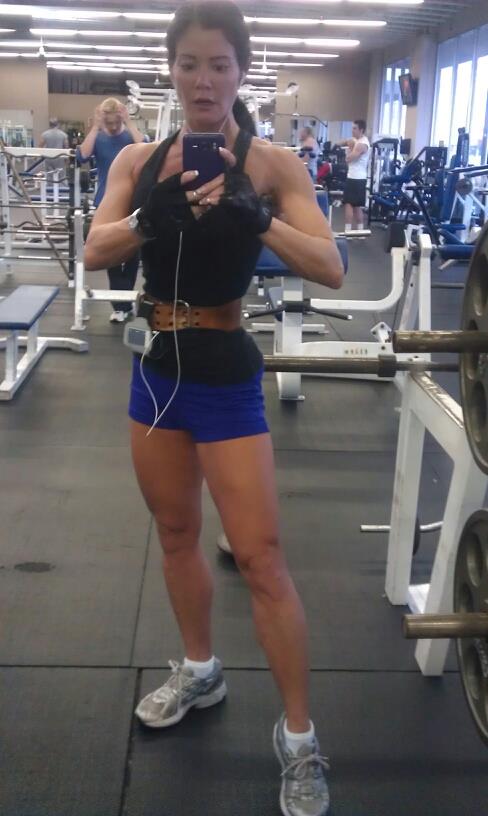 I move at a frenetic pace every single day, switching gears constantly and trying to pack as much as I can into each day. My determination, organization and just plain stubbornness usually ensure that every single item on my to-do list gets done, and that certainly includes my intense workout regimen. I work out six days per week, usually twice per day, and find it downright challenging to fit it all in while also attending to my career, family, and personal responsibilities. So why not just abandon the crazy gym schedule? Not a chance!
When I go to the gym, I have a perfect opportunity to recharge my body. I push myself to train harder and heavier with each day, and I love getting to that point where I may question whether I have the energy or strength to complete the entire routine (I always do though). The time I spend in the gym is my personal time, ME time, and allows me to take care of myself without worrying about anyone or anything else in my life during that small pocket of time. It’s like putting the oxygen mask on myself to ensure that I will be able to help others. My daily workouts keep me on a consistent schedule and provide structure to my day.
Another wonderful benefit of training as hard as I do is that I get to beat the aging process. I can honestly say that I am in better shape now than ever before. One of the joke statements I often make is that I am aging like a fine wine. What amazes and inspires me is the fact that there are a number of people in the fitness industry who are doing the very same thing. The population may be aging, but the newer crop of people over 40 who have embraced clean eating and resistance training looks better than ever and enjoys better vitality and health than the over 40 crowd from previous decades. It can be quite a guessing game to accurately determine someone’s age by looks alone these days!
 When the NPC established the Men’s Physique Division for male competitors in its bodybuilding events back in 2011, it fueled an impressive interest in competing among men who were in great shape but not big enough to compete in the bodybuilding division. Suddenly a division popped up which did not demand the extreme muscularity that characterizes Men’s Bodybuilding. But what are judges looking for in the Men’s Physique Division? They want to see men who are fit and who display great shape, muscularity, conditioning and symmetry. Overall proportion trumps massive muscle bellies here, but keep in mind that Men’s Physique competitors have a decent level of muscularity.
Men’s Physique competitors are split up into different classes on the basis of height instead of weight. Local and regional events will usually have an Open division (all ages), Masters 35+, and at times a Masters 45+ division. At the national level, only a couple of contests feature a Masters Division, forcing many older competitors to compete against those much younger in the Open Divisions. IFBB Men’s Physique Pros compete in one class regardless of height or age.
Attire for Men’s Physique competitors consists of board shorts which sadly cover the majority of the quadriceps and the hamstrings. Competitors compete barefoot.
During judging, each competitor is expected to walk to the center of the stage individually and perform front and back poses for the judges. Once each competitor has had a chance to hit his poses, judges will call out competitors to the center of the stage for comparisons.
 dr. stacey naito's blog