Are You A Sponsored Athlete Or An Unpaid Salesperson?

Original post can be found here:
http://www.rxmuscle.com/blogs/the-business-fitness-modeling-and-showbiz/11790-are-you-a-sponsored-athlete-or-an-unpaid-salesperson.html

Are you an athlete
Most sports supplement companies and other fitness related companies aggressively promote their products through athletes who can sing the praises of their benefits. Who could be better at describing the efficacy of a product and how it enhances training or recovery than an athlete who not only already uses those types of products, but someone who has a following and who can convince new customers to purchase from the company which they represent?

Here’s where things get problematic. The pool of bodybuilding and fitness athletes is pretty massive, and the waters are teeming with athletes who are anxious to get their so-called “big break”. As a result of this, savvy marketing teams from fitness related companies often sweep up these individuals because they are enthusiastic and can propel a brand’s exposure. All the company needs to do is to offer some free product to the athlete and provide instructions on how to use social media to get the word out that these products exist. Then the athletes post images of themselves holding or using products, and add affiliate codes so that any orders which are generated through that athlete’s post are credited to the athlete. This can be a great way for an athlete to make some extra money while competing or chasing down fitness related gigs and projects.

It is important to bear in mind that such athletes really aren’t sponsored, but are instead unpaid salespeople who provide free advertising and generate sales via social media posts which direct followers to product websites. Yes, they get commissions if they have affiliate codes, but such commissions are nothing to write home about unless someone is really blowing the roof off in sales. This is in stark contrast to a true athlete sponsorship, in which an athlete is paid to represent the brand as a brand ambassador. The sponsored athlete is chosen for his or her physique, performance history and awards, facial good looks, charisma, enthusiasm, and often the size of his or her social media following. Usually a sponsored athlete signs a contract which stipulates that he or she will receive a certain amount of free product, and in most cases will also receive financial compensation which is either paid via a monthly salary or via a contest stipend. Though the athlete usually agrees to a set requirement or recommendation to provide social media posts for the company at regular intervals, the company pays the athlete for his or her trouble. Personal appearances and events are also part of the sponsored athlete agreement and clearly described in the written contract. The sponsored athlete is compensated for use of his or her likeness on advertising materials as well.

Obviously it is a far better deal to become an official sponsored athlete for a company. Otherwise, you are just providing free advertising and cheap labor in exchange for products which are sold at a significant markup from what they are manufactured at. If you post a selfie with product that somehow goes viral, the company will certainly love the boost, but I doubt you will ever see any type of compensation if you aren’t a sponsored athlete, which means you provided your likeness for free. The truth of the matter is that there are only a handful of athlete sponsorships to go around, with a massive surplus of athletes vying for those spots. The athletes who end up getting sponsorships stand out from the crowd in some way, or fit a brand’s look and philosophy so well that it makes sense to bring them on board to represent a brand. The rest of the athletes must navigate through all the companies out there to try to find an arrangement which benefits them in some way. Sometimes it is easy to sell a product, usually because the athlete enjoys using it so much that he or she doesn’t mind providing free advertising or labor.

Sometimes a supplement company will launch a contest which is based on social media posts. One company, which shall remain unnamed, launched a huge campaign this year that was patterned on this idea, and decided to award 5 of the entrants $10,000. Sure, that sounds like a good chunk of change, but if there were 8,000 entrants, then 7,995 walked away with nothing. At the end of the campaign, the company got tons of free advertising and all those hashtags they requested for “tracking” purposes also propelled their brand in a huge way. To be honest, this is a brilliant marketing tactic, but not the best move for the majority of athletes who participated. I have also seen companies launch contests in which entrants must purchase a product, then post on social media with hashtags to enter the contest. This is another form of free advertising for the company, a great way to generate sales, a brilliant means for them to boost exposure, and yet another way for athletes to be suckered into doing free advertising. I don’t see much harm in taking part in such a contest if you truly love a product and want to proclaim it, but just remember that it works wonders as an advertising tool for the company without any benefit for you.

One thing I will never advocate is purchasing products, even at a steep discount, while also representing a brand as one of its “sponsored” athletes. If you are asked to pay for a product while also providing free advertising on social media channels, run quickly in the other direction! Basically you are dealing with a company which doesn’t value you enough as an athlete to provide compensation for your advertising efforts. This isn’t the same as purchasing a product, finding out you like it, THEN posting something on social media which lets people know how much you like it. I know of several athletes who had done this, which sparked the attention of the company which manufactured the product, eventually leading to a sponsorship deal. But do not, I repeat, DO NOT PAY for products as a way to get false sponsorship for a company.

It isn’t a bad thing to work as an unpaid salesperson in the fitness industry as long as you know your place and value. Once your following builds, the smart thing to do is to leverage your visibility into getting an athlete sponsorship. The main thing is to make sure that you don’t get taken advantage of in the process.

Love Scenes

Depending on the typecasting which exists for an actor, kissing scenes or sex scenes may be a regular part of the mix. This can throw a wrench in relationships, and in some cases, result in their demise.

Performance kissing and lovemaking (or straight up nasty fucking, excuse the expression) has to look convincing and appealing. Many actors have stated that kissing and sex scenes for the film camera, television camera, or stage are rather different from regular intimate interactions. However, the intimate acts which actors must perform are still exactly that, intimate. It’s important for actors to build up some sort of relationship with their fellow actors prior to such scenes. And though the intimate act (be it a kiss, a fondle, or a full-on sexual act) must be performed in front of the entire crew, it’s still a shared moment which would make most people blush and squirm from the awkwardness.

I am also aware of the fact that actors might not be attracted to the other actor (s) in the scene, and that they might not even be the gender to which the actor finds him or herself attracted. Yet, as the saying goes, the show must go on. Then again, they may indeed be physically attracted to their co-stars. I have heard actors admit that they get an enjoyment, a charge, out of performing an intimate scene, because there is an exchange of energy between the actors, and the artistic process is in full force.

In addition, the actors must make the scene believable, which means the passion, the lust, the hunger, must all be generated from the actors’ past experiences. It’s all part of getting into character. So in that sense, the feelings are genuine. The question I have, though, is how fair is it to say that the character is the one in the midst of the embrace, and not the actor who is performing it? To me, that sounds like a cop-out. As someone who has had to endure a partner performing such scenes, I cannot accept the rationale that the actor is not the one engaged in the activity, and that because it’s acting, it’s perfectly acceptable. Call me a prude, call me narrow-minded, but the thought of my man swapping spit, grabbing an actress by the breast or ass, or grinding up against another human in the act of feigned copulation, quite frankly makes me sick to my stomach.

Actors will often offer this rebuttal: “It’s ACTING, it’s my job. It’s what I have to do. It’s my normal.”

It’s just work? Yeah, so is stripping. And porn. And prostitution.

And what about the feelings of insecurity and jealousy which I believe would and should naturally spark in an actor’s mate? If a partner cannot seem to adjust or accept the intimate performances which an actor may be called on to perform, is that partner being unfair? What about how the actor approaches his or her partner with the news that a liplock, a bump and grind, or nudity will be required for a scene? Does an actor have the right to wave the flag of “creative license” in the face of his or her boyfriend/girlfriend/spouse?

I’ll tell you this much: the idea of my man’s lips, tongue, hands, body on another actor bugs me to no end. Such activities are private, intimate interactions, and my strong belief is that they should NOT be shared with anyone else, even during an acting scene which is supposedly an artistic expression and completely make-believe. Pheromones are released during a romantic kiss, and can’t be avoided. And quite frankly, there have been enough stories about actors hooking up off the set because they discovered that there was a sexual or romantic connection, one that might be worth jeopardizing an existing relationship for.

The only other industries which require intimate encounters between humans are stripping, porn and prostitution. Perhaps the actions don’t have the same meaning as they do when the working individual is with his or her real-life love interest, but the activities are still very much occurring. Yes, I know those of you who are actors want to debate this, especially since you only feign sexual encounters. However, no other industry besides the ones I have previously mentioned even approaches the compromising positions and intimate encounters which acting does. For actors to be called upon to kiss, fondle and grind up against others, and to expect their mates to be completely okay with it just seems like the ultimate double standard, and I am not afraid to say that I find the whole thing rather unreasonable.

Here are a few admissions from actors which I found online:

“And when I kiss a woman, in my head, I WANT HER. I committed to whatever I was playing fully. This doesn’t mean I wasn’t professional and respectful, but as a young man making out with a young women (sic), I was thinking, THIS IS AWESOME!”

“Most of the answers here are very much along the lines of ‘it’s just a job’
However, I am what is often described as a method actress. I will look at my scene partner and think about what it would be like to kiss him, touch him, what he would look like naked, what he would do to me if we were alone, those sorts of sexy things. And also if we are working together for more than a day or so, I do tend to get a bit of a crush on my scene partner for a while. It goes away and I’ve never acted on those feelings.”

“It’s like running in the rain. There’s a certain point when you go, ‘[Expletive] it, I’m already wet. I’m not going to get any less wet, so I might as well just enjoy how this feels.’ I mean, sure, there’s awkwardness about being in a weird flesh-colored thong, bouncing on top of an actress. I am not a small human being. I weigh at least 200 pounds and I’m six-foot-two. And Wiig is a twig; she’s a skinny little thing. It’s weird and uncomfortable at first, but then all the awkwardness melts away and you think, All right, we’re doing this, so let’s have fun with it. You know what I mean? You’re in that moment and it’s happening and it’s not going to get any better, so you might as well enjoy it.” — Jon Hamm, on Bridesmaids

For more interesting quotes from celebrities regarding filming sex scenes, you can click on the link here:

http://www.cosmopolitan.com/entertainment/celebs/a31833/celebrity-quotes-about-filming-sex-scenes/

How To Avoid Competition Suit Mishaps

team-u-2103-front-copy

If you are a female competitor in the NPC, IFBB, WBFF or other bodybuilding organization, you have probably had a suit mishap at some point. Whether it’s a light colored suit which becomes muddied and stained by competition spray tan, a connector which snaps (hopefully not while you were onstage!), a suit which doesn’t adequately cover your goodie parts and caused a wardrobe malfunction, or a suit which simply doesn’t fit correctly to your body, suit issues can be quite distressing.

I know competition suits are not cheap, and I also know the frustration which comes from having issues with suits. I have personally experienced a snapped connector (it occurred backstage about 45 minutes before I hit the national stage), and a suit which was too big. For this reason, I developed certain habits which served as insurance that I would not run into any unresolvable problems on show day.

Darker, yet vibrant colors are a good way to ensure that you won’t have to deal with excessive suit staining. White suits are notorious for picking up spray tan and are next to impossible to remove. Wardrobe malfunctions can be remedied by packing an emergency kit which includes safety pins, needle and thread so you can perform last-minute fixes. Another thing which I HIGHLY recommend is to ALWAYS pack a backup suit. When my suit connector broke, I simply wore my backup suit onstage.

The fit of a suit can make all the difference between placing well and being dumped into the bottom of the bin during judging. A well-fitting suit will adequately cover your curves without throwing off your natural lines, and will accentuate your strong features while camouflaging any weak points on your body. Make sure to set aside enough time when purchasing a suit or having one custom made to allow for alterations so that you can look your best on contest day.

jeb_8326-1

The Bottleneck Level: National Bodybuilding Events (Repost)

1011848_10201594990895444_1146870848_n

Every single year I watch nationally qualified competitors duke it out onstage in hopes of finally making it through the bottleneck and achieving Pro status. Some competitors get smacked down repeatedly, yet keep hitting the national circuit for so long that they must compete against new blood, further limiting their chances. There are times when I shake my head in wonder over the outcome of a national or Pro event when individuals who clearly should have been in first callouts were neglected. I know that feeling all too well because it has happened to me a number of times. Every year the national level events get bigger, which results in even more pressure and more competition to get through that level and into the big wide world of Pro status. When a competitor finally gets pushed out of the bottle and glides into Pro waters, he or she will bask in it, enjoying the victory, but the majority of Pro competitors soon discover that becoming a Pro doesn’t mean that life will become any easier. If anything, it becomes more difficult, because the bar is set much higher.

Those of us who compete live in a bubble. In fact, I will go as far as to say that when we escape the bottle, we end up in a fishbowl instead of open water. Please don’t interpret this to mean that I lack appreciation for being a Pro, because it is indeed a great honor. But the world at large is a vast ocean which bodybuilding leagues really don’t connect to, similar to the artificial environment which a bowl provides for a pet fish. Bodybuilding is its own world, and though I may love it, I also know that it won’t make me a superstar. Even the biggest bodybuilding legends (except for Arnold) don’t have the full global recognition which they deserve, because bodybuilding is such a niche industry. The only bodybuilders who are household names are the ones who became thespians.

I will admit that when I finally got my Pro Card (after 14 Pro qualifiers), I was relieved and ecstatic because I had finally reached a goal I had set for myself. However, I also fully realize that it wasn’t entirely up to me when or if I would ever get that card, so I always tried my best not to berate myself when I fell short of that Pro card goal. A number of competitors who have been on the national circuit for a very long time have built up a tremendous following on social media channels and have so much power and influence, yet they sell themselves short because they focus on the Pro Card chase as a singular goal. These are precious gems whose shine is only dulled by the disappointment they experience when the sport of bodybuilding edges them out of the winners’ circle.

If you have been competing for a very long time and are getting weary from slipping in national placings or just missing that Pro card too many times, it’s time to take a good look at where your passion truly lies. If your true passion lies directly in the experience of stepping onstage, then by all means continue. However, if you are broke, exhausted, sore and dejected, and you have a true passion beyond the stage for inspiring others to reach fitness goals, then why not BREAK the bottle and swim into the wide ocean? If you build a name, a brand, and a following, you can establish a presence in the real world which will enable you to impact others in the truest sense. In addition, you might stand to make some decent money from nurturing your passion for fitness. Honestly, how much money have you made from competing? Just saying.

Oil and Water: Is Crossfit Detrimental For Developing Aesthetic Muscle? (repost)

I truly enjoyed writing this article which was featured on Sports Nutrition Supplement Guide. You can see the published post here: http://sportsnutritionsupplementguide.com/training/crossfit/item/1389-oil-and-water-is-crossfit-detrimental-for-developing-aesthetic-muscle#.V1HlOvmlyWg

Read on to find out what I think about Crossfit:

Could someone please tell me why this move is even necessary?  It's dangerous and incredibly damaging to the joints and soft tissues in the body.

Could someone please tell me why this move is even necessary? It’s dangerous and incredibly damaging to the joints and soft tissues in the body.

I will boldly state right now that I’m not a fan of Crossfit, and will be delighted when its novelty wears off. I’ve dedicated my life to supporting, empowering, inspiring, guiding, coaching and otherwise promoting any activity that gets people moving. This is one reason I waited to publicly write about my arguments against the principles of Crossfit. The other, more specific reason, is that it’s become more common to hear NPC and IFBB competitors ask if Crossfit will enhance their efforts to get into contest shape. If the latter is you, let me cut to the chase. Not only will Crossfit widen your waistline as a result of the constant heavy “functional” lifting, it will also cause cortisol spikes, which make your body hold onto belly fat for dear life.

Before I get into why Crossfit is counterproductive to developing aesthetic muscle, a word to those who have found Crossfit gets them active, and has not caused them injury. Keep it up. If it’s Crossfit you need to keep you moving and motivated to be fit, don’t stop on my account. If however, Crossfit just doesn’t feel right, or your goal is to create your best body, and give you the best chance to stay injury free, read on. You’ll find that you don’t have to become part of the latest fitness craze to reach all of your fitness goals and then some.

CrossFit’s Unnecessary Nine

We begin our class with a review of the nine fundamental exercises that CrossFit is built upon:

Air Squat
Front Squat
Overhead Squat
Shoulder Press
Push Press
Push Jerk
Deadlift Sumo
Deadlift High Pull
Medicine Ball Clean

Oh boy, I can only imagine how many lumbar disc herniations have occurred in weekend athletes as a result of performing most of these movements, not to mention the rotator cuff strains and tears from the stress on the shoulders. First off, it just annoys me to know CrossFit renamed the free squat or bodyweight squat to Air Squat in an effort to be catchy and original. Then again, I see no point in getting a client to perform 200 or 300 “air” squats in a row, not unless your objective is to drive your client to complete exhaustion and overtraining. Based on what I have witnessed with the design of CrossFit regimens, exhaustion and overtraining is the inevitable outcome.

CrossFit routines also incorporate other exercises such as pull-ups and pushups. What bothers me here is that these movements are performed in a high rep range, to the tune of 100 or more. Then the client may be pushed to do tire flips or one of the Olympic lifts that CrossFit has managed to make faddish, even though they were developed over 100 years ago.

One of the calling cards to CrossFit workouts is training at “super high intensity”, which taken in correct doses are fundamental to conditioning. As it is used in CrossFit programming, the benefits are far outweighed by the negatives they incur. In CrossFit context, they tax the central nervous system to an excessive degree. Crossfit fanatics may love the feeling of being pushed to the limit, but this borders on being DANGEROUS. When the body is fatigued to the extent that it is in a Crossfit routine, the risk for muscle breakdown and frank rhabdomyolysis is considerable. No physical discipline is worth the risk of landing in the hospital.

I understand that Crossfit offers a great social environment and a feeling of camaraderie, but at what price? Every single person I know who is a fan of Crossfit has been injured while doing it. The suggested Crossfit regimen of 3 days on, 1 day off is too rigorous when you consider the fact that Olympic lifts are part of the core of Crossfit training. The body simply cannot repair itself in enough time. To fatigue a Crossfit client by having him/her do a WOD (workout of the day for those of you not familiar with Crossfit) and then stack on deadlifts for reps or 5 foot high box jumps is insane.

Benefits drop dramatically when the body is completely depleted like that. The Crossfit ideology of deplete and endure is BS. In contrast, bodybuilders and physique enthusiasts, train hard and heavy, and yes, they often train to depletion or failure, but they certainly aren’t going to attempt 100 pull-ups after destroying a traditional back workout. They understand the law of diminishing returns all too well.

Proponents of Crossfit often state that the training is functional and enhances the day to day activities which people perform. When was the last time you had to do a clean and jerk while on the job? Unless you work as a firefighter, stock room clerk or some other physically demanding work role, I seriously doubt that you are performing movements which mimic what happens while in a Crossfit box. Besides, if you’re injured as a result of Crossfit (or should I say WHEN), you can’t possibly perform any challenging physical movement which strains your injured body part.

For those of you who compete in the NPC or IFBB (or INBA, WBFF, etc.), don’t expect to be able to incorporate Crossfit into your contest prep training and sculpt your physique in the manner required for bodybuilding. I actually had a client who begged me repeatedly to let her do Crossfit two days a week despite my recommendation that she abandon it and focus on traditional weight lifting. I finally acquiesced, and allowed her to incorporate Crossfit as part of her training.

As I had predicted, she sustained an injury, her waist widened from all the heavy complex movements which made her midsection boxy, and she became soft as a result of the cortisol spikes which the high intensity Crossfit training created. After 3 weeks of seeing all her efforts from pre-Crossfit training unravel, I asked her to reconsider her decision to engage in Crossfit. As soon as she stopped doing Crossfit, her waist began to nip in, and her body began to tighten up again. Amen for old school weightlifting!

If it sounds like I am saying you will have to decide between doing Crossfit and competing in any of the bodybuilding divisions, I am. You simply cannot create the nipped in waist and beautiful taper that defines every single bodybuilding division. If you do Crossfit, you will create a strong body (plus some injuries), but you will also widen your silhouette and carry a layer of fat as a result of all that cortisol you will release from constant high intensity training. Look at a typical Crossfit athlete. Shoulders are broad, quads and hams are thick, and the abdominal region is thick and boxy. That is what happens when compound Olympic lifts are performed on a regular basis. If that is your aesthetic ideal, by all means knock yourself out with Crossfit, but you will be destroyed on a bodybuilding stage. On the subject of Olympic lifts, even power lifters have the sense not to rep out on these movements. Yet Crossfitters, blinded by the so-called warrior mentality that leads them to do stupid things that invite injury, will rep out on movements which recruit a tremendous amount of muscle fibers and hence tax the central nervous system. I am willing to bet that the Crossfit nation contends with adrenal burnout, permanent muscle damage, and repetitive tendon and ligament ruptures on a relatively consistent basis, and that such negative aspects will eventually cause the demise of this fad sport.

I will always staunchly defend the focus and the principles behind bodybuilding. I know that NPC and IFBB competitors are true warriors and know how to push through grueling training. I also strongly believe that for the most part, most competitors are smart enough not to over train or invite injury by performing movements which are biomechanically unsound. The world of bodybuilding not only rewards strength, but it also recognizes the aesthetic ideal which all bodybuilders aspire to achieve, regardless of division. Bodybuilding is not about flipping a massive tire across a gym, it’s about sculpting and defining muscle.

Draped In Gold…Ravish Sands Competition Suit MUST SELL

10363339_751936458170126_1023755265943085552_n

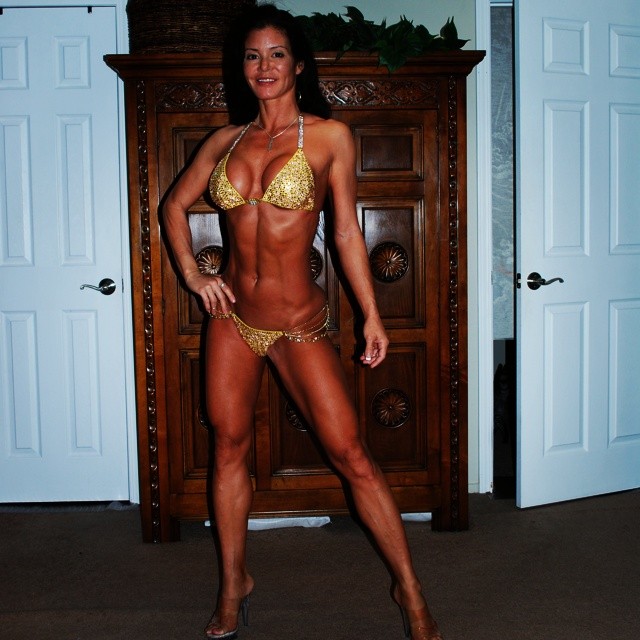
I love this GORGEOUS Ravish Sands suit, but it really needs to go, as it is a reminder for me of what I have decided to let go of, i.e., the world of competing. This is a custom made suit, and is perfect for the NPC or IFBB Bikini competitor who wants to be a golden goddess! The base of the suit is a hologram yellow, and the top and the front of the bottoms are heavily crystallized with Swarovski crystals. The gold and rhinestone chain connectors are flirty and sexy, and gently drape around and under the hips.

I paid $500 to have this suit made, and wore it on the IFBB Pro stage at two events in 2014. The suit is in fantastic condition, with no missing crystals or signs of wear, and there is only a minimal amount of staining on the inside of the suit from competition spray tan.

This suit will fit a 34 to 36 C or D cup, and the bottoms will fit a 34 to 35 inch hip. For reference, I am 5’5″, and I competed in this suit at 119 lbs., with 34-24-34 dimensions.

I am now willing to let go of this suit for $165 which includes shipping.

Please message me at stacey@staceynaito.com if you are interested. Serious inquiries only. I really want this beautiful suit to go to a good home!