How To Shop For Healthy Foods

From Sports Nutrition Supplement Guide Article I wrote which was posted on their site.

From Sports Nutrition Supplement Guide Article I wrote which was posted on their site.

Grocery stores in the U.S. can be nutritional traps for uneducated shoppers, because processed foods are placed prominently in the center aisles, while nutrient-dense whole foods are pushed to the periphery. It’s a smart marketing ploy, since many shoppers are easily lured by the colorful and appealing packaging which processed foods feature. There’s even a whole science devoted to the psychology behind food labeling! Because of this, I always advise patients and clients to do the majority of their shopping around the perimeter of a grocery store, even in places like Whole Foods, in order to maximize chances of making the healthiest food choices.

Think about it. If a food item can be stored in a box, bag or can at room temperature, it means that it probably has preservatives which keep it from spoiling. Start reading ingredient labels and you might be shocked at what you find. If ingredient labels are excessively long or have long names which you can’t pronounce, you probably should steer clear. Remember that the least processed foods will be assimilated by your body the most readily.
Grocery store junk

Supermarkets and grocery stores are designed to lure you in like a rat in a maze, but instead of getting a reward at the end of the maze, you might be signing up for health issues if you are distracted by all the colorful advertising found on the most popular food items. Keep in mind that these stores are designed to tempt shoppers to make impulse purchases. Such impulse buys can be especially tempting if you are ravenous with hunger when you shop.

Here are some guidelines which will help you to make healthy food choices when perusing a grocery store.

1. Shop around the perimeter of the store – Most processed foods are found in the aisles of a grocery store, while whole foods like fresh produce and meats are found around the perimeter.

2. Read food labels – Be aware of hidden sugar, sodium, artificial flavors and colors, and preservatives.

3. Keep purchases of packaged foods to a minimum – Beware of foods which are packaged in boxes, bags, or cans, as these foods tend to be filled with preservatives.

4. Prepare a shopping list and stick to it – Making a list will ensure that you do not forget any necessary items and will also help prevent impulse purchases if you adhere strictly to the items which are on your list.

5. Eat a meal before you shop – If you shop for groceries when you are satiated, you will be less likely to make impulsive purchases or buy more than what you need.

6. Fill your cart with fruits, vegetables, whole grains, lean meat, fish, poultry, nuts and beans.

7. Try a new fruit or vegetable each week – This will add variety to your meal plan.

8. Spend the most time during your shopping trip in the produce section.

9. When choosing whole grain cereals, aim for at least 4 grams of fiber per serving– Make sure the sugar content is minimal.

10. Choose lean cuts of meat – Good beef cuts are round, top sirloin and tenderloin. When buying poultry, purchase the skinless variety.

11. If you can’t purchase fresh fruit, choose frozen fruits and vegetables over the canned variety.

12. Avoid food items that contain more than five ingredients, artificial ingredients, or ingredients you can’t pronounce.

13. Be careful when choosing bread – Many refined breads are dark from added molasses, caramel or other coloring. Look for breads which contain 100% whole wheat or other grain as their first ingredient. Try to avoid enriched wheat flour as it is actually made with processed white flour. Make sure the bread you select has at least 2 grams of fiber per slice.

14. Select fish which is high in omega-3 fatty acids – Best selections are salmon, rainbow trout, lake trout, and tuna. (Below is a list of seafood lowest in Mercury)
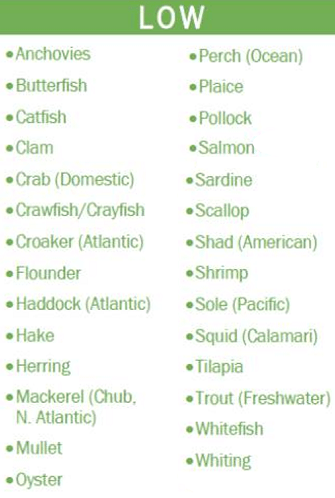
low mercury foods
15. Choose strong-flavor chesses – Sharp cheddar, feta and Parmesan have strong flavors which means you will need to use less to flavor your foods.

16. Purchase Greek yogurt – Greek yogurt is thicker and creamier than other varieties, and the protein content is much higher. My favorite is Fage Total 0-Percent Greek Yogurt.

17. If you must buy frozen entrees, make sure they contain less than 400 calories, 4 grams of saturated fat, and 600 milligrams of sodium, with at least 14 grams of protein and 2 grams of carbohydrate.

18. Add vegetables and/or cooked brown rice or quinoa to your frozen entrée to increase the size and nutrition level of the meal.

19. Add fresh or frozen fruit to cooked oatmeal to provide sweetness without added sugar.

20. Eat oatmeal – Make sure to buy regular oatmeal, not the instant variety.

Here’s to happy and healthy shopping!

Maintaining A Healthy Perspective With Contest Prep Plans

The following article is featured on SportsNutritionSupplementGuide.com as well:

http://sportsnutritionsupplementguide.com/authors/authoritative-experts/stacey-naito/item/1496-maintaining-a-healthy-perspective-with-contest-prep-plans#.VVezzPlVikp
brainfood1

Those of us who compete are well aware of the critical importance of following specific meal plans which are designed to optimize lean muscle mass and promote fat loss. However, these meal plans, especially during cutting phases, can be extremely restrictive. In our quest for attaining the ideal physique for whatever division we compete in, we may find ourselves in a spiral of obsessive nose-to-the-grindstone adherence to foods we may have grown to abhor, intertwined with strong temptation to deviate from the plan and indulge in forbidden foods, only to berate ourselves afterwards for doing so. After all, we are only human, and after weeks or months of eating clean, we may be so exasperated with daily servings of asparagus, tilapia, chicken breast, and sweet potatoes that our emotional food triggers may kick in and undermine our contest prep efforts.

With orthorexia, there is an unhealthy fixation on clean foods and one’s moods are dictated by how rigidly a clean diet is maintained. So how is this different from what competitors do in the weeks leading up to a competition? The mentally healthy approach is to regard food simply as fuel and to dismiss any emotional association with particular items. I have been witness to and a participant in the fantasizing of forbidden foods in a manner akin to lustful, sexual craving. I have heard competitors talk backstage at length about all the foods they were planning to indulge in immediately following their final visit onstage for the night.

What I find interesting about such food fixations is how they are distinguishable from anorexic behavior. When I was 19, I battled anorexia, dropping to 85 pounds on a 5’5’’ at my lightest. With anorexics, they have a clear and complete aversion to calorie-rich foods and have successfully turned off any interest or cravings for such items, whereas with bulimics, orthorexics and many healthy competitors in contest prep mode, coveting indulgent foods is rather commonplace. Among all these groups, there is a propensity for obsessive and compulsive behaviors. One may argue that such obsessions and compulsions are a vital component of contest prep and that without such tendencies a competitor will lack the focus necessary to succeed.

It seems apparent that competitors as a general rule, are dangerously close to that fine line which separates a healthy relationship with food from orthorexia. I remember quite well how rigid I was about the food I ate when I was anorexic and even kept a daily food journal in which I wrote down the calories and fat grams of every food substance ingested. I also recall how horrified and ashamed I was of myself when I would reluctantly consume a food I regarded as fattening.

Over 20 years later, I have a healthy relationship with food and for the most part regard it as fuel. Yet I am immersed in the world of contest prep and like many other competitors will balk and grumble about the clean foods I must eat. There are times when the mere thought of eating another spear of asparagus seems like the most disgusting activity in the world. On the rare occasion that I find myself in a restaurant, I find it an alien concept to peruse a menu and actually be able to order whatever I want from any part of the menu. There are also times during which my metabolism is in hyperdrive and I could eat almost nonstop for the duration of the day.

Here’s the thing: if I indulge in something that is not part of a contest prep meal plan, I don’t flog myself. Rather, I allow myself to enjoy the rare treat and move on. If you find yourself wallowing in extreme anxiety and prolonged guilt over ingesting a food item which is on the banned list, beware. This could signify the beginning of a food-related psychopathology.

Could You Be Undernourished?

Bodybuilder-FoodOriginally written for and published by sportsnutritionsupplementguide.com

If you are a fitness fanatic or competitor, you may assume that you are adequately nourished because you practice clean eating. However, that might not necessarily be the case. Shockingly, many people who are in the fitness world suffer from under-nutrition as a result of consuming limited types and amounts of foods in an effort to reach a super lean state. Think about it: if you are limiting caloric intake during a contest prep phase, have eliminated foods which become demonized during prep such as fruits and peanut butter, and aren’t supplementing your body with the nutrients it needs, then you are probably undernourished. Such nutrient deficits can have a serious negative impact on your health if practiced for an extended period of time.

Under-nutrition is a nutrient or energy deficiency, while malnutrition can represent either a deficiency or an excess of nutrients. Some individuals (especially women) in the fitness world continually follow meal plans which are unbalanced and extremely low in calories and are thus chronically undernourished. Such a state of deficit can be amplified if certain medical conditions such as leaky gut are present, because whatever nutrients are supplied to the body might not be absorbed properly.

Mild cases of under-nutrition are often symptom-free, while more severe cases are usually symptomatic. Some deficiencies can cause permanent damage to the body, for example, blindness with severe vitamin A deficiency. Typical symptoms of under-nutrition vary based on the specific deficiency, but can include:

Joint and bone pain
Ringing in the ears
Difficulty breathing
Poor night vision
Sores at the corners of the mouth
Muscle weakness
Impaired immunity
Fatigue
Delayed wound healing
Dry skin and hair
Bleeding gums
Skin rashes
Easy bruising
Digestive problems
Dizziness
Irregular or halted menstrual periods
Depression

It can be difficult to determine whether a symptom is reflective of a nutrient deficiency or some other cause, but if your diet is restrictive, there’s a decent chance that a nutrient deficiency is to blame. The following nutrients are being highlighted here because they are most likely to be lacking in a fitness person’s diet.

Vitamin D3: The majority of the U.S. population is deficient in this vitamin, which is not only important for bone health but also reduces the risk of heart disease, type 2 diabetes, and many types of cancer. Here’s the challenge: very few foods contain vitamin D3 (egg yolks, fatty fish like salmon), and the skin only makes vitamin D3 in response to exposure to sunlight. Common symptoms of vitamin D3 deficiency are muscle aches and joint pain, both of which could mistakenly be brushed off by bodybuilders as the consequence of heavy lifts at the gym. If you want to supplement with vitamin D3, take 5,000 mg per day.

Calcium: Have you ever gotten a mad craving, especially in the middle of contest prep, for fatty foods or soda? Both cravings can be a sign of calcium deficiency. Calcium is essential for formation of healthy bone tissue and plays a vital role in nerve impulse conduction. Because the typical fitness meal plan excludes dairy sources, a calcium deficiency can sneak up on fitness people. Take 500 milligrams twice daily.

Iodine: This element is essential for the production of thyroid hormones. Main dietary sources of iodine include table salt, eggs, seafood, and dairy products. However, table salt is avoided by most fitness people, as are dairy products, increasing the risk of developing an iodine deficiency. Ironically, though sea salt provides many of the minerals which are missing in table salt (such as magnesium and potassium), it also potentially creates iodine deficiency since it is not fortified with iodine.

It may be difficult to tell if an iodine deficiency exists in the early stages because symptoms don’t surface until the thyroid gland reacts to the lower iodine levels. By that time, the symptoms of hypothyroidism have usually kicked in, such as fatigue, constipation, dry skin, depression and weight gain. The good news is that iodine supplements are available. Iodine deficiency can also be remedied by consuming seafood, kelp and meat products.

Magnesium: Have you ever noticed that your cravings for chocolate are intensified as you get closer to a contest date, or right before you ladies hit “that time of the month”? Chocolate cravings are a common signal that the body is deficient in magnesium. Deficiencies of this important mineral are quite common among regular folk and bodybuilders. Magnesium is important for hundreds of bodily functions, has a calming effect, and keeps the digestive tract moving optimally. It also has a protective effect against high blood pressure. If you prefer to supplement magnesium with a tablet, take 400 mg at night. If you prefer food sources of magnesium, almonds are an excellent source, providing 80 milligrams per ounce. Spinach, legumes, seeds, unrefined whole grains, and cashews are also good sources of magnesium.

Potassium: Lack of this mineral can wreak havoc on contest prep since it is excreted during the diuresis phase of most contest prep regimens. Potassium is present in every cell of the body, is essential for energy production, guards against high blood pressure, and maintains fluid balance. Daily needs range about 5,000 milligrams daily, and can be obtained from fit-friendly foods like spinach, sweet potatoes and broccoli, but during final week prep, the loss of potassium during the water-shedding phase must be compensated for in order to avoid cramping, weakness, tingling, numbness, nausea, vomiting or palpitations. Severe potassium deficiency can be life threatening and must be corrected quickly.

Zinc: Some women have intense food cravings right before their periods which can be a sign of zinc deficiency. Zinc plays a vital role in cell division, DNA synthesis, immune system function, and protein synthesis. A deficiency of zinc can result in hair loss, skin rashes, frequent colds and other infections, insomnia, loss of taste or smell and decreased libido. If you prefer to obtain zinc from food sources, turn to red meat, wheat, oats, eggs, nuts, peas, and leafy green vegetables. Otherwise, a 50 milligram daily supplement will suffice for most individuals.