You Need To Go To Olympia

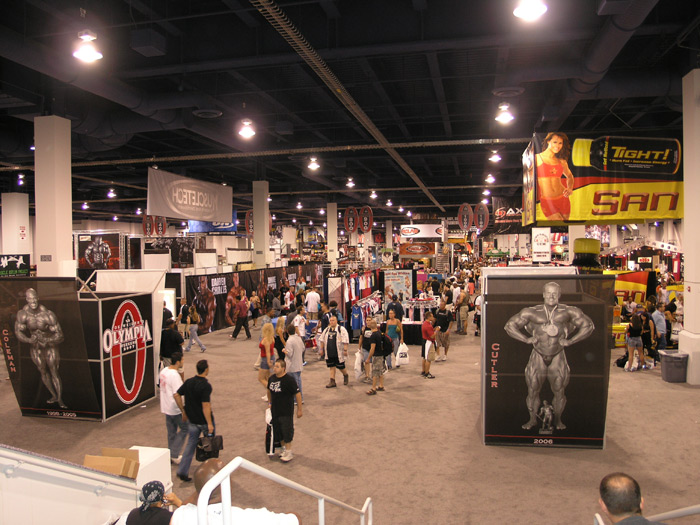
Olympia is the granddaddy of bodybuilding events, compelling people from all over the world to descend upon Sin City for a weekend of glistening, supertanned muscles, scantily clad bodies, and enough free sports supplement samples to keep everyone amped up with bloated bellies as they walk through the Expo. The Olympia Expo is quite a sensory overload, a smorgasbord of sounds, sights, smells, and tastes! You also should watch out for flying objects since items such as t-shirts are thrown into crowds during hyped-up giveaways at the larger booths. You won’t find too many events in which such action-hero genetic freaks can easily and comfortably congregate. I feel very much at home in such company, and look forward to all the Olympia events every single year.

I love working a booth at the Expo even though it prevents me from seeing most of the competitions that take place in the main arena. I gladly suffer through the sore feet that result from standing and walking all day. Fans and followers will look for the booth I am working at in order to say hello and take a picture with me, and that always means a great deal to me, especially since I know that the crowded Expo hall can be very tricky to navigate when someone is looking for a specific booth or person. Every Olympia is also a great reunion in which I can see many of my fitness and bodybuilding friends from all over the world.

If you have any interest in fitness and bodybuilding but have never been to Olympia, make an effort to travel to Las Vegas one year in late September so that you can witness this incredible event.
olympia-expo

Make Sure To Visit The Muscle & Performance Magazine At Olympia This Weekend!

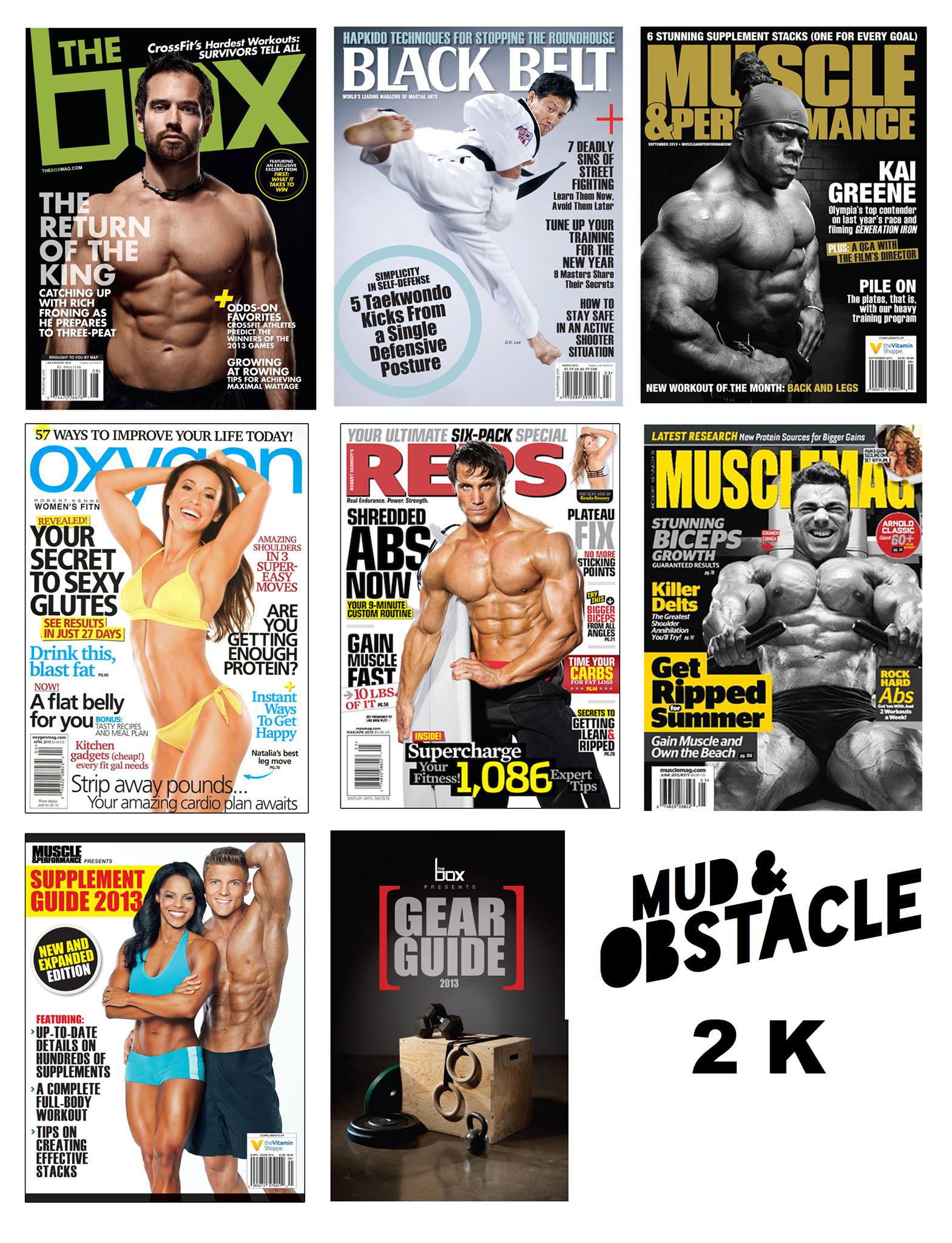
Muscle & Performance Magazine is enjoying a tremendous year with Muscle & Performance, Black Belt and The Box magazines, and will resurrect Oxygen, Reps and Musclemag magazines as a result of its acquisition of RKP recently. I am so honored to be working this booth again this year! M & P Mags

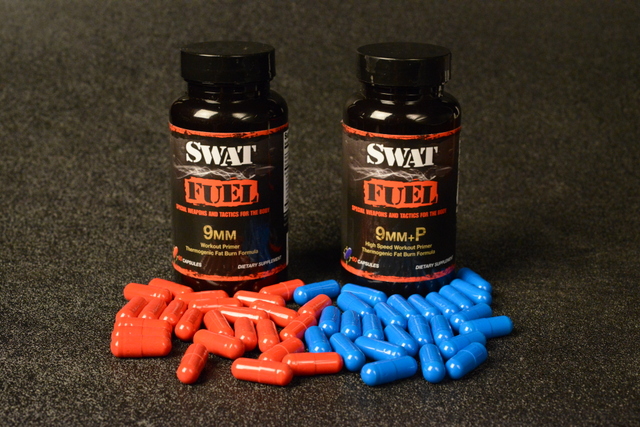
Swat Fuel 9mm and 9mm+P Fat Burners Are The Best

9mm and 9mm+PIf you are looking for a revolutionary fat burner which provides sustained energy for an entire day and which also works as a potent pre-workout booster, you need to check out 9mm and 9mm+P from Swat Fuel. I am not joking – prepare to be amazed.

I am not easily impressed by sports supplements because there are so many products out there that over-promise and under-deliver. However, I can honestly say that Swat Fuel 9mm and 9mm+P are unique and superior to any other thermogenic fat burners on the market. These products were originally formulated for law enforcement individuals and military personnel to specifically provide sustained stamina and energy which lasts the entire day and does not produce jitters. These products optimize fat metabolism and are excellent for use as pre-workout boosters to maximize your energy and stamina during your lift. Even if you don’t work out, you can count on these powerful formulations to increase energy levels without the usual jitters or crash that many thermogenics cause.

9mm is a powerful thermogenic and pre-workout formula, but if you are trying to lose weight or you want to become ripped, opt for 9mm+P which also contains a natural appetite suppressant.

Prepare to SWEAT LIKE A PIG during your workouts when you take these supplements! Also make sure to hydrate very well when taking either product. Even from the first time I took 9mm, my reaction was one of total surprise. As the sweat poured off me and I noticed that I had laser focus with my lift, I just kept saying, WOW. I was truly blown away, and I continue to be impressed by the fact that this product delivers true to its description.

Every time I take this stuff, I am drenched in sweat about five minutes into my lift. No other thermogenic has ever had this effect on me. What amazes me is that my heart does not race, I do not get the jitters, and my workouts are much more powerful than on the days when I don’t take it.

Go to http://swatfuel.com/solidfuel.aspx to order, and remember to enter discount code 1HOTHAPA for a generous discount at the time of your order.

Swat Fuel Fat Burners – Superior Products!

If you are looking for a revolutionary fat burner which provides sustained energy for an entire day and which also works as a potent pre-workout booster, you need to check out 9mm and 9mm+P from Swat Fuel. I am not joking – prepare to be amazed.

I am not easily impressed by sports supplements because there are so many products out there that over-promise and under-deliver. However, I can honestly say that Swat Fuel 9mm and 9mm+P are unique and superior to any other thermogenic fat burners on the market. These products were originally formulated for law enforcement individuals and military personnel to specifically provide sustained stamina and energy which lasts the entire day and does not produce jitters. These products optimize fat metabolism and are excellent for use as pre-workout boosters to maximize your energy and stamina during your lift. Even if you don’t work out, you can count on these powerful formulations to increase energy levels without the usual jitters or crash that many thermogenics cause.

9mm is a powerful thermogenic and pre-workout formula, but if you are trying to lose weight or you want to become ripped, opt for 9mm+P which also contains a natural appetite suppressant.

Prepare to SWEAT LIKE A PIG during your workouts when you take these supplements! Also make sure to hydrate very well when taking either product. Even from the first time I took 9mm, my reaction was one of total surprise. As the sweat poured off me and I noticed that I had laser focus with my lift, I just kept saying, WOW. I was truly blown away, and I continue to be impressed by the fact that this product delivers true to its description.

Every time I take this stuff, I am drenched in sweat about five minutes into my lift. No other thermogenic has ever had this effect on me. What amazes me is that my heart does not race, I do not get the jitters, and my workouts are much more powerful than on the days when I don’t take it.

Go to http://swatfuel.com/solidfuel.aspx to order, and remember to enter discount code 1HOTHAPA for a generous discount at the time of your order. 9mm and 9mm+P

How To Select Athletic Shoes

With all the brands, types and styles of athletic shoes that exist these days, it may be challenging to figure out which ones to buy.  As a response to the questions I get about this, I have compiled a list of tips to help you navigate through the choices out there and select footwear that is ideal for the type of activity you plan to engage in. 

Select shoes appropriate for your feet.  Most of us know whether we have narrow, medium width or wide feet, but do you know what type of arch you have?  A good way to assess this is to do what is called a “wet test”. To do this, you will need a piece of brown paper like the type that is used for brown paper grocery bags.  Wet the bottom of your foot, step onto the paper (make sure to put your full weight on that foot) and trace your footprint.  If you have a print with little to no curve on the inside edge, you have flat feet and your feet tend to roll inward (overpronation).  This type of foot needs a shoe which gives good support to prevent movement.  If your footprint shows a large empty space in the inside edge and there is a narrow connection between your heel and forefoot, you have high arches and tend to turn outwards (supination).  This type of foot needs a soft and cushioned midsole.  If your footprint is somewhere in-between, you have a neutral arch and should choose a shoe with a mix of support and cushioning.

If you wear an orthotic, bring it.  You should also bring the socks that you usually wear when engaging in whatever activity you are buying the shoes for.  I have heard of people who have made the mistake of fitting shoes to their feet when wearing socks that are either thicker or thinner than what they are accustomed to wearing, which results either in the hassle of making an exchange or return or the pain of wearing ill-fitting shoes.

Shop later in the day.  During the course of the day, feet will expand, which means they will be their largest towards the evening.  When determining the fit of a shoe, it is important to take this into consideration and fit to your feet when they are their largest to avoid disfomfort.

Make sure shoes are comfortable and enable the movements your sport requires.  While athletic shoes should be comfortable while standing in them, it is also a good idea to engage in jumping, lateral movements or whatever foot motions mimic the types of movements you will do while wearing the shoes.  Take note of any shifting or discomfort.

Buy a pair of shoes that fit well.  There should be about ½ inch between the front of your big toe and the end of the shoe.  A quick guide which you can use is your thumb.  When you lift off with your heel, the shoe should not slip off the heel at all.  You should be able to wiggle your toes while wearing the shoes, but the shoe should also feel secure around your foot.

Don’t go cheap!  I see a lot of people grab athletic shoes that are on clearance which aren’t the best fitting or the best constructed shoes for them.  This is not to say that you can’t find a decent pair of athletic shoes on sale, but try not to head straight for the bargain bin when you are searching for shoes.  Your main objective should be to find a well-constructed pair of shoes which fits your foot well and is designed for the activity you will use them for. 

Replace shoes before they completely fall apart.  I always find it amusing when I see guys at the gym wearing shoes that are tattered.  I wish I could just ask them, “If you care about your conditioning so much, why do you neglect your feet which are bearing all the weight and pressure you put on them during your routine?”   Most people can expect to replace their shoes every six months, or until they begin to notice that the shoe feels less supportive or develops areas which are uncomfortable.  Another gauge is to check the back of the sole frequently and to replace the shoes once that area begins to appear worn out. 

Buy shoes which are task-specific and expect to have multiple pairs.  Not all shoes are created alike.  A cross-training shoe is designed for midfoot support and has tread which enables lateral movements.  A walking shoe, in contrast, is rather rigid and is designed to minimize foot movement.  Running shoes are quite flexible but are also built with extra cushioning to absorb the high impact of the foot-strike on the pavement. 

If you exercise frequently, purchase several pairs.  If you get in the habit of rotating through your shoes, you will allow your shoes to air out between uses and will also extend the wearability of your shoes since you will be alternating through your collection.  I currently have eight pairs of athletic shoes in rotation and make sure to wear the type of shoe which is appropriate for the activity I plan to do on a particular day.  For example, I wear my running shoes when I plan to do high intensity intervals on the treadmill, and I have other shoes designated as my plyometrics shoes, my leg day shoes and my general lifting shoes. 


Pullovers: Old-School Magic

(originally posted on http://www.Myotropics.com)

Ah, the pullover.  This classic exercise has deepened the chests of bodybuilders for many years and is perhaps the best move for expanding the ribcage.  But does it have any utility in shaping the physiques of those who compete in the newer divisions of men’s physique and bikini?

I regularly perform pullovers (usually dumbbell, but at times barbell) as part of my training regimen, a fact which may surprise people.  For the past eight months I have welcomed pullovers into my chest days and over that span of time have noticed a wider lat sweep, more developed rear delts, and more prominent serratus anterior fibers. Certainly if a bikini competitor like me can benefit from doing pullovers, a men’s physique athlete could only stand to benefit from such physical changes, making pullovers beneficial for the new breed of competitive athlete.

I would be remiss if I did not address the immense controversy surrounding the pullover and what muscles are involved.  Many will insist that the pectoral muscles are the primary movers in pullovers, while others may stubbornly argue that the latissimus dorsi is the main muscle recruited.  Thus I am providing a breakdown of the exercise in an effort to clear up some of the confusion.

Analysis of the Pullover Exercise

The pullover exercise recruits a number of muscles, making it an excellent movement for balancing out the upper body.  During the concentric, or upward phase of the pullover movement, the pectoralis minor is recruited during the initial phase of shoulder extension, followed by recruitment of the sternal fibers of the pectoralis major to assist in progressive extension of the shoulder.  Other muscles involved in extension of the shoulder are latissimus dorsi, teres major, posterior deltoid, infraspinatus, teres minor, and subscapularis.  Latissimus dorsi, rhomboids and teres major are also involved in scapular retraction and medial rotation of the humerus during the concentric phase.

There has been some controversy surrounding whether the pullover is primarily a chest or back exercise.  A study conducted by Marchetti and Uchida (JAppl Biomech, 2011 Nov;27(4):380-4.Epub 2011 Oct 4.) examined the activity of the pectoralis major and latissimus dorsi by means of EMG analysis during the barbell pullover exercise.  It was determined that the pectoralis major was activated to a much greater degree than the latissimus dorsi, and that the higher activation was dependent on the external force lever arm produced.

A more heated controversy surrounds the utility of the pullover movement in recruiting the serratus anterior.  During the eccentric phase of a pullover, i.e. during the phase in which the weight is being lowered overhead towards the floor, the serratus anterior, intercostal cartilage and intercostal muscles are stretched, triggering hypertrophy.  But what is the degree of recruitment of the serratus anterior?  A review of musculoskeletal anatomy reveals that the serratus anterior muscle sweeps over the lateral portions of the intercostal muscles as well as the lateral portion of the ribcage.  Serratus anterior fibers also run above the attachments of the latissimus dorsi muscle fibers on the lateral aspects of the first eight ribs.  This explains why a well developed serratus anterior contributes to the flare of the lats in a balanced competitive bodybuilder.  Another critical attachment of the serratus anterior is to the medial border of the scapula, enabling it to pull the scapula forward and tethering it to the thoracic wall, thus conferring stability to the scapula (preventing scapular winging).  However, such winging is prevented by lying supine on or across a bench as is done during a pullover.

In summary, the serratus anterior abducts, upwardly rotates and weakly elevates the scapula.  Some will argue that in a pullover movement, the serratus anterior does not contribute greatly to the movement itself, rendering the pullover almost useless in building the serratus fibers.  Others will argue that due to the stretch stimulus of the eccentric phase of the pullover, the serratus anterior is strongly activated and responds with appreciable hypertrophy.


Description of the Pullover Exercise

Dumbbell Pullovers:  Lie on bench or across bench (this allows a greater stretch of the ribcage) with feet firmly planted on floor.  Hold a dumbbell with both hands, with palms against the underside of the upper end of plates and thumbs crossing over one another around handle.  Lower weight behind your head, inhaling as you do so and keeping elbows slightly bent.  Then raise dumbbell so that it is directly above you, elbows straight.

Barbell Pullovers:  Lie on bench.  Extend arms above you and take an overhand grip (palms will be facing upwards) on the barbell with hands shoulder width apart and elbows straight and in line with arms.  Lower weight behind your head, inhaling as you do so.  Then raise barbell so that it is directly above you.

Generally speaking, the dumbbell version tends to afford a better stretch in the chest and ribcage, while the barbell version appears to trigger more lat recruitment.  Both versions will cause a stretch and expansion in the ribcage and serve as excellent finishing moves during chest day.


References

Effects of the Pullover Exercise on the Pectoralis Major and Latissimus Dorsi Muscles as Evaluated by EMG. JAppl Biomech, 2011 Nov;27(4):380-4. Marchetti, P.H. and Uchida, M.C.
 

Always a Bridesmaid, Never a Bride…

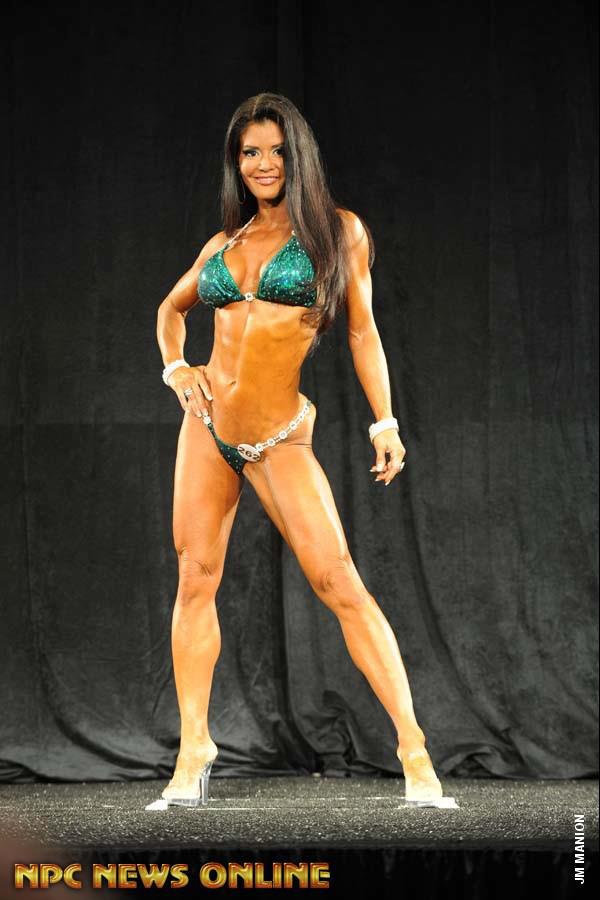
I have now competed in thirteen pro-qualifying NPC/IFBB Bodybuilding contests since 2009, yet I have not attained the IFBB Professional Status that I have been chasing after.  I am not going to deny my frustration and despondency over this fact, because I have worked so hard at every aspect of competing and have improved dramatically with each event.  However, I have had a number of people ask me why I would continue competing if I have not been successful in reaching my goal by now.  I have also been asked why I want that Pro Card so badly.  Some individuals have gone as far as to suggest that I switch organizations, which is something I will NEVER do.

Let me put it in plain terms:  I have set IFBB Pro Status as a personal goal, and it dangles before me like a carrot.  Yes, I have made more sacrifices than you could imagine in order to compete, and yes, I have scratched my head wondering why I have gone up for four National-level Overall comparisons and have been passed up for a Pro slot every time.  But I will NOT be deterred or discouraged from continuing to compete.  When I train as hard as I do, I notice continued improvements in my physique which are a direct slap in the face to the aging process.  I LIKE chasing after goals and will not give up just because this particular goal continues to elude me.  Perhaps it hasn’t been my time, the stars and planets were not aligned properly, or I just wasn’t the right flavor for the judges’ eyes that day.  Whatever the case, I love competing, which is why I have already begun formulating my strategy and show schedule for 2013.

IFBB North American, 2012

I will definitely return to the stage next year.  Watch out, world!

A Bikini Athlete’s Favorite Ab Exercise

I admit that abdominals are my favorite of all the body regions to train and have been for my entire adult life.  In fact I cannot think of a single time that I balked when it was time in my training split to work my abs.  This makes designating a particular abdominal exercise as my favorite especially challenging for me, since I consider very move to be a valuable component of an abdominal routine.

After having evaluated the level of motivation I have during each abdominal exercise, I have determined that my top abdominal move is the decline bench crunch.  If you have not performed this exercise before (and yes, I realize that many of you are already familiar with this move), I would highly recommend that you incorporate decline bench crunches into your routine.  Decline bench crunches are excellent at targeting the rectus abdominis and hip flexors due to the increased range of hip flexion which occurs on a decline bench.

Adjust a decline bench so that it is at a 30 to 45 degree angle (the more advanced you are, the greater the angle you can use).  Sit on bench with your feet hooked under the rollers and lie back on the pad with your arms folded across your chest.  Exhale as you bring your head, shoulders and back off the pad, coming to a full sit up position, then return slowly to start position.  You can perform 12 to 20 reps per set, 3 to 5 sets, but I will admit that when I do decline bench crunches, I perform 5 to 6 sets of 30 reps.  If you crave an extra challenge, extend your arms overhead while you perform this move.

Decline bench crunches can also be performed with a twisting motion at the top of the move, recruiting the obliques and serratus anterior.

Those of you who are really looking to punch up this exercise can perform a weighted variation of this move in which you hold a dumbbell behind your head, hold a plate on your chest, or pull on a cable during the exercise.

After incorporating decline bench crunches into your training split, don’t be surprised if people begin noticing your washboard abs!