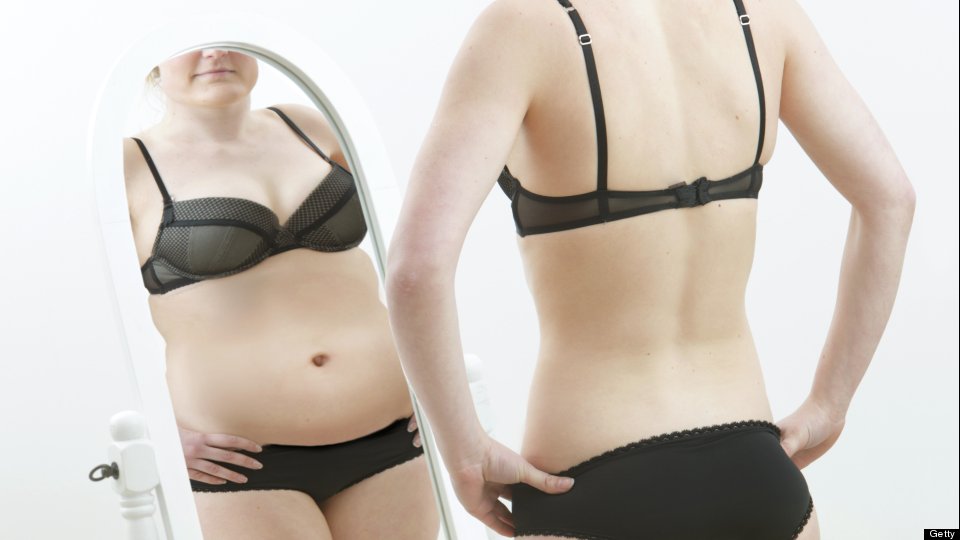
It almost seems to be an inherent part of a woman’s nature to be self-effacing, so much so that women often downplay or neglect their beauty and talents. In fact, I am willing to bet that if you placed an average looking man and an average looking woman in front of a mirror and asked them to assess their physical appearance, the man would concentrate on his assets, while the woman would immediately zone in on her imperfections and problem areas. Though the natural human tendency is to practice self-enhancement, in which we rank our abilities or physical attractiveness as higher than it actually is, women are exposed to physical ideals which bust their confidence and often plant a seed of self-loathing. How can an average woman feel good about herself when she sees rail thin models in fashion magazines who are excessively Photoshopped? Consider this: the average high fashion model has these body statistics:
Fashion Editorial Model
FEMALE: Usually 5’8” – 6’0” (175 cm) in height. Tall, thin build, narrow hips, smaller bust, and usually young. Ages start at fourteen up to early twenties.
Weight: 113 – 128 lbs.
Bust: 32” – 34”, cup A, B, sometimes C
Waist: 26” maximum
Hips: 35 1/2” maximum
Thank goodness the tide is turning in favor of a healthy, realistic view of women’s bodies. Women are beginning to understand that fashion magazines depict a view of the female form which is so far removed from reality that it isn’t reasonable to compare themselves to it. I love this passage from an article I read on this subject:
Perhaps we’re finally starting to realize that so much of what we see on TV, in the movies and in magazines is actually fake. A few women’s blogs — particularly Jezebel — have become sort of watchdogs for Photoshop fakery in women’s magazines. Most recently, the blog attained an untouched photo of Jennifer Aniston, posting the untouched picture next to the airbrushed photo of the actress that appeared in an Australian magazine.
“I think those are great because they really remind people that what they’re seeing in the magazines isn’t reality,” says David Frederick, a psychology researcher at the University of California, Los Angeles, who co-authored the survey along with researcher Kim Elsesser and professor Janet Lever of California State University, Los Angeles. “You’re taking someone who’s already considered really attractive, and then you’re saying, ‘She’s not enough; we have to do more to her.’ So you’re literally creating an impossible ideal. Even the perfect women aren’t perfect.”
I think it will take a while before we women are completely healed from the skewed perception of ideal female beauty which countless magazines, Barbie dolls, and fashion billboard ads have imprinted on us. It is that skewed view which contributes to the flaw-finding gaze which many women adopt when regarding themselves in the mirror and which makes that reflective surface act more like a funhouse fat mirror.

 dr. stacey naito's blog