My Years As An Arachnophobe

I spent the bulk of my childhood as an arachnophobe, all because of two incidents which occurred when I was rather young. The second incident was even more jarring than the first, and scarred me for many years.

The first incident occurred when I was six years old while I was at summer camp. All the kids had gone swimming in an effort to beat the triple digit heat, and were in the locker rooms getting dressed after a fun afternoon in the pool. I was standing at one locker, almost completely dressed, and just needed to put on my socks and shoes, so they were sitting on top of a bench. Suddenly, one of the girls shrieked, which triggered a domino effect, causing several other girls to follow suit. These girls jumped on top of nearby benches, looking down at one spot on the floor. I simply stood where I was, puzzled by their reaction.

Our teacher came in and asked one of the girls what all the noise was about.

“There’s a spider on the floor!”

The teacher looked at the floor, then said, “Oh yeah, that’s a black widow. We’d better kill that one!” Whereupon she grabbed one of my sneakers and deftly smashed the spider to a mushy black pulp.

I was so horrified that I refused to wear my shoes. When my mom picked me up, she asked me why I wasn’t wearing my shoes. “The teacher squashed a black widow spider with my shoe!” I was so adamant about my refusal to wear those sneakers that I wouldn’t even wear them after my mom had scoured the soles of the shoes, removing any remaining spider residue from them.

The second incident occurred less than a year later. I was staying at my best friend Tammy’s house in Sun Valley, an area which is known to have rattlesnakes and tarantulas. Tammy’s family had a habit of catching tarantulas and giving them to their poolman, who would defang them and sell them to pet stores.

One afternoon, we decided to go to the movies, and returned to the house shortly before dark. I was sitting in the rear passenger’s seat, Tammy’s brother Chad in the middle, Tammy on the left, her sister Wendy in the front passenger’s seat, and her mother in the driver’s seat. Tammy’s mother pulled into the garage and closed the garage door, and we began filing out of the vehicle.

As soon as Wendy set foot on the garage floor, she exclaimed, “Nobody move! Tarantula in the corner!” Sure enough, there was a large tarantula in the far right corner of the garage, about six feet in front of me. Wendy carefully tiptoed past me to the wall to pick up a small, empty aquarium to place over the tarantula, thus trapping him. Her movement must have startled the tarantula, because it sprung up about two and a half feet in the air and forward, landing about eight inches from my feet.

Wendy said, “Don’t move!”, which was almost unnecessary because I was paralyzed with fear. By this time, she had grabbed the aquarium, and quickly placed it over the tarantula, who sprang up and hit the base of the aquarium and fell back to the garage floor, trapped in its glass dungeon.

That second incident really solidified my arachnophobia. I spent the next 28 years so afraid of spiders that, although I would never shriek or lose my cool, I would simply leave a room if I saw a spider in it. My mother became accustomed to me leaving a room and saying, “Mom, please kill the spider there!”. Once I was an adult living on my own, I would ask my boyfriend to rid the room of any spider who dared to chase me out of there.

What cured me was a touch of desensitization therapy which took place at, of all places, the Los Angeles County Fair in 2001. My then-husband Pete and I encountered an exotic pet petting zoo at the fair, and two tarantulas were featured in the zoo. Pete was well aware of my arachnophobia, as he had been ridding the house of spiders for me for a few years. I never liked his method, which consisted of capturing the spider and letting it go outside, because in my arachnophobic mind, he was just releasing a pissed off spider who would find its way back into the house and terrorize me once again.

It was Pete’s idea for me to hold a tarantula so that I would benefit from desensitization. I honestly think that his psychiatry rotation (he was a medical student then) had influenced him to make the suggestion, but it made a lot of sense to me, so I begrudgingly agreed to hold a tarantula.

I remember the handler placing this hairy, scary creature into the palm of my hand. I have very small hands, so the tarantula’s legs extended along my fingers and my wrist. It rested there for about 15 seconds, kind of hovering, and I could barely breathe at first, then I calmed down when I realized the spider wouldn’t do anything to me. Then it decided to crawl along my forearm, and that is when I told the handler to get the f*$@ing thing off of me!

Guess what though? It worked. Since that day, I have not been freaked out by a spider’s presence. More recently, I saw two black widow spiders, and quickly stomped on them with, you guessed it, a shoe-clad foot.

The Magic Of Kundalini Yoga

I fell into kundalini yoga quite by accident earlier this year, when I decided to sign up for a class at a local yoga studio which was listed on ClassPass. From the first class, I was deeply moved, intrigued, and interested in continuing the practice. I hadn’t been aware of the fact that kundalini yoga is considered to be the most powerful and spiritual form of yoga, but I am grateful that it is now a part of my life. Kundalini yoga also complements my daily meditation practice.

How is kundalini yoga different from other forms of yoga? While it can be VERY physical, kundalini yoga is incredibly spiritual and meditative. You will spend a decent amount of time in “easy pose”, which is a standard pose for meditation. Kundalini yoga consists of chants, repetitive movements, and coordinated breathing techniques which are all designed to increase consciousness and activate the body’s energy centers. Because this type of yoga targets energy blockages, sessions can be emotional, intense, sacred, and filled with a sense of connectedness to everyone.

An article by James McCrae states that the objective of kundalini yoga is “decentralized and selfless – help people actualize their Higher Self”. The practice of kundalini yoga has been around since approximately 1,000 B.C. – 500 B.C. during the time in which the Upanishads were written. Kundalini, or “coiled snake”, refers to the energy of creation which sits at the base of the spine, and which can be activated and made to move up the spine and throughout the entire body. It was brought to the western world in the late 1960’s by Yogi Bhajan.

Kundalini yoga can be regarded as the fast track to spiritual enlightenment, and can bring about immense positive changes to one’s life. It increases awareness, brings a sense of well-being, and also creates a stillness and calmness which help to deflect the stresses of the modern world.

Loaded Emails

When I sat down to write this piece, I was still steaming mad from an incident which occurred earlier that day. Basically, a whole slew of individuals, including me, who were working with a certain company, were summarily and abruptly dismissed via a very general email. In addition, the email dared to accuse us of engaging in practices which would definitely not be considered very decent, practices of which I was never guilty.

In a heartbeat, we were all cut at the knees, without any true explanation. Mind you, I had worked with this company for a number of years, put up with their frequent bait-and-switch tactics, and found myself fighting to stay in the game when the powers that be kept showing how fickle they were. It was one of those situations in which someone would suddenly get cut, then a few months down the road, someone else would suffer the same fate. It was obvious that loyalty didn’t matter to them, because they had no loyalty towards the people who worked for them.

How have I dealt with the sudden kick off the gangplank? I have cleaned house, cut out the fat just like they did. Since all the work I did over the years wasn’t appreciated, I had no problem deleting them from my life. I guess business is business, and no one’s feelings matter. Done deal.

Of Orifices and Zero Freedom

As a physician, I have had the incredible honor and privilege of studying every part of the human body, to the most minute detail. I have hovered over cadavers which were fileted and displayed for they eyes of inquisitive medical students, and scrubbed in on colon resections, open heart surgery, neurosurgery, cataract removal, etc. During my first month of internship as a newly minted physician, I massaged a dying heart with my gloved hands (no, the patient didn’t survive). I have also delivered over 40 infants via vaginal and Cesarean methods, and have pronounced the demise of patients in the wards. In fact, there are many stories I have collected over the years, some incredibly sad, some disgusting, some frightening, and some infuriating, but all true, and all part of my experience as a doctor.

I knew full well that by signing up for an education in medicine, I would be subjected to disgusting, morbid, frightening things, and that I would face mortality on a regular basis. However, after several years of working in family practice, I began to notice that I wasn’t thrilled with the fact that I examined orifices of every kind on a very regular basis. Whether it was a nostril, a mouth, an ear canal, an anus, a urethral meatus (layman’s term pee-hole), or vagina I had to examine, I was never thrilled about it, and the orifices below the belt were certainly much more bothersome to address. My intense dislike of such examinations, combined with the tedium of primary care and the low insurance reimbursement for services and procedures provided, caused me to retreat from primary care and focus more on the areas I had more interest in, namely, physical medicine, cosmetic dermatology, and anti-aging medicine, all of which are much cleaner and which do not require me to conduct examinations on private parts.

Another feature of primary care which made me cringe was the intense demand on a practitioner’s time. The only time it ever seemed reasonable for me to literally lose sleep night after night as a physician was when I was in training. At this point, there is no way you could convince me that such a thing is healthy, and I refuse to sign up for that. I won’t give up weekends to take on three stacked 12-hour work shifts, and I will not give up the few holidays I celebrate (Thanksgiving, Christmas Eve, Christmas Day, New Year’s Eve, and New Year’s Day) in order to work. As it is, I give up other major holidays to work, but since the work I perform on those holidays is in bodybuilding and fitness, I don’t mind it at all.

I love being a physician, and I find it incredibly rewarding to make a positive impact on my patients. However, I will not sacrifice balance in my life, or the freedom to pursue my other interests, in order to prove to society what a good physician I am. I don’t believe for a second that running oneself into the ground working as a physician ever sends a positive message to others. I don’t ever want to be the kind of doctor who is saddled with so many chart notes to write that an entire weekend is devoted to completing them. Not for me.

Lasty, I think it’s so strange that society still assumes that doctors are supposed to give their time and knowledge at a moment’s notice, on demand, yet I don’t see those same demands placed on people in other industries. I can’t tell you how many times I have been in a brief conversation with a complete stranger, who dares to ask me a medical question as soon as my profession is revealed. I swear, one of these days I am going to get a t-shirt made that says, “THE DOCTOR IS OFF-DUTY RIGHT NOW…NO MEDICAL QUESTIONS PLEASE”!

Working For Free – REPOST

bloggers-working-free

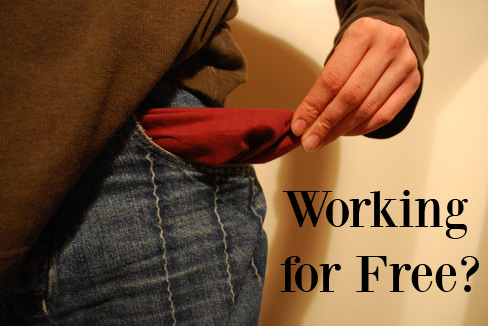
Have you ever completed a work project which offered no compensation except for a pat on the back? If so, did it bother you? It should have. By agreeing to slave away (pun definitely intended here) at an assignment with full awareness that you would receive absolutely no monetary compensation, you just devalued yourself.

I am not talking about volunteer work, or favors which you offer to do for a family member or friend. I am also not talking about getting your feet wet by taking on a task in an unfamiliar area so that you can gain valuable experience. I am instead referring to situations in which you are asked to provide your knowledge, expertise and service in an area in which you excel, and are coaxed into it with the promise that it’s a one-time favor, or that there will be compensation sometime in the future, only to discover that the promise was in fact a lie.

As a result of my abiding loyalty to companies, friends, family, and pets, I am the type of person who never leaves. You can count on me, and I honor my word. One of my faults is that I assume that other people are the same way, and even when I can plainly see that I am being taken advantage of, I often still hang on. This type of behavior spilled over into the world of medicine, wellness and fitness for a while, but a couple of years ago, I cut off all of the companies and individuals who got too much of a good thing for too long, essentially my time, services and knowledge for free.

In one situation, one company asked me to provide professional services on a monthly basis, stating that it would be unpaid to start out with, but that compensation would be given after a few months. Next thing I knew, I had provided those services free of charge for eighteen months! When I fired a warning shot, essentially stating that I no longer wanted to work for free, the company responded by inferring that the “exposure” I was receiving from them was payment enough. The funny thing is, I didn’t need the exposure, nor was this company in a position to help me. I merely agreed to the arrangement as a temporary favor to them, sort of a good faith move. All it ended up doing was getting me stuck in a monthly obligation which I got zero benefit from doing. Once I realized this, I severed ties immediately. Though I used very professional and polite language, it felt so good to tell them that I was done being an indentured servant. No longer did I have to put their assignments in my calendar, or resent the fact that each one of those assignments chewed up a good hour or two of my time.

More recently, I agreed to complete an assignment for free simply because I found it intriguing, and I had a small pocket of time in which to complete the assignment. I also felt that it was a good way to introduce my skill set to the company. However, I made it very clear that the assignment was isolated, and that if the company wanted my services in the future, I would only consider paid assignments.

Time is money, and because I hold a medical degree and a bachelor’s degree, am a board certified physician, and have worked in the fitness industry for three decades, I have value which deserves proper compensation. Would you like to work for free, especially if it is in an area in which you have expertise? Let’s face it, we all need to find a way to bring money in. We have skills, we have knowledge, and we deserve to get a financial return for services rendered in our chosen work environment.

If you are the type of person who has a tendency to take on more than your schedule can handle, perhaps it’s time to evaluate your obligations and see if any of them are a threat to your self-worth. If they are unpaid, uncontracted, require your skills in an area in which you are considered an expert, and are contributing to a decline in your quality of life because they are a time burden, then you should consider dropping those obligations.

Our New Security Blanket

Think about the one thing which is constantly at your side, namely, your phone.

You rely on that small, handheld computer to keep your life in order, so much so that misplacing it sends you into an instant panic. Your LIFE is on that phone, dammit, and if you were to lose it, you would hate to imagine how much its loss would disrupt your life. I am willing to bet that you carry your cell phone everywhere, even into the restroom, which is why cell phones harbor some of the nastiest germs which are found on inanimate objects these days.

Your thumbs assert their special evolutionary spot in the animal kingdom by constantly texting, liking posts, scrolling, and sweeping to the left or right. Unfortunately, that also means gamekeeper’s thumb, an injury to a tendinitis in thumb ligaments is all to common now.

Your relationship with your phone is so tight that you will stare into it even while at dinner with friends, and it will tempt you to fuss with it while driving, despite the dangers associated with driving and texting.

I have a suggestion for you if you are so attached to your phone that it has become a security blanket. Why not leave it at home while you run to the gym? How about leaving it on your desk at work while you use the restroom? Leave it face down on the table when you are having dinner with friends. Avoid looking at it once you have crawled into bed. It won’t be the end of the world if you put your phone down every once in a while.

Two Breaths

Regular meditation practice has shaped my life for the past eleven years, and I honor and value all it has bestowed upon me in terms of balance, harmony, calmness and peace. When I began practicing meditation on a consistent basis, I was at a low point in my life as a result of a long-term relationship which had suddenly terminated. As fate would have it, I met a wonderful person who became my meditation teacher, my spiritual guide, and my dear friend. He invited me to become part of a local meditation group which met one to two times per week, and I gladly accepted. Within a couple of months, I began to learn how to sit in silence, let thoughts and feelings go, and focus on being completely in the moment. I quickly realized what a gift it was to fall into awareness during these sessions.

After my meditation teacher passed away in April of 2014, I went through a rough period in which I was so grief-stricken by his death that I was paralyzed, unable to meditate for several months. When I returned to meditation practice, it was alone, without the comfort of a group, but I was able to quickly fall into awareness during my sessions.

At the beginning of this year, I encountered another difficult life challenge, and instead of shying away from my meditation practice, I decided to sit daily. One tool which kept me accountable with daily meditation practice was a phone app called Insight Timer, which I still use. It is no longer a struggle for me to sit daily in meditation, and I have noticed profound changes in my demeanor and my general outlook on life.

In an effort to fortify my spiritual practice, I added kundalini yoga, and have noticed even more profound changes in my energy and my physiology, especially in my breathing. A few days ago, I had noticed that my respiratory rate had become much slower, so I decided to assess it while I practiced relaxation breathing. I was astonished when I discovered that I am now able to slow down my breathing to two respirations per minute. The breaths which I take during meditative and relaxation sessions are very slow, with a pause at the end of both the inhalation and exhalation phases.

Most people are so accustomed to shallow respirations in their daily lives that they assume that 12 to 14 respirations per minute is considered acceptable. As a physician, I regularly encounter a respiratory rate in that range, and am trained to consider that normal. However, in my spiritual practice, I know that in order to take 12 to 14 breaths per minute, the breaths tend to be quite shallow.

Modern society keeps us on the hamster wheel and fosters anxiety, but it is vital to step off the wheel, slow down, and allow the trappings of daily life to fall away so that we can truly let go. If you find yourself constantly wound up, try slowing down your breathing on a consistent basis. It has beneficial effects on your mood and blood pressure, and decreases muscle tension.

Keep That Body Running Smoothly

I’m willing to bet that most of you who are reading this article keep up to date with scheduled maintenance on your vehicles so that they will run as smoothly as possible. I also know that many of you insist on using a certain brand or grade of gasoline to optimize your car’s performance. Do you take care of your body in the same way, putting healthy, nutritious food into your gullet every day? Do you exercise regularly? If the answer to either or both of those questions is no, then you are neglecting your body’s needs for optimal function, fitness and health. Over time, such bad habits have a cumulative effect and can manifest in countless diseases and dysfunctions, including potential killers like hypertension, heart disease, diabetes and cancer.

Just as additives in gasoline can hinder the performance of a car, processed foods will interfere with optimal body functions, and your body must deal with breaking down, eliminating, or storing the chemicals found in packaged meats and other junk foods. The preservatives and artificial colors and flavors which are added to packaged foods trigger production of free radicals in the body. Free radicals are unstable molecules which damage the cells of the body and contribute to the development of cancer, atherosclerosis, and aging in general. In contrast, foods which are rich in antioxidants offset this harmful cascade. If your meals regularly consist of fresh vegetables, fresh fruit, nuts, beans and lean meats, you will be filling your body with clean fuel, providing nutrients which will optimize your health.

Another important component of optimal daily body maintenance is regular exercise. If you can commit to a consistent exercise schedule (and you CAN), you will reap a myriad of benefits, including improved circulation, better cardiac output, improved muscle tone, better concentration, and more energy. Your body is an amazing machine, and just like any machine, will begin to malfunction if it is mishandled or neglected. Regular exercise can be compared to running the engine in your car regularly to keep the pistons and gears running smoothly.

It’s Really All Just Stuff

I love beautiful things like nice watches, nice cars, luxurious bed linens, designer clothing, museum grade wall art, diamonds, etc. But I also struggle with the strong belief that it’s all just STUFF, and that monetary value can plummet to nothing as a result of natural disaster, fire, theft or loss. For this reason, I tend to shy away from purchasing anything that is nice enough to spark up anxiety over how I would feel if something happened to that item. In addition, I lack the financial resources to make big ticket purchases anyway.

After seeing the news coverage on the devastation which Hurricane Harvey and Hurricane Irma wrought over parts of our country, I thought even harder about personal belongings and how everything can be destroyed so quickly. My heart goes out to every single resident in Houston, Florida, Georgia and South Carolina who has been affected by Mother Nature’s fury. Natural disasters become equalizers, pitching people from all socioeconomic strata into the same situation, homeless, without power, and in some cases, without a means to make a living.

When the La Tuna Wildfire hit the Tujunga/Sunland/Burbank area on September 1st, I was definitely concerned for my safety. The fire burned over 2,000 acres that first day, then by September 3rd, had destroyed over 7,000 acres and reached the community in which I live. Needless to say, I didn’t sleep very much that weekend and was ready to pack some essentials (food, water, clothing for a couple of days) and my cats and evacuate if the fires encroached on structures. That fire certainly put things into perspective for me, and I found myself thinking about what is truly important to me.

I am always grateful for having a roof over my head, a bed to sleep in at night, food and water, plumbing, electricity, and transportation. We can’t take these things for granted.

When Your Mind Won’t Wind Down


Where Is The Off Switch?

Have you ever been so wound up with thoughts or concerns that your brain refused to allow you to fall into blissful sleep? As long as your emotions are influenced by excessive amounts of stress, the pressure will continue to spark anxiety which will continue to rob you of sleep, even if your body is completely wiped out. A vicious cycle of insomnia not only prevents the body from getting the restorative sleep it needs, it can contribute to depression or panic disorder.

People are so busy these days that it can be a challenge to check off everything on to-do lists, so it is rather common to see folks working right up until bedtime. However, if you are having problems turning off your thoughts at night, you must break this habit and allow yourself to calm your mind in preparation for sleep. That means you need to avoid activities like housework, checking emails, paying bills, or any other activity which keeps your mind active, for at least an hour before your usual bedtime.

Anxiety and Sleep

What fuels the mind and makes it work overtime in the majority of cases is anxiety. The bed is supposed to be a place for sleep, yet many individuals lie in bed with thoughts spilling over, and are unable to get the thoughts to cease because they provoke anxiety. The chances of solving any problems while trying to fall asleep are slim, so the constant worrying only serves to interrupt much-needed sleep. Honestly, how often have you been able to solve an issue you were worried about, after you crawled in bed? Your mind will be better equipped to solve any issues which plague you if you shut off your thoughts and allow the restorative benefits of sleep to take over.

Go To Paradise

Try redirecting your thoughts by practicing guided imagery. While lying in bed, close your eyes and imagine a beautiful place, such as a tropical paradise. Breathe slowly and evenly, while imagining hearing the waves crash on the beach, and feeling the sand and the warmth of the sun. You can even play ambient sounds of the ocean to help you visualize the scene. This relaxation technique can be extremely effective in not only shutting off the endless chatter in your brain, but also in getting you to fall asleep.

If you are concerned that ideas or concerns will pop into your head in the middle of the night, keep a notebook and a pen next to your bed. Once you write something down, put the notebook away and let it go. Remember that it really can wait until tomorrow.