The Benefits of Houseplants

Since one of my biggest interests lies in houseplants, I thought I should cover the health benefits of growing greenery within a household. Houseplants offer a range of health benefits, both physical and mental, making them a great addition to any home or office space. Here are some of the key benefits:

1. Improved Air Quality

One of the most well-known benefits of houseplants is their ability to purify indoor air. Plants absorb carbon dioxide and release oxygen through photosynthesis. Additionally, certain houseplants, such as peace lilies, spider plants, and snake plants, are known to remove toxins from the air, including formaldehyde, benzene, and trichloroethylene. This can lead to cleaner, fresher air indoors, which may help reduce respiratory issues and improve overall health.

2. Stress Reduction

Several studies have shown that being around plants can help reduce stress and anxiety. The presence of greenery has a calming effect, potentially lowering heart rates and blood pressure. Simply interacting with plants—whether it’s watering them, trimming leaves, or just admiring their beauty—can trigger a relaxation response, helping you feel more grounded and less overwhelmed. Houseplants offer a range of health benefits, both physical and mental, making them a great addition to any home or office space. The best part of having a large collection of houseplants is that my home has a Bohemian, Zen-like feel to it which people find relaxing and welcoming.

I will say that watering the plants in my collection is a bit of a hassle, even considering the fact that I only water half of the plants each week. Part of the issue is that I have over 100 plants inside my home, and many of them are suspended from ceiling hooks, making it necessary for me to cart around a stepladder on plant watering day. However, as long as you have a manageable assortment of plants in your residence, the task shouldn’t be too strenuous.

3. Enhanced Mood and Mental Health

Houseplants can have a positive impact on mental well-being. Studies suggest that spending time around plants can improve mood, reduce feelings of fatigue, and increase feelings of calm and contentment. The act of caring for a plant, and the sense of responsibility that comes with it, can also boost feelings of accomplishment and purpose. For people experiencing mild depression or anxiety, the nurturing of plants can offer therapeutic benefits, acting as a form of mindfulness or relaxation practice.

4. Improved Productivity and Concentration

Research has shown that having plants in the workspace or at home can improve focus, cognitive function, and productivity. Plants can increase attention span, enhance memory retention, and even promote creativity. In offices, employees with plants in their workspaces often report higher satisfaction, fewer sick days, and improved mental clarity. The presence of plants can help people feel more connected to nature, even in an urban setting.

5. Better Humidity and Temperature Regulation

Houseplants naturally release moisture into the air through a process called transpiration, which can help maintain a more balanced level of humidity in the home. This is particularly helpful in environments where air conditioning or heating systems dry out the air. Proper humidity can reduce the risk of dry skin, sore throats, and respiratory irritation. Additionally, plants can help moderate temperature fluctuations by absorbing sunlight and releasing moisture, leading to a more stable and comfortable living environment.

6. Better Sleep

Certain plants, like lavender and jasmine, have been shown to promote better sleep. The calming scents emitted by these plants may help to lower anxiety levels and encourage relaxation before bedtime. Moreover, the act of caring for plants and spending time in nature can also help you develop healthier sleep habits by reducing stress during the day.

7. Boost to Immune System

Some research suggests that exposure to plants and nature can have a positive effect on the immune system. Spending time in green spaces, even within your home, can increase the production of white blood cells, which help defend against illness. Additionally, houseplants can encourage you to spend more time in your living space, which could lead to healthier habits, such as better hydration, nutrition, and sleep, all of which support a stronger immune system.

8. Reduction in Noise Pollution

Houseplants can also absorb sound, which helps reduce noise levels in indoor environments. In a busy home or office, the presence of plants can create a more peaceful atmosphere by dampening echoes and muffling background noise. This can lead to improved concentration and overall well-being, particularly in noisy urban environments.

9. Connection to Nature

Having plants in your home helps foster a sense of connection to the natural world. In urban environments, where access to parks and green spaces may be limited, indoor plants can provide a touch of nature, helping to counteract the effects of “nature-deficit disorder” (a term coined by Richard Louv to describe the negative impact of disconnection from nature). This connection can improve your mental and emotional well-being, helping you feel more grounded and centered.

10. Aesthetic and Environmental Benefits

In addition to the direct health benefits, houseplants also improve the aesthetic value of a space, making it feel more welcoming and vibrant. A well-decorated home or office with plants can enhance your environment, making it feel more lively and positive. This positive visual impact can indirectly boost your mood and contribute to a healthier mindset.

Final Thoughts

Integrating houseplants into your environment can be a simple yet effective way to enhance both physical and mental well-being. Whether you’re looking to improve air quality, reduce stress, boost productivity, or just make your home more inviting, the presence of plants can have far-reaching benefits for your health. And the best part is that they require relatively little effort to maintain, making them an easy and accessible way to improve your overall quality of life.
Wisteria Strong

© virtosmedia, 123RF Free Images

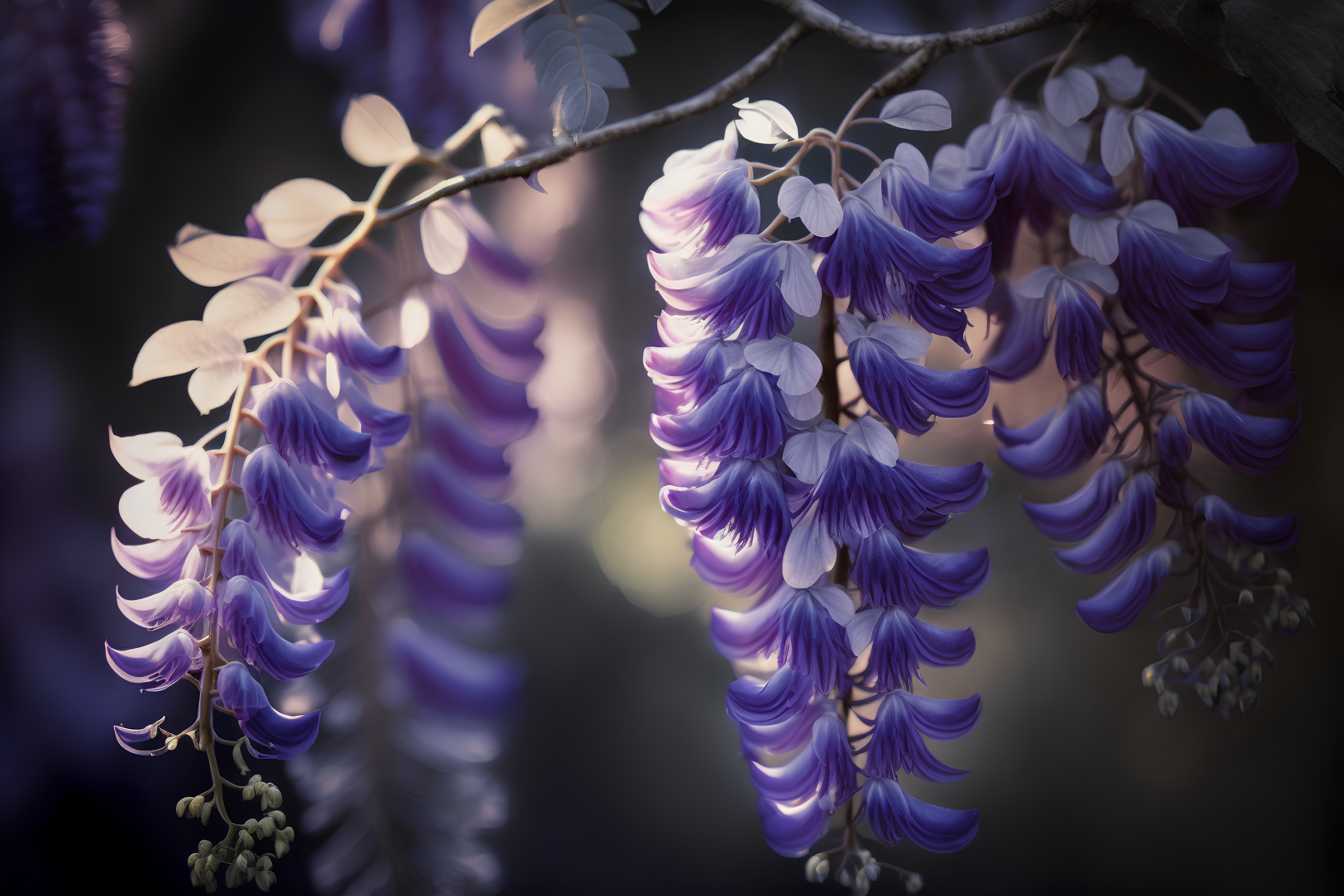
Wisteria is a beautiful vining plant which fascinates me, mostly because my surname means “among the wisteria”. However, I never knew how hardy wisteria was until very recently, so it holds even more symbolism for me now. The blossoms on a wisteria vine are absolutely gorgeous, but it turns out that the Chinese wisteria (Wisteria sinensis) and Japanese wisteria (Wisteria floribunda) are invasive when planted in gardens and forests in the United States. Evidently, the root system of a wisteria plant can extend up to one mile, which means that wisteria vines in yards across a neighborhood are most likely from a single specimen.

Here is a great video explanation of what non-native wisteria plants do in U.S. soil:

Spring Island Trust

If you live in the United States and are considering planting wisteria, you might want to consider American wisteria (Wisteria frutescens), because it is far less aggressive than its Chinese or Japanese counterparts. Interestingly enough, the type of wisteria which is most commonly planted in American gardens is the Japanese version, and the wisteria plant which adorns the security gate where I live is the Japanese variety. That seems fitting for me, considering the meaning of my last name and the fact that it is a Japanese name!

My Longest Trailing Plants

I thought it might be fun to cover the trailing plants in my collection which have been the most rewarding in terms of growth. They all exhibit the longest trailing vines among my collection of close to 150 plants.

This Scindapsus pictus was purchased in January 2021, and this image was shot on January 23rd, 2021.
In three months, the Scindapsus pictus I mentioned in the previous image has grown significantly, which you can see here (this image was taken on April 25th, 2021).

__________________________________________________________________________________

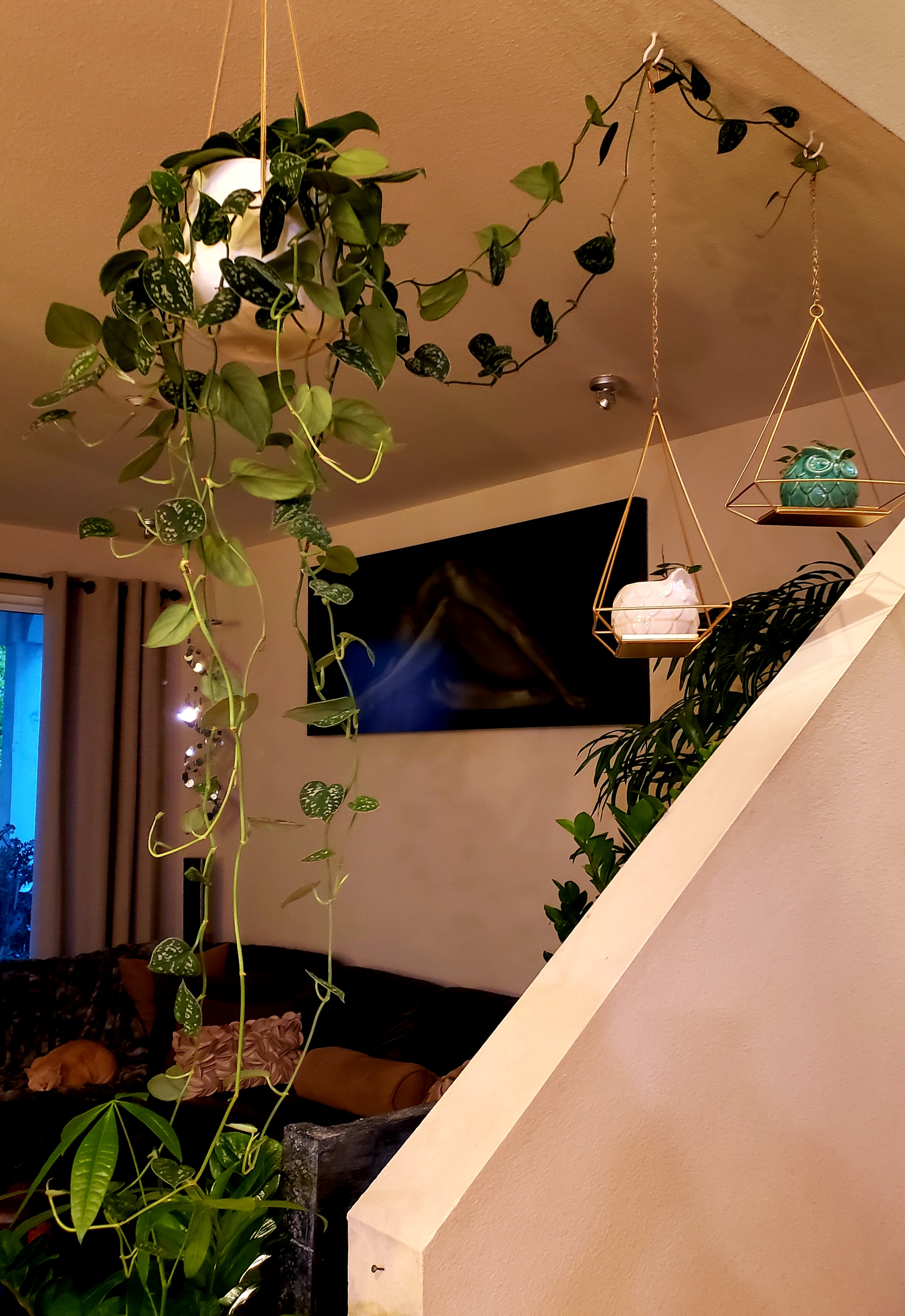
This is another Scindapsus pictus which was bought at the same time the one in the first image was acquired. The longest stem on this one measures 63 inches from the edge of the pot to the tip, and is seen running along the ceiling hooks along with another trailing vine. You can see that there are three other vines which are colliding with the Pachira (which is also growing like mad) which is underneath it. I can’t keep up with the growth on this one!

__________________________________________________________________________________

I got this Senecio radicans in June of 2020. Here it is pictured with the vines just starting to extend beyond the bottom of the pot.
The longest vine on the Senecio radicans from above measures 46 inches in this image, which was taken on April 25th, 2021.

__________________________________________________________________________________

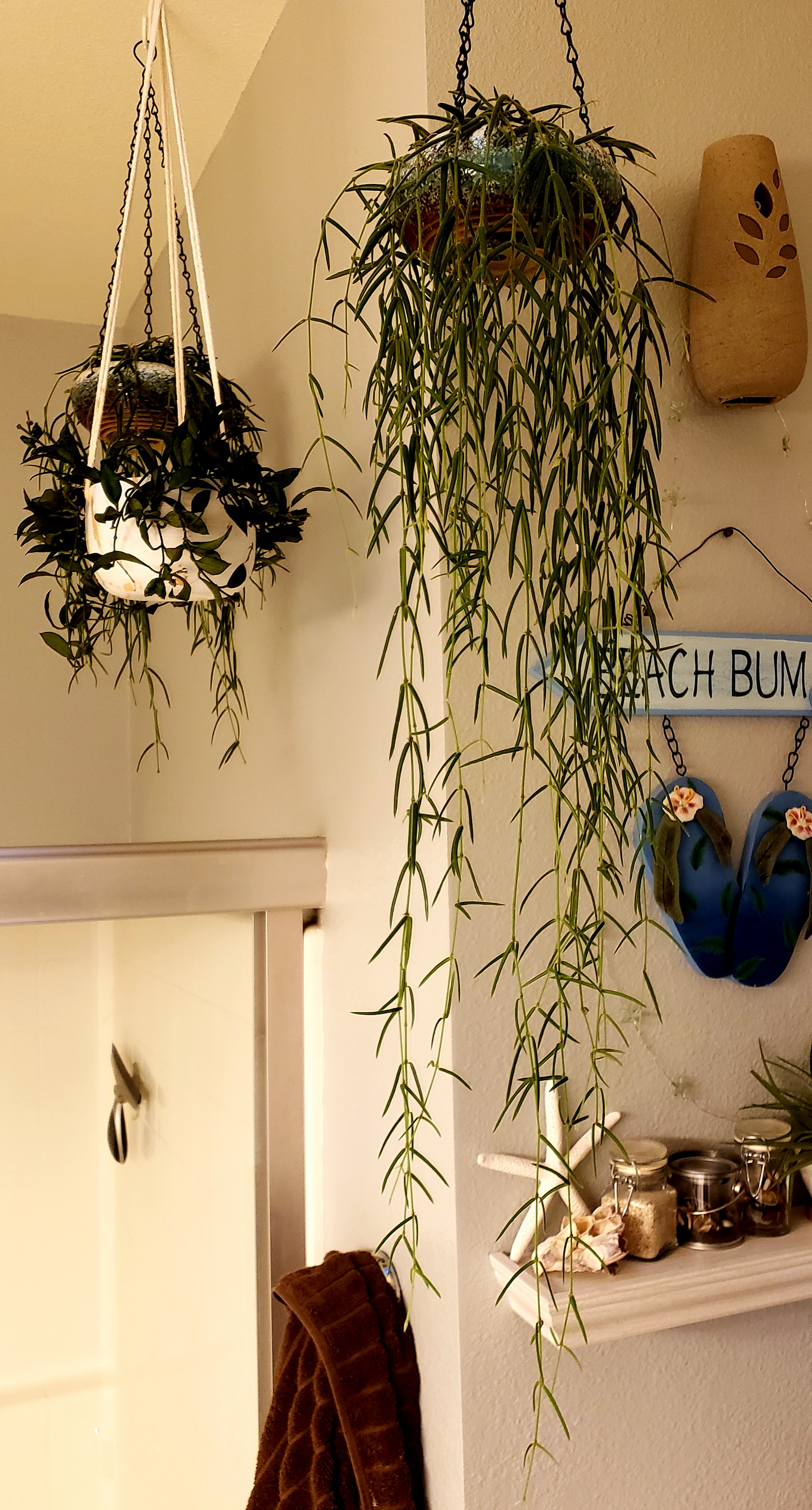
Finally, this is a shot of my longest Hoya linearis, taken on April 25th, 2021. The longest strand measures at 33 inches.

__________________________________________________________________________________

I am so impressed by and proud of my beautiful trailing plants!

Who Names Their Plants?

Image ID : 164070565
Source: 123rf.com
Copyright : Olga Ionina

On more than one occasion, friends have asked me if my plants have been christened with names.  For the most part, I have not gone to the trouble to name all of my plants, mainly because I personally feel that it is unnecessary and silly for me to do so.  I’m not knocking anyone who chooses to name all their plants, but the desire is, for the most part, absent in me.

So how do I discern between the close to 150 indoor plants which surround me at home?  I tend to use certain descriptors when I scribble my plant watering notes each week (yes, I keep track of which plants get watered in a given week), and those descriptors are pretty straight forward.  Usually, I will use the species name as a label, and if I have numerous specimens, I will write down the location of the plant. For example, I have two Hoya shepherdii, both of which are suspended over the two sinks in my master bath, so I refer to the one as “L shepherdii” and the other as “R shepherdii”.  I realize these labels aren’t exciting, but they are effective in helping me to keep track of my plants when I am watering them. 

However, there are three plants with bona fide names which I bestowed upon them, one of which was named the day I received it, one which was christened with a name about a month after it joined the plant brood, and one which earned its name after it exhibited an astonishing rate of growth.  While two of the names are quite fitting for the characteristics the two plant babies possess, one name is reflective of the species of the plant, and quite honestly reveals how lazy I was about using a lengthy German name when I could truncate it and use a fun name.

Sid:  Sid is a Ferocactus emoryi, “Emory’s barrel cactus”

My dear friend Blanche was at my house when I received Sid in the mail as a freebie which arrived along with a much-coveted monkey cactus I had ordered. As soon as I saw this spiky cactus, a name just popped into my head, and I exclaimed to Blanche, “For some reason, I really feel like this little guy needs a name!”, to which Blanche responded with, “I do too, and I’m thinking of a name too! If you say the same name I’m thinking of, I’ll freak!” The name which had popped into my head was Sid Vicious, so I revealed this to Blanche, who immediately squealed and said, “That’s the EXACT name I thought of too!” Later that day, I ordered a Sex Pistols mug to house the Emory’s barrel cactus.

Fred: Monstera adansonii ‘Friedrichsthalii’

This Monstera adansonii Friedrichsthalii very quickly became “Fred” after I needed to find a way to distinguish it from my other Monstera adansonii.

Rapunzel: Senecio radicans “String of Bananas”

This Senecio radicans was quite short when I bought it in June of last year, and it struggled for about two months before I changed its hang spot to an area right near a bathroom window, and essentially let it dry out completely between waterings. From that point, this plant just took off, and got so incredibly lacy and long that I decided it deserved the name Rapunzel. The longest tendril on this plant was measured on April 23rd at 46 inches from the edge of the pot to the end, which is three inches longer than it was a month prior. This radicans has aptly earned its descriptive and accurate name.

For comparison, the plant pictured above is another Senecio radicans which I purchased in January of this year. Both the radicans which I purchased in January and Rapunzel were at the level which you see marked in yellow when I brought them into my home. I look forward to seeing Rapunzel’s sister grow as long as Rapunzel.

Since plant people are increasingly more committed to their plants, often considering them to be pets or family members, it’s no surprise that more people are naming their houseplants. I like Nicoletta Richardson’s idea of naming plants after travel destinations from her bucket list, but for me, and if I had the energy to put into naming ALL of my plants, I could definitely see myself becoming a copycat and doing the very same thing. But I’d rather stick with the assigned scientific nomenclature because it appeals strongly to my scientific nerdiness, as well as to my propensity for properly classifying and labeling things.

How Many Plants Is Too Many?

Source:123rf.com
Image ID : 124546860
Copyright : Elnur Amikishiyev


The year 2020 seemed to blow the lid off plant addiction and hoarding.  More people than ever before have developed an obsession for houseplants, which makes sense since we have all pretty much been going stir crazy since the beginning of COVID-19 and lockdown.  It makes sense that we all turned to these beautiful, air-purifying, living things to enhance our home spaces and give us something to focus on besides our troubles.

There is a fascinating psychology behind collecting plants which differs from accumulation of inanimate collectible items.  Houseplants can have an incredibly calming, stress-reducing effect on us, and they also nicely soften the look and feel of home environments while also cleaning the air.  In addition, the rewards of watching a plant thriving under one’s care are considerable.  I know that every time one of my plants pushes out new growth, I get almost giddy with excitement.  

To be honest, I don’t even remember precisely how last year’s plant obsession really started.  I remember seeing and ordering two  Epipremnum cebu blues on May 27th, and two Zamioculcas zamiifolia ravens on Etsy on May 31st, two weeks after my father’s passing.  After that, it’s kind of a green blur.  My indoor plant count is now at 140.  That’s enough for me, because I have run out of reasonable space.

I think my dad’s death, the lockdown and hysteria surrounding COVID, my two roommates suddenly bailing on me, the loss of work, the fact that my weekly in-person visits with my mom were halted for six months, all pushed me into a very specific nesting mode.  I wanted to spruce up my place, and make it cozy and cool.  I added an outdoor fountain which immediately attracted mosquitoes during the warmer months (lesson learned, but I still have the fountain).  I added comfy pillows to all the seating in my living room and den, imparting a Bohemian vibe which I really enjoy.

After lockdown began, I had no desire to hoard things like clothing or little knick-knacks, though I know other people who began accumulating such items.  Instead, I wanted all the plants which caught my eye, living things I could nurture and watch grow, which also helped to melt away my stress. Though I am not one of those people who talks to their plants or names them (a select few have names…more on this in another post), I am aware of every single plant in my home. I know if a leaf is turning yellow, if a specimen needs to be rotated to get more even sun exposure.

So how many plants would be considered overkill?  Though I think the answer is quite subjective, there is an interesting Australian article which analyzes the optimal number of plants one should have in a room:

https://www.bhg.com.au/how-many-plants-you-need-per-room

Plants not only clean the air, they have a relaxing and calming effect on humans, so why have a limit on the number of plants to pack into a space?  My personal take on this is that I think it’s a mistake to allow one’s plant collection to overtake essential areas in a home, such as a kitchen counter, coffee table, floor space in a shower, stairs, and doorways, with the last two creating hazards since they would impede a speedy exit if a natural disaster were to occur.  It’s also a bad idea to put plants in spots where they clearly wouldn’t survive, such as a very dark room with no grow lights added.

I have my plants placed so strategically in my home that no one ever guesses that I have 140 indoor plants.  Although I fully address the light and humidity needs of all my plants, I also make sure they harmonize with the space they are in and look like they belong where they are.   I will never be one to buy a massive shelving unit or glass cabinet in which to shove my plants, because I think it looks supremely unattractive, and also ironically doesn’t showcase the plants optimally.  Whenever I see a plant person with a large shelving unit which is littered with plants, I know that the plant person is the only one who can fully appreciate all the specimens on the shelves, because they all tend to get lost in one big jumble.

I’ve heard some criticism from a couple of close friends about my plant collection, but I know that they don’t have the same mindset that someone who is into plants would have, so I’m not bothered by the snide remarks.  Ultimately, what matters is how a plant person feels about their plant collection.