Rethinking Plant Watering: Why Light and Humidity Matter More Than Watering Schedules

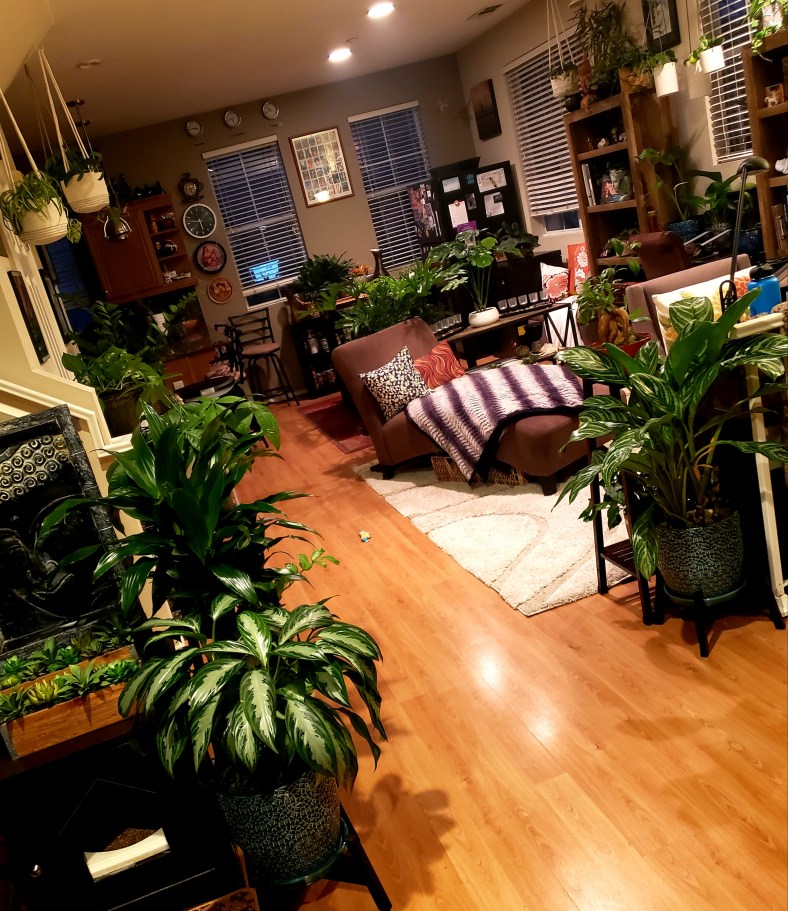
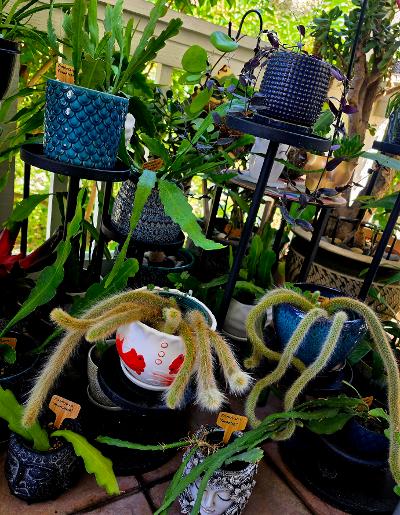
A glimpse of part of my balcony jungle…

People often think a plant’s watering needs are determined mostly by how often the soil dries out. In reality, light and humidity are the primary factors that determine how quickly a plant uses water. Watering is the response to those conditions—not an independent requirement.

Here’s why.

Light drives water consumption

Light is the energy source for photosynthesis. As light levels increase, plants become more active:

  • Photosynthesis speeds up.
  • Stomata (tiny pores on leaves) open to take in carbon dioxide.
  • Open stomata allow water vapor to escape through transpiration.
  • The roots replace that lost water by absorbing more from the soil.

This means:

  • A plant in bright light may need water every few days.
  • The exact same plant in low light may use only a fraction as much water and stay moist for weeks.

This is why overwatering is so common indoors. People keep watering on a schedule even though the plant isn’t using the water because it isn’t receiving enough light.

Humidity controls how fast plants lose water

Humidity determines the difference between the moisture inside a leaf and the surrounding air.

  • Low humidity creates a large difference, so water evaporates from leaves quickly.
  • High humidity slows evaporation because the air is already holding more moisture.

Think of it like hanging a wet towel:

  • It dries rapidly on a dry day.
  • It dries much more slowly on a humid day.

Plants behave similarly.

Higher humidity doesn’t necessarily mean a plant needs less water forever—it simply slows the rate at which it loses water.

Watering is a consequence, not a care category

Many care guides list separate requirements like:

  • Bright indirect light
  • High humidity
  • Water weekly

But these are not independent variables.

A better way to think about it is:

Light and humidity determine how quickly a plant uses water. Watering simply replaces what the plant has already used.

If the environment changes, the watering schedule should change too.

Why humidity and watering are often confused

Many tropical plants are described as “needing lots of water.”

What they often need is moist air, not constantly wet soil.

For example:

  • A plant with thin, delicate leaves may develop crispy brown edges in dry indoor air.
  • Many people interpret those brown edges as “the plant is thirsty.”
  • They water more frequently.
  • The soil stays wet because the roots weren’t actually short on water.
  • Eventually the roots may suffer from oxygen deprivation or rot, while the leaves continue browning because the real issue—low humidity—hasn’t changed.

This creates a cycle where the symptoms worsen despite more watering.

Similar symptoms, different causes

Several environmental stresses produce similar-looking leaf damage:

SymptomPossible cause
Brown leaf edgesLow humidity, underwatering, fertilizer buildup
Drooping leavesDry soil, overwatered roots, heat stress
Yellow leavesOverwatering, aging leaves, nutrient issues
Crispy leavesLow humidity, sun scorch, underwatering

Because these symptoms overlap, people often assume watering is the solution when the underlying cause is environmental.

A common example

Imagine a tropical houseplant moved from a greenhouse (around 70–80% humidity) into a home with winter humidity around 25%.

The owner notices:

  • Brown tips
  • Curling leaves
  • Slower growth

A common assumption is:

“It’s drying out faster. I should water more.”

But the soil may already be staying wet for a long time. The plant isn’t lacking soil moisture—it is losing water from its leaves faster than it can comfortably replace it because the air is much drier.

Increasing humidity or reducing environmental stress often addresses the problem more effectively than watering more often.

Light has an even larger effect than many people realize

A plant in strong light may use several times more water than the same plant in dim conditions.

For example:

  • Bright window + warm temperatures + low humidity = rapid water use.
  • Dim corner + cool temperatures + high humidity = very slow water use.

Yet many people continue watering both plants once a week because they think of watering as a fixed schedule instead of something that responds to environmental conditions.

A better mental model

Rather than asking:

“How often should I water this plant?”

It’s usually more useful to ask:

  1. How much light is the plant receiving?
  2. How warm is the environment?
  3. How humid is the air?
  4. How quickly is the soil actually drying?

The answers to those questions determine when watering is needed.

In other words, light determines how much water a plant uses, humidity determines how quickly it loses that water, and watering simply replenishes what has been lost. This is why two identical plants in different environments can have dramatically different watering schedules, even though they are the same species.

Beaucarnea recurvata (AKA Ponytail Palm)

Check out my video featuring Beaucarnea recurvata, more commonly known as Ponytail Palm!

Sadly, this plant took a turn for the worse in August of 2021 (right after we had no central A/C for three weeks in July), so I banished it to my balcony, where it continued to decline. I had no choice but to dispose of it in early October of 2021. However, even though my ponytail palm didn’t fare well, I still think it’s a cool plant to have, and it is relatively easy to care for. Mine just didn’t like the sweltering heat!

Who Names Their Plants?

Image ID : 164070565
Source: 123rf.com
Copyright : Olga Ionina

On more than one occasion, friends have asked me if my plants have been christened with names.  For the most part, I have not gone to the trouble to name all of my plants, mainly because I personally feel that it is unnecessary and silly for me to do so.  I’m not knocking anyone who chooses to name all their plants, but the desire is, for the most part, absent in me.

So how do I discern between the close to 150 indoor plants which surround me at home?  I tend to use certain descriptors when I scribble my plant watering notes each week (yes, I keep track of which plants get watered in a given week), and those descriptors are pretty straight forward.  Usually, I will use the species name as a label, and if I have numerous specimens, I will write down the location of the plant. For example, I have two Hoya shepherdii, both of which are suspended over the two sinks in my master bath, so I refer to the one as “L shepherdii” and the other as “R shepherdii”.  I realize these labels aren’t exciting, but they are effective in helping me to keep track of my plants when I am watering them. 

However, there are three plants with bona fide names which I bestowed upon them, one of which was named the day I received it, one which was christened with a name about a month after it joined the plant brood, and one which earned its name after it exhibited an astonishing rate of growth.  While two of the names are quite fitting for the characteristics the two plant babies possess, one name is reflective of the species of the plant, and quite honestly reveals how lazy I was about using a lengthy German name when I could truncate it and use a fun name.

Sid:  Sid is a Ferocactus emoryi, “Emory’s barrel cactus”

My dear friend Blanche was at my house when I received Sid in the mail as a freebie which arrived along with a much-coveted monkey cactus I had ordered. As soon as I saw this spiky cactus, a name just popped into my head, and I exclaimed to Blanche, “For some reason, I really feel like this little guy needs a name!”, to which Blanche responded with, “I do too, and I’m thinking of a name too! If you say the same name I’m thinking of, I’ll freak!” The name which had popped into my head was Sid Vicious, so I revealed this to Blanche, who immediately squealed and said, “That’s the EXACT name I thought of too!” Later that day, I ordered a Sex Pistols mug to house the Emory’s barrel cactus.

Fred: Monstera adansonii ‘Friedrichsthalii’

This Monstera adansonii Friedrichsthalii very quickly became “Fred” after I needed to find a way to distinguish it from my other Monstera adansonii.

Rapunzel: Senecio radicans “String of Bananas”

This Senecio radicans was quite short when I bought it in June of last year, and it struggled for about two months before I changed its hang spot to an area right near a bathroom window, and essentially let it dry out completely between waterings. From that point, this plant just took off, and got so incredibly lacy and long that I decided it deserved the name Rapunzel. The longest tendril on this plant was measured on April 23rd at 46 inches from the edge of the pot to the end, which is three inches longer than it was a month prior. This radicans has aptly earned its descriptive and accurate name.

For comparison, the plant pictured above is another Senecio radicans which I purchased in January of this year. Both the radicans which I purchased in January and Rapunzel were at the level which you see marked in yellow when I brought them into my home. I look forward to seeing Rapunzel’s sister grow as long as Rapunzel.

Since plant people are increasingly more committed to their plants, often considering them to be pets or family members, it’s no surprise that more people are naming their houseplants. I like Nicoletta Richardson’s idea of naming plants after travel destinations from her bucket list, but for me, and if I had the energy to put into naming ALL of my plants, I could definitely see myself becoming a copycat and doing the very same thing. But I’d rather stick with the assigned scientific nomenclature because it appeals strongly to my scientific nerdiness, as well as to my propensity for properly classifying and labeling things.

I Think My Plants Dig Me :-)


Source: 123rf
Image ID : 158781949
Copyright : followtheflow


For those of you who have plants in your home, have you noticed that your plants don’t look as healthy after you return home from a trip? I have consistently noticed in the past year that whenever I go on a trip, at least one of my plants is drooping, exhibiting brown leaf edges, or some other sign of less than optimal health.  I didn’t mind it quite as much last winter, when I only had six plants inside my residence, but by my second out of town trip in September, I had over 30 plants, and wasn’t very pleased by the fact that I came home to see half a dozen droopy, sad plants.  Four of my plants swung back to perfect health within three days, while two of them ended up in the houseplant graveyard.  Thing is, I was only gone for four days, and I returned the day before my regular weekly plant watering day.

Then in November, I made another four-day trip, and by that time I had over 50 plants.  I scheduled my trip so that I would once again return home the day before my weekly plant watering/assessment day, yet I once again returned to a number of plants which were not looking very happy.  I’m thankful that they bounced back to health, but I still can’t figure out why this keeps happening.

I only devote one hour, one day per week, to assess the watering needs of my plants, water the ones which need a drink, spray orchid plant food on all my Hoyas (Hoyas love it), and rotate the pots by 90 degrees clockwise.  I don’t fuss over my plants daily like some people do, not because I don’t care about my plants, but because my plate is always so full that I avoid plants which are fussy and require that type of attention.

My den and dining area, early February 2021


Now that my indoor plant collection exceeds 100, I truly wonder what would  happen if I were to take a short trip out of town.  And though plants don’t have feelings per se, why is it that my plants are so much healthier and perkier when I spend more time at home?  As weird as this may sound, I’m almost convinced that plants pick up on our energies, and since I admire my now sizeable plant collection and appreciate every single specimen, I believe my plants sense that.  I know that in general, I have a very green thumb, and had discovered that talent about a quarter century ago, but my recent foray back into houseplant cultivation somehow seems different.  I feel much more connected to the plants in my home, and though I don’t talk to them, simply looking at them makes me happy.  I think they know how I feel.

I read this comment on a blog post about plants on The Smiling Gardener which I found quite interesting:

About fifty years ago as an enquiring hippy I ran atest with my wife to see if plant groth could be affected by love and hate . Four pots of garden soil had the same number of seeds sown in them and were placed together in a window and watered the same amount. The pots had either
1) no treatment
2) SM 3 seaweed liquid feed
3) Projection of love or positive feelings every time we passed
4) Projection of hate or bad mental feeligs every time we passed
Now this sounds quite unscientific and already plenty of room for doubters and skeptics to burst out laughing.

The results ?
No treatment -several seeds germinated plus a few garden weeds.
Seaweed treatment – as above but more seeds germinated and more garden weeds.
Projection of ‘love’- a veritable jungle of germination.
Projection of ‘hate’ – NOTHING germinated

Obviously no prejudiced person could even consider these results as indicative of anything but I always found them very interesting . May even try it again in different format fifty years later.

  • ron daguerre


Feel free to check out the links below, both of which explore the idea of whether plants have feelings.  At the very least, there is scientific evidence that plants send chemical signals to each other through the air or soil.  Could my plants be chatting it up about how groovy my home is, how the humidity and the grow lights and natural light are (hopefully) just right?

https://www.houseplantscorner.com/post/do-plants-get-lonely

https://www.refinery29.com/en-us/do-plants-have-feelings-expert-answer