Tag NPC
Birthday Number 50 Is Around The Corner…
I shot this video back in February, right after the Super Bowl. Now that my birthday is a week away, I thought it was the perfect time to share this video in which I share my thoughts about getting older.
The Bottleneck Level: National Bodybuilding Events (Repost)

Every single year I watch nationally qualified competitors duke it out onstage in hopes of finally making it through the bottleneck and achieving Pro status. Some competitors get smacked down repeatedly, yet keep hitting the national circuit for so long that they must compete against new blood, further limiting their chances. There are times when I shake my head in wonder over the outcome of a national or Pro event when individuals who clearly should have been in first callouts were neglected. I know that feeling all too well because it has happened to me a number of times. Every year the national level events get bigger, which results in even more pressure and more competition to get through that level and into the big wide world of Pro status. When a competitor finally gets pushed out of the bottle and glides into Pro waters, he or she will bask in it, enjoying the victory, but the majority of Pro competitors soon discover that becoming a Pro doesn’t mean that life will become any easier. If anything, it becomes more difficult, because the bar is set much higher.
Those of us who compete live in a bubble. In fact, I will go as far as to say that when we escape the bottle, we end up in a fishbowl instead of open water. Please don’t interpret this to mean that I lack appreciation for being a Pro, because it is indeed a great honor. But the world at large is a vast ocean which bodybuilding leagues really don’t connect to, similar to the artificial environment which a bowl provides for a pet fish. Bodybuilding is its own world, and though I may love it, I also know that it won’t make me a superstar. Even the biggest bodybuilding legends (except for Arnold) don’t have the full global recognition which they deserve, because bodybuilding is such a niche industry. The only bodybuilders who are household names are the ones who became thespians.
I will admit that when I finally got my Pro Card (after 14 Pro qualifiers), I was relieved and ecstatic because I had finally reached a goal I had set for myself. However, I also fully realize that it wasn’t entirely up to me when or if I would ever get that card, so I always tried my best not to berate myself when I fell short of that Pro card goal. A number of competitors who have been on the national circuit for a very long time have built up a tremendous following on social media channels and have so much power and influence, yet they sell themselves short because they focus on the Pro Card chase as a singular goal. These are precious gems whose shine is only dulled by the disappointment they experience when the sport of bodybuilding edges them out of the winners’ circle.
If you have been competing for a very long time and are getting weary from slipping in national placings or just missing that Pro card too many times, it’s time to take a good look at where your passion truly lies. If your true passion lies directly in the experience of stepping onstage, then by all means continue. However, if you are broke, exhausted, sore and dejected, and you have a true passion beyond the stage for inspiring others to reach fitness goals, then why not BREAK the bottle and swim into the wide ocean? If you build a name, a brand, and a following, you can establish a presence in the real world which will enable you to impact others in the truest sense. In addition, you might stand to make some decent money from nurturing your passion for fitness. Honestly, how much money have you made from competing? Just saying.
How To Assess A Client For Body Asymmetries (repost)

I originally wrote this piece for AFE and am reposting it here.
Fitness pre-testing is a valuable tool for evaluating movement patterns and assessing a client’s strengths and weaknesses. The information gathered from such testing can then be utilized to develop a customized program which addresses and corrects functional abnormalities. The more thorough the pre-testing, the better equipped a trainer is to help the client reach optimal potential within the training program, while also guarding against injuries which the client might be predisposed to as a result of compensatory patterns.
Many people have developed compensatory patterns over time. Sometimes structural abnormalities exist from birth, or develop in childhood, and often throw surrounding soft tissues and joints out of alignment. In other cases, injuries from sports or other activities can cause a person to begin favoring one side of the body in an effort to reduce the stress load on the injured side. The problem with these compensatory patterns is that they allow the weak or restricted side to become even worse over time. Because of this, functional weight training should always address these patterns in an effort to correct them.
How To Determine Asymmetry
One of the most valuable early tests for determining structural asymmetry is the single leg stance, in which the client’s ability to stabilize the trunk over the supporting leg is determined. Misalignments of the hips, knees, or ankles/feet can be detected easily with this screening tool. For example, if one hip joint is restricted or otherwise unstable, the client will shift weight in an effort to maintain balance. A trainer can then utilize the information gathered from the single leg stance test to focus on compromised function in a joint or extremity.
Clients will frequently exhibit asymmetries in strength, range of motion, or muscle recruitment which can easily be overlooked if a trainer doesn’t have a practiced eye. Because of this, a thorough assessment of the client’s posture, range of motion, and form should be implemented before training begins so that the trainer can identify and properly address compensatory movement patterns.
Let’s say a client exhibits poor movement while performing a basic bodyweight squat, the source of the dysfunction must be determined so that the trainer can correct it. Is the limitation is coming from the foot, the knee, the hip joint, the pelvis, or the sacrum? Is the issue one of limited mobility, muscle weakness, joint instability, or of poor muscle activation? The origin and the nature of the dysfunction will determine which corrective exercises should be added to the client’s program.
Sports and Compensatory Patterns
Asymmetries are especially common in people who engage in sports such as baseball, golf, soccer, football, and tennis, which rely heavily on one side of the body. Because of this, it is important to ask clients if they currently play sports or have played them in the past. It is also important to ask clients about any past injuries which may be contributing to current compensatory patterns. Compensation results from a number of factors, including muscle weakness, impaired joint mobility, musculoskeletal asymmetry, leg length discrepancy, previous injury, and even joint stress from obesity. Joints can become lax and unstable, forcing contralateral muscles to take the brunt of the movement in order to stabilize the dysfunction. What often results is overuse in the compensating region, which in turn adversely affects the client’s training, and also reinforces the asymmetry.
Minimalist Footwear (repost)

I wrote this article for AFE last year, and am reposting it for you to enjoy.
Less Is More
Are there benefits to training in minimalist footwear? Studies have demonstrated that training while wearing minimalist shoes results in enhanced performance, due to greater foot pliability and a closer approximation to a barefoot stance. Since our feet adjust to wearing raised heels over time, it can be incredibly challenging to keep our heels on the ground while performing exercises like deep squats. Proponents of minimalist footwear may even argue that barefoot is best for heavy weightlifting, but the risks of exposure to microbes or hazardous fragments of glass, metal, or rocks, make minimalist shoes a much more feasible choice while at the gym.
Dysfunctional movement patterns become established throughout the body over time. Conventional athletic shoes can often contribute to ankle and foot dysfunction because they inhibit natural foot action. If you don’t believe it, then try to perform some of your physical activities barefoot and see how well, or poorly, you perform. Chances are that the impaired mechanics in the feet and ankles will make it difficult at best to perform those activities. By gradually switching over to minimalist footwear, an athlete can essentially correct improper foot mechanics and optimize kinetic feedback throughout the body during movement.
Benefits Of Minimalist Shoes
Conventional athletic footwear features a cushioned heel which also can compromise power. In contrast, minimalist footwear features little to no heel, and the soles are very thin and malleable, so they allow the joints in the foot to move and adjust to weight loading movements. In addition, the heels and midfoot make solid contact with the floor, causing more activation in the glutes and hamstrings. Studies have demonstrated that people who wear minimalist footwear develop greater strength in their legs and feet, since more power is transferred from the working muscles, through the feet, and into the movement. Plyometric movements and sprint power will also be enhanced while wearing minimalist shoes.
A 2011 study by Squadrone and Gallozzi assessed the ability of experienced runners to estimate the degree of inversion, eversion, dorsiflexion, and plantarflexion, of a slope surface board placed under their right foot while standing. They found that the degree of proprioceptive feedback which subjects received while wearing Vibram Five Fingers® was much more accurate than in subjects who wore a standard running shoe. In conclusion, cushioned shoes conferred a distinct disadvantage when compared to minimalist shoes during assessment of foot position awareness.
How To Transition Into Minimalist Shoes
Anyone who is transitioning from conventional athletic shoes to minimalist footwear needs to do so gradually, since the body has to adjust to radically different proprioceptive input. There have been cases of metatarsal stress which developed after converting too quickly to minimalist shoes. However, once the transition is made, noticeable strength gains should occur. Try spending about 15 to 30 minutes, twice a day, wearing minimalist shoes around the house. After about a week or two, you can try them out at the gym one to two days a week until you become accustomed to the feel of the shoes. Be aware that your gait and foot stance will probably change as you acclimate to this type of shoe.
REFERENCES:
1. Squadrone R, Gallozzi C (2011) Effect of a five-toed minimal protection shoe on static and dynamic ankle position sense. J Sports Med Phys Fitness Sep;51(3): 401-8.
Offset Load Training

Introduction
Offset load training is a training approach in which different loads are used on the right and left sides of the body during an exercise, challenging the body to adjust. If you have ever dealt with clients who have demonstrated asymmetry in strength or power between one side of the body and the other, or who have visible differences in muscle mass when comparing each side, and have addressed their asymmetry solely with isolated unilateral movements, you can implement offset load training as a very effective way to break through training plateaus and to address accumulated asymmetry between the right and left sides of the body. Offset load training is not only more challenging than isolated unilateral exercises, it also results in more neural connections and greater kinetic efficiency.
Asymmetries in strength or muscle development most commonly result from natural dominance on one side, but they can also emerge as a result of injury. During bilateral training, the stronger side will always compensate for the weaker one by taking on more of the load, so the weaker side remains at a disadvantage. In contrast, unilateral and offset movements force each side of the body to bear the load fully and independently, effectively forcing the weaker side to work. Over time, differences in strength between each side are diminished as a result of this type of training.
Benefits Of Offset Load Training
One of the greatest benefits of offset load training is greater trunk stability and strength. Any time you perform a unilateral or offset movement (think of using a shovel), you activate your abdominal muscles in order to resist rotational forces and maintain a neutral spine. Another benefit of offset load training is that offset exercises challenge the nervous system to adapt to the unequal weight distribution by recruiting muscles in a coordinated fashion to maintain balance. You might be surprised by how much your client’s overall strength will increase as a result of improved conditioning in the smaller stabilizing muscles of the trunk. This is because enhanced balance and trunk strength stabilize the extremities and transfer power to them. In other words, if the muscles in the trunk are more efficient at stabilizing the spine, the limbs will benefit from greater power.
How To Add Offset Load Training To A Client’s Regimen
Offset load training works with most barbell and dumbbell movements and can be easily incorporated into a client’s training regimen. You can use this form of training as an adjunct to bilateral movements in a client’s plan. When selecting weights, make sure the difference in weights between sides is moderate, and keep the rep range around eight to twelve reps. Instead of handing dumbbells to your client, have the client lift them so that the muscles of the trunk will become activated even before the exercise is performed. If you are using a barbell, load each side with a different number of plates. If using the double cable assembly, set the pins at different weights. Be sure to monitor your client closely during this type of training, especially those relatively new to lifting weights who have poor balance and coordination.
Oil and Water: Is Crossfit Detrimental For Developing Aesthetic Muscle? (repost)
I truly enjoyed writing this article which was featured on Sports Nutrition Supplement Guide. You can see the published post here: http://sportsnutritionsupplementguide.com/training/crossfit/item/1389-oil-and-water-is-crossfit-detrimental-for-developing-aesthetic-muscle#.V1HlOvmlyWg
Read on to find out what I think about Crossfit:

Could someone please tell me why this move is even necessary? It’s dangerous and incredibly damaging to the joints and soft tissues in the body.
I will boldly state right now that I’m not a fan of Crossfit, and will be delighted when its novelty wears off. I’ve dedicated my life to supporting, empowering, inspiring, guiding, coaching and otherwise promoting any activity that gets people moving. This is one reason I waited to publicly write about my arguments against the principles of Crossfit. The other, more specific reason, is that it’s become more common to hear NPC and IFBB competitors ask if Crossfit will enhance their efforts to get into contest shape. If the latter is you, let me cut to the chase. Not only will Crossfit widen your waistline as a result of the constant heavy “functional” lifting, it will also cause cortisol spikes, which make your body hold onto belly fat for dear life.
Before I get into why Crossfit is counterproductive to developing aesthetic muscle, a word to those who have found Crossfit gets them active, and has not caused them injury. Keep it up. If it’s Crossfit you need to keep you moving and motivated to be fit, don’t stop on my account. If however, Crossfit just doesn’t feel right, or your goal is to create your best body, and give you the best chance to stay injury free, read on. You’ll find that you don’t have to become part of the latest fitness craze to reach all of your fitness goals and then some.
CrossFit’s Unnecessary Nine
We begin our class with a review of the nine fundamental exercises that CrossFit is built upon:
Air Squat
Front Squat
Overhead Squat
Shoulder Press
Push Press
Push Jerk
Deadlift Sumo
Deadlift High Pull
Medicine Ball Clean
Oh boy, I can only imagine how many lumbar disc herniations have occurred in weekend athletes as a result of performing most of these movements, not to mention the rotator cuff strains and tears from the stress on the shoulders. First off, it just annoys me to know CrossFit renamed the free squat or bodyweight squat to Air Squat in an effort to be catchy and original. Then again, I see no point in getting a client to perform 200 or 300 “air” squats in a row, not unless your objective is to drive your client to complete exhaustion and overtraining. Based on what I have witnessed with the design of CrossFit regimens, exhaustion and overtraining is the inevitable outcome.
CrossFit routines also incorporate other exercises such as pull-ups and pushups. What bothers me here is that these movements are performed in a high rep range, to the tune of 100 or more. Then the client may be pushed to do tire flips or one of the Olympic lifts that CrossFit has managed to make faddish, even though they were developed over 100 years ago.
One of the calling cards to CrossFit workouts is training at “super high intensity”, which taken in correct doses are fundamental to conditioning. As it is used in CrossFit programming, the benefits are far outweighed by the negatives they incur. In CrossFit context, they tax the central nervous system to an excessive degree. Crossfit fanatics may love the feeling of being pushed to the limit, but this borders on being DANGEROUS. When the body is fatigued to the extent that it is in a Crossfit routine, the risk for muscle breakdown and frank rhabdomyolysis is considerable. No physical discipline is worth the risk of landing in the hospital.
I understand that Crossfit offers a great social environment and a feeling of camaraderie, but at what price? Every single person I know who is a fan of Crossfit has been injured while doing it. The suggested Crossfit regimen of 3 days on, 1 day off is too rigorous when you consider the fact that Olympic lifts are part of the core of Crossfit training. The body simply cannot repair itself in enough time. To fatigue a Crossfit client by having him/her do a WOD (workout of the day for those of you not familiar with Crossfit) and then stack on deadlifts for reps or 5 foot high box jumps is insane.
Benefits drop dramatically when the body is completely depleted like that. The Crossfit ideology of deplete and endure is BS. In contrast, bodybuilders and physique enthusiasts, train hard and heavy, and yes, they often train to depletion or failure, but they certainly aren’t going to attempt 100 pull-ups after destroying a traditional back workout. They understand the law of diminishing returns all too well.
Proponents of Crossfit often state that the training is functional and enhances the day to day activities which people perform. When was the last time you had to do a clean and jerk while on the job? Unless you work as a firefighter, stock room clerk or some other physically demanding work role, I seriously doubt that you are performing movements which mimic what happens while in a Crossfit box. Besides, if you’re injured as a result of Crossfit (or should I say WHEN), you can’t possibly perform any challenging physical movement which strains your injured body part.
For those of you who compete in the NPC or IFBB (or INBA, WBFF, etc.), don’t expect to be able to incorporate Crossfit into your contest prep training and sculpt your physique in the manner required for bodybuilding. I actually had a client who begged me repeatedly to let her do Crossfit two days a week despite my recommendation that she abandon it and focus on traditional weight lifting. I finally acquiesced, and allowed her to incorporate Crossfit as part of her training.
As I had predicted, she sustained an injury, her waist widened from all the heavy complex movements which made her midsection boxy, and she became soft as a result of the cortisol spikes which the high intensity Crossfit training created. After 3 weeks of seeing all her efforts from pre-Crossfit training unravel, I asked her to reconsider her decision to engage in Crossfit. As soon as she stopped doing Crossfit, her waist began to nip in, and her body began to tighten up again. Amen for old school weightlifting!
If it sounds like I am saying you will have to decide between doing Crossfit and competing in any of the bodybuilding divisions, I am. You simply cannot create the nipped in waist and beautiful taper that defines every single bodybuilding division. If you do Crossfit, you will create a strong body (plus some injuries), but you will also widen your silhouette and carry a layer of fat as a result of all that cortisol you will release from constant high intensity training. Look at a typical Crossfit athlete. Shoulders are broad, quads and hams are thick, and the abdominal region is thick and boxy. That is what happens when compound Olympic lifts are performed on a regular basis. If that is your aesthetic ideal, by all means knock yourself out with Crossfit, but you will be destroyed on a bodybuilding stage. On the subject of Olympic lifts, even power lifters have the sense not to rep out on these movements. Yet Crossfitters, blinded by the so-called warrior mentality that leads them to do stupid things that invite injury, will rep out on movements which recruit a tremendous amount of muscle fibers and hence tax the central nervous system. I am willing to bet that the Crossfit nation contends with adrenal burnout, permanent muscle damage, and repetitive tendon and ligament ruptures on a relatively consistent basis, and that such negative aspects will eventually cause the demise of this fad sport.
I will always staunchly defend the focus and the principles behind bodybuilding. I know that NPC and IFBB competitors are true warriors and know how to push through grueling training. I also strongly believe that for the most part, most competitors are smart enough not to over train or invite injury by performing movements which are biomechanically unsound. The world of bodybuilding not only rewards strength, but it also recognizes the aesthetic ideal which all bodybuilders aspire to achieve, regardless of division. Bodybuilding is not about flipping a massive tire across a gym, it’s about sculpting and defining muscle.
Draped In Gold…Ravish Sands Competition Suit MUST SELL
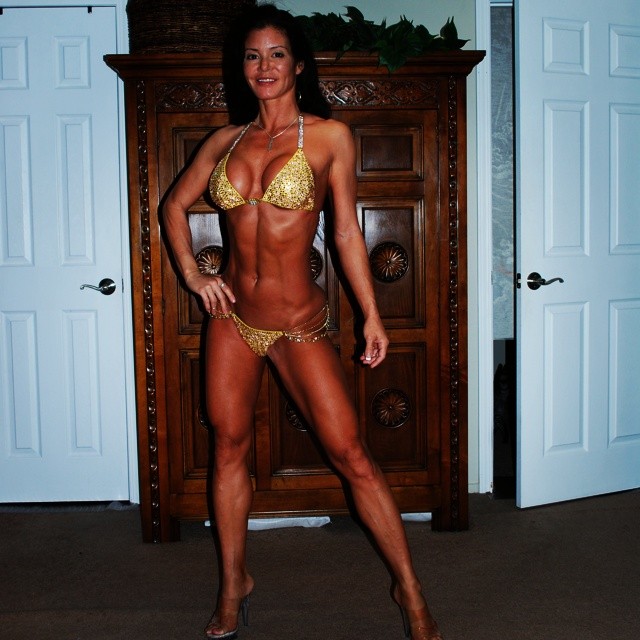
I love this GORGEOUS Ravish Sands suit, but it really needs to go, as it is a reminder for me of what I have decided to let go of, i.e., the world of competing. This is a custom made suit, and is perfect for the NPC or IFBB Bikini competitor who wants to be a golden goddess! The base of the suit is a hologram yellow, and the top and the front of the bottoms are heavily crystallized with Swarovski crystals. The gold and rhinestone chain connectors are flirty and sexy, and gently drape around and under the hips.
I paid $500 to have this suit made, and wore it on the IFBB Pro stage at two events in 2014. The suit is in fantastic condition, with no missing crystals or signs of wear, and there is only a minimal amount of staining on the inside of the suit from competition spray tan.
This suit will fit a 34 to 36 C or D cup, and the bottoms will fit a 34 to 35 inch hip. For reference, I am 5’5″, and I competed in this suit at 119 lbs., with 34-24-34 dimensions.
I am now willing to let go of this suit for $165 which includes shipping.
Please message me at stacey@staceynaito.com if you are interested. Serious inquiries only. I really want this beautiful suit to go to a good home!
“Do You Still Compete?”
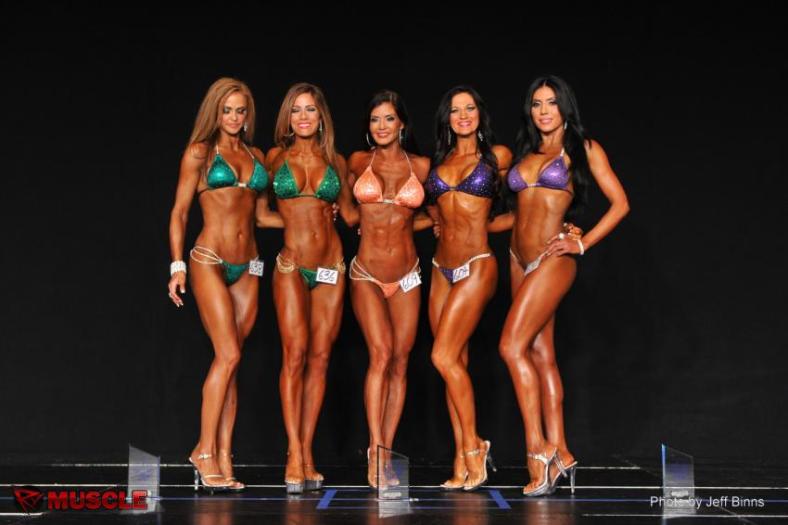
First Place Masters Bikini 35+ B Class, Team Universe, July 2013
Whenever I hear that question now, I have mixed feelings, which range from a sense of longing for the stage, to complete relief that I have not stepped onto a bodybuilding stage for close to two years now. My short answer to the question, “Do you still compete?” is “Probably not.”
Though I competed in four Pro Bikini events, I was struggling so much with metabolic damage and perimenopause that I often think it wasn’t the best idea to jump onto the Pro stage only 4 months after I won my IFBB Pro Card. That sort of strategy might work for a twenty-something competitor who is at the top of the heap, but it didn’t work for my 47-year old body which had been beaten down physically, emotionally, and mentally. I honestly needed a break, but I pushed through, and as a result had ho-hum placings.
It has taken over three years for my body to return to a level of leanness which I feel comfortable with. I know you might assume that I was in a massive spiral with my weight and body fat, but it wasn’t THAT bad, at least not compared with many other competitors who spiral. Nevertheless, I spent over two years with excess fluff that I was not accustomed to at all, and I couldn’t stand how I looked or felt.
Here’s the breakdown of my stats throughout the years:
From age 21 through 43: Between 104-109 lbs., 11-13% body fat
2010 – Age 44: 112-113 lbs., 12% body fat
2011 – Age 45: 114 lbs., 12% body fat
2012 – Age 46: 115 lbs., 12% body fat
2013 – Age 47: FIRST HALF OF YEAR: 117 lbs., 11% body fat SECOND HALF OF YEAR: 119-126 lbs., 13-18% body fat
2014 – Age 48: 121-125 lbs., 14-18% body fat
2015 – Age 49: 119-123 lbs., 12-15% body fat
2016 – (soon to be 50): 115-119 lbs., 11-13% body fat
It has been a veritable see-saw for me over the years. I also firmly believe that I would not have gone through menopause as early as I have if it had not been for all the metabolic insults I made to my poor body as a result of competing. Since 2013, I have investigated every possible cause for the water retention issues which rather suddenly hit me. This year I have FINALLY been able to rid myself of the excess fluid around my midsection, but somehow that was at the cost of the fullness in my glutes which I had worked so tirelessly to achieve during the years in which I competed.
If you ask me what my plans are for competing, don’t be surprised if I evade the question. I realize with each passing day that competing is no longer something which I rely on to define who I am. I have paid my dues and proven my worth, and though I completely understand why people have a drive to compete, I am no longer chomping at the bit to throw on a ridiculously expensive, blingy bikini and stripper heels and put myself at the mercy of a panel of judges.
Squat Pant Obsession
!
I have a confession: I am obsessed with Beleza Brazil Squat Pants, so much so that my leaning towards Lululemon capris has dwindled to almost zero. Beleza Brazil Squat Pants are very high quality and well made, and incorporate some of the softest, most curve-flattering fabric on the planet! I still remember the first time I tried on a pair, and I truly was expecting them to fit like just about every capri legging to fit. Yet I pulled them on and immediately noticed how the cut and the fabric hugged my curves like a second skin, and how my booty just went POP! once I had them on. It was love at first sight with these pants, and since that fateful day back in January, I have worn these wonderful booty enhancers pretty much daily. Not only do I wear them to the gym, I wear them to run errands, and I even have a pair of the Long pants in Blue, which I love to wear with short black legwarmers and black pointy-toed boots for a night out. Oh yes, I am obsessed with BB Squat Pants!

Here are the specs on these incredible pants:
Features: Booty shaping waistband to contour your natural shape, Elastic Free waistband to avoid muffin top.
Fabric: SoftMAX
Properties: Custom made for the softest feeling to touch, while still having hold and support.
Moisture Wicking, four way stretch, preshrunk, chafe resistant, breathable, UV protection, antibacterialRise: Medium
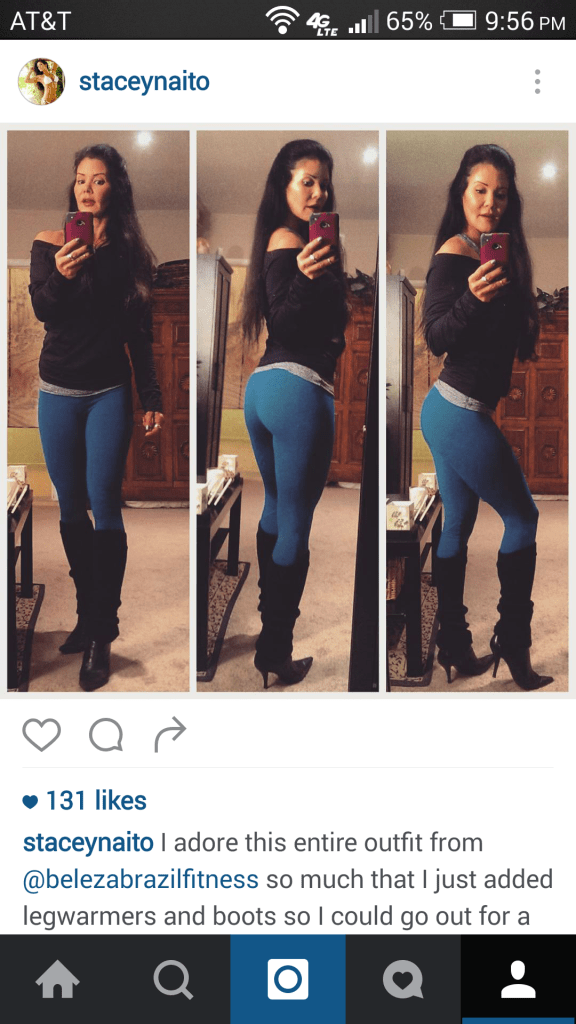
Squat Pants are different from all the workout pants out there. They do something magical to the derriere which almost defies explanation. Obviously the cut and stitching are brilliant, and make a woman’s rear view spectacular! I have tried Freddy Pants which NEVER have looked right on me (apparently I am in between sizes), but these pants look unbelievably good on, not only around my glutes, but on my thighs and calves.

I also love how the fabric holds you in without squeezing you like a compression garment. The fabric also wicks moisture very effectively. You can truly MOVE in these pants, which makes them ideal for weightlifting (especially heavy leg day, because these won’t restrict movement at all}, yoga, cardio, etc. And the colors…WOW!
Three colors were launched in early March, and all three colors (Charcoal, Navy, and Violet) are COMPLETELY SOLD OUT! You can still purchase Red (which is a vibrant, beautiful red with a slight rose tinge to it…I LOVE this color!) and Blue {which is a deep teal blue and so pretty!) on the website in both the Mid Calf and the Long Length, but even those colors are limited in quantity.
NEW COLORS will be launching later this month, and they WILL NOT LAST! Whatever you do, DO NOT WAIT to place your order once those new colors launch! I am telling you, these Squat Pants will become your very favorite pants to wear. EVER.
I will post on social media when the new colors come in so you all have a chance to buy them!
In the meantime, I encourage you to visit the Beleza Brazil online store while the colors I mentioned are still available. Click on this link to shop and order:
http://www.belezabrazilstore.com/#_a_NAITO
My Discount Code: NAITO
Make sure to enter my discount code for free shipping on your order.

 dr. stacey naito's blog