Which Protein Powder If You’re Lactose Intolerant?

If you are lactose intolerant, then you are quite accustomed to checking to see if dishes contain dairy. You might also be wary of whey and casein protein powders due to their derivation from milk. However, if you have only a mild lactose intolerance, you may not have an issue with whey and casein. Why is this?

Many individuals with a mild lactose intolerance are fine with whey protein isolate as well as with casein. Both whey and casein are separated from the lactose during processing. There are small concentrations of lactose which bypass the separation, but usually this is not enough to mount a reaction in a mildly lactose intolerant individual. Only the most sensitive individuals will have a problem with these forms of protein. Bear in mind that whey concentrate is not the same as whey isolate, and that individuals who are more lactose intolerant or who have other gut issues might not tolerate the concentrate form of whey.

You may be asking what the big deal is with whey and casein, and whether they are better than other forms of protein. Why take a chance of mounting a reaction in the belly when there are other forms of protein?
whey scoop
Whey is a complete protein, meaning that it provides all the amino acids the body requires. It is also relatively cheap. Casein protein is also a complete protein, and is digested very slowly, making it a great option for bedtime.

While soy is also a complete protein, it undergoes considerable processing, and it contains phytoestrogens which are estrogen mimics. I am definitely not a fan of soy protein and will not advocate its use.

Rice, hemp and pea proteins are good alternatives for the vegan or vegetarian crowd, but since they are not complete proteins, they must be combined to fill out the amino acid profile. Rice protein is very easily digested, while pea protein has glutamic acid, which helps convert carbs into energy instead of being stored as fat. Hemp protein is rich in omega-6 fatty acids and has a high fiber content.

As long as you mix plant based proteins to get a complete profile, you will not be at a disadvantage if you cannot tolerate whey or casein. However, when it comes to cost, nutrition profile, and convenience, whey will always win the prize for being the king of protein powders.

On a personal note, I discovered that I had a mild intolerance to whey and a moderate intolerance to casein, and though I only have a mild case of lactose intolerance, the whey and casein proteins themselves cause my body to react. As a result, I keep whey protein intake to a minimum, consuming only a small amount (about 20 grams) a few times per week. This is a drastic drop from the 60 to 70 grams of whey protein which I was ingesting during my competing days in the off-season.

These days, I opt for soy-free plant-based proteins. Since the combination of pea and rice proteins delivers a complete amino acid profile, I tend to look for those blends. Healthy Skoop has a very tasty version which mixes beautifully:

Protein

I also use MitoXcell’s new Plant Protein formula, which also features hemp protein and the original MitoXcell formula for mitochondrial optimization. I think it’s a superior protein, but it’s a bit chalky for my tastes:

MitoXcell Plant Protein

Riche Magazine And The Nation’s Top Ten Fitness Models

1r1

“America’s Top Ten Fitness Models 2016” is the big feature in Riche Magazine’s July 22nd issue! You can get your copy of this publication by clicking here:

https://www.joomag.com/…/riche-magazine…/0763834001469056114

Guess who took the #1 spot? Drumroll please…

1r1b

1r1c

I am so blessed and grateful for this honor! Thank you Alex Deal and RHK Publications!

Make Regular Exercise A Priority

inspiration-4

I freely admit that I chuckle to myself whenever I hear people say that they wish they had the discipline to work out on a consistent basis. It’s not that I am insensitive to the rigors of busy schedules, because I spend my days running from place to place, multitasking and barreling through tons of tasks, errands and responsibilities. But I set aside about an hour per day, six days per week, to go to the gym, and I train HARD and HEAVY every time. In recent months, I have also managed to fit in two aerial hoop classes each week. The main reason why I am so consistent about exercising consistently is that it is a priority, as important as brushing my teeth and showering on a daily basis. As a matter of fact, I look forward to my gym sessions as a way to begin each day, which is why Sunday, my rest day, is a bit rough for me and throws me off my usual daily pattern of waking up and heading straight to the gym.

Perhaps you are one of those people who believes that there isn’t time to work out, and you continue to allow your schedule to annihilate any chance of working out. The thing is, if you actually made working out a MUST instead of something to fit into your schedule as it allowed, you would find a way to get your butt to the gym and follow a plan. I have definitely noticed that people who want to reach certain fitness goals are much more successful in reaching them when they follow a specific regimen which provides guidance and structure. Making promises to yourself like, “I will go to the gym on Mondays, Tuesdays, Thursdays and Fridays from 6 am to 7:30 am”, or “I will drive straight to the gym after work every day” can be a great start to adding discipline and consistency, but you need to follow through and hold yourself accountable.

I am not kidding when I say that you need to put your workouts into your schedule! Enter your workouts on your iPhone or your Google calendar so that you have the time blocked out in your schedule. Don’t allow other things to interfere with the time you have allotted for exercise either, because when you do that, you reinforce the idea that exercise is not that important and can be pushed off. Those of us who are committed to a fitness way of life don’t allow life’s little hiccups to interfere with our gym time. It’s that simple.

Why I Love Lyra (Aerial Hoop)

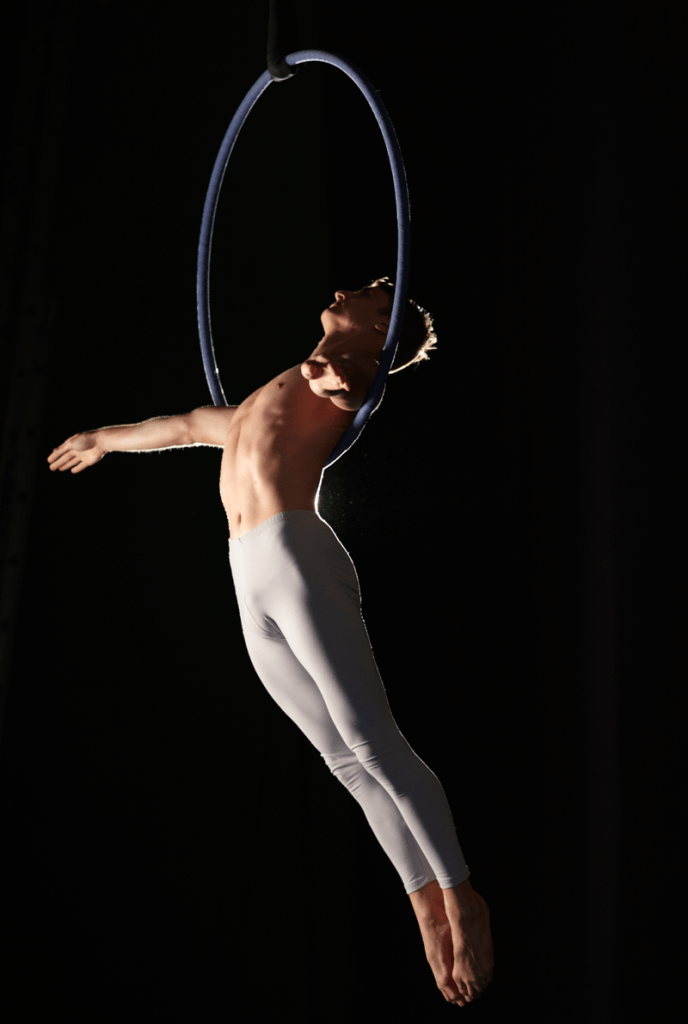
Crucifix on the lyra...one of my favorite moves

Crucifix on the lyra…one of my favorite moves

I fell in love with the lyra, also known as the aerial hoop, from the moment I first mounted one. I remember not being quite sure if I would enjoy lyra, since I had spent several months experimenting with different aerial disciplines, and was still finding my way among them. Here is a summary of the different aerial arts which I had tried, and my impressions of each one.

Pole – I took two pole classes several years ago, and though I was sore in places I didn’t think I would ever be sore in (mostly groin and lower back), I really didn’t enjoy the movements. In addition, the connotation of pole dancing is indelible in my brain, and I just couldn’t get past the feeling that I was a dirty girl for even taking a couple of classes. Both instructors I got were incredibly self-absorbed, and I found them irritating to no end. I also found it humorous that the students were encouraged to explore their sexual energy in the class, because at no point did I feel sexy. If anything, I felt completely foolish and awkward, and basically counted the minutes until class would be over. Yes, it was that bad for me.

Flying Trapeze – Last summer I signed up for a Groupon deal for a flying trapeze class at TSNY-LA on the Santa Monica Boardwalk, and moments after I did so, I had a split second of panic. I remember thinking, oh crap, what have I gotten myself into? Then I took that class in August 2015, and found the experience exhilarating. Once I was on the trapeze, I truly enjoyed swinging and challenging my body to move in new ways. It was the compromise I was looking for, since I had been unable to find adult gymnastics classes to accommodate my desire to return to the gymnastics moves I had learned as a child. I signed up for two more classes at Richie Gaona’s school because I wanted to gain more experience on the trapeze. Unfortunately, my nerves always got rattled whenever I was up on the board, on deck to fly, because that board was so narrow and so high off the ground. I just couldn’t get over being 20 feet up on the air, leaning far forward into the trapeze, while trusting someone to hold me and keep me from slipping off the board. It began to overshadow the joy of flying, so I gave it up.

Silks – I took one class at Aerial Physique, a nice facility in Brentwood which focuses on silks for its aerial offerings. The instructor was a sweetheart, and the class was fun, but my poor ankles did not enjoy the sensation of being wrapped in fabric as my body weight sank upon them for the foot locks I performed. My elbows and hands screamed in agony over the torsion which occurred when I set up for a trick which required me to grip the massive swaths of fabric. Though I enjoyed the beauty of the apparatus, I didn’t like what the fabric was doing to my poor joints, and I also couldn’t remember the complicated trick sequence the instructor wanted the other student and me to learn. This was the first experience I had with instructors who just assumed that you would pick up all the specific vocabulary for all the tricks you were learning, and it irked me. Why on earth would I know these terms if it was my first time taking silks? Grrrrr.

Static Trapeze – I took a class in static trapeze after falling in love with the lyra, so I expected that I would enjoy the experience. What I discovered was that for as much as I loved being on the lyra, I absolutely hated the static trapeze. The ropes were extremely rough and painful to negotiate during some of the tricks we learned, yet they were flexible enough to make me feel quite unstable while up in the apparatus. I did not enjoy the experience of twisting the rope around my thighs and risking significant rope burn and bruising, and my grip strength was definitely challenged by the gauge of the ropes. I didn’t click with the instructor at all either, so I scratched this apparatus off my list very quickly.

Aerial Cube – Now THIS is a fun apparatus, and I definitely intend to take more classes using this. Imagine an open cube, consisting of bars around which you can wrap your body and hang from. It was like being on the monkey bars at the park, and incredibly fun. The only caveat is that since there is a lot of metal, you are basically in a suspended cage, and if you don’t time certain moves properly, body parts like shins can collide with those bars and leave nasty reminders of your time on the cube.

Aerial Cube:
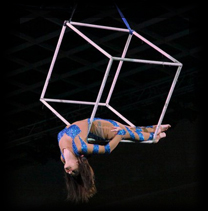
cube

Lyra – Love at first knee hang. Truly. There is something about the simplicity and symbolism of the perfect circle which has a strong appeal for me. The lyra also seems to be incredibly accommodating to many different body types and sizes, because I have seen people of all shapes and heights manage to wrap their bodies around this sturdy apparatus with more ease than some of the other aerial equipment. However, don’t be fooled into thinking that performing on a lyra is easy! In order to properly mount a lyra (or any other aerial apparatus, for that matter), you must have strong abdominal muscles and decent upper body strength. It took me three classes before I was able to properly do a straddle mount without cheating!
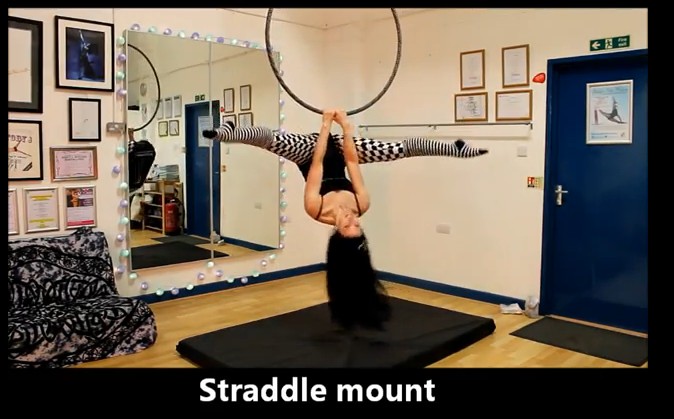
straddle mount

I took my first lyra class at the beginning of May at Aeriform Arts in Hollywood, and am still taking classes, though I have switched for the time being to a facility near my home. I have in fact lost count of how many classes I have taken so far, but it’s been more than a dozen now. Once or twice a week, you will find me swinging from a suspended hoop, enjoying the challenge and not minding the calluses which have taken up permanent residence on the palms of my hands. My back is wider and has more detail as a result of lyra, and my shoulders are also more developed. I don’t mind the fact that my elbows scream from the tendinitis which flares up more often now, nor do I mind the deep ache from my lats which asserts itself if I resume lyra practice full force after a few days of rest. It’s also incredibly empowering to find a new form of creative expression at the half century mark of my life, one which most people my age would be terrified of. I have learned many new tricks, including the Russian splits and Yoga Cat pictured below (no, that isn’t me, but I have performed these moves successfully a number of times).

Russian Splits:

russian splits on lyra

Yoga Cat On Top Strop:

Yoga cat top strop

There is a good reason why the time spent on aerial equipment is referred to as flying, because I really do feel like I am flying when I am in class, free as a bird. I intend to continue this love affair for quite a while!

The Bottleneck Level: National Bodybuilding Events (Repost)

1011848_10201594990895444_1146870848_n

Every single year I watch nationally qualified competitors duke it out onstage in hopes of finally making it through the bottleneck and achieving Pro status. Some competitors get smacked down repeatedly, yet keep hitting the national circuit for so long that they must compete against new blood, further limiting their chances. There are times when I shake my head in wonder over the outcome of a national or Pro event when individuals who clearly should have been in first callouts were neglected. I know that feeling all too well because it has happened to me a number of times. Every year the national level events get bigger, which results in even more pressure and more competition to get through that level and into the big wide world of Pro status. When a competitor finally gets pushed out of the bottle and glides into Pro waters, he or she will bask in it, enjoying the victory, but the majority of Pro competitors soon discover that becoming a Pro doesn’t mean that life will become any easier. If anything, it becomes more difficult, because the bar is set much higher.

Those of us who compete live in a bubble. In fact, I will go as far as to say that when we escape the bottle, we end up in a fishbowl instead of open water. Please don’t interpret this to mean that I lack appreciation for being a Pro, because it is indeed a great honor. But the world at large is a vast ocean which bodybuilding leagues really don’t connect to, similar to the artificial environment which a bowl provides for a pet fish. Bodybuilding is its own world, and though I may love it, I also know that it won’t make me a superstar. Even the biggest bodybuilding legends (except for Arnold) don’t have the full global recognition which they deserve, because bodybuilding is such a niche industry. The only bodybuilders who are household names are the ones who became thespians.

I will admit that when I finally got my Pro Card (after 14 Pro qualifiers), I was relieved and ecstatic because I had finally reached a goal I had set for myself. However, I also fully realize that it wasn’t entirely up to me when or if I would ever get that card, so I always tried my best not to berate myself when I fell short of that Pro card goal. A number of competitors who have been on the national circuit for a very long time have built up a tremendous following on social media channels and have so much power and influence, yet they sell themselves short because they focus on the Pro Card chase as a singular goal. These are precious gems whose shine is only dulled by the disappointment they experience when the sport of bodybuilding edges them out of the winners’ circle.

If you have been competing for a very long time and are getting weary from slipping in national placings or just missing that Pro card too many times, it’s time to take a good look at where your passion truly lies. If your true passion lies directly in the experience of stepping onstage, then by all means continue. However, if you are broke, exhausted, sore and dejected, and you have a true passion beyond the stage for inspiring others to reach fitness goals, then why not BREAK the bottle and swim into the wide ocean? If you build a name, a brand, and a following, you can establish a presence in the real world which will enable you to impact others in the truest sense. In addition, you might stand to make some decent money from nurturing your passion for fitness. Honestly, how much money have you made from competing? Just saying.

How To Assess A Client For Body Asymmetries (repost)

Asymmetric Musculature

I originally wrote this piece for AFE and am reposting it here.

Fitness pre-testing is a valuable tool for evaluating movement patterns and assessing a client’s strengths and weaknesses. The information gathered from such testing can then be utilized to develop a customized program which addresses and corrects functional abnormalities. The more thorough the pre-testing, the better equipped a trainer is to help the client reach optimal potential within the training program, while also guarding against injuries which the client might be predisposed to as a result of compensatory patterns.

Many people have developed compensatory patterns over time. Sometimes structural abnormalities exist from birth, or develop in childhood, and often throw surrounding soft tissues and joints out of alignment. In other cases, injuries from sports or other activities can cause a person to begin favoring one side of the body in an effort to reduce the stress load on the injured side. The problem with these compensatory patterns is that they allow the weak or restricted side to become even worse over time. Because of this, functional weight training should always address these patterns in an effort to correct them.

How To Determine Asymmetry

One of the most valuable early tests for determining structural asymmetry is the single leg stance, in which the client’s ability to stabilize the trunk over the supporting leg is determined. Misalignments of the hips, knees, or ankles/feet can be detected easily with this screening tool. For example, if one hip joint is restricted or otherwise unstable, the client will shift weight in an effort to maintain balance. A trainer can then utilize the information gathered from the single leg stance test to focus on compromised function in a joint or extremity.

Clients will frequently exhibit asymmetries in strength, range of motion, or muscle recruitment which can easily be overlooked if a trainer doesn’t have a practiced eye. Because of this, a thorough assessment of the client’s posture, range of motion, and form should be implemented before training begins so that the trainer can identify and properly address compensatory movement patterns.

Let’s say a client exhibits poor movement while performing a basic bodyweight squat, the source of the dysfunction must be determined so that the trainer can correct it. Is the limitation is coming from the foot, the knee, the hip joint, the pelvis, or the sacrum? Is the issue one of limited mobility, muscle weakness, joint instability, or of poor muscle activation? The origin and the nature of the dysfunction will determine which corrective exercises should be added to the client’s program.

Sports and Compensatory Patterns

Asymmetries are especially common in people who engage in sports such as baseball, golf, soccer, football, and tennis, which rely heavily on one side of the body. Because of this, it is important to ask clients if they currently play sports or have played them in the past. It is also important to ask clients about any past injuries which may be contributing to current compensatory patterns. Compensation results from a number of factors, including muscle weakness, impaired joint mobility, musculoskeletal asymmetry, leg length discrepancy, previous injury, and even joint stress from obesity. Joints can become lax and unstable, forcing contralateral muscles to take the brunt of the movement in order to stabilize the dysfunction. What often results is overuse in the compensating region, which in turn adversely affects the client’s training, and also reinforces the asymmetry.

Minimalist Footwear (repost)

minimalist-shoes-5

I wrote this article for AFE last year, and am reposting it for you to enjoy.

Less Is More

Are there benefits to training in minimalist footwear? Studies have demonstrated that training while wearing minimalist shoes results in enhanced performance, due to greater foot pliability and a closer approximation to a barefoot stance. Since our feet adjust to wearing raised heels over time, it can be incredibly challenging to keep our heels on the ground while performing exercises like deep squats. Proponents of minimalist footwear may even argue that barefoot is best for heavy weightlifting, but the risks of exposure to microbes or hazardous fragments of glass, metal, or rocks, make minimalist shoes a much more feasible choice while at the gym.

Dysfunctional movement patterns become established throughout the body over time. Conventional athletic shoes can often contribute to ankle and foot dysfunction because they inhibit natural foot action. If you don’t believe it, then try to perform some of your physical activities barefoot and see how well, or poorly, you perform. Chances are that the impaired mechanics in the feet and ankles will make it difficult at best to perform those activities. By gradually switching over to minimalist footwear, an athlete can essentially correct improper foot mechanics and optimize kinetic feedback throughout the body during movement.

Benefits Of Minimalist Shoes

Conventional athletic footwear features a cushioned heel which also can compromise power. In contrast, minimalist footwear features little to no heel, and the soles are very thin and malleable, so they allow the joints in the foot to move and adjust to weight loading movements. In addition, the heels and midfoot make solid contact with the floor, causing more activation in the glutes and hamstrings. Studies have demonstrated that people who wear minimalist footwear develop greater strength in their legs and feet, since more power is transferred from the working muscles, through the feet, and into the movement. Plyometric movements and sprint power will also be enhanced while wearing minimalist shoes.

A 2011 study by Squadrone and Gallozzi assessed the ability of experienced runners to estimate the degree of inversion, eversion, dorsiflexion, and plantarflexion, of a slope surface board placed under their right foot while standing. They found that the degree of proprioceptive feedback which subjects received while wearing Vibram Five Fingers® was much more accurate than in subjects who wore a standard running shoe. In conclusion, cushioned shoes conferred a distinct disadvantage when compared to minimalist shoes during assessment of foot position awareness.

How To Transition Into Minimalist Shoes

Anyone who is transitioning from conventional athletic shoes to minimalist footwear needs to do so gradually, since the body has to adjust to radically different proprioceptive input. There have been cases of metatarsal stress which developed after converting too quickly to minimalist shoes. However, once the transition is made, noticeable strength gains should occur. Try spending about 15 to 30 minutes, twice a day, wearing minimalist shoes around the house. After about a week or two, you can try them out at the gym one to two days a week until you become accustomed to the feel of the shoes. Be aware that your gait and foot stance will probably change as you acclimate to this type of shoe.

REFERENCES:

1. Squadrone R, Gallozzi C (2011) Effect of a five-toed minimal protection shoe on static and dynamic ankle position sense. J Sports Med Phys Fitness Sep;51(3): 401-8.

Offset Load Training

weight plates

Introduction

Offset load training is a training approach in which different loads are used on the right and left sides of the body during an exercise, challenging the body to adjust. If you have ever dealt with clients who have demonstrated asymmetry in strength or power between one side of the body and the other, or who have visible differences in muscle mass when comparing each side, and have addressed their asymmetry solely with isolated unilateral movements, you can implement offset load training as a very effective way to break through training plateaus and to address accumulated asymmetry between the right and left sides of the body. Offset load training is not only more challenging than isolated unilateral exercises, it also results in more neural connections and greater kinetic efficiency.

Asymmetries in strength or muscle development most commonly result from natural dominance on one side, but they can also emerge as a result of injury. During bilateral training, the stronger side will always compensate for the weaker one by taking on more of the load, so the weaker side remains at a disadvantage. In contrast, unilateral and offset movements force each side of the body to bear the load fully and independently, effectively forcing the weaker side to work. Over time, differences in strength between each side are diminished as a result of this type of training.

Benefits Of Offset Load Training

One of the greatest benefits of offset load training is greater trunk stability and strength. Any time you perform a unilateral or offset movement (think of using a shovel), you activate your abdominal muscles in order to resist rotational forces and maintain a neutral spine. Another benefit of offset load training is that offset exercises challenge the nervous system to adapt to the unequal weight distribution by recruiting muscles in a coordinated fashion to maintain balance. You might be surprised by how much your client’s overall strength will increase as a result of improved conditioning in the smaller stabilizing muscles of the trunk. This is because enhanced balance and trunk strength stabilize the extremities and transfer power to them. In other words, if the muscles in the trunk are more efficient at stabilizing the spine, the limbs will benefit from greater power.

How To Add Offset Load Training To A Client’s Regimen

Offset load training works with most barbell and dumbbell movements and can be easily incorporated into a client’s training regimen. You can use this form of training as an adjunct to bilateral movements in a client’s plan. When selecting weights, make sure the difference in weights between sides is moderate, and keep the rep range around eight to twelve reps. Instead of handing dumbbells to your client, have the client lift them so that the muscles of the trunk will become activated even before the exercise is performed. If you are using a barbell, load each side with a different number of plates. If using the double cable assembly, set the pins at different weights. Be sure to monitor your client closely during this type of training, especially those relatively new to lifting weights who have poor balance and coordination.