
Back in the day, the topic of gender boiled down to biology, defined by one’s sex chromosomes. XX, and you were female, XY, and you were male. Chromosomal disorders such as XO,XXX, XXXX, XXXXX resulted in individuals who possessed female genitalia, while XXY, XXXY, XY/XXY, XYY aberrations resulted in the expression of male genitalia. True hermaphroditism (1), in which both female and male genitals or a hybrid of them exist, is exceedingly rare, so much so that there has never really been a pressing need for a third gender box.
In recent years, however, there has been so much debate and confusion regarding gender versus sexual orientation and identity, that surveys are jumping on the bandwagon to appease to this new crop of outspoken individuals. Biology has abruptly taken a backseat to sexual identity, with all its permutations and definitions. And don’t you dare try to argue biology with the new sexual order, either.

Call me old school, but if we are talking about biology, then there are MALES and FEMALES. For the purposes of the general human population, such genetic definitions accommodate the vast majority of individuals. So if a questionnaire or survey asks someone to check off a GENDER box, it shouldn’t be an insult to a person to mark one of those two boxes. Yet the new millennial order has eschewed biology, turning the query into a chance to declare specific social-sexual preferences. I have never been offended by the standard gender question, and cannot understand how some people insist on applying flawed logic and getting bent out of shape over it.

If gender is such a difficult issue in today’s society, then why do so many couples post gender reveals on social media? It’s either a boy, or a girl, period. Traditionally, when a survey asked for your gender for classification purposes, it wasn’t asking about your bedroom habits. Now it’s a wide open door for people to declare their defiance and independence from a staid society which has been sexually repressed for far too long. It’s suddenly cool when gathering demographic information to inquire about a person’s whole social identity.
I was prompted to write about this topic when I was asked to complete a profile for a social influencer platform. When I reached the gender section, I saw that it was FIVE PAGES LONG. There were 52 different gender choices. I was stunned. This wasn’t a gender question. This was a social-sexual labels question. And it truly annoyed me. It’s not like I have a problem with the labels, I just have a problem with them being referred to as genders. I also don’t quite understand how transgender people suddenly became so ANGRY at the world.
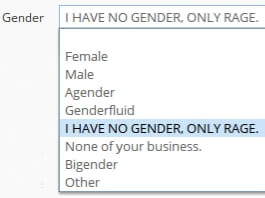
Honestly, many of the labels are redundant, and one in particular should not be used by the majority of the nonbinary public. Say someone identifies as the following:
AFAB (assigned female at birth)
Female to male
FTM
Trans male
Trans man
Transgender male
Transgender man
Transmasculine
Transsexual male
Transsexual man
Guess what? They all (except for AFAB, which already implies that the individual has rejected their biological origin) say the SAME THING.
Also, anyone who refers to themselves as Two-spirit has no right to use that label unless they truly are members of the indigenous Native American community from which the phrase originated. Here’s the description of “Two-spirit”:
Two-Spirit (also two spirit or, occasionally, twospirited) is a modern, pan-Indian, umbrella term used by some Indigenous North Americans to describe Native people in their communities who fulfill a traditional third-gender (or other gender-variant) ceremonial role in their cultures.
The term two-spirit was created in 1990 at the Indigenous lesbian and gay international gathering in Winnipeg, and “specifically chosen to distinguish and distance Native American/First Nations people from non-Native peoples.” The primary purpose of coining a new term was to encourage the replacement of the outdated and considered offensive, anthropological term, berdache. While this new term has not been universally accepted—it has been criticized by traditional communities who already have their own terms for the people being grouped under this new term, and by those who reject what they call the “western” binary implications, such as implying that Natives believe these individuals are “both male and female”—it has generally received more acceptance and use than the anthropological term it replaced.
“Two Spirit” is not interchangeable with “LGBT Native American” or “Gay Indian”; rather, it was intended, despite being in English, to carry on the traditional meanings of the terms in Indigenous languages for the culturally-specific ceremonial roles that are recognized and confirmed by the Elders of the two-spirit’s ceremonial community. Opinions vary as to whether or not this objective has succeeded. Often incorrectly used as a synonym for “LGBT Native”, the term and identity of two-spirit “does not make sense” unless it is contextualized within a Native American or First Nations framework and traditional cultural understanding. However, the gender-nonconforming, LGBT, or third and fourth gender, ceremonial roles traditionally embodied by Native American and FNIM people, intended to be under the modern umbrella of two-spirit, can vary widely, even among the Indigenous people who accept the English-language term. No one Native American/First Nations’ culture’s gender or sexuality categories apply to all, or even a majority of, these cultures.
Oh, and Two-spirit is NOT a gender per biological standards either.
It’s fine if someone doesn’t want to be pigeonholed into a stereotypical gender description, and identifies as being transgender. In fact, there is legislation which aims to designate X as a gender marker for nonbinary and transgender individuals, and apparently, this option is available on birth certificates issued in the Canadian province of Ontario. However, I rail against the idea that the standard gender question on surveys and other forms must add a whole mess of redundant descriptions of sexual and social behavior.
REFERENCES:
1. A Human Intersex (“True Hermaphrodite”) with XX/XXY/XXYYY Sex Chromosomes
Fraccaro M.a · Taylor A.I.b · Bodian M.b · Newns G.H.b. Cytogenetics 1962;1:104–112
https://doi.org/10.1159/000129719


 dr. stacey naito's blog