
Copyright: olegdudko
Last year right around Christmas, I taught my dear friend Karla how to make origami cranes, and though she struggled at first, she began to get the hang of making them. She thought they were pretty neat, and asked if they were ever made for a specific purpose, so I told her about the tradition of making one thousand cranes and stringing them up to hang for a number of different occasions, including making a wish for an ill person’s recovery, the birth of a child, wedding blessings, or to grant good luck within a home. Senbazuru (a thousand cranes) is the Japanese way to make a wish and bless it so that it might come true.
Emma Taggert offers an explanation of how the origami crane emerged in Japanese culture:
“The tradition of the Japanese orizuru (ori– “folded,” tsuru “crane”), or paper crane, began in feudal Japan (1185–1603 CE), when people gifted each other the paper figures as symbols of honor and loyalty. However, it wasn’t until the 16th century that the art of the origami crane was officially recorded. Hiden Senbazuru Orikata (“Secret to Folding One-thousand Cranes”), published in Japan in 1797, is the first known book on origami. It features the earliest known instructions on how to make origami cranes, along with countless examples of different kinds.”
Since I grew up making origami cranes, I can quite literally make them with my eyes closed, but I understand that for someone who is unfamiliar with origami, making that first crane can be a challenge. Here is a video tutorial for those of you who want to learn how to make one:
For those of you who already know how to make origami cranes, you might want to challenge yourself with renzuru, a form of origami in which multiple forms are made from a single piece of paper:
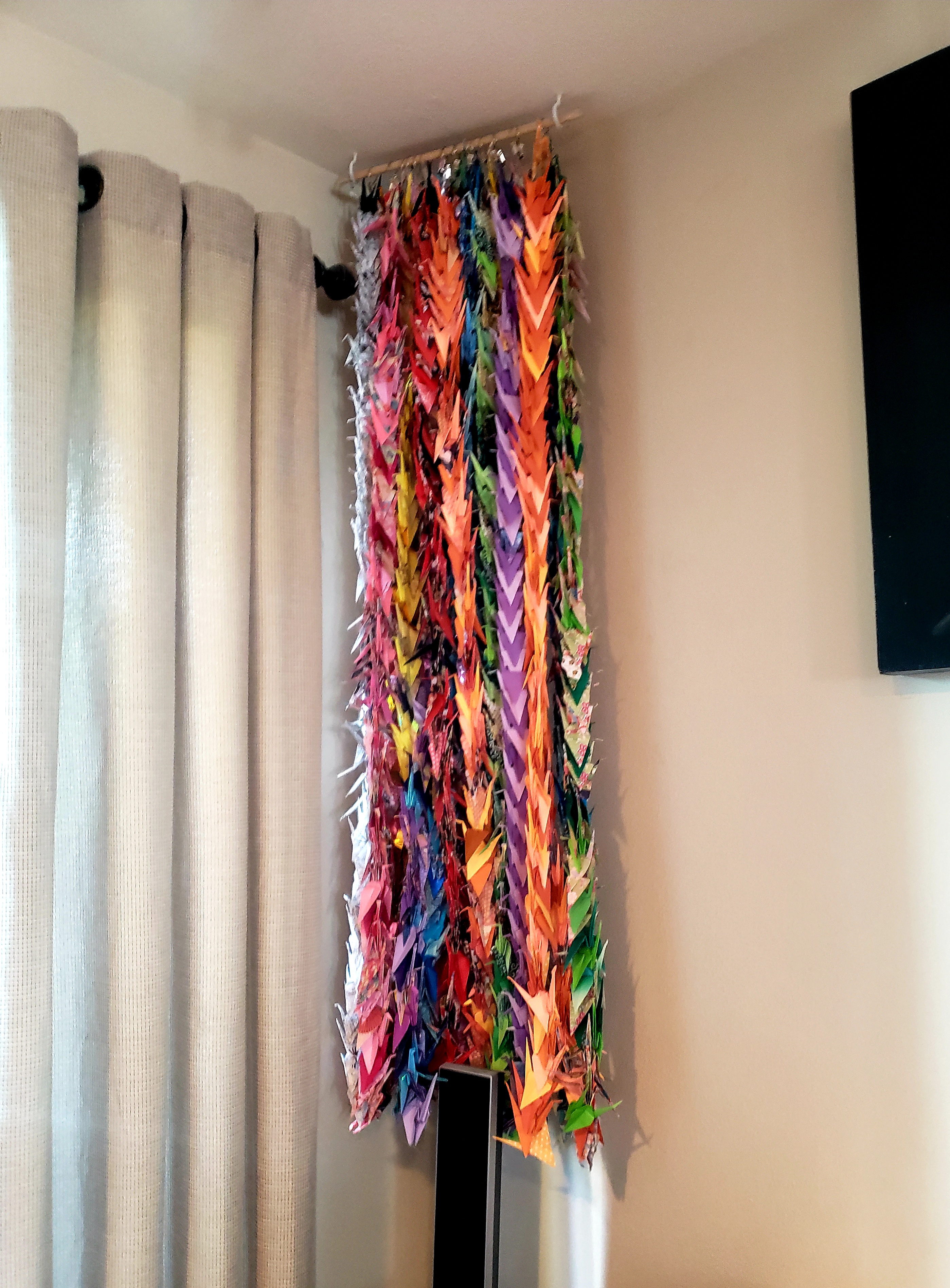
Getting back to my friend Karla, she amazed me in July when she gifted me with a thousand cranes for my birthday. I wasted no time in gettting a dowel and hooks for the cranes so that I could display them in my living room. Once they were hung, I realize I had chosen a great spot because during the day, the cranes catch the sunlight, and in the evening, the uplights which I have behind my sofa impart a lovely glow on them.

 dr. stacey naito's blog