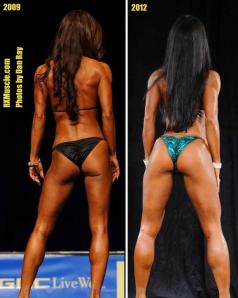
Another Great Post from Siouxcountry.com! Comparison Booty Shots From 2009 and 2012

Liked · 2 hours ago

On your timeline · Hide

PROGRESS!

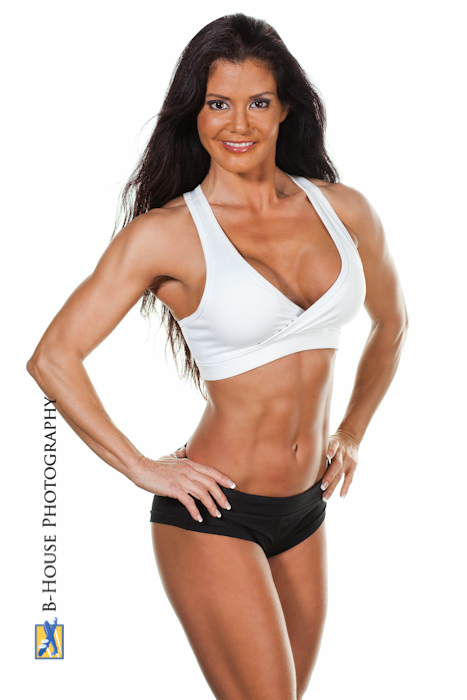
Masters bikini competitor Stacey Naito didn’t place at her first National show in 2009. Three years later she looked her best at the 2012 IFBB North American where she placed 7th in her open class and won her masters class! Well done Stacey! Her page……… Stacey Naito National NPC Bikini Champion ………More before and after photos on…….. Siouxcountry.com

Photo credit: Dan Ray / RXMuscle.com — with Stacey Naito.


2009 to 2012 Comparison

How To Select Athletic Shoes

With all the brands, types and styles of athletic shoes that exist these days, it may be challenging to figure out which ones to buy.  As a response to the questions I get about this, I have compiled a list of tips to help you navigate through the choices out there and select footwear that is ideal for the type of activity you plan to engage in. 

Select shoes appropriate for your feet.  Most of us know whether we have narrow, medium width or wide feet, but do you know what type of arch you have?  A good way to assess this is to do what is called a “wet test”. To do this, you will need a piece of brown paper like the type that is used for brown paper grocery bags.  Wet the bottom of your foot, step onto the paper (make sure to put your full weight on that foot) and trace your footprint.  If you have a print with little to no curve on the inside edge, you have flat feet and your feet tend to roll inward (overpronation).  This type of foot needs a shoe which gives good support to prevent movement.  If your footprint shows a large empty space in the inside edge and there is a narrow connection between your heel and forefoot, you have high arches and tend to turn outwards (supination).  This type of foot needs a soft and cushioned midsole.  If your footprint is somewhere in-between, you have a neutral arch and should choose a shoe with a mix of support and cushioning.

If you wear an orthotic, bring it.  You should also bring the socks that you usually wear when engaging in whatever activity you are buying the shoes for.  I have heard of people who have made the mistake of fitting shoes to their feet when wearing socks that are either thicker or thinner than what they are accustomed to wearing, which results either in the hassle of making an exchange or return or the pain of wearing ill-fitting shoes.

Shop later in the day.  During the course of the day, feet will expand, which means they will be their largest towards the evening.  When determining the fit of a shoe, it is important to take this into consideration and fit to your feet when they are their largest to avoid disfomfort.

Make sure shoes are comfortable and enable the movements your sport requires.  While athletic shoes should be comfortable while standing in them, it is also a good idea to engage in jumping, lateral movements or whatever foot motions mimic the types of movements you will do while wearing the shoes.  Take note of any shifting or discomfort.

Buy a pair of shoes that fit well.  There should be about ½ inch between the front of your big toe and the end of the shoe.  A quick guide which you can use is your thumb.  When you lift off with your heel, the shoe should not slip off the heel at all.  You should be able to wiggle your toes while wearing the shoes, but the shoe should also feel secure around your foot.

Don’t go cheap!  I see a lot of people grab athletic shoes that are on clearance which aren’t the best fitting or the best constructed shoes for them.  This is not to say that you can’t find a decent pair of athletic shoes on sale, but try not to head straight for the bargain bin when you are searching for shoes.  Your main objective should be to find a well-constructed pair of shoes which fits your foot well and is designed for the activity you will use them for. 

Replace shoes before they completely fall apart.  I always find it amusing when I see guys at the gym wearing shoes that are tattered.  I wish I could just ask them, “If you care about your conditioning so much, why do you neglect your feet which are bearing all the weight and pressure you put on them during your routine?”   Most people can expect to replace their shoes every six months, or until they begin to notice that the shoe feels less supportive or develops areas which are uncomfortable.  Another gauge is to check the back of the sole frequently and to replace the shoes once that area begins to appear worn out. 

Buy shoes which are task-specific and expect to have multiple pairs.  Not all shoes are created alike.  A cross-training shoe is designed for midfoot support and has tread which enables lateral movements.  A walking shoe, in contrast, is rather rigid and is designed to minimize foot movement.  Running shoes are quite flexible but are also built with extra cushioning to absorb the high impact of the foot-strike on the pavement. 

If you exercise frequently, purchase several pairs.  If you get in the habit of rotating through your shoes, you will allow your shoes to air out between uses and will also extend the wearability of your shoes since you will be alternating through your collection.  I currently have eight pairs of athletic shoes in rotation and make sure to wear the type of shoe which is appropriate for the activity I plan to do on a particular day.  For example, I wear my running shoes when I plan to do high intensity intervals on the treadmill, and I have other shoes designated as my plyometrics shoes, my leg day shoes and my general lifting shoes. 


This was posted by SiouxCountry.com yesterday!! WHOOT WHOOT!!

Like This PageLiked · 5 hours ago

On your timeline · Hide

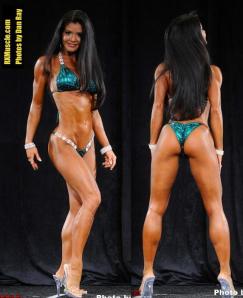
AWESOME! Stacey Naito in her mid 40s has been competing in bikini at the National level for a few years. At 46 years young she looked her best yet at the 2012 IFBB North American. Placing 7th out of 30 women in her open class & 1st in her masters class! Her page……….. Stacey Naito National NPC Bikini Champion …..More photos of women that compete on…… Siouxcountry.com Photo credit: Dan Ray / RXMuscle.com — with Stacey Naito.

 Post on SiouxCountry 12.11.12

Why I Prefer To Work Out Alone

As a physician I meet new people constantly and have mastered the art of setting a patient’s mind at ease.  I am amenable to chit-chat when running errands and enjoy engaging in conversations with strangers while at social events.  However, when I am at the gym, I automatically shift into a “don’t mess with my flow” mode which has left other gym members with the distinct impression that I am some sort of ice queen.

I have made numerous attempts over the years to train with friends and at the conclusion of every one of those training sessions have resolved to avoid such scenarios at all costs.  Thus in my estimation having a training partner has a completely ergolytic effect on my regimen.  Though I recognize the utility in having a supportive human by one’s side to encourage one more rep, such commentary from a pep squad only serves to distract me and in some cases raise my ire.

I have spent my entire life as an aggressive self-starter.  Without such drive I would never have endured the rigors of medical school and residency.  As an NPC national Bikini champion I have consistently pushed myself to reach a personal best, which has been no easy task given the demands of my career and life in general.  I stroll into a gym with my equipment and my regimen for the day like a thoroughbred horse lining up at the gate, blinders in place, ready to charge towards the finish line at full speed.  It certainly doesn’t help that I am usually in an incredible rush to get to the office or a meeting and must keep moving from movement to movement.  You can imagine how I respond to the weekend warrior who decides to wipe the drool from his chin and ask me while I am in the middle of a set how he can get his abs to look like mine.  So the mere thought of spending my entire gym session hyperaware of my time constraints while trying to work in on gym equipment with a training partner is more anxiety-provoking than a trip to the dentist.

If you and your training partner are completing staggered supersets, I suppose you could yell words of encouragement at each other.  If there is sufficient equipment for two side-by-side setups, or if you are engaging in plyometrics, it is possible that you may both train simultaneously.  However, if you are taking turns on equipment, especially if you are using different weights for each set, a thirty-second rest could easily broaden into 60, 90, 120 or more seconds as you load or re-rack or perhaps have a good laugh about the Facebook post one of you just saw on your cell phone.

With all that said, I realize that some individuals thrive in a workout regimen which includes a training partner.  After all, a supportive and upbeat buddy could consistently push you beyond what you believe you are capable of with respect to strength, power and endurance.  If this is what your training partner possesses, and this person is easily able to surrender the cell phone along with idle chat for the duration of the workout, you are quite lucky indeed.

A Bikini Athlete’s Favorite Abdominal Exercise

I admit that abdominals are my favorite of all the body regions to train and have been for my entire adult life.  In fact I cannot think of a single time that I balked when it was time in my training split to work my abs.  This makes designating a particular abdominal exercise as my favorite especially challenging for me, since I consider very move to be a valuable component of an abdominal routine.

After having evaluated the level of motivation I have during each abdominal exercise, I have determined that my top abdominal move is the decline bench crunch.  If you have not performed this exercise before (and yes, I realize that many of you are already familiar with this move), I would highly recommend that you incorporate decline bench crunches into your routine.  Decline bench crunches are excellent at targeting the rectus abdominis and hip flexors due to the increased range of hip flexion which occurs on a decline bench.

Adjust a decline bench so that it is at a 30 to 45 degree angle (the more advanced you are, the greater the angle you can use).  Sit on bench with your feet hooked under the rollers and lie back on the pad with your arms folded across your chest.  Exhale as you bring your head, shoulders and back off the pad, coming to a full sit up position, then return slowly to start position.  You can perform 12 to 20 reps per set, 3 to 5 sets, but I will admit that when I do decline bench crunches, I perform 5 to 6 sets of 30 reps.  If you crave an extra challenge, extend your arms overhead while you perform this move. 

Decline bench crunches can also be performed with a twisting motion at the top of the move, recruiting the obliques and serratus anterior.

Those of you who are really looking to punch up this exercise can perform a weighted variation of this move in which you hold a dumbbell behind your head, hold a plate on your chest, or pull on a cable during the exercise.

After incorporating decline bench crunches into your training split, don’t be surprised if people begin noticing your washboard abs!