This 94-Year-Old Grandmother Is A Champion Powerlifter

I am utterly shocked and completely impressed by this lady! Read on to find out how she got started at the age of 91. This totally proves that you are NEVER too old to lift weights!

Original post can be found at:
http://www.mindbodygreen.com/0-22172/this-94-year-old-grandmother-is-a-champion-powerlifter.html

by Emi Boscamp, MBG Editorial – October 16, 2015 5:25 PM

A 94-year-old woman can dead lift 135 pounds. What did you do today? (Yeah, I didn’t do much of anything either.)

Floridian Edith Traina is a grandmother — and that’s an accomplishment in itself — but she’s also a champion powerlifter. She started doing it at the tender age of 91 and has since become addicted to the competition, reports FOX13 Tampa.
“(My friend) dragged me kicking and screaming to the gym, and I figured I’d keep her happy for a while and get her off my back, but I got hooked,” Traina (which, by the way, is the most fitting last name possible) told FOX13 Tampa.

Since then, the self-described “champion” has competed in more than a dozen competitions, is the only person in her age group, and hopes to be able to lift 200 pounds by the time she hits 100. Though it may be good for her health, she does it because of how it makes her feel emotionally.

“With this, I just walk up, lift it, put it down. I get all these applause — great for the ego,” she said.

Watch her do her thing below (and prepare to feel like a bum). Keep on trainin’, Traina — we’re rooting for you!

Nutrient Timing

nutrient-timing
If you are at all interested in optimal fitness, you need to be aware of what nutrients your body needs in order to build muscle and metabolize fat as well as optimize performance. This is better known as nutrient timing. Proper timing of the foods you eat will support hormone function and promote a lean and muscular physique, while eating the wrong foods at the wrong time will trigger fat deposition, loss of muscle, and longer post-workout recovery times.

When nutrient timing comes into play, the goal is to shift body composition so that fat loss and muscle gain are optimized and glycogen stores are maximized. Such shifts have long-standing health benefits which can effectively prevent development of major diseases such as diabetes and high blood pressure. One caveat is that consuming excessive amounts of food will result in fat gain regardless of nutrient timing.

During training days, you should consume higher amounts of protein and carbohydrate and decrease your fat intake. The general rule is to consume about 1 to 2 grams of carbohydrates per pound of body weight, with most of your carbs consumed post-workout. On your rest days, you should consume higher fat and protein while dropping your carb intake to about 0.5 grams per pound body weight. The rationale behind this is that you want to encourage higher insulin levels post-workout, but lower insulin levels at all other times.

You may want to bump up your carbohydrate intake a bit throughout the day if you are looking to gain muscle, since insulin stimulates growth or anabolism. You can also ingest carbs throughout the day if you are already lean and just want to maintain. However, if you are looking to lose body fat, you need to consume most of your carbs during and post-exercise, and consume mainly protein and fat during all other times.

I Can’t Eat That! – Balancing Healthy Eating And Normal Life

Fast_Food hottie

There are countless challenges and roadblocks which can derail us from our efforts to follow a healthy meal plan, especially when we are faced with the indulgent foods that emerge during the holidays. Whether you are a seasoned competitor who is accustomed to following a strict meal plan, someone who wants to adopt healthier eating habits, or battling excess body weight, it can be very difficult to pass up regular restaurant meals, fast foods, and holiday treats. However, it IS possible to stay on track even in the face of such temptations.

The first and most important thing is to remember your GOAL, whether it is improved health, weight loss, or getting into contest shape for an upcoming event. Your goal should serve as a tangible mark which you are aiming for. I always tell my patients and weight management clients to post images of people who possess the type of physique they covet in a prominent place (such as a refrigerator) so that they can be reminded of their specific goal.

Here are other effective strategies to help you follow a healthy meal plan:

1. Keep forbidden foods out of the kitchen so that the temptation to eat something unhealthy is removed. This means that you need to avoid purchasing chips, crackers, cookies, ice cream, packaged pasta dinners and whatever other unhealthy foods you tend to gravitate towards. If unhealthy foods are not in your kitchen cupboards, you won’t be tempted to grab them and indulge.

2. Prep your meals at home beforehand. Meal prep can be tedious but it is well worth it when you consider the control you will have over what goes into your body. You can control ingredients, cooking method and portion sizes and maximize your chances of maintaining healthy eating habits. Once you have prepared your food, you can store single serving sizes in individual storage containers which are easy to pack when you need them.

3. Invest in a great food cooler bag. Trust me, you NEED one of these!

4. Make sure your meal plan is balanced. The best meal plans have lean protein, healthy fats and slow digesting carbohydrates. Do not fall into the trap of thinking that all fat is bad! You need certain healthy fats to maintain normal cellular function.

5. Avoid fast food restaurants. Fast food restaurants (and most restaurants for that matter) feature extremely unhealthy options which can completely destroy your efforts at reaching your health and fitness goals. You will also save a ton of money by avoiding the calorie and saturated fat laden options found at such establishments.

6. Don’t cave in to peer pressure. I don’t know what it is about friends and family, but it seems like they get some twisted thrill out of convincing others to eat forbidden foods. If you find yourself in such a situation, you need to ask yourself if it is worth unraveling your healthy eating habits in order to appease a relative or buddy. I have heard, “Awww, come on, a couple of bites won’t hurt ya!” from people who usually mean well but who are unaware of the psychological torture they might be putting me through. I honestly don’t want to be pressured into consuming something that will make me feel guilty or will not digest well . It isn’t worth it!

So Excited For Everyone Competing At NPC Nationals This Weekend!

The NPC Nationals will be taking place this weekend, with over 1,000 competitors! This is the largest NPC National event in history. The best way to get a glimpse of what is occurring in Miami this weekend, I have included a video introduction here from J.M Manion. For those of you who don’t know who this awesome man is, here is his Twitter profile description, which I absolutely love:

Professional Photographer & Journalist for NPC News for 30 years. Owner of multi-media company J.M. Manion Productions, Inc. & Jedi Master

Yes, indeed! He IS a Jedi Master! Or wait, isn’t he Batman? Those of you in the loop will get the reference!

Best of luck to everyone competing!

Getting Back On The Horse: Returning To The Gym

Please check out my latest article for Sports Nutrition Supplement Guide! Please read original post and see the site here:

http://www.sportsnutritionsupplementguide.com/training/training-tips/item/1549-getting-back-on-the-horse-returning-to-the-gym#.Vkpn9RCrSi5

Horse_Gym_310x250

Perhaps the ebb and flow of life has thrown you off your fitness routine, and you are ready to return to the gym. It might be that you are post-partum, or had to nurse an injury or illness. Or it could be that you have been moving at such a frenetic pace in your life that you got sidetracked from your “every damned day” gym schedule, and need to get back into the groove. Whatever the reason is for putting consistent gym visits on the back burner, the good news is that you can re-establish a consistent fitness regimen. In order to ensure the greatest success with your efforts, here are some suggestions which will motivate you and keep you on track.

Set Goals

I bet some of you may have forgotten about the power of setting specific goals for yourself. It may be that you have been away from the iron den for a long time, so you might want to set strength gain goals in which you move up in your 1 rep max every two weeks, increase the number of free dips or pullups you can perform every few weeks, or even increase the amount of time you hold a plank.

Another type of goal you can set for yourself is to increase muscle mass in a measurable way, perhaps a one inch increase in your calf girth over a 6 week period, for example. Instead of meandering back into the gym and having a general objective, like just getting back in there, make sure to hang a carrot in front of you so that you are even more motivated to stick to the program.

Be Realistic

Thank goodness for muscle memory, because it enables those who are at a high level of fitness to regain their muscle mass and strength rather quickly after a period of inactivity. However, those who were at a lower level of fitness at their baseline will lose muscle and strength pretty rapidly, after even as little as two weeks of not lifting weights. Depending on what your degree of muscularity or strength was before your setback, you will have to give yourself some time to build back up to previous levels of muscle mass and strength. If you find yourself with more padding around the midsection, glutes, or thighs than what you had when you were hitting the weights consistently, make sure that you target fat loss with your training and food intake.

Eat Properly

You can’t expect to achieve stellar results just by hitting the weights like a fiend, while putting junk food in your body, so make sure to establish healthy eating habits to support your return to lifting weights. If your eating habits have gone by the wayside, incorporate a consistent meal plan which provides your body with clean macronutrients and supports your weight training. Throw out the forbidden foods which may be lurking in your kitchen, such as sweets, crackers, chips, and ice cream. Stock your kitchen with whole foods like lean turkey, chicken breast, salmon, eggs, green vegetables, sweet potatoes, brown rice, almonds, walnuts, and avocado. Confine cheat meals to one evening on the weekends.

Don’t Overtrain

Make sure to give yourself time to get back into the swing of things, especially if you are returning after an injury or illness. You MUST take it easy, otherwise you run the risk of injuring or re-injuring yourself, causing an even bigger setback. If you were very fit before you took your break, your muscle mass and strength should both return to their previous levels within a couple of weeks.

Pushing Through – Dealing With Troubling Times

Life is not about how hard you can hit, but how much you can get hit & still keep moving forward. -Rocky Balboa
bull
It is commonplace these days to hear people say that times are tough, and indeed they are. Truth is, there will ALWAYS be something we will be forced to contend with. At times those challenges can be so trying that they threaten to break our spirit and obscure the light at the end of the tunnel. However, it is imperative to push through those trials and tribulations while remembering what our goals are.

Your goals may be long term and centered around a career aspiration or the pursuit of an avocation for which you have great passion. Perhaps you have a weight loss goal or want to improve your general health. Or maybe you compete and are chasing after that elusive Pro Card or Olympia qualification. Chances are that any challenges which hit unexpectedly have no direct correlation to these goals, so why allow them to push you off course? You may get knocked around a bit, but the important thing is to get back in line with that prize you have set before you.

It always amazes me to hear patients and clients describe how they abandoned their meal plans and exercise regimens, and thus their fitness and health goals, when they were forced to deal with stressful life events such as divorce, legal issues, job loss, or family illness. What goes through my mind when I hear such things is that these people are doing themselves a disservice by dropping a regular regimen which has immense long term payoffs. A thread of stability is established when there is consistency with food intake and exercise which can actually lessen the impact of life stressors. Energy levels are boosted, depression is minimized, and an individual can assert his or her own personal needs in the face of adversity.

So if tough times are getting you down, remember to put the oxygen mask on your own face and take care of your own needs. Those who persevere will be rewarded after the storm passes. Hang in there!

The BEST Health Insurance Policy – REPOST

Health apple

With the recent upheaval in the world of health insurance coverage, I thought it would be a perfect time to talk about ways that we can safeguard against the need to access insurance benefits and keep our out-of-pocket costs to a minimum. If you have a predisposition towards conditions such as high blood pressure, diabetes, high cholesterol, joint issues, depression or anxiety, a little self-nurturing can go a long way in keeping those issues at bay. Though there is no absolute guarantee that being proactive about your health will completely prevent disease from manifesting in your body, you can minimize the chances by following sensible guidelines.

1. Get Regular Exercise: If you have yet to take part in regular exercise, here are a bunch of reasons why you should. First of all, regular exercise supports and encourages healthy circulation, lowers blood pressure and reduces cholesterol levels. It also reduces your risk of developing type 2 diabetes and some types of cancer. When you strengthen your muscles with resistance training, you protect your bone density and improve your mobility. There are also mood-elevating benefits which exercise confers which can push away depression and anxiety. Lastly, exercise keeps your mind and memory sharp as you age. A good plan is to exercise 30 minutes a day, 4 to 5 days per week at a moderate intensity. Now, if you aren’t quite at that point, or you ae nowhere near that point, don’t get discouraged. The important thing is to start. You can work up to the 30 minutes a day, 4 to 5 times per week regimen gradually, as long as you remain committed to the program. Make sure to schedule exercise sessions into your day, and STICK TO THEM!

2. Reduce Stress: You may be thinking that reducing stress may be next to impossible in this hectic society, but it is absolutely essential for your physical, emotional and spiritual well-being. When you go through life at top speed, anxiously rushing through in an effort to meet deadlines, you not only miss out on special moments, but you also overtax every major organ in the body, including adrenals, heart, pancreas, liver, colon, brain and skin. Similar to over-revving an engine, you cannot expect to keep going at a gallop constantly without burning out the engine. Have you ever noticed that you are more prone to catching colds when you burn the candle at both ends? Simple things, such as practicing breathing techniques when anxiety creeps in, or truly allowing yourself to BE IN THE MOMENT when you take a break, can be very helpful in reducing stress. Pay attention to the times when you feel overwhelmed, when you feel like you are unraveling or are at that point in which you are either going to explode or give up and hide under a rock. It’s during those times that stepping outside the bubble is crucial. And once you understand not only that you CAN step away, you may relish that escape when it feels like the walls are closing in on you.

3. Practice Sound Nutrition: Proper nutrition is critical to supporting optimal health. This means eating meals throughout the day instead of starving yourself, and turning to whole food sources as much as possible. By incorporating leafy green vegetables, fresh fruit, whole grains, lean meats and healthy fats, you will equip your body with the fuel it needs to function properly and to repair itself optimally. Without proper nutrition, inflammation and free radicals can wreak havoc on an already challenged body, culminating in disease and illness. It is important to stay away from fast foods at all costs.

4. Get Sufficient Sleep: Slumber enables our bodies to repair cells and tissues so that we can function during our waking hours. It supports a healthy metabolism and also reinforces learning and memory from the day’s activities. When you don’t get enough sleep, your body cannot adequately repair itself. If sleep deprivation occurs regularly, the metabolism becomes sluggish, inflammation accumulates, and the risk for diseases of all kinds becomes significant. Make sure to get a solid eight hours of sleep each night, and try to go to sleep at around the same time each night.

5. Laugh: I listed this as a separate topic from stress reduction because I honestly believe that laughter as a daily medicine can do wonders for one’s health. Over the past several years, I have resorted to listening to comedy when I am in my car instead of listening to music, literally adding comic relief to the commutes I make around the Los Angeles area. Laughter truly is the best medicine!

I’m sure some of you are completely on board with what I am advocating, and are implementing some or all of these healthy habits in your daily regimen. Then there are those of you who believe the advice is sound, but haven’t found the motivation to make the necessary life changes which can have a profound positive impact on your health. Lastly, there’s a group of you who stubbornly refuse to listen to advice, who will keep practicing unhealthy habits as a rebellion to everyone around you. I’ve got a message for the last group. Every single person I have EVER met who threw caution to the wind like that, and pretended not to care about the health impact of habits like poor nutrition, alcohol and drug use, lack of exercise, smoking, and reckless lifestyles, somehow got it in the end. Whether it was a cancer diagnosis, high blood pressure, obesity, or some other illness, every single one of them was forced to change their tune. Don’t be one of those individuals who is forced by illness to finally wake up!

You have the power to transform your life. Don’t forget that!

You Got This!

1044164_10200783919535118_1917423334_n
In keeping with the fact that we are approaching the last NPC Pro Qualifier contest of the year in November, I figured it was a perfect time to talk about envisioning your goal, whether it be the attainment of a Pro Card or some other coveted prize. The key is to adopt the attitude that you have already reached your goal, because such an attitude carries immense power and forces you to adopt an “I won” attitude. I chased after a Pro Card for five years, and I honestly believed that it was only after I had adopted the attitude in 2013 that I already WAS a Pro that my energy truly changed.

Focus is not enough. In order to truly draw the proper energy, you need to envision already reaching your goal. You can always tell when a competitor is “on” because he or she will throw off sparks of “I got this” confidence. There is a glow about that person onstage which sets him or her apart from everyone else. It has less to do with a great suit or great posing (though those things help too) and everything to do with owning that “I won” attitude. I have seen it repeatedly and I also know I had that glow when I won my Pro Card.

So if you have been hitting the stage or the gym with a “Please pick me” attitude, you need to scrap that and truly own the attitude that you have already locked down the win. Even if you don’t nail down a Pro Card spot, you can take that attitude with you to future events and maximize your chances of getting high placings with your confidence.

My Flying Trapeze Experience

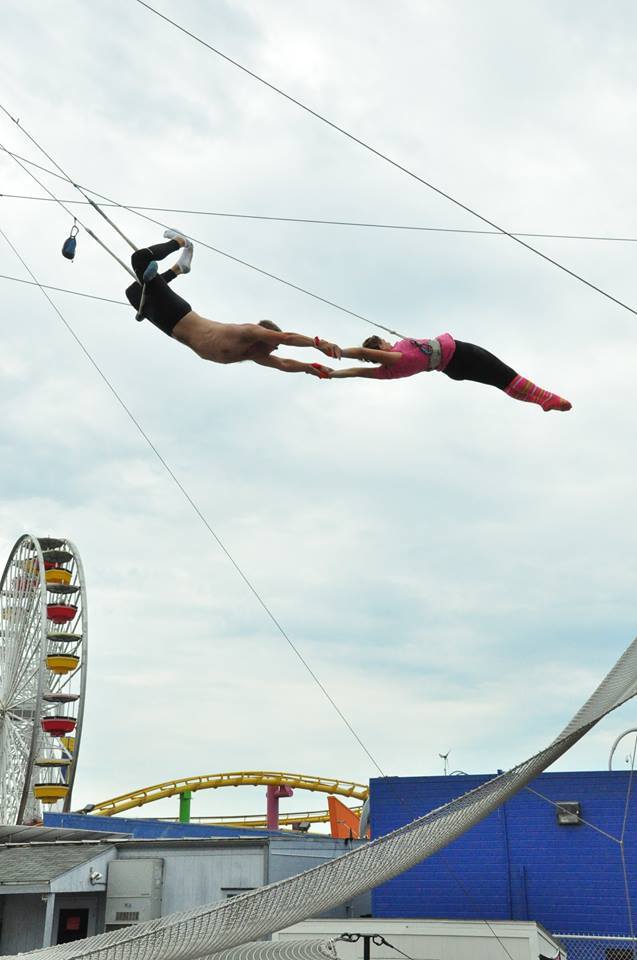
I took a flying trapeze class in mid-October at TSNY LA, and absolutely loved the experience. It was the salted caramel pretzel of experiences, frightening and exhilarating and challenging and fun all at the same time. Once I was on the trapeze swing and doing tricks, I felt a complete rush of excitement, but every single time I had to stand on that VERY narrow platform, 20 feet up in the air, the adrenaline would surge through me, and I would feel very nervous. Honestly, standing on the platform was the only negative part of the experience for me! The actual tricks I learned were completely awesome, and I had NO fear while doing them. The competitive spirit in me kicked in, as did my gymnastics background, and I put in 100% effort so that I could kick ass up there. I am proud to say that I did not disappoint myself. In my last trick, I completed a successful catch from a knee hang position on the fly bar, with the catcher on the catch trap (the other bar). What a rush!

Though the experience was supposed to be a bucket list item, I enjoyed the experience so much that I am considering taking regular classes. Call me crazy, but I loved the challenge, and since my body remembered all the childhood tumbles and moves from gymnastics, the kid in me was awakened. Another thing I noticed was that my upper lats were more sore after doing trapeze work than when I hit back day at the gym. I truly enjoyed the new physical challenges and hope that my schedule allows me to fit regular classes in.

12112445_1008406495856453_1649270197717728514_n

12091362_1008406482523121_4271950569616594504_o

For those of you who want to know more about the flying trapeze, I have copied and pasted the Wikipedia definition here:

The flying trapeze is a specific form of the trapeze in which a performer jumps from a platform with the trapeze so that gravity makes the trapeze swing. Most flying trapeze acts are performed between 20 and 40 feet above the ground.

The performance was invented in 1859 by a Frenchman named Jules Leotard, who connected a bar to some ventilator cords above the swimming pool in his father’s gymnasium in Toulouse, France.

In a traditional flying trapeze act, flyers mount a narrow board (usually by climbing a tall ladder) and take off from the board on the fly bar. The flyer must wait for a call from the catcher to make sure he or she leaves at the correct time. Otherwise, the catcher will not be close enough to the flyer to make a successful catch. The flier then performs one of many aerial tricks and is caught by the catcher, who is swinging from a separate catch bar. Once in the catcher’s hands, the flyer continues to swing and is thrust back toward the fly bar in a maneuver called a “return”. A return could consist of some kind of twist back to the bar, an “angel” (when the catcher holds the flyer by the feet and one arm), or any other trick that a flyer can think of to get back to the bar. Once back to the fly bar, the flyer can return to the board, and another flyer takes a turn.

12079068_1008318229198613_1900487063332663710_n

Terminology:

Listo/Lista – Ready: Used by the flyer and/or catcher to signify that they are holding the fly bar (for a flyer) or have built enough height in their swing for a catch (for a catcher) and ready to go.

Ready – Used by the catcher to tell the flyer that they should leave the board momentarily. The flyer bends their knees and if executing a one-handed take-off, dips the bar so they can raise it higher when they jump off the board.

Lining Up – Called from the board. When the person working the board for those who have not yet learned to retrieve and serve the bar themselves gives the flyer the fly bar. It really means that the flyer is “lining up” their trick.

Hup – Signal to leave the board and/or the fly bar. Sometimes used by the catcher to tell the flyer to let go after a catch when landing in the net.

First – Usually called by someone pulling safety lines when tricks are being thrown to the net. It is used for front-end tricks to signify getting to the first position.

Final – Also usually called by one pulling safety lines. It is used for front-end tricks to signify getting to the final position.

Gotcha – Some catchers say “Gotcha!” when they catch to signify that they have a good grip on the flyer and that the flyer can let go of the fly bar.

Catch Trap – The trapeze that the catcher swings on.

Fly Bar – The bar the flyer uses.

Apron – The net in front of the catch trap. (The back apron is the net in back of the board.)

Rise/Riser – A narrow board placed on the rungs of the ladder to allow the flyer to take off from a higher point.

Noodle – The long pole used to reach the fly bar when the person working the board cannot reach it normally.

Mount – When the flyer mounts the board after a return.

Return – When the flyer, after a successful catch, manages to return to the fly bar, and often all the way back to the board. In professional shows, the flyers rarely come down from the board.

Grips – Can be gymnastics grips or ones made out of tape. They are used to protect the flyer’s hands.

Chalk – Used by the flyer and catcher to absorb wetness and to reduce sticking to things such as the fly bar.

Force Out – Kicking the legs out at the peak of the flyer’s swing to gain height.

Hollow – Comes right after the force-out. It is basically a neutral position.

Sweep – Comes after “hollow”. Signifies kicking the legs back.

Seven – The last part of a force-out swing. Flyer brings legs in front of them so they will not hit the board.

Cutaway Bar – The bar that the catcher holds when the flyer executes tricks to the catcher such as normal Cutaways and Reverse Knee-Hangs.

Cut (as in Cut Catch) – The flyer is caught in a legs catch and swings out into the apron. On the next swing into the apron, the flyer thrusts their body up, and the catcher lets go of the flyer’s legs and grabs their hands.

Tricks

Below is a list of flying trapeze tricks that can be thrown to a catcher:

Feet Across (a.k.a. “Legs”)
Heels Off
Hocks Off
Splits (Front End/Back End)
Straddle Whip (Front End/Back End)
Whip (Front End/Back End)
Bird’s Nest/Birdie (Front End/Back End)
Shooting Star
Half Turn
Straight Jump
Cut Catch
Uprise Shoot
Forward Over
Forward Under
Double Over
Passing Leap
Piggyback
Pullover Shoot
Reverse Knee Hang
One Knee Hang
Flexus
Somersault
Hocks Salto
Front Hip Circle/Back Hip Circle
Seat Roll/Penny Roll (Full Time/Half Time)
Planche (Front End/Back End)
Pirouette (540)
Layout
One and a half Somersault
Cutaway
Cutaway Half
Cutaway Full
Double Somersault
Double Cutaway
Double Cutaway and a half twist
Double Layout
Full Twisting Double
Double-Double
Triple Somersault
Triple Twisting Double
Full Twisting Triple
Triple Twisting Double
Triple Layout

These are tricks performed bar to bar:

Hocks Off
Splits (Front End/Back End)
Straddle Whip (Front End/Back End)
Whip (Front End/Back End)
Bird’s Nest/Birdie (Front End/Back End)
Half Turn
Straight Jump
Planche (Front End/Back End)
Layout
Double Somersault

These are tricks that can be performed without a catcher:

Salute
Half Turn
Force Out Turn Around
Back Mount
Suicide
Reverse Suicide
Pirouette

Returns:

Half Turn
Flexus
Birdie
Legs (Twist one direction to grab the bar.)
Angel (1 or 2 legs)
Pirouette

TSNY Trapeze Tricks Chart
If you are in the Los Angeles area, and you are interested in taking a flying trapeze class, here are two excellent schools. The first one is the school I went to for my first class, and the second one is the place where I will probably take more classes.

http://losangeles.trapezeschool.com/

http://www.flyingtrapeze.com/