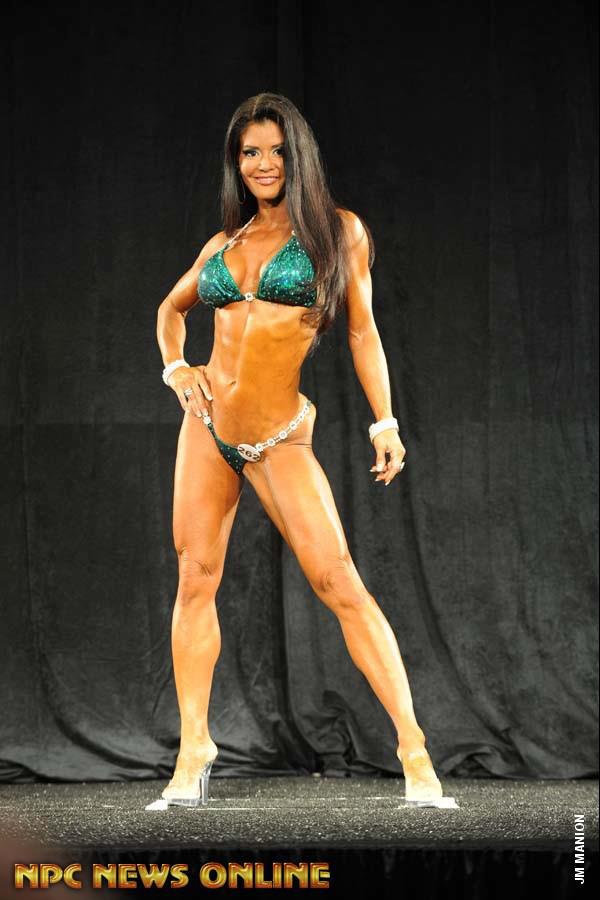
Strike A Pose

It takes a certain amount of bravery to grace the stage, clad in a minimal amount of clothing which reveals your body shape and conditioning, while standing under glaring stage lights and the scrutinizing gazes of a panel of judges.  Some of us love the exhilaration of such an experience, while others cringe at the thought.  Let’s face it, being onstage is something that won’t appeal to everyone, and that is completely acceptable.  However, it is extremely empowering to celebrate the efforts of your training and discipline by holding your frame in poses which best display your hard work.  I find myself telling people constantly that having that awareness of self engenders a spiritual metamorphosis which affects every aspect of one’s life. 

Because of this I believe that there is some utility in learning to pose.  It instills a confidence which changes your posture and your general attitude.  Think about the individuals who strike you as overflowing with self-confidence.  They walk with purpose and often have a bit of a swagger to their step.  They exude an energy which is attractive and inspiring.  You don’t even need a competitor-level physique to learn to pose in such a way that aligns the mind-muscle connection and enables you to celebrate the miracle that your body represents. 

This does not mean that I advocate boastful posing in front of the mirrors at the gym, though I find it acceptable to cast sly glances at your muscles while they are working through a challenging move.  By learning to pose, you can assess your progress if you are on a weight loss or muscle building program even if you never intend to strut your stuff onstage.

For some folks, standing in front of a mirror can be stress-inducing.  Yet it is this sort of visual feedback which can fuel your motivation and help you attain your goals more effectively.  I have patients and clients who dread taking standard front and back shots, yet when point out their strengths while also showing them how to stand and pose with confidence, they begin to experience a psychological shift.  This shift becomes more pronounced with time as their physiques begin to respond to proper nutrition and regular exercise.  I always love hearing someone say they notice muscles they didn’t think they had, or that their clothes fit differently.  I will often notice that the way patients dress and walk will slowly but surely change as they begin to accept themselves for who they are both inside and out. 

The best thing you can do for yourself is to learn how to pose and take full ownership of the abilities and strengths you possess.  So get in front of that mirror and show it what you have!

Pullovers: Old-School Magic

(originally posted on http://www.Myotropics.com)

Ah, the pullover.  This classic exercise has deepened the chests of bodybuilders for many years and is perhaps the best move for expanding the ribcage.  But does it have any utility in shaping the physiques of those who compete in the newer divisions of men’s physique and bikini?

I regularly perform pullovers (usually dumbbell, but at times barbell) as part of my training regimen, a fact which may surprise people.  For the past eight months I have welcomed pullovers into my chest days and over that span of time have noticed a wider lat sweep, more developed rear delts, and more prominent serratus anterior fibers. Certainly if a bikini competitor like me can benefit from doing pullovers, a men’s physique athlete could only stand to benefit from such physical changes, making pullovers beneficial for the new breed of competitive athlete.

I would be remiss if I did not address the immense controversy surrounding the pullover and what muscles are involved.  Many will insist that the pectoral muscles are the primary movers in pullovers, while others may stubbornly argue that the latissimus dorsi is the main muscle recruited.  Thus I am providing a breakdown of the exercise in an effort to clear up some of the confusion.

Analysis of the Pullover Exercise

The pullover exercise recruits a number of muscles, making it an excellent movement for balancing out the upper body.  During the concentric, or upward phase of the pullover movement, the pectoralis minor is recruited during the initial phase of shoulder extension, followed by recruitment of the sternal fibers of the pectoralis major to assist in progressive extension of the shoulder.  Other muscles involved in extension of the shoulder are latissimus dorsi, teres major, posterior deltoid, infraspinatus, teres minor, and subscapularis.  Latissimus dorsi, rhomboids and teres major are also involved in scapular retraction and medial rotation of the humerus during the concentric phase.

There has been some controversy surrounding whether the pullover is primarily a chest or back exercise.  A study conducted by Marchetti and Uchida (JAppl Biomech, 2011 Nov;27(4):380-4.Epub 2011 Oct 4.) examined the activity of the pectoralis major and latissimus dorsi by means of EMG analysis during the barbell pullover exercise.  It was determined that the pectoralis major was activated to a much greater degree than the latissimus dorsi, and that the higher activation was dependent on the external force lever arm produced.

A more heated controversy surrounds the utility of the pullover movement in recruiting the serratus anterior.  During the eccentric phase of a pullover, i.e. during the phase in which the weight is being lowered overhead towards the floor, the serratus anterior, intercostal cartilage and intercostal muscles are stretched, triggering hypertrophy.  But what is the degree of recruitment of the serratus anterior?  A review of musculoskeletal anatomy reveals that the serratus anterior muscle sweeps over the lateral portions of the intercostal muscles as well as the lateral portion of the ribcage.  Serratus anterior fibers also run above the attachments of the latissimus dorsi muscle fibers on the lateral aspects of the first eight ribs.  This explains why a well developed serratus anterior contributes to the flare of the lats in a balanced competitive bodybuilder.  Another critical attachment of the serratus anterior is to the medial border of the scapula, enabling it to pull the scapula forward and tethering it to the thoracic wall, thus conferring stability to the scapula (preventing scapular winging).  However, such winging is prevented by lying supine on or across a bench as is done during a pullover.

In summary, the serratus anterior abducts, upwardly rotates and weakly elevates the scapula.  Some will argue that in a pullover movement, the serratus anterior does not contribute greatly to the movement itself, rendering the pullover almost useless in building the serratus fibers.  Others will argue that due to the stretch stimulus of the eccentric phase of the pullover, the serratus anterior is strongly activated and responds with appreciable hypertrophy.


Description of the Pullover Exercise

Dumbbell Pullovers:  Lie on bench or across bench (this allows a greater stretch of the ribcage) with feet firmly planted on floor.  Hold a dumbbell with both hands, with palms against the underside of the upper end of plates and thumbs crossing over one another around handle.  Lower weight behind your head, inhaling as you do so and keeping elbows slightly bent.  Then raise dumbbell so that it is directly above you, elbows straight.

Barbell Pullovers:  Lie on bench.  Extend arms above you and take an overhand grip (palms will be facing upwards) on the barbell with hands shoulder width apart and elbows straight and in line with arms.  Lower weight behind your head, inhaling as you do so.  Then raise barbell so that it is directly above you.

Generally speaking, the dumbbell version tends to afford a better stretch in the chest and ribcage, while the barbell version appears to trigger more lat recruitment.  Both versions will cause a stretch and expansion in the ribcage and serve as excellent finishing moves during chest day.


References

Effects of the Pullover Exercise on the Pectoralis Major and Latissimus Dorsi Muscles as Evaluated by EMG. JAppl Biomech, 2011 Nov;27(4):380-4. Marchetti, P.H. and Uchida, M.C.

 

The Drive To Grace The Stage

This is from my 19th NPC competition…

There is truly something magical about competing onstage at NPC bodybuilding contests that defies adequate description.  People who have not been drawn into the world of competing imagine, and rightly so, that it must be intimidating to step onstage in an outfit which in many respects is similar to a set of fancy underwear, while a panel of judges assess the lines of your body and compare them to other competitors.  What often happens to competitors (and it certainly occurred with me at my first show) is that a spiritual transformation occurs which is in keeping with the physical transformation, similar to a butterfly emerging from a cocoon and spreading its wings in flight for the first time.  The countless months of adhering to a structured training regimen and meal plan are celebrated during the course of several minutes while standing under blinding stage lights.

I take pride in being disciplined enough to endure a rigorous plan which requires me to sacrifice many common pleasures such as having free time on the weekends and eating foods outside my plan. The resulting changes in my physique have made the often arduous journey completely worthwhile.  However, I understand that those who do not compete may regard such dedication as extreme.  People have asked me why I continue to compete when I have already had a number of excellent show placings.  Without getting into a lengthy discussion about my quest to attain IFBB Professional Status in the Bikini Division, I will say that each competition represents a new goal which encourages me to keep raising the bar higher.

I have spoken with countless individuals who have asked me to describe the culture of bodybuilding competitions, and many have expressed an interest in entering a contest just to see what the experience might be like.  At the very least I encourage people to attend a competition because I know that the environment can be very inspiring to behold.  Some people will venture further and ask detailed questions about what it takes to compete, how to train and prep, what suit or shorts to wear, how to tan, etc.  Though I am always excited to discover that someone might be interested in competing, I try to ferret out important personality characteristics which will either make one well suited for competing, or will completely demolish a person’s self-worth.  I realize this sounds negative, but it is reality-based and backed up by my own personal ups and downs since I began to compete.

I have seen people who decide to compete but fail to recognize the work that goes into prepping for a competition.  Those individuals invariably get quite a shock when they discover all the essential elements and expenses involved.  I continue to be amazed by people who believe they can eat and drink whatever they want, exercise minimally, then slap on a Mystic Tan and a suit or trunks they usually wear at the beach and win a show.  At the risk of dissuading some readers from competing, I am providing a list of contest prep elements and expenses which are most commonly encountered.

What Is Involved In Contest Prep?

  1. Structured training and cardio plan
  2. Structured meal plan
  3. Competition suit/trunks
  4. Competition tanning
  5. NPC Registration
  6. Show entry fee
  7. Professional makeup
  8. Professional hair styling
  9. Travel expenses (flight, hotel, rental car, gym fees)
  10.  Jewelry and shoes

As a competitor who has traveled for ten pro qualifiers, all of which are outside of the state in which I live, I am well aware of how prohibitive the combined expenses can be.

Thinking of Competing? 

For those who have not been discouraged thus far, I have three questions which will assist in determining whether or not competing is the right choice for you.

  1. Are you comfortable with being scrutinized by a panel of judges?  It can be quite distressing to stand onstage in a row with other competitors, smiling until your jaw cramps, doing half or quarter turns in unison and hoping you get moved to the middle spot.  Unless you can allow yourself to enjoy the experience for what it is and resist taking a poor show placing personally, you should refrain from competing.

However, if you can celebrate your personal accomplishments and enjoy the experience of being on par with some of the best bodies in society, you may indeed gain great pleasure from competing.

  1. Are you capable of adhering to a strict training and meal regimen?  Quite frankly, following a very strict meal plan which prohibits preferred foods and which coerces you into eating foods you can’t stand can really wear you down after a while.  But it is even more critical to follow such a regimen as you approach a competition.  This often requires you to follow the meal plan to the letter for months at a time (aside from the occasional cheat meal).  In addition, consistency with a specific training regimen also requires complete focus.  If you are the type of person who is prone to omitting training blocks for whatever reason, perhaps you are better off attending rather than competing in a show.

Those who rigidly follow a training regimen and meal plan which is designed to prime them for a specific contest consistently do relatively well.

  1. Do you enjoy being onstage or do you freeze up?  If the mere thought of being onstage with glaring stage lights oriented toward you has you hyperventilating and forgetting any posing you may have easily practiced in the privacy of your own living room, you might as well remain in the audience and watch the other competitors do their thing.


At the other extreme are people who look like they are having a blast onstage and exude such positive and appealing energy that they catch the interest of the judges and audience.

“But I Don’t Have Time To Work Out!”

It always amazes me when people insist that they have no time to exercise and list one reason after another to substantiate such a claim.  I completely understand that work schedules can be extremely demanding and exhausting.  Some individuals may have the best of intentions in planning to go to the gym after work, but this can be a major feat after working long hours.  So does one give up on such a pursuit?  Absolutely not!  There are numerous ways in which one can fit exercise into a hectic daily schedule.

I work at three different office locations and am constantly battling traffic which eats up a lot of my time.  Because of this, I make sure to PLAN AHEAD and schedule my training and cardio sessions around my work schedule.  A little extra planning, along with the determination to make exercise a daily priority, can ensure that regular workouts become an integral part of one’s schedule.


Keep Your Car Trunk Stocked!

From personal experience, I have found that keeping my car trunk stocked with all my gym equipment and an “emergency” gym outfit is an excellent way of ensuring that I will be well-prepared for a gym visit whenever it presents itself.  Another thing that I do is if I have a workout planned after work, I make sure to drive to the gym regardless of how tired I am.  I have counseled patients and clients who make the mistake of going home after work, convincing themselves that they will go to the gym after having a meal, settling in, but what usually happens is “…oh wait, there’s that great show on television…and I have laundry to do, etc…” thus killing any chance of them gathering the motivation to trek to the gym.


Set Your Alarm Early.

For people who consider themselves early birds, it may be more effective to set the alarm to go off earlier in the morning to allow sufficient time to get a workout in before the workday begins.  One of the benefits of going to the gym before work is the energizing effect which exercise confers.  Another benefit is that your workout will be complete, leaving your evenings after work open for other tasks.

Some people may balk at the idea of having to trek to the gym in the morning, stating that it takes extra time to travel to and from the facility.  If this is the case, there are two options:  either wake up earlier, or exercise at home.  You can even start your day with a brisk walk or jog before eating breakfast, then get ready for work.


Exercise During Lunch.

A third option which one might consider is to work out during a lunch break.  Although this usually poses more time constraints than the other options, exercise during the lunch hour may be a very effective means of staying in shape, provided the workouts are intense.  If you decide to grab a quick workout at the gym, be sure to bring a bag with toiletries so that you can shower before heading back to work.  You can also try to grab a decent workout while at work with resistance bands and plyometric movements.


Regardless of which options you select, you should definitely be able to fit regular exercise into your busy schedule.  You can even break up your workouts into segments in which lifting is done in the morning, with cardio performed either during the lunch hour or after work.

What about incorporating exercise into your daily routine while at work? You can take the stairs instead of the elevator, stretch whenever you rise from your chair, even throw in a couple of wall sits in the office while you are waiting for something to print. It’s those little activities which can really add up during the course of a day and give you a boost of energy.

How to Avoid Stretch Marks From Workouts

Stretch marks form as a result of rapid  stretching from growth by muscle gain, fat gain, or pregnancy.  The most common areas in which they develop are the abdomen, buttocks, arms, hips, thighs, breasts and calves.  There is a strong genetic component, which means if you are predisposed to forming stretch marks, the more apt you are to develop them if a rapid gain in mass occurs.

However, even if your genetic blueprint dictates that you are more prone to getting these pesky marks, there are a number of things which you can do to minimze their formation.

1.  Drink plenty of water daily.  Aim for at least eight 8-ounce cups of water each day to ensure adequate hydration.

2.  Increase protein intake to optimize collagen formation.

3.  Decrease the amount of weight lifted at the gym to prevent very rapid increases in muscle mass.  A 12-15 rep range is advised.  I can already sense some readers balking at this, but there is a tradeoff:  either have a more modest increase in mass over a longer period of time or gain mass rapidly and run the risk of developing stretch marks.

4.  Take certain supplements.  Make sure to take fish oil, flaxseed oil, zinc, and vitamins A, C, and D.= on a daily basis.

5.  Eliminate sugar from your diet!  Refined sugar breaks down the elastin in your skin, making you more vulnerable to stretch marks, early aging, and increased risk of scar formation from cuts.

6.  Exfoliate your skin regularly.  This sloughs off the dead skin cells, thus minimizing the appearance of stretch marks which may already exist.

7.  Moisturize skin thoroughly and regularly.  For many years cocoa butter cream has been used by pregnant women to prevent stretch marks, but there is no final verdict on whether it has any benefit. However, I love cocoa butter’s emollient effects and believe it should be added to an anti-stretch mark regimen.  Vitamin E oil is another excellent moisturizer which can be applied to stretch marks or areas which are the most prone to their formation.

8.  If you develop new stretch marks, you can use prescription tretinoin on a once daily basis with decent results.  Just make sure that the stretch marks you are treating are less than six weeks old. Other topicals such as Tri-Luma and Stri-Vectin also may be used with some benefit.

9.  As a last resort for existing lesions, you may consider laser skin resurfacing or micro-needling.  

Always a Bridesmaid, Never a Bride…

I have now competed in thirteen pro-qualifying NPC/IFBB Bodybuilding contests since 2009, yet I have not attained the IFBB Professional Status that I have been chasing after.  I am not going to deny my frustration and despondency over this fact, because I have worked so hard at every aspect of competing and have improved dramatically with each event.  However, I have had a number of people ask me why I would continue competing if I have not been successful in reaching my goal by now.  I have also been asked why I want that Pro Card so badly.  Some individuals have gone as far as to suggest that I switch organizations, which is something I will NEVER do.

Let me put it in plain terms:  I have set IFBB Pro Status as a personal goal, and it dangles before me like a carrot.  Yes, I have made more sacrifices than you could imagine in order to compete, and yes, I have scratched my head wondering why I have gone up for four National-level Overall comparisons and have been passed up for a Pro slot every time.  But I will NOT be deterred or discouraged from continuing to compete.  When I train as hard as I do, I notice continued improvements in my physique which are a direct slap in the face to the aging process.  I LIKE chasing after goals and will not give up just because this particular goal continues to elude me.  Perhaps it hasn’t been my time, the stars and planets were not aligned properly, or I just wasn’t the right flavor for the judges’ eyes that day.  Whatever the case, I love competing, which is why I have already begun formulating my strategy and show schedule for 2013.

IFBB North American, 2012

I will definitely return to the stage next year.  Watch out, world!

A Bikini Athlete’s Favorite Ab Exercise

I admit that abdominals are my favorite of all the body regions to train and have been for my entire adult life.  In fact I cannot think of a single time that I balked when it was time in my training split to work my abs.  This makes designating a particular abdominal exercise as my favorite especially challenging for me, since I consider very move to be a valuable component of an abdominal routine.

After having evaluated the level of motivation I have during each abdominal exercise, I have determined that my top abdominal move is the decline bench crunch.  If you have not performed this exercise before (and yes, I realize that many of you are already familiar with this move), I would highly recommend that you incorporate decline bench crunches into your routine.  Decline bench crunches are excellent at targeting the rectus abdominis and hip flexors due to the increased range of hip flexion which occurs on a decline bench.

Adjust a decline bench so that it is at a 30 to 45 degree angle (the more advanced you are, the greater the angle you can use).  Sit on bench with your feet hooked under the rollers and lie back on the pad with your arms folded across your chest.  Exhale as you bring your head, shoulders and back off the pad, coming to a full sit up position, then return slowly to start position.  You can perform 12 to 20 reps per set, 3 to 5 sets, but I will admit that when I do decline bench crunches, I perform 5 to 6 sets of 30 reps.  If you crave an extra challenge, extend your arms overhead while you perform this move.

Decline bench crunches can also be performed with a twisting motion at the top of the move, recruiting the obliques and serratus anterior.

Those of you who are really looking to punch up this exercise can perform a weighted variation of this move in which you hold a dumbbell behind your head, hold a plate on your chest, or pull on a cable during the exercise.

After incorporating decline bench crunches into your training split, don’t be surprised if people begin noticing your washboard abs!