Don’t Go “Nuts” On Nuts

Original post can be found at: http://sportsnutritionsupplementguide.com/latest-news/health-and-fitness-news/item/1106-don-t-go-nuts-on-nuts#.VGqaavnF-K0
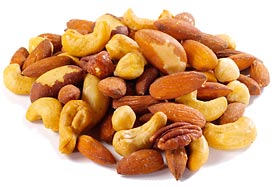
nuts
I rarely encounter competitors who aren’t completely enamored of nuts and who lament their absence during contest prep. And for good reason. The substantial texture and flavor of nuts have captured the interest of the general population and have elevated nuts to superfood status. However, due to their significant nutrient density, “too much of a good thing” can certainly be applied to nuts of any kind. I have encountered patients who may have previously been in the habit of mindlessly polishing off an entire bag of potato chips in one sitting and who have similarly finished an entire jar of nuts, believing that the health benefits of nuts could somehow negate the caloric assault on their weight loss plans.

Everything in Moderation
That being said, I am far more likely to praise the benefits of nuts than I am to discourage their consumption. As a self-professed nut lover I am well aware of how delectable they are, yet I usually will portion them out in an effort to prevent any overindulgence. This is especially true when I consume nut butters. I know that if I keep the almond butter jar open, I am likely to dip into it once more, so I make myself remove a serving size then quickly seal the jar and put it away. When you consider that the average nut butter contains approximately 190 calories per 2 tablespoons and 16 grams of fat, the calories can stack up very quickly indeed. However, on a positive note, researchers in Spain discovered that frequent nut consumption was associated with a decreased risk of weight gain.

Benefits of Nut Consumption:

May help to lower cholesterol
Rich in arginine, which enhances blood flow
Rich in fiber, unsaturated fatty acids and phytochemicals
Contain mono- and polyunsaturated fats which are cardioprotective
Best plant source of protein
Rich in vitamin E, B vitamins, selenium, calcium, magnesium, copper, iron and phosphorous
Rich in a number of compounds which may protect against gallstone disease
May reduce the risk of age-related macular degeneration
Negative Aspects of Nut Consumption:

High fat content
Many nuts are flavored with sugar, added fat, sodium, chemicals and preservatives
High in calories • Some people have allergies to nuts which in some cases can serve to be fatal
Contain oxalates which can crystallize and form kidney stones
“Nutty Top Five”
Though all nuts provide superior health benefits, I consider the five nuts listed below to be the best of the bunch for various reasons. Make sure to opt for the raw or dry roasted varieties whenever possible. When nuts are roasted in oil, there is a high probability that they have either been heated in hydrogenated oils or subjected to high temperatures which can destroy their nutrient properties. Studies recommend a daily intake of one to two ounces of nuts as part of a healthy diet.

Pecans: This is the most caloric nut in this list at 200 calories for 18 to 20 halves, and also contains the smallest amount of protein at 3 grams while packing 20 grams of fat. However, these slightly sweet nuts still offer health benefits when consumed. Pecans contain a plant steroid called beta-sitosterol, which helps to relieve the symptoms of an enlarged prostate. They are extremely rich in B vitamins, vitamin E, and ellagic acid, which is a potent antioxidant. Pecans are excellent when added to the vegan baked goods I make, and I especially love them in my admittedly non-contest friendly Thanksgiving stuffing!
Cashews: Technically, cashews are thick-shelled seeds, but confer all of the general benefits of nuts, including monosaturated fatty acids like oleic and palmitoleic acids. They are quite calorie dense at 180 calories for 14 nuts but also contain a number of important minerals, including manganese, potassium, selenium, copper and zinc. Another important substance which can be found in cashews is zea-xanthin, which is selectively absorbed into the retinal macula lutea in the eyes and confers protection against age-related macular degeneration. The texture of these seeds is so meaty and satisfying that they easily made it onto my top five list. In addition, cashew butter is delectable! If you need a change from peanut butter, try this option.
Hazelnuts: These nuts are loaded with folate, vitamin E, and B vitamins. I recently started eating these nuts after encountering them in a mixed assortment, and was surprised by their distinctive flavor and relatively hard texture. Hazelnuts are excellent snacking nuts and good for a change.
Walnuts: Walnuts are extremely rich in alpha linoleic acid (ALA) which can reduce inflammation and oxidation in the arteries after eating fatty meals. A serving of 14 halves contains 180 calories but also provides about 90% of the recommended daily intake of omega-3 fatty acids. Scientists at University of Scranton, Pennsylvania recently discovered that walnuts have highest levels of polyphenolic antioxidants than any other common edible nuts. Walnuts are incredibly versatile and can be mixed into vegan baked goods, fudge, salads, Greek yogurt, oatmeal, or eaten plain.
Almonds: These nuts have the lowest calorie density, and also contain the most calcium of any nut. They are rich in dietary fiber and phytochemicals and confer excellent protection against diseases. Almonds are an excellent source of vitamin E, with 60% of the recommended daily intake of vitamin E packed into a 30 gram serving. Over the past year I have replaced peanut butter with almond butter because I vastly prefer the flavor of the almond variety. I have also heard numerous people report that almond butter was more easily digestible than peanut butter. As for the whole nut, I consider the almond’s textural variety and its flavor to be superior to other nuts, making it my go-to when I grab a serving.
Summary: As long as nuts are not consumed in the same volume as lean meats and vegetables are, daily consumption will confer a myriad of health benefits to one’s diet. If you haven’t already incorporated nuts into your meal plan, consider doing so in order to optimize your health.


Hand X Band For A Stronger Grip And Great Rehab For Tennis Elbow

handxband_diagram
If you think about all the grasping and gripping you do in your daily life, such as opening doors, driving, working out with weights, etc., it’s pretty obvious that you use the muscles which flex your fingers far more often than the ones which extend (or straighten out) the fingers. Over time, this results in overdevelopment of the finger flexors relative to the extensors. A new product called the Hand X Band enables you to selectively exercise the finger extensors, establishing muscular balance and increasing strength. These clever bands are inexpensive, durable, and effective.

The Hand X Band is great for athletes who want to balance their strength and muscular development, but it is also excellent for upper extremity rehab.

You can order direct from the site: http://handxband.com

Corsets And Waist Training

https://www.yahoo.com/style/whats-the-deal-with-the-corset-training-101355906803.html

I am posting an article which I found the other day on Yahoo! Style which made me chuckle. Here is the original link as well. I will reserve comments until the end of the article.
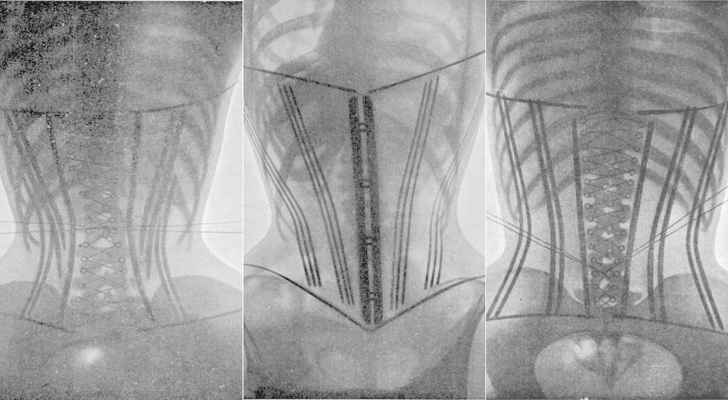
X-Rays-Show-that-Women-Would-Destroy-their-Rib-Cages-due-to-Corsets-2
To the ways you can attempt to whittle your waist — Slim-Fast, side planks — add one more: Corset training.

The method, which requires you to cinch yourself into a corset for four to six hours a day, is popular with celebrities and has been intriguing many other women seeking hourglass shapes.

Both Kim and Khole Kardashian have tried it. Kim posted a picture of herself yesterday in her mom’s foyer wearing a corset — hers is from a company called “What A Waist” — with the caption “I’m really obsessed with waist training!”

Jessica Alba is a fan, too. She actually wore two at the same time to help her lose weight after both of her pregnancies. “It was brutal; it’s not for everyone,” she told Net-A-Porter. “I wore a double corset day and night for three months. It was sweaty, but worth it.”

Self-described “corset fetishist” Kelly Lee Dekay, 27, has been doing corset training for seven years, and claims she has a 16-inch waist because of it. “I loved how Batman’s outfit let him channel a different side of himself,” she told the Sun. “That’s what the corset does.”

Women have worn corsets for ages. In the 1500s, they smashed down their entire torso. Later, in the late 1800s or Victorian era, they were used to help define the waist. It’s thought that the reason ladies back then were always fainting was because their corsets were squeezing their internal organs and restricting their breathing.

In these modern times, however, women now think that wearing a corset can actually help you lose weight. The Cincher by AMIA claims, “[It can] sculpt inches from your midsection and enhance your curves while increasing thermal activity in your core.”

According to TheCorsetDiet.com, you can shed up to six pounds a week by wearing one of their custom-made waist shapers. The UK-based company describes the pressure from its corsets as “gentle hugging feeling.”

But when writer Rebecca Harrington tried wearing one, albeit from a different brand, she wrote on NYMag.com, “My breathing is slightly impaired, but I can still breathe; I just have to take short, staccato breaths. I try to drink coffee, and it’s very difficult. After four hours, I whip off the corset and throw it across the room. My waist has red welts on it.”

In reality, doctors say that the corset is not — I repeat not — helping you reshape your body with simple pressure. It’s simply so tight around your stomach that you won’t — or can’t — eat too much, and doctors roundly decry any kind of corset diet or waist training as a viable long-term weight loss method.

“It’s outrageous, and it just absolutely makes no medical sense whatsoever,” Keri Peterson, M.D., a physician at Lenox Hill Hospital in New York told Women’s Health.

It also could be dangerous. Wearing one could actually shift or compress your internal organs and fracture your ribs, Dr. Jyotindra Shah said. “People might put it so tight that the liver, spleen and kidneys could get bruised,” she told The Huffington Post.

Even “corset fetish” Dekay knows she has to remove hers sometimes. “It can be restrictive when climbing stairs,” she told the Sun. “You can’t carry heavy things as you could hurt yourself. I don’t go to the gym in it. That would be very dangerous as I lift weights.”

squeem-26r

Okay, here goes my commentary. I jumped on the corset bandwagon back in 2011 when I was informed that it was a very effective way to whittle the waist. During the time in which I diligently wore a corset (or two) several hours a day, every day, I noticed my waistline whittle down from 24 inches to 22-1/2 inches. So do I think it works? I KNOW it works.

I have to say I disagree with so-called doctors’comments that the corset prevents consumption of large amounts of food, thus resulting in weight loss. This just sounds like something one of my male colleagues would mutter. If caloric consumption is kept constant, women and men who engage in corset training WILL have a reduction in inches no matter what. This sounds like the typical uber conservative medical snobbery which makes other doctors the types of people I will NEVER choose to spend extensive periods of time with. I do agree that the practice of wearing a corset is outrageous, painful, and could be dangerous. But it DOES work. What price beauty?

Over the centuries, women have compressed their waistlines effectively with corsets, so it blows my mind that these narrow minded physicians have decided to toot their horns and express skepticism. As a physician who competes, I chose to give corsets a chance and had great results. I am glad that I didn’t allow the part of my brain which is trained in traditional Western medicine talk the competitor in me out of doing all that I could to make my waist smaller.

I would usually wear a neoprene wrap underneath my corset (or Squeem as it is somewhat affectionately called in the bodybuilding world due to one manufacturer brand), or one corset over a second. I would do this for at least 6 hours, sometimes as long as 14 hours. Was I uncomfortable? Yes. Did I sweat like a pig? You bet. Was it worth it? I think so.

I have dealt with the metal boning poking out as the corsets would wear out, and would glue them back into their channels, so I know all too well the sensation of metal poking into my underboob, my ribcage or my hip bone when the corsets began wearing out. I would have digestive upset, abdominal pain, and at times had difficulty breathing. During one stretch of time when I was wearing latex corsets, I developed painful lesions all over my back from the yeast overgrowth which resulted from the long hours of wear and the constant sweating. It took me over a year for my skin to heal from all those lesions, and I have a couple of permanent scars to mark my determination to sculpt a waistline that would win a Pro Card. Thankfully, I won that Pro Card in 2013 and almost immediately tossed the corsets aside.

Now I wear corsets from time to time if I feel the need to squeeze out extra water from my midsection, but I will probably never return to the days of wearing corsets for many hours, driving to work in pain because a metal boning was jabbing me in the rib, sweating profusely under nice clothing, and dealing with skin around my midsection which was constantly macerated, lighter in pigment, and showing signs of skin breakdown.

I know you ladies want to slim down the midsection, but please be careful when you wear corsets! It isn’t worth ruining your skin and compressing organs to wear these torture devices for extended periods of time. Give your skin and your torso a rest in between the sessions during which you are training your waist. I recommend wearing corsets for a 4 hour stretch.