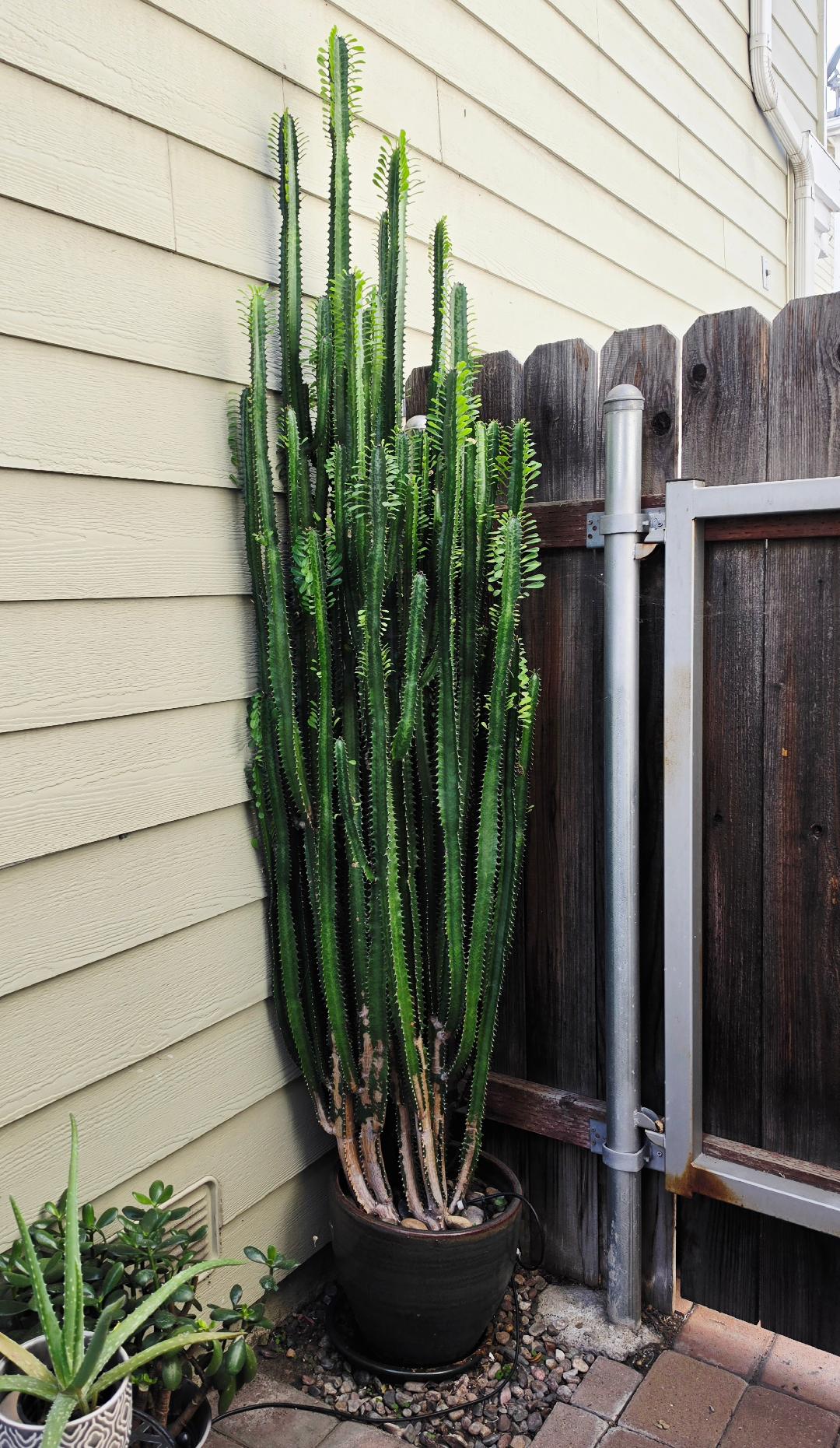
Euphorbia trigona, also known as the African Milk Tree, is a striking succulent often mistaken for a cactus, though it actually belongs to the spurge family (Euphorbiaceae). It’s popular as a houseplant because of its sculptural shape and relatively easy care.
🌍 Origins
Euphorbia trigona is native to central and western Africa, particularly regions like Cameroon. In its natural habitat, it grows in warm, semi-arid environments with plenty of sunlight. It has long been cultivated both locally and globally, so its exact wild origin range is a bit blurred by human propagation.
🌿 Appearance
This plant has a very distinctive look:
- Growth form: Upright, columnar stems that branch upward, giving it a candelabra-like shape
- Stems: Triangular (hence trigona), with ridges lined by small paired spines
- Leaves: Small, oval leaves grow along the ridges; they’re usually green but can be reddish in some varieties
- Color varieties:
- Standard green
- “Rubra” or “Royal Red” form with reddish stems and leaves
Although it resembles a cactus, it differs in structure and produces a milky white sap (latex), which is typical of spurges and can be irritating or toxic if handled improperly.
📏 How Tall Can It Get?
Height depends heavily on where it’s grown:
- Indoors: Typically reaches 4–6 feet (1.2–1.8 m), though with time and good conditions it can grow taller
- Outdoors (warm climates): Can reach 10–15 feet (3–4.5 m) or more, forming a large shrub-like structure
It grows relatively fast compared to many succulents, especially with bright light and consistent care. When I bought my Euphorbia trigona in 2021, it was about 18 inches tall. One spring, it shot up about 2 feet, which I never expected. About a year and a half ago, a close friend and I decided to move it from my second-floor balcony to the side yard on the first floor. My reasoning was that it was almost 6 feet tall, and would be almost impossible to move from the balcony if it got much larger. As you can see in the photo, it is now 7-1/2 feet tall!

