Why Regular Decluttering Matters—Even When Your Home Is Already Organized

123rf.com 186109350

When most people hear the word decluttering, they may picture overflowing closets, junk drawers that can barely close, or piles of belongings that have accumulated over the years. Decluttering is often viewed as something we do when our homes have become noticeably messy or disorganized.

But what if your home is already tidy? As a personal example, I am a very tidy and organized person by nature, and I get anxious whenever I am in a home which is disorganized or cluttered. Nevertheless, I make sure to perform regular scheduled decluttering sessions throughout my home.

Even for someone who is naturally organized, keeps things in their place, and generally maintains a clutter-free home, there is still tremendous value in regularly scheduled decluttering. In fact, when your spaces are already well organized, the process can be less about getting rid of things and more about reorganizing, reassessing, and refining the way your home functions.

I have noticed that when I have a decluttering session, items which I might have forgotten about will be brought to the forefront in my mind. Another thing which occurs is that I will encounter items which have become obsolete, which means they can be donated, sold, or thrown in the trash. Every decluttering session makes my home more efficient, and I get great satisfaction from optimizing my living space.

Organization Is Not a One-Time Project

One of the biggest misconceptions about organization is that once a space has been organized, it will stay that way indefinitely. Over time, areas which were once quite tidy can spread out and occupy more space, and other added items may prove to be obsolete after a period of time.

Our lives change. Our needs change. Our belongings change.

Something that made perfect sense in a kitchen cabinet two years ago may no longer be the best use of that space today. A closet that was perfectly arranged last season may need to be reconsidered as our wardrobe changes. Books accumulate, drawers acquire new contents, and items that once had a specific purpose may quietly become unnecessary.

Even a beautifully organized space can become less functional over time.

That is why decluttering should be thought of as maintenance rather than a one-time event.

Just as we regularly clean our homes, we can periodically review the things inside them. I make sure to schedule my decluttering and deep cleaning sessions throughout the year to ensure that they are performed.

The Benefit of Reorganizing What Already Works

Decluttering doesn’t always mean throwing things away.

Sometimes, the biggest benefit comes from simply looking at a familiar space with fresh eyes.

Take a closet, for example. You may have everything neatly arranged, but perhaps the items you wear most frequently aren’t as accessible as they could be. Or maybe your storage system worked beautifully when you first created it, but your habits have changed.

The same principle applies to cabinets and drawers.

A kitchen drawer might be perfectly tidy but contain tools you rarely use. A bathroom cabinet may be organized but hold products you no longer reach for. A desk drawer may have everything neatly separated while still containing items that haven’t been used in years.

There is something surprisingly satisfying about opening a familiar drawer and realizing, This could work better.

Reorganization can make everyday life just a little easier.

Our Homes Should Reflect Our Current Lives

One of the most useful reasons to declutter regularly is that our possessions can quietly become a record of who we used to be.

We hold onto clothes for a lifestyle we no longer have. We keep books we bought with the intention of reading someday. We save decorative objects because they once meant something to us. We keep duplicate items because they might be useful eventually.

None of these things are inherently problematic. But collectively, they can occupy valuable physical and mental space.

Regular decluttering gives us an opportunity to ask a simple question:

Does this still belong in my life as it is today?

That question can apply to practically everything in our homes.

Don’t Forget the Things on Display

Decluttering isn’t limited to what is hidden behind closed doors.

The things we see every day matter, too.

Bookshelves, coffee tables, mantels, countertops, open shelving, and other visible areas can gradually become crowded. Because these items are part of our everyday surroundings, we can become accustomed to seeing them and stop noticing how much visual information they create.

Every so often, it can be refreshing to remove everything from a shelf or display area and start again.

Maybe a collection would look better with fewer pieces. Perhaps the books could be rearranged by color, size, subject, or simply according to what you enjoy looking at most. A decorative object that once felt special may no longer resonate with you.

There is no need to completely reinvent the room.

Sometimes removing just a few things allows the pieces you truly love to stand out again.

The Mental Benefits of a Well-Edited Home

Our physical surroundings can influence how we feel.

A home doesn’t have to look minimalist to feel calm, and there is certainly nothing wrong with having collections, decorative objects, or sentimental belongings. The goal isn’t to create an empty space. It is to create a space that feels intentional.

When our surroundings are thoughtfully edited, there can be less visual noise and fewer small decisions competing for our attention.

There is also a certain mental relief that comes from knowing that the things around you have been deliberately chosen.

A well-organized home says, in a quiet way: Everything here has a place, and everything here has a reason to be here.

Regular decluttering helps maintain that feeling.

Schedule It Before You Need It

Perhaps the most effective way to make decluttering part of your lifestyle is to schedule it.

Waiting until you feel overwhelmed can turn the process into a major undertaking. Instead, consider setting aside a little time throughout the year to revisit different areas of your home.

You might dedicate a weekend to closets, an afternoon to kitchen cabinets, or an hour to bookshelves and visible displays.

It doesn’t have to be an enormous project.

In fact, regular small resets are often much easier than occasional massive cleanouts.

Think of it as a seasonal check-in with your home.

What is working? What isn’t? What has changed? What do I no longer need? What could be arranged differently?

Those questions can be surprisingly powerful.

Decluttering Is Also About Appreciation

There is another benefit to regularly going through our belongings: it reminds us of what we already have.

When we reorganize a closet, we rediscover clothes we love. When we revisit a bookshelf, we come across books we’ve forgotten about. When we go through a cabinet, we may realize we don’t need to buy another version of something because we already own exactly what we need.

Decluttering can therefore be less about acquiring less and more about seeing and appreciating what we already have.

It can encourage more thoughtful consumption because we’re more aware of our belongings and the space they occupy.

A Home Doesn’t Have to Be Perfect

Regular decluttering isn’t about creating a picture-perfect home or constantly rearranging everything.

It is about staying connected to your space.

Even people who are naturally tidy and organized can benefit from occasionally stepping back and asking whether their systems still serve them. Organization is not a finish line. It is an ongoing process that evolves alongside us.

And perhaps that is the greatest benefit of scheduled decluttering: it allows our homes to evolve intentionally rather than simply accumulating change over time.

A home should support the life you’re living now—not simply preserve the way you lived several years ago.

So even if your closets are neat, your drawers are organized, and your countertops are clear, take a moment every so often to look again.

Open a cabinet.

Pull everything out of a drawer.

Rearrange a bookshelf.

Edit a display.

Revisit the things you’ve kept.

You may discover that nothing needs to go—and that’s perfectly fine. Sometimes the reward is simply finding a better arrangement, appreciating what you have, and creating a space that feels fresh again.

Because decluttering isn’t necessarily about getting rid of things.

Sometimes, it’s simply about making room for the life you’re living now.

Deep Cleaning and Decluttering


Image ID212950086 123rf.com

Over this recent period, I’ve been intentionally tending to my home as a way of tending to myself. Each task I completed was not just about cleaning or organizing, but about restoring a sense of peace, agency, and care in my daily life. Moving through these spaces with purpose helped me reconnect with myself and reminded me that small, consistent acts can be deeply healing.

I began by decluttering and reorganizing existing storage, including carefully sorting through holiday ornaments and letting go of items that no longer served me. Releasing what I didn’t need created both physical space and emotional breathing room. At the same time, I chose to bring in gentle moments of joy, like adding new Christmas stockings for the cats — a small but meaningful expression of warmth, playfulness, and love that made my home feel more alive and personal.

I spent time thoughtfully organizing my makeup and fragrances, transforming what had once felt scattered into something intentional and inviting. This shift made my daily routines feel more like rituals of self-respect rather than obligations. I also worked through closets throughout the home — the bedroom, master closet, gym closet, laundry area, and other storage spaces — cleaning, sorting, and creating systems that feel sustainable. With each cleared shelf and reorganized space, I felt a growing sense of clarity, stability, and confidence.

Alongside this inner and outer clearing, I made practical upgrades that supported my well-being. Refreshing the bedroom with new comforter sets transformed it into a space of comfort and rest, a place where I can truly recharge. I also deep-cleaned the master bathroom and other key areas, restoring them as calm, supportive spaces for daily care and grounding.

Altogether, this work has been an act of self-affirmation. By caring for my environment with intention, I reinforced the belief that I deserve a home that supports me, comforts me, and reflects who I am becoming. As my space has grown more organized, warm, and intentional, I’ve felt lighter, steadier, and more empowered in my life. This process has reminded me that tending to my surroundings is a meaningful way of honoring my own growth and well-being.

It’s All Just Stuff

Rummage sale items

This year I decided to embark on the biggest purge of my life, which involved going through all of my belongings to determine what I wanted to keep and what needed to go. I went through items in my garage which included items from my childhood which had held a certain amount of sentimental value, things I had bought in recent years that had not been used, and some of my mom’s collectibles which I held onto mainly out of guilt and obligation. Something took over me during this purge in which I decided to be rather ruthless in getting rid of items which were just taking up space. I began to truly understand that it really was just STUFF, and that my memories would not be destroyed if I got rid of some things. Based on this new way of thinking, I sold my guitars, vintage oil paintings, record albums, old toys, assorted appliances, clothing, jewelry, and bikinis. Over the past couple of months I also listed and sold many items on eBay, and as a result was able to recoup some of the money I had spent on items which I no longer had any use for. The entire experience has been incredibly liberating, like shedding old skin, and the feeling of being bogged down which I had been struggling with suddenly vanished.

I HIGHLY recommend doing a purge of stored items whenever you get a chance, not only because you can de-clutter your home effectively by doing so, but also because the process can be therapeutic. Sometimes letting go of something you have kept out of obligation or habit can allow you to move forward and grow.

Closet Organization 101

Are you the type of person who can’t keep your closet organized? Do you have stuff crammed into the corners and clothing strewn on the floor? Are you unable to find anything in your closet? If so, it might be time to clean it up and establish some order in your home.

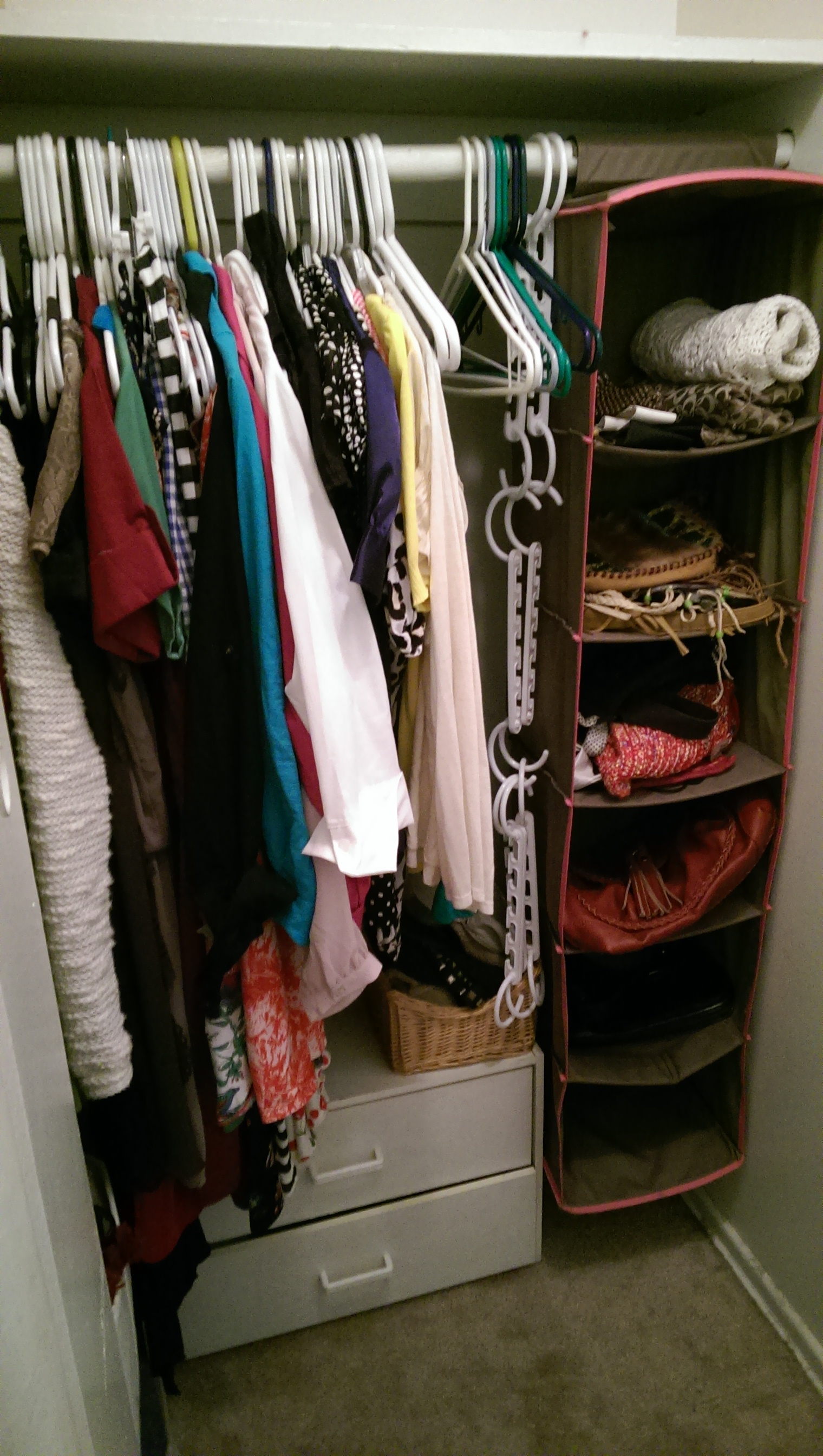
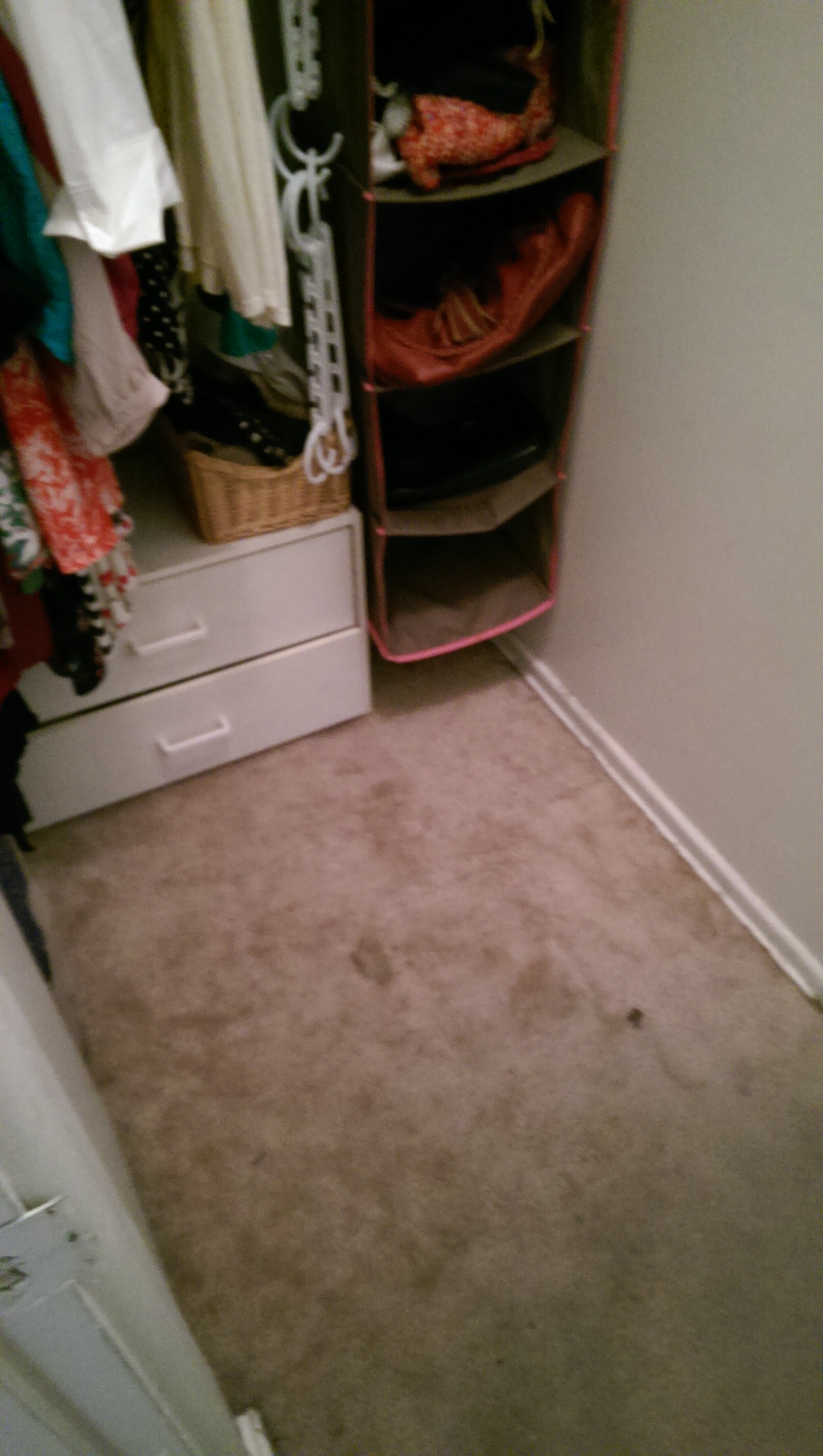
Here are some before pictures of a friend’s closet:

IMAG2375

IMAG2376

IMAG2377

I completely understand why my friend has had difficulty finding things. I mean, who could find anything in such a disorganized space? Within the span of about 3-1/2 hours, I had organized the closet and convinced my friend to get rid of items which were in need of repair or hadn’t been used in a long time. Ideally, I would have added some decorative elements and completely transformed the space, but financial and time constraints stood in the way, so I just worked with what was already there.

Here is what I was able to accomplish in terms of organization:

IMAG2379

IMAG2380

IMAG2381

How did I accomplish this? I began by removing every single item from the closet so that I would have a clean slate. I then slowly returned items back into the closet, first by bringing the hangers back and organizing them by type. Next I organized the clothing by type, so that all coats were together, dresses were together, etc. I further organized clothing by sleeve length and by color so that an organized and eye-pleasing palette was created. I also moved and reassigned a soft hanging shelf storage system for my friend’s handbags.

This is phase one, in which I have established some organization in my friend’s place and cleaned up years’ worth of junk. Stay tuned for phase two of this reorganizing project, in which I will transform all the spaces in this person’s apartment.

An Organized Person’s Approach To Decluttering

Before After Closet 2

The images above are NOT from my house, but are great examples of a before and after organization transformation.

I often take my intense need for organization for granted and assume that other people are just like me. However, I know that this isn’t the case, and that many individuals tend to get literally and figuratively buried in their own stacks of paperwork, unfinished projects, and unused items which have sat in storage for far too long. One of the reasons why I am able to remain relatively organized on a consistent basis is because I go through every item I own several times a year and assess its value and function in my life. If it no longer serves a need, it goes to Goodwill, the trash, or a pile of items which will be part of a garage sale. I fail to see the point of hanging onto things I don’t need, because those items only collect dust and take up space. In addition, items of value which sit in storage are better utilized by being sold, because then the money can go towards paying bills or fattening up a vacation fund.

When I conduct my regular organizational purges, I move in a clockwise or counter-clockwise fashion, starting in one corner of the room. I make sure to COMPLETELY sort everything in that area before I move onto the next portion of the room. I have discovered that this method is very effective for decluttering, especially for individuals who become easily overwhelmed with the task of cleaning and organizing a space. As an example, I may start at a storage cabinet. The exterior of the cabinet is cleaned, and any items which are on top of or around the cabinet are assessed. Once the area outside the cabinet is done, I will go through each shelf in the cabinet. Whenever I assess an item, I ask these questions:

1. Does this item belong where I found it?
2. If the item doesn’t belong where I found it, and I am going to keep it, where does it belong?
3. When was the last time I used this item?
4. Is this item damaged and in need of repair?
5. Will I have a need for this item in the future?
6. Does this item have sentimental value?
7. If I decide to get rid of the item, does it have enough value to put into a garage sale, or does it belong in a Goodwill pile or the trash?
8. Is this a collectible or specialty item which requires research and appraisal?

People who have hoarding tendencies have strong emotional attachments to objects, and will have a particularly difficult time answering these questions, especially numbers 5,6,7 and 8. In their minds, EVERYTHING has some sort of value which warrants a permanent spot in their home, even if it isn’t being used.

When I conduct these semi-annual purges, I have the following on hand:

trash bags
cleaning solution and paper towels
box designated for Goodwill/Salvation Army
box for items which need to be repaired or professionally cleaned
area for garage sale items
area for collectibles to sell

Once I get started, I am pretty ruthless about getting rid of things I don’t need. To be honest, I love making money back on items I bought which haven’t been used in a while, and I also get great joy out of donating things to Goodwill. Above all, I am very honest with myself about emotional attachments to inanimate objects. There are some items I will NEVER get rid of, like the little yellow musical stuffed dog that was in my crib, jewelry my mother gave me, my Pro Card watch, and all my trophies, but I am not going to develop anxiety about getting rid of a sweater I have had for 15 years which I haven’t worn for over 5 years!

If you are long overdue on spring cleaning, now is a good time to clear up the clutter. You’ll end up with a cleaner, more organized home, you will know where everything is, and you may make some decent money selling some of your belongings!

It’s All Just Stuff: Decluttering Your Home

Creek
Despite the fact (or perhaps BECAUSE of the fact) that my mother’s family is full of pack rats, I cannot stand the idea of accumulating tons of items which just take up space. Since my mom and I had different philosophies about objects and belongings, the subject of decluttering was a point of contention between us.  My mom sequestered all kinds of things in boxes and tissue paper for decades, never to be worn or used, frozen in a static, pristine state and kept hidden. After dealing with tremendous guilt over my mother’s attachment to things which I had somehow held myself responsible for, I let it go, and was able to purge items which only collected dust in closets and the garage. I just had a garage sale last weekend and it felt GREAT to finally let go of large, bulky items such as two very traditional oil paintings which simply were never my style to begin with, and which sat in museum boxes in my garage for nine years. I also got rid of a bunch of hot little mini-dresses which I had worn during trophy presentations at bodybuilding contests from 2010 through 2013. I must have pulled about 40 dresses from my collection, all of which were only worn once or twice. It was like shedding old skin, and it felt fantastic.

One of my friends had asked me if I had ever gotten rid of something and later regretted it. There have been a few instances in which this occurred, even as recently as last weekend when I realized that a re-seller who had purchased several groups of items had gotten a few gems which I had foolishly forgotten to remove when I was organizing and displaying items for the garage sale. Though I had a moment of sadness, I let it go since there wasn’t a single thing I could do about retrieving those things. Oh well, I thought, it truly is all just stuff. There are some items I will NEVER get rid of, things which hold huge sentimental value. But for the most part, just about anything which is damaged or worn down or sitting on a shelf unused in my residence will eventually find its way into a garage sale.

If you haven’t used something in a while and it is collecting dust, get rid of it. There is probably someone out there who will use it and will appreciate it. If there is something you haven’t used or worn because you are waiting for the right occasion, either USE IT or let it go!