The Costs Of Competing

Overall Team U Pic 2

A number of competitors have asked me recently how much they should expect to spend on competing, which prompted me to write this post. Competitive bodybuilding can get pretty expensive, so you should be prepared to invest some coin in your prep and contests. When I calculated the total amount which was spent by my sponsors and me on all associated costs (coaching, suits, tanning, entry fees, flight, hotel, rental car, supplements, food, shoes, makeup, etc.) which got me to the seven national qualifiers and fourteen pro qualifiers I competed in during the amateur portion of my contest history (2009 through 2013), I was shocked. The total came to over $100,000! Thank goodness my sponsors paid for the majority of those expenses, because otherwise, I wouldn’t have been able to hit the national stage the way I did. Obviously the drive to compete took over me, and demanded a tremendous amount of financial and personal sacrifice which I was willing to make.

Over the years I have spoken with other competitors who have had the same drive to compete who have done stupid and risky things in order to keep competing. Though I took financial risks during my Pro Card chase, I didn’t have children or a spouse to worry about, so my behavior didn’t put anyone else at risk. I admit I had foolishly pushed myself to the limit in the past, knowing that as a consequence I would not be able to afford more basic living expenses, but I got wiser as I continued to compete. I have heard of others who have done similar things, with some competitors risking all they owned for the chance to continue competing. Let me be very clear: Pro status will never help you to cushion a nest egg, so if you are risking financial security for the sake of competing, you had better take a good, long look at the reasons why your obsession with competing is pushing the need for basic survival into the corner. It’s time for a reality check.

Be sensible about the money you spend on competing and set a competition budget which doesn’t put undue strain on your finances. Before I went Pro, I established a separate “show fund” in which I set aside money for competitions, so I was always aware of what I could and could not afford. Once a budget is set, it is important to limit oneself to the number of competitions which will keep one within budget. This can be challenging, especially when one is on a mad quest to chase a national qualification or Pro status.

I always advise competitors who frequently compete to search for potential sponsors. I have had competitors ask me how to obtain sponsorship and who also lament the fact that it is exceedingly difficult to land sponsorship from a supplement company. My response to this is that sponsors can come in all forms! Here are some suggestions for potential sponsors:

Fans
Friends and family
Business associates
Smaller supplement companies

The trick to asking for sponsorship is to graciously ask for assistance in paying for an event. Remember that even a small amount will help. I have competed at events which have been sponsored by a number of entities, with the tan covered by one, entry fee covered by another, flight by yet another, etc.

If your budget is really tight, stick to nearby contests so you don’t have to pay outrageous travel expenses. If you are nationally qualified, you will be somewhat stuck since there are only seven national level events each year, and they place in very specific geographic areas. You might have to limit the number of Pro qualifying events you enter if your budget is very limited. However, I know the feeling of having to hit all the national events in a year in order to maximize one’s chances at a Pro Card. Even when I was sure I would not be able to afford doing a bunch of national events back to back, I somehow managed to to it because I wanted that Pro Card SO badly. I will be quite blunt and tell you that if you are a nationally qualified master’s competitor, you are probably better off confining your stage time to Pro qualifiers which have master’s divisions. That means that there are three chances at a Pro Card each year for you: NPC Team Universe, Master’s Nationals, and IFBB North American.

Other ways you can keep costs down while still hunting for that Pro Card are to stay with friends or family when you travel to Pro-qualifiers, or share a hotel room with one or more competitors. I strongly advise you to avoid sharing a room with people who are in your height or weight class, though, because it can be torture if you face off against each other onstage, and one of you does well while the other doesn’t. It could get uncomfortable or even ugly.

Even if you don’t have far to travel (those of you who live in the tri-state area are in a good spot geographically for several national events), you still need to pay for coaching, competition suits, spray tanning, supplements, food, shoes, makeup and stage accessories. The stream of contest related expenses is exhaustive, so you need to be prepared. There are ways to cut costs down, but whatever you do, don’t scrimp on quality. You still need to bring a polished and well-conditioned package to the stage.

Competing On A Budget

Originally published on RxGirl.com on Sunday, 14 October 2012. The original post was published with white text on white background, so the only way to read it on the site is to highlight the text. To make things easier for everyone, I have copied and pasted the article here for you to read.

http://www.rxmuscle.com/rx-girl-articles/6778-competing-on-a-budget.html

Figure top 5
Several weeks ago I calculated the total amount which has been spent by my sponsors and by me on all costs associated with the half dozen national qualifiers and the thirteen pro qualifiers I have competed in since 2009, and almost fell over in my chair. I am by no means blessed with disposable income so I can honestly say that my drive to compete has required a tremendous amount of financial and personal sacrifice. However, I realize that many of you prefer to keep expenses to an absolute minimum, so I offer a number of suggestions on how to meet the financial demands of competing without putting undue strain on your wallet.

1. Set a specific competition budget and stick to it. I have a separate “show fund” in which I set aside money for competitions and am well aware of what I can and cannot afford. I know competitors (and I admit I have foolishly pushed myself to the limit in the past) who have paid a show entry fee then later came to the realization that they could not afford the other expenses for the event and had to back out of it. Once a budget is set, it is important to limit oneself to the number of competitions which will keep one within budget. This can be challenging, especially when one is on a mad quest to chase a national qualification or pro status.

2. Look for a sponsor. I have had competitors ask me how to obtain sponsorship and who also lament the fact that it is exceedingly difficult to land sponsorship from a supplement company. My response to this is that sponsors can come in all forms! Here are some suggestions for potential sponsors:

Fans
Friends and family
Business associates
Fitness clothing companies
Smaller supplement companies

The trick to asking for sponsorship is to graciously ask for assistance in paying for an event. Remember that even a small amount will help. I have competed at events which have been sponsored by a number of entities, with the tan covered by one, entry fee covered by another, flight by yet another, etc.

3. Stick to nearby contests. It makes sense to compete within your geographic area if you are trying to keep costs down. If you are competing at local and regional events, make sure these events are within reasonable driving distance from where you live. National-level events are much trickier since they are fewer in number and take place in very specific areas. If your budget allows it, you may consider competing at pro-qualifiers provided 1) your budget allows it, and 2) you limit the number of pro-qualifying events you enter.

4. Stay with friends. If you are considering competing at an event which is far from where you live, consider asking friends or family who live near the venue if it is possible to stay with them.

5. Purchase a used competition suit. Many competitors will retire gently used suits and put them up for sale. This is a great way to get a suit without breaking the bank. Keep in mind that you should determine whether your body is similar to the competitor who has worn the suit, as this will greatly affect how the suit fits YOU.

6. Bling out your own suit. A competition suit encrusted with crystals can range from several hundred to thousands of dollars and can really kill a competition budget! A great option is to purchase a plain suit then purchase crystals, beads or sequins from wholesale supplier online, then apply the embellishments yourself. Please refer to my article on How To Bling Out Your Own Suit for more details on how to do this. By choosing this option you will save a considerable amount of money. In addition, you can customize your design, making your suit truly one-of-a-kind.

7. Do your own makeup. Out of the eighteen competitions I have been in, I only had my makeup professionally done four times, and that was in 2009 and 2010. Since then, I learned how to apply makeup for the stage and as a result, have saved a significant amount of money. Please refer to my article, Perfect Stage Makeup for pointers. Also make sure to PRACTICE a couple of times before the contest so that you don’t wind up with a disaster on the big day. There are plenty of great tutorial videos on YouTube which will walk you step-by-step through makeup application for a smoky eye.

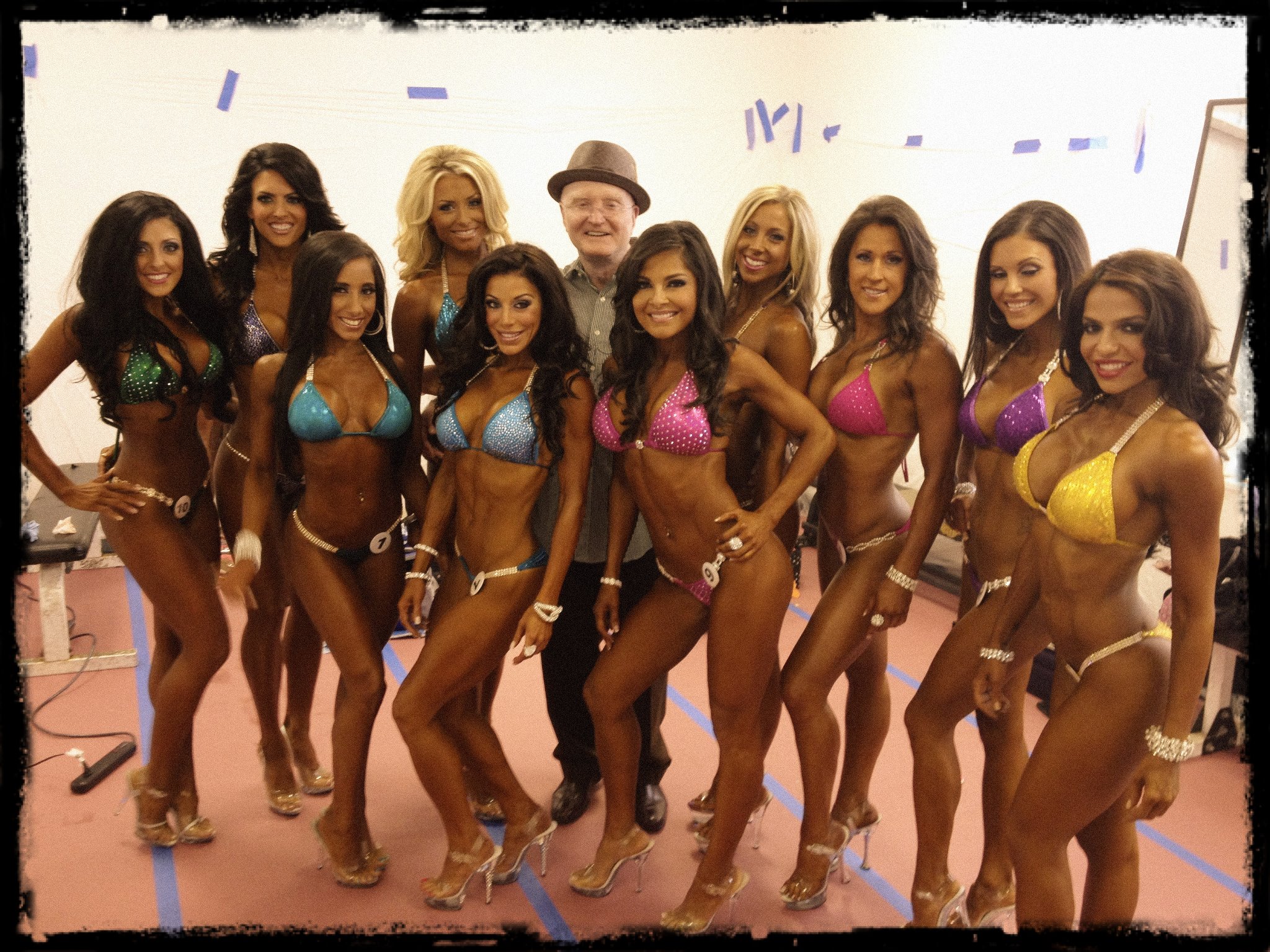
Pro Bikini gals backstage
8. Do your own hair backstage. Generally speaking, you really don’t need to get too fancy with your hairstyle. For figure and bikini, either flatironing for a sleek look or adding big, soft curls will look nice onstage. Fitness, women’s physique and women’s bodybuilding may necessitate putting some hair up if you have hair that is long enough to get in the way of your routine. Make sure to use either smoothing serum for flatironed styles or hairspray for curls so that things stay in place. However, do NOT make your hair so stiff that you cannot gracefully move it off your back during your back pose.

9. Apply tanning solution yourself. This is a tough one, since I always have my tan done professionally. However, if you are truly on a tight budget, it is certainly possible to apply tanner yourself. The only limitation will be when you need to tan your back. There is a tool which you can purchase called Xen-Tan Hard To Reach Back Applicator which does a decent job of evenly depositing self-tanner on hard to reach areas if you aren’t able to find someone to help you apply your tanner. This clever device is available at a number of sites, including Neiman Marcus, Zappos, 6 PM, Amazon and Ulta. I merely chose the Ulta site because that is where I purchased mine.
http://www.ulta.com/ulta/browse/productDetail.jsp?skuId=2242675&;productId=xlsImpprod4141877&navAction=push&navCount=1&categoryId=cat90022

Make sure to apply a thin, even layer and allow to dry before applying the next layer. The number of layers you will apply will depend on your base skin tone and the brand of solution you decide to use, but you should plan on applying two to five coats of color.

As for the solutions which I consider the best for stage, I love Jan Tana High Definition Color and Liquid Sunrayz. Bronze Angel by Dream Tan is also great. Some people love Pro Tan so this brand may also work well for you. However, I personally cannot use this product as it fades immediately on me, hence my hesitation with this particular brand.

I hope these tips will enable you to compete at the shows you have your eye on! Best of luck!