Tag Bump to Rump
Exercise #5 In Bun Burner Video Series: Bulgarian Split Squats
Exercise #3 In Bun Burner Video Series Now On YouTube (Hyperextension Holds)
Exercise #3 In Bun Burner Video Series: Hyperextension Holds
I Love This Back Shot From Trudge Photo!
I love the sassiness that is implied in this image!

Plyo Video Series: Frog Jumps
Check Out My Profile On The P28 Foods Team Athlete Page!

Please click on the link below to read my P28 Testimonial and Bio:
Are Bikini Competitors Getting More Ripped?
I remember the general appearance of the top bikini competitors in the NPC in 2009 who eventually went on to earn IFBB Professional Status. With a couple of exceptions, these ladies displayed curvy yet toned bikini bodies without an excessive amount of muscular development in the quads, delts, or abs. Over the years, however, there has been an increasing degree of muscularity within the IFBB Pro ranks with a correspondingly lean and ripped group of ladies in the amateur ranks as well.
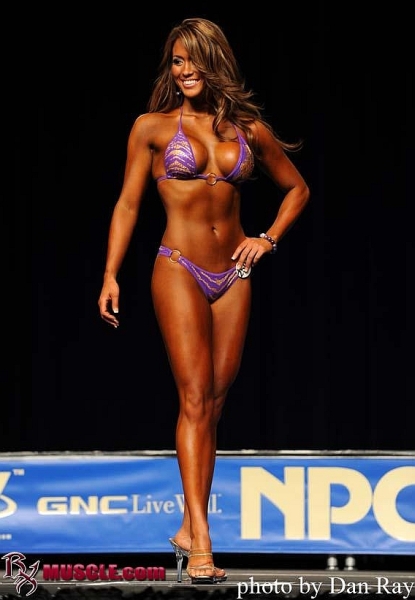
Due to the extremely subjective nature of bodybuilding, it can be downright confusing to determine what the judges are looking for. Depending on the geographic region and level of competition, the ideal may lean towards a softer, curvier physique (as exemplified by Jessica Anderson who went Pro in 2009), or it may lean heavily towards an extremely lean, ripped body such as the one Nathalia Melo has brought to the Olympia stage. I completely understand the frustration which bikini competitors may face as they adjust their competition prep to come in looking a certain way, only to show up on the day of the contest and discover that the judging pendulum has swung in the opposite direction. This also explains in part why a competitor can go to one contest and do poorly, then hit another stage and place very well.

Undoubtedly these ladies look incredible regardless of whether they are softer or more defined and muscular. But if you are a bikini competitor trying to determine what YOU should reach for with respect to degree of muscularity and conditioning, do some research into the region in which you are competing. I do know some competitors who are stubborn and who will not waver from their own personal ideal, but if you choose to do this, just be aware that while it may be rewarded eventually, there is just as good a chance that it will not. Judges look favorably upon competitors who work on weaker areas on their physiques.
There has been an increasing trend more recently towards a greater degree of muscularity and a leaner, yet compact, curvy, muscular frame without muscle separation. This will make it more difficult for a genetically blessed gal to simply jump onstage with little to no prep and get a high placing. I also strongly feel that this tendency legitimizes the division as a celebration of muscle and downplays the derogatory “T and A show” label that has been used unfairly by some naysayers.
How To Do A Smith Machine Squat
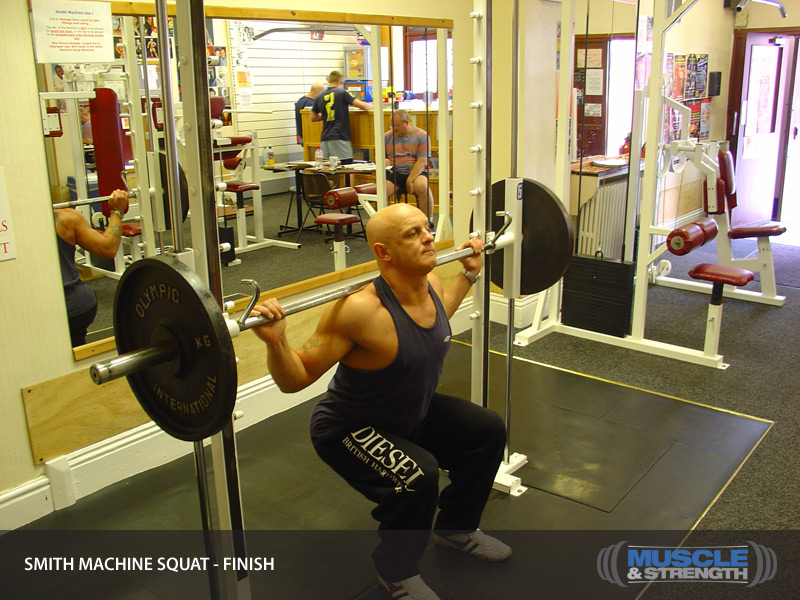
I was recently asked by a dear friend and client about the proper way to do Smith Machine squats. There is a safe and very effective way to do squats on the Smith Machine which will maximize recruitment of the glutes, hamstrings and quads.
Your torso should be in line with the Smith machine rack during the squat movement. A good way to check your form is by looking in the mirror from a side view to check your alignment. Tuck your tailbone in slightly but make sure to keep your back neutral. In order to keep everything in line with your upper body, you need to make sure that your feet are far enough forward. You can place your feet close together, shoulder width apart, or at a wide stance.

Keep in mind that if there is a slant to the Smith Machine apparatus that you will have a tougher time keeping your back in line with the slant, in which case you will favor keeping your upper body completely perpendicular to the floor instead. Make sure to keep your back NEUTRAL the entire time.
When you push the bar up, you will only go up halfway. Concentrate on squeezing your glutes and pushing through your HEELS. On the down phase, you will come down beyond 90 degrees (around 60 degrees at the knees). Move slowly and deliberately. If you are doing these correctly, you will feel a stretch in your hamstrings and glutes.
Discussion of Bump to Rump Video Series: Exercise #1 – Smith Machine Lunges
Stand at the Smith Machine and step forward with one foot so that you can come down into full lunge position without your knee moving over your toes anteriorly. Step with your back foot into a very deep lunge. With this movement, you will be performing pulse lunges on one leg, performing all repetitions before switching legs. Make sure to keep your hips level and your back neutral during this exercise, and squeeze your glutes as you perform the movement. In addition, try to come up only part way from lunge position, then go into your next repetition. Once all reps are completed on one leg, switch legs and repeat. Ideally, you would keep switching legs without any rest in order to maximize muscle recruitment.
 dr. stacey naito's blog