
Feature Article is on pages 26 through 29. Please visit http://issuu.com/billybow/docs/fitnessxmag-june2012 to access the digital copy for FREE!
Feature Article is on pages 26 through 29. Please visit http://issuu.com/billybow/docs/fitnessxmag-june2012 to access the digital copy for FREE!


I love the sass I threw out in this image! Taken at the NPC USA’s, July 2010

No odd surgery or up here. Just clean eating, hard training, focus and determination. From IFBB North American this past Labor Day weekend.

Candice Perfect and me at the end of a very long night handing out trophies!
As a physician I meet new people constantly and have mastered the art of setting a patient’s mind at ease. I am amenable to chit-chat when 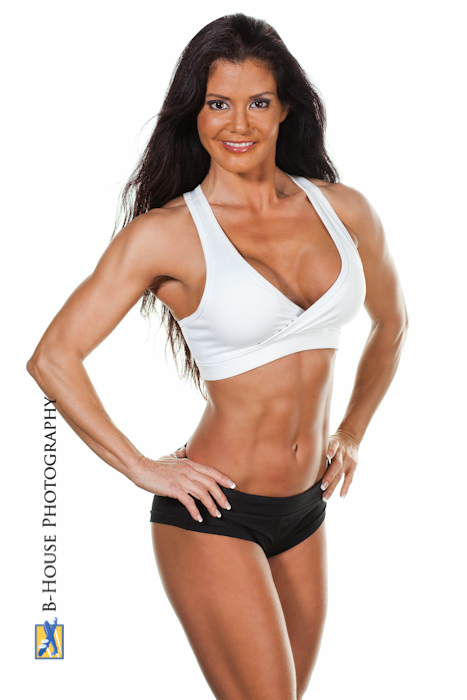 running errands and enjoy engaging in conversations with strangers while at social events. However, when I am at the gym, I automatically shift into a “don’t mess with my flow” mode which has left other gym members with the distinct impression that I am some sort of ice queen.
I have made numerous attempts over the years to train with friends and at the conclusion of every one of those training sessions have resolved to avoid such scenarios at all costs. Thus in my estimation having a training partner has a completely ergolytic effect on my regimen. Though I recognize the utility in having a supportive human by one’s side to encourage one more rep, such commentary from a pep squad only serves to distract me and in some cases raise my ire.
I have spent my entire life as an aggressive self-starter. Without such drive I would never have endured the rigors of medical school and residency. As an NPC national Bikini champion I have consistently pushed myself to reach a personal best, which has been no easy task given the demands of my career and life in general. I stroll into a gym with my equipment and my regimen for the day like a thoroughbred horse lining up at the gate, blinders in place, ready to charge towards the finish line at full speed. It certainly doesn’t help that I am usually in an incredible rush to get to the office or a meeting and must keep moving from movement to movement. You can imagine how I respond to the weekend warrior who decides to wipe the drool from his chin and ask me while I am in the middle of a set how he can get his abs to look like mine. So the mere thought of spending my entire gym session hyperaware of my time constraints while trying to work in on gym equipment with a training partner is more anxiety-provoking than a trip to the dentist.
If you and your training partner are completing staggered supersets, I suppose you could yell words of encouragement at each other. If there is sufficient equipment for two side-by-side setups, or if you are engaging in plyometrics, it is possible that you may both train simultaneously. However, if you are taking turns on equipment, especially if you are using different weights for each set, a thirty-second rest could easily broaden into 60, 90, 120 or more seconds as you load or re-rack or perhaps have a good laugh about the Facebook post one of you just saw on your cell phone.
With all that said, I realize that some individuals thrive in a workout regimen which includes a training partner. After all, a supportive and upbeat buddy could consistently push you beyond what you believe you are capable of with respect to strength, power and endurance. If this is what your training partner possesses, and this person is easily able to surrender the cell phone along with idle chat for the duration of the workout, you are quite lucky indeed.
I admit that abdominals are my favorite of all the body regions to train and have been for my entire adult life. In fact I cannot think of a single time that I balked when it was time in my training split to work my abs. This makes designating a particular abdominal exercise as my favorite especially challenging for me, since I consider very move to be a valuable component of an abdominal routine.
After having evaluated the level of motivation I have during each abdominal exercise, I have determined that my top abdominal move is the decline bench crunch. If you have not performed this exercise before (and yes, I realize that many of you are already familiar with this move), I would highly recommend that you incorporate decline bench crunches into your routine. Decline bench crunches are excellent at targeting the rectus abdominis and hip flexors due to the increased range of hip flexion which occurs on a decline bench.
Adjust a decline bench so that it is at a 30 to 45 degree angle (the more advanced you are, the greater the angle you can use). Sit on bench with your feet hooked under the rollers and lie back on the pad with your arms folded across your chest. Exhale as you bring your head, shoulders and back off the pad, coming to a full sit up position, then return slowly to start position. You can perform 12 to 20 reps per set, 3 to 5 sets, but I will admit that when I do decline bench crunches, I perform 5 to 6 sets of 30 reps. If you crave an extra challenge, extend your arms overhead while you perform this move.
Decline bench crunches can also be performed with a twisting motion at the top of the move, recruiting the obliques and serratus anterior.
Those of you who are really looking to punch up this exercise can perform a weighted variation of this move in which you hold a dumbbell behind your head, hold a plate on your chest, or pull on a cable during the exercise.
After incorporating decline bench crunches into your training split, don’t be surprised if people begin noticing your washboard abs!

June 2012 Shoot

One of those “between shots” shots…
 dr. stacey naito's blog