Stand at the Smith Machine and step forward with one foot so that you can come down into full lunge position without your knee moving over your toes anteriorly. Step with your back foot into a very deep lunge. With this movement, you will be performing pulse lunges on one leg, performing all repetitions before switching legs. Make sure to keep your hips level and your back neutral during this exercise, and squeeze your glutes as you perform the movement. In addition, try to come up only part way from lunge position, then go into your next repetition. Once all reps are completed on one leg, switch legs and repeat. Ideally, you would keep switching legs without any rest in order to maximize muscle recruitment.
Tag Bikini division
Discussion of Bump to Rump Video Series: Exercise #2 – Single Leg Smith Squats
Plant one foot on the floor with the Smith Bar on your shoulders. Come down into squat position on that leg, with your other leg tucked under you, until your thigh is parallel to the floor. Avoid twisting your hips during the movement, and avoid arching or curving your back. When you come up from the squat, only come up part of the way, and drive the pushing energy into the floor through your heel while you squeeze your glute. If you have knee issues, go with a very light weight.
Discussion of Bump to Rump Video Series Exercise #3 – Supine Smith Machine Leg Presses
Lie on a bench so that your hips line up with the Smith Machine bar. Place your feet on the bar at shoulder width or even a bit wider. Release the bar and allow it to slowly come down by flexing your knees and hips. Press the bar up, squeezing your glutes and pointing your heels up so that the driving force is through the posterior portion of your legs.
This move can be incorporated into your leg day once a week as an intense finishing exercise. I would not perform this exercise early in your regimen as it will result in excessive fatigue of the hams and glutes before you get a chance to progress to other exercises. Go as heavy as you can without compromising form or your ability to release the Smith bar. I also think it is best to face towards the mirror instead of out on the gym floor, as this can be a pretty revealing position for passerby to witness!
Discussion of Bump to Rump Video Series Exercise #4 – Straddle Bench Jumps
The best stability can be obtained from placing a bench under the Smith Machine bar and using the bar to hold onto as you jump onto the bench. Starting position is standing with your feet on the floor on either side, straddling the bench. You will jump onto the bench with both feet, then return to start. Move rapidly and without pausing. It is a simple move but you will definitely feel these and will be out of breath at the end of your set!
Discussion of Bump to Rump Video Series Exercise #5 – Bench Step Overs
Crouch slightly next to the right side of a bench. Step onto the bench with your left foot with enough room so that you can also step on with your right foot. As soon as you place your left foot onto the bench, you will hop, then place your right foot on the bench while the left foot comes down to the floor on the left side of the bench. Repeat movement so that you end up on the right side of the bench again.
This is a rapid movement in which you be moving constantly. If you want an extra pump, you can pulse the movement when you briefly plant your foot on the floor, just like I do in the video. If you choose to do this in double time, you will get a much more intense workout and will no doubt be out of breath!
Discussion of Bump to Rump Video Series Exercise #6 – BOSU Squats
Place a Bosu ball dome side up on the floor. Holding onto a weight plate at your belly, step onto the Bosu ball so that your feet are slightly narrower than shoulder width apart and you remain balanced on the ball. Squat low as if you are sitting into the squat (do NOT lean forward), and make sure to maintain as much contact with your heels and the Bosu ball as possible. If you do not have a weight plate, you can use a dumbbell, medicine ball or kettlebell, but keep it as close to your belly as possible to shift your center of gravity more posteriorly. When you come up from the squat position, only come up halfway, then go immediately into the next low squat.
Discussion of Bump to Rump Video Series Exercise #7 – Swing Lunges
This exercise will challenge your balance, so I highly recommend performing this exercise without weights and your hands at your hips until you get accustomed to the movement. From a standing position, step into a front lunge, then immediately step into a back lunge with that same leg. Switch legs and repeat. As an option, you may wish to do all repetitions on one leg before switching, but I find that most people have better balance if they switch legs with each rep. The key to maintaining balance is to SQUEEZE your glutes when you perform these lunges and keep your hips level without twisting or bending.
For an extra blast on the glutes, you can do swing lunges with a pump. To do this, you will step into a front lunge, then pulse in a small movement at the peak of the lunge. Move immediately into the back lunge and pulse in a small movement at the peak. Don’t be surprised if your glutes burn at the end of a few sets of these!
Discussion of Bump to Rump Video Series Exercise #8 – Single Leg Dumbbell Deadlifts
Stand holding dumbbells at your sides and palms facing in. Another variation is to use one heavier dumbbell which would be held on the side of your supporting leg, with your other hand on your hip as you perform the movement. Bend forward at the hips as you raise one leg behind you, squeezing your glute as you do so. As you do this, bring the dumbbell(s) down so that they almost touch the floor, and pronate or twist your wrists so that your palms face your body as the weights come towards the floor. Return to start. Make sure to keep your knees soft throughout this movement, and if you have issues with your knees, maintain a slight bend in them. You will perform all repetitions on one leg before switching to the other side.
Dancing Onstage
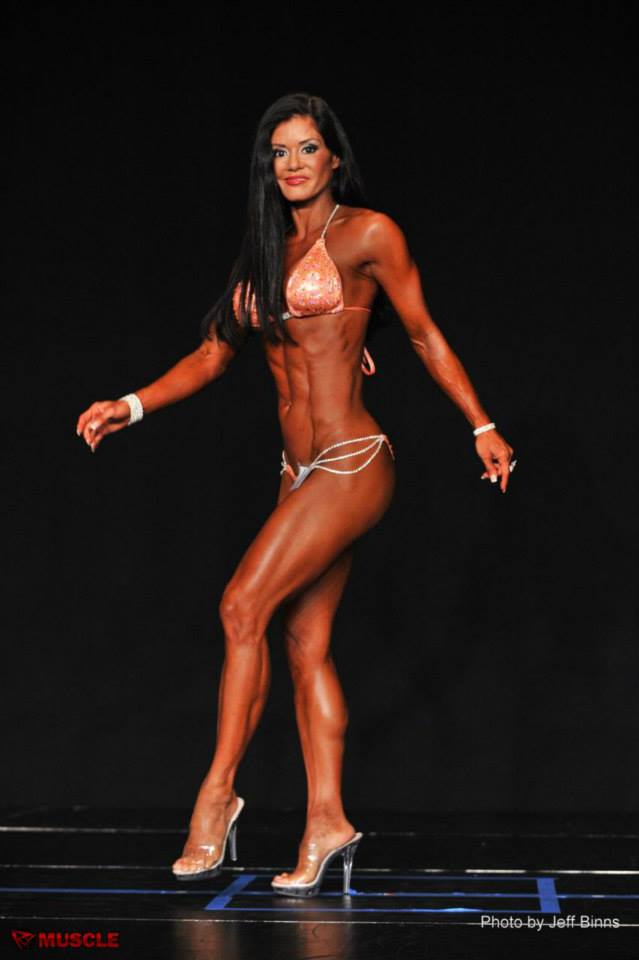 If you compete in Women’s or Men’s Bodybuilding, Women’s Physique or Fitness divisions, you may incorporate dance moves as part of your routine onstage. Dance moves are always a crowd favorite and add to the entertainment value of a posing routine, breaking up the monotony of hitting one mandatory pose after another. But I am not talking about true dance moves here. What I am talking about is the flow of energy and the fluidity which a competitor should ideally bring onstage regardless of the division in which he or she competes. This includes Figure, Men’s Physique and Bikini divisions.
You may exclaim, “But I am not a dancer!”, and that is fine. You don’t need a dance background to move gracefully onstage. However, when you step onstage, your movements should look effortless and should demonstrate the confidence you should have while up there. The worst thing you can do is to have a deer-in-headlights look or to move like a robot because you are overthinking your steps. It also will NEVER serve you to get nervous onstage. So how do you combat these obstacles to really bringing it onstage and crushing the competition? Here are some tips to help you develop that flow and swagger before you hit the stage.
TIP #1: PRACTICE PRACTICE PRACTICE!
You should be practicing walking and posing as MUCH as possible! Make sure to wear your suit or trunks whenever you practice so that you can become aware of how the attire fits your body and shows off your lines as you move. Figure and bikini ladies need to practice in their show heels so that they can become aware of shifts in their center of gravity as they move. Once you have your basic poses down, work on your turns and transitions. Finally, once you are VERY comfortable with your posing, you can add flourishes and styling which are reflective of your personality.
I tell clients to walk around their homes wearing their contest heels not only to break them in but to also get used to how they carry their bodies when wearing those heels. A pair of regular street heels won’t quite do it either, so make sure to wear the shoes you will actually be wearing onstage. Do NOT get high platforms because they are tricky to wear onstage and will increase the chance of tripping or twisting your ankle, and they also make your leg line look very chopped up and clunky. You won’t be fooling anyone by getting Frankenstein platforms, trust me!
TIP #2: VIDEOTAPE YOURSELF AND USE MIRRORS
A great way of getting feedback (besides having competitor pals watch you pose, which I also recommend) is to videotape yourself walking and hitting your poses. You may think you look great, but by watching footage, you may pick up on some bad habits or angles which you can then work on before contest time. After competing for several years I honestly think that videotaping yourself is an indispensable tool when practicing your posing.
Whenever possible, you should also practice in front of a mirror. I used to practice in a dance room which had mirrors on three walls so I could check out my posing from all angles, but if you don’t have access to a room like that, you can just practice in front of an inexpensive full length mirror.
TIP #3: WATCH YOUTUBE VIDEOS
I always advise clients to watch YouTube videos from NPC National and IFBB Pro events in order to learn from top competitors. Watch the competitors who get first callouts because their posing plays a big part in their top callouts. You can usually tell which competitors will end up doing well because they make the poses look like second nature, moving gracefully or purposefully from one pose into the next. One word of caution: if you are a local or new competitor, do not try to add the styling that the pros add. For one thing, that sort of thing will come with time and experience onstage. Secondly, most judges do not like all the unnecessary flourishes and will mark you down if you add too much “flavor”. Keep your transitions nice and clean.
TIP #4: GET A POSING COACH
I think every competitor can benefit from having a posing coach, even if they just have one session. A posing coach will lend a trained eye and correct any bad habits, making adjustments so that the client’s physique is displayed in the best way. Even the slightest shift of the hips can look great on one body and horrible on another. If you are in the Los Angeles area, I am available for one-on-one posing, but if you reside elsewhere, there are some excellent posing coaches out there who can help you out. Make sure to select someone who knows how to pose for your particular division!
TIP #5: FLUIDITY
Once you have been practicing posing for a while, you can work on making your movements as fluid as possible. This means that when you transition from one pose to the next that you don’t look like a robot when doing so. It also means getting out of your head! I have seen competitors who are obviously thinking about their next pose, and their movements end up looking very choppy. You should not be thinking, “okay, front pose, then I will step with my right, er, my LEFT foot, then ummmm…” because that will ensure a very unappealing presentation onstage. You can have your internal chat before you step onstage, but leave it backstage where it belongs.
TIP #6: SMILE!
Perhaps the best thing you can wear onstage to engage the judges and the audience is a smile. You need to look like you are having a blast onstage, not like you are dreading those few minutes up there. This definitely means that you will be smiling so much that your face may end up fatiguing from it, but believe me, it makes a big difference.
TIP #7: DON’T BE NERVOUS
I remember being very nervous the first few times I competed. Then after a while I thought to myself, “What is the point of being nervous?” and all my jitters sort of melted away. This doesn’t that mishaps don’t occur, but your attitude about them makes all the difference in the world. I was at the IFBB North American in Cleveland in August of 2011 and I kind of tripped over my feet when doing a transition during overall comparisons. Instead of getting rattled I just kept moving and it wasn’t a big deal at all. I have also heard a story about a competitor whose top flew open during her posing routine. She kept going, topless, until she finished her poses, then picked up her top from the stage floor and walked off!
If I ever start to feel any kind of nervousness (which at this point is very rare), I remind myself that I know most of the judges and many of the other competitors, and that unless I do something really stupid onstage, I have absolutely NOTHING to worry about. Leave your anxiety and jitters off the stage and just get up there and have fun!
Discussion of Bump To Rump Video Series Exercise #9 – Side Single Leg Press
Sit on leg press machine so that you are supporting your upper body on one side instead of on your back, with your bottom leg nestled on the floor to add stability. Place your other foot on the foot plate so that your toes are near the side edge of the plate. Push plate up, emphasizing pushing through your HEEL and squeezing your glute as the plate moves up. Return to start. Perform all repetitions on one leg, then switch to other side. This is more challenging than a single leg press that is performed when you are on your back, so use a lighter weight and concentrate on your form. As long as you are driving through your heel and getting that glute squeeze in, you will feel the burn even with a light weight.
Try stacking side single leg presses in a superset with weighted bench step ups or swing lunges to really blast the glutes and hams.
 dr. stacey naito's blog