
The new Star Wars trilogy got me riled up for a number of reasons, with the main reason being that Disney had gotten their hands on the franchise. Simply by virtue of Disney’s involvement, I was wary of how true they would be to George Lucas’s original vision. As a matter of fact, I initially resisted the idea of going to see “The Force Awakens”. However, it only took a few days after the film was released for me to cave in, and so I found myself watching the Disney version of the iconic sci-fi/fantasy story line on Christmas Day.
Surprisingly, I enjoyed “The Force Awakens” and thought Disney did a decent job of keeping the audience riveted, and the character development of the new characters was also acceptable. I went to see the film a second time on New Year’s Day, and that was when I began to analyze and dissect the story much more. I guess you could say the George Lucas fan in me awoke and began to scrutinize the details of the newest trilogy.
Though Lucas had initially spoken of developing three Star Wars trilogies, and even proposed and wrote out brief story elements of Episodes VII to Episode IX while filming “The Empire Strikes Back”, he never fully fleshed out those episodes. He was quoted in 1980, stating “It’s a nine-part saga that has a beginning, a middle and an end. It progresses over a period of about fifty or sixty years with about twenty years between trilogies, each trilogy taking about six or seven years.”
Somehow along the years, George Lucas lost the impetus to carry through with all three trilogies, and by the late 1990’s, stated that he had no intention of making the third trilogy, and would not allow anyone else to do so either.

Here’s an interesting excerpt from Wikipedia in which George Lucas responded to questions about the trilogies:
(link is: https://en.wikipedia.org/wiki/Star_Wars_sequel_trilogy)
In August 1999, at a press conference in New York City to discuss The Phantom Menace, Lucas described the “nine year commitment” required to make a Star Wars trilogy. In 2002, he said: “Basically what I said as a joke was, ‘Maybe when Harrison and Carrie are in their 70s, we’ll come back and do another version.’ The thing I didn’t realize then, and that I do realize now very clearly, is that not only would they be in their 70s, but I would be in my 70s too.” In 2007, Lucas described making the films at that age as “an idea that seemed amusing at the time, but doesn’t seem realistic now”, and suggested that ‘off-the-cuff’ comments he had made in earlier years had been misconstrued as absolute statements.
At a 1997 “Special Edition” press conference, Lucas said: “Everyone said, ‘Well, are you going to do sequels to the first three?’ But that was an afterthought; I don’t have scripts on those stories. The only notion on that was, wouldn’t it be fun to get all the actors to come back when they’re 60 or 70 years old and make three more about them as old people.” In a 1997 issue of Star Wars Insider, he said: “The whole story has six episodes…. If I ever went beyond that, it would be something that was made up. I really don’t have any notion other than, ‘Gee, it would be interesting to do Luke Skywalker later on.’ It wouldn’t be part of the main story, but a sequel to this thing.”
In an interview published in the February 1999 issue of Vanity Fair, Lucas said: “When you see it in six parts, you’ll understand. It really ends at part six. I never had a story for the sequels, for the later ones.” In 2008, after all six films had been released, Lucas said: “The movies were the story of Anakin Skywalker and Luke Skywalker, and when Luke saves the galaxy and redeems his father, that’s where that story ends.”
In 1999, when asked about the possibility of someone else making Star Wars films, Lucas said, “Probably not, it’s my thing.” In a 2008 interview in Total Film, Lucas ruled out anybody else making Star Wars films. Asked if he was happy for new Star Wars films to be made after his death, he said: “I’ve left pretty explicit instructions for there not to be any more features. There will definitely be no Episodes VII–IX. That’s because there isn’t any story. I mean, I never thought of anything. And now there have been novels about the events after Episode VI, which isn’t at all what I would have done with it. The Star Wars story is really the tragedy of Darth Vader. That is the story. Once Vader dies, he doesn’t come back to life, the Emperor doesn’t get cloned and Luke doesn’t get married…”
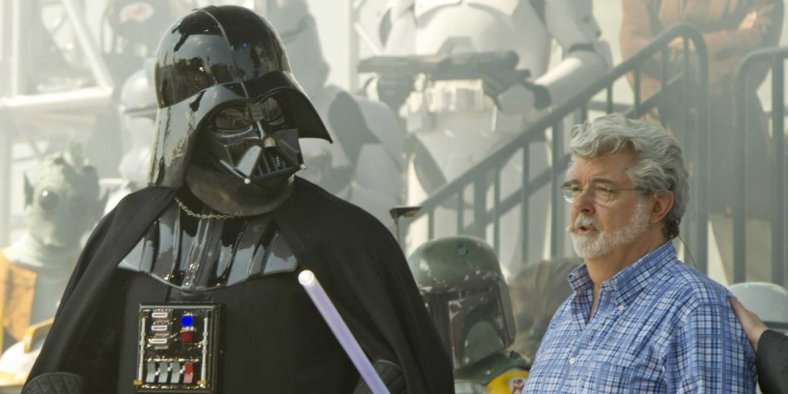
Then things took a shift following the 2012 Disney acquisition of Lucasfilm. I can’t say that I blame Lucas for selling Lucasfilm, especially since he was probably lured by the $4 billion for which he sold both the company and the rights to Star Wars. However, his most recent interview last month suggests that he may have deep regrets about having relinquished rights to his baby, Star Wars. He had some inkling that Disney was about to pull the rug out from under him when they informed him in 2012 that they would not use the story treatments he had submitted. The powers that be at Disney essentially flexed their muscles and pushed Lucas away.
Here is another excerpt from Wikipedia which summarizes some of the ideas Lucas had about later episodes:
Episode VII would begin roughly 20 (or perhaps 30–40) years after the end of Return of the Jedi (according to Lucas in 1980 and 1982).
R2-D2 and C-3PO would be the only characters who might continue through all nine films (Lucas in 1980, 1981 and 1983).
The trilogy would deal with the rebuilding of the Republic (Lucas in 1980).
“It’s like a saga, the story of a group of people, a family” (Lucas in 1980).
The focus would be on Luke Skywalker’s journey to becoming the premier Jedi knight, with Luke’s sister (who was not Leia) appearing in Episode VIII, and the first appearance of the Emperor, and Luke’s ultimate confrontation with him, in Episode IX (a storyline as planned pre-1980, according to A New Hope and The Empire Strikes Back producer Gary Kurtz).
Luke would have a romantic relationship with a female love interest (Lucas in 1988).
The main theme of the trilogy would be moral and philosophical problems, such as the necessity for moral choices and the wisdom needed to distinguish right from wrong, justice, confrontation, and passing on what you have learned (Lucas in 1983 and 1989).
The key actors, Hamill as Luke Skywalker, Ford as Han Solo, and Fisher as Princess Leia, would appear, in their 60s or 70s (Lucas in 1983).
In Episode IX, Hamill would cameo, “like Obi-Wan handing the lightsaber down to the next new hope” (according to Hamill, in 2004).
“The other one — what happens to Luke afterward — is much more ethereal. I have a tiny notebook full of notes on that. If I’m really ambitious, I could proceed to figure out what would have happened to Luke” (Lucas in 1980).
Interviewed in 2012 after the announcement of the new trilogy, Lucas biographer Dale Pollock said that he had, in the 1980s, read the outlines to 12 Star Wars episodes planned by Lucas, but had been required to sign a confidentiality agreement. Pollock said:
“The three most exciting stories were 7, 8 and 9. They had propulsive action, really interesting new worlds, new characters. I remember thinking, ‘I want to see these 3 movies.'”
The next series film would “involve Luke Skywalker in his 30s and 40s.”
Disney would probably use Lucas’s outlines as the basis for the sequel trilogy. “That’s in part what Disney bought.”
Author Timothy Zahn, whose Star Wars novel series, the Thrawn Trilogy, is set in the Star Wars expanded universe, was also interviewed in 2012. Zahn confirmed the sequel trilogy would not be based on the Thrawn novels, but said he had been briefed years before on Lucas’s plans for the sequels (Zahn had discussions with Lucas before the first Thrawn novel was published in 1991). Zahn said:
The original idea as I understood it—and Lucas changes his mind off and on, so it may not be what he’s thinking right now—but it was going to be three generations. You’d have the original trilogy, then go back to Luke’s father and find out what happened to him, and if there was another seventh, eighth, or ninth film, it would be Luke’s children.
directed by J. J. Abrams who co-wrote the screenplay along with Lawrence Kasdan, co-writer of the screenplays for The Empire Strikes Back and Return of the Jedi. George Lucas was set to provide Abrams with advice as a creative consultant; however, he had no involvement in the film, with his representative saying Lucas “ideally would love not to see any footage until he walks into the theater next December. He has never been able to be surprised by a Star Wars film before and he said he was looking forward to it.”
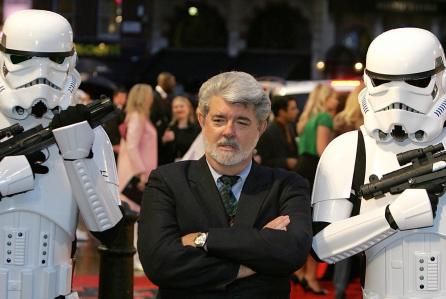
The following text is from the most recent interview conducted with Lucas, in which he criticizes the most recent “Star Wars”film:
George Lucas has criticized the latest installment of “Star Wars,” the series he created, in an interview with Charlie Rose, describing the film as too “retro” for his taste and jokingly comparing the Walt Disney Company, which bought the rights to the franchise in 2012, to “white slavers” who had bought his children.
The hourlong interview, broadcast on Dec. 25 and released online this week, focused on Mr. Lucas’s legacy, which was celebrated at the Kennedy Center Honors this month. But he was harsh in criticizing the film industry for focusing on profit over storytelling.
At one point he said that filmmakers in the Soviet Union had more freedom than their counterparts in Hollywood, who, he maintained, “have to adhere to a very narrow line of commercialism.”
Mr. Lucas appeared particularly unhappy with the direction the “Star Wars” franchise has taken since he sold the rights to it, along with Lucasfilm, his company, to Disney for $4 billion. He compared the sale to a breakup and a divorce.
“These are my kids. All the Star Wars films,” he said. “I love them, I created them, I’m very intimately involved in them.”
He added, trailing off with a laugh: “And I sold them to the white slavers that take these things and. …”
Mr. Lucas said that he decided to sell his company in part because his filmmaking interests had changed and that the more experimental movies he wanted to make would not be financially successful enough to ensure the health of the company and the well-being of its employees.
Still, he said he had begun working on another “Star Wars” film before the sale, including preparing story treatments and “working with a writer.” But, he said, Disney was not “that keen to have me involved.”
“They decided they didn’t want to use those stories,” he said. “They decided they were going to do their own thing. So I decided, ‘Fine.’ ”
The film that Disney made, “Star Wars: The Force Awakens,” has grossed more than $1 billion worldwide since its release on Dec. 18 and received mostly positive reviews from critics.
But not from Mr. Lucas. On Mr. Rose’s show, he criticized the producers and writers of the latest film for emphasizing familiar elements of his previous work — some of which he said had issues — over innovation and storytelling of their own.
“The first three movies had all kinds of issues,” he said of the original trilogy, which was released between 1977 and 1983. “They looked at the stories and said, ‘We want to make something for the fans.’ All I wanted to do was tell a story of what happened. It started here, and it went there.”
“They wanted to do a retro movie,” he continued. “I don’t like that. Every movie, I worked very hard to make them different, make them completely different with different planets, different spaceships, to make it new.”
Getting over “Star Wars” is like getting over a lost love, Mr. Lucas said. He told Mr. Rose that he tried to approach it the way one would approach the end of a relationship, by focusing on the future instead of the past.
“You have to put it behind you, and it’s a very, very, very hard thing to do,” he said. “But you have to just cut it off and say, ‘O.K., end of ballgame, I have to move on.’ And everything in your body says, ‘Don’t, you can’t.’”
On Thursday, Mr. Lucas apologized for his “white slavers” remark and backtracked on his criticism of Disney.
“I misspoke and used a very inappropriate analogy and for that I apologize,” he said in a statement released to several trade publications.
“I am thrilled that Disney has the franchise and is moving it in such exciting directions in film, television and the parks. Most of all I’m blown away with the record breaking blockbuster success of the new movie and am very proud of J.J. and Kathy,” he said, referring to J. J. Abrams, the “Force Awakens” director, and Kathleen Kennedy, Lucasfilm’s president.



 dr. stacey naito's blog