Here Are The 2016 Liquid Sun Rayz Sponsored Athletes!

lsr_logo_og

I am BEYOND thrilled to be chosen as one of the Liquid Sun Rayz Sponsored Athletes for 2016!

This company is the very best in the industry! You can count on perfect color which is applied professionally by the NICEST people on the planet! Liquid Sun Rayz also sells an entire line of skin care products which optimize competition color and regular spray tans. They have a line of beautiful and affordable jewelry for female competitors, and they also have a Beauty Team which provides fantastic makeup application and hair styling. The people who work with Liquid Sun Rayz are like family to me, and I am honored and blessed to be affiliated with them!

Please click on the link below to see who made it into the 2016 Team. Please also LIKE the Liquid Sun Rayz page so you can get all of their updates!

https://www.facebook.com/media/set/?set=a.945371798872481.1073741894.157115621031440&type=3

Wardrobe Issues

“Darling-I-Have-Nothing-to-Wear”-Said-No-Woman-Ever-Thanks-to-These-Five-Tricks

Have you ever had a moment when you looked at all of your clothing and thought, “I don’t feel like wearing any of these things!”, and wished that a wardrobe fairy would alight upon your shoulder and grant your wish for a whole new wardrobe? Well, I have had that feeling repeatedly over the last few months, and I cannot figure out why I am experiencing such a feeling. As a result, I have been itching to switch things up, and add some color and flair.

The main challenge I face when it comes to adding wardrobe items is the fact that I can’t stand shopping. My eyes glaze over within about 15 minutes of being in a mall or shopping area. I will NEVER understand the rush that many women get from bouncing into a store, trying on mountains of clothing, spending their hard-earned money (or their husband’s or boyfriend’s, as the case may be), then moving on to the next store to repeat the process. No thank you!

Online shopping has been a welcome alternative to walking into brick and mortar stores for me. It is quick, relatively painless, and many companies make returns and exchanges easy. Even so, I still have a problem spending money on clothing, because clothing never holds much value. I know that the markup on clothing is astronomical, and I also know that reselling items yields almost no return on the initial investment.

However, I also know that flattering, comfortable, and stylish clothing can boost a person’s spirits and confidence. Though I go through all of my belongings several times a year and get rid of things which are threadbare or damaged, or which don’t fit me correctly, I still have this feeling that I need a change. Perhaps a few new tops would do the trick, since some of the tops in my closet have been a part of my life for close to two decades. I look at them now and think, what the hell am I doing, keeping these things?

It doesn’t help that my body has been shifting ever so slightly, but enough that my clothing fits differently. I am essentially the same size, but I know that age-related muscle loss is occurring, which makes me very upset. Another curious thing which happened recently is that I am suddenly cold in cold weather. I had spent a good year in the grip of night sweats and hot flashes, and grew accustomed to always running hot. I could go out in 35 degrees Fahrenheit weather without a coat and be fine. That has all come to a screeching halt, which I welcome, but the problem is that I got rid of most of the sweaters I had!

Is this a mid-life crisis? Maybe. Whatever it is that I am going through, I had to figure something out to keep me from tearing my hair out in frustration.

My solution: I purchased some new, inexpensive dresses, tops, sweaters and leggings, and said goodbye to some clothing items that just HAD to go in the give-away pile. I have been trying to assemble new outfits so that I present different looks which still reflect my personality. It has been fun looking at the new styles!

Latinpost.com Repost Star Wars Episode 7 Spoilers, Rumors: Revisiting Original Trilogy Controversies From Special Editions

young Anakin BS

This is a repost from Latinpost.com (link: http://www.latinpost.com/articles/71553/20150812/star-wars-episode-7-spoilers-rumors-revisiting-original-trilogy-controversies.htm)

“Star Wars” has the largest fanbase in the world. No other franchise or brand can boast the numbers that the galaxy far, far away has.

Yet with all of its numbers, there has been a great deal of division within the “Star Wars” ranks. The prequels have been a source of animosity. However, the special editions have prompted equal or greater levels of vitriol against the creator George Lucas.

Lucas is no longer at the helm of the franchise and, starting on Dec. 18, fans will see a new cinematic galaxy owned by Disney.

With the first major step about to be taking, some have sought ways to bring fans to peace with the current versions of all the films in existence, including the Special Editions. Whether one agrees or disagrees with the changes (and some, such as the rocks hiding R2-D2 in “Episode IV,” fall into the category of overthinking details), Lucas most did most changes with some level of intent and major alterations usually had some rationale behind them.

With that in mind, let us look at some of the controversial changes to the original films and examine their impact and how they fit into Lucas’ overall vision. One must realize that in changing the special editions, Lucas sought to blend them better with his new vision for the series that was altered by the prequel films. As a result, the films could not simply work on their own, but had to fit a larger perspective and expanded universe.

Darth Vader’s “No!”

At the end of “Return of the Jedi,” Darth Vader is faced with watching his son die at the hands of his master or save him. In a series of closeups, the audience sees Vader’s plight and eventually watches in awe as he grabs the emperor and hauls him down a nearby precipice. The action plays without any dialogue, a moment of sheer cinematic beauty that has captivated for years since.

For the 2011 Blu-Ray release of the films, Lucas did some tinkering and added some dialogue to the scene. When Vader finally makes up his mind to throw away the emperor he utters the cry of “No,” taken out of “Revenge of the Sith.”

The moment in Episode III is one of the most parodied and defiled by fans and detractors, many noting that it turns the formerly dominant villain into a pathetic character.

However, Lucas himself confirmed those very intentions during an interview with the Rolling Stone back in 2005.

“He’s done a lot of horrible things in his life that he isn’t particularly proud of. Ultimately, he’s just a pathetic guy who’s had a very sad life,” said Lucas.

At the point in time when he shouts out the “No” in “Revenge of the Sith,” Vader has just found out that he has lost his beloved Padme. In fact, based on the emperor’s own words, Vader has killed the very thing he sought save. His shout is one of powerlessness.

By reminding viewers of that very moment in “Return of the Jedi,” Lucas hints at Vader’s own realization of his powerlessness to save Padme and thus his pathetic “No” turns into a rejection of his futile nature and thus seeks to compound his sense of strength and power in that moment using this very counterpoint.

He has finally done for his son what he failed to do for his wife and mother. It might not be the most subtle of ways to go about expressing the idea, but it certainly brings “Episode III” to consciousness right away, thus linking the ideas, themes and the overall arc of Vader’s transformation from a pathetic and helpless man to one in control of his destiny, no longer powerless to save his loved ones.

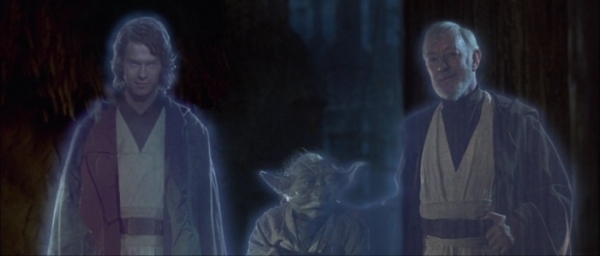
Hayden Christensen’s Force Ghost

Another controversial choice and undeniably misguided one for most fans (this writer included). Luke has just seen his father unmasked, so when he sees the force ghost he would likely recognize the face he has just seen. Why would he recognize the face of a man younger than him? How would he know that this is his father?

There have been a number of ideas regarding this change. The most obvious is that when watched in order of episodes, audiences grow to know Hayden Christensen as Anakin and seeing him at the end links the two trilogies together.

Another idea comes from Obi-Wan Kenobi’s speech to Luke early in the film where he states that once Anakin turned to the dark side and became Darth Vader, he ceased to exist as Anakin. Henceforth, by returning to the light, Anakin retains the physical form of his light side self; since he was last in the light as Hayden Christensen, then that would be the form that appears as a force ghost.

Han Shoots First

The Han and Greedo debate is at the forefront of most complaints regarding the special editions. In 1977, there was no doubt that Han Solo shot Greedo in cold blood, establishing himself as a selfish rogue that would not allow anyone to get the best out of him. That he eventually heads back to save Luke in the Death Star trench run represented a shift from the selfish murdering smuggler to a selfless team player.

In 1997, Lucas tinkered with the moment, having Han shoot after being shot at by Greedo. It has haunted fans since. Lucas has made changes in subsequent releases, bringing the shots closer together as if to appease fans, but the reality is that the late versions still have Greedo shooting first with Han retaliating.

So what does this all accomplish? By having Han retaliate, it softens him as a character. He still murders Greedo, but now he is only doing it because he was assaulted first. He thus becomes slightly less of a menace.

One interesting way to view this change would be from one of the major themes in Lucas’ saga — the aggressor ultimately falling on his or her sword. This theme was championed by David Begor in his “Defense of the Clones,” published by Bright Lights Film Journal.

The cycle of violence is a major theme in all six movies, coming to an end only when Luke Skywalker drops his weapon, realizing that his aggression will only beget more aggression; as noted, only when Luke does drop his weapon does the tide turn for the rebels and do they finally manage to defeat the empire. Prior to Luke’s action, audiences bear witness to characters on the attack repeatedly seeing that violence turn against them. We see it in the Jedi’s decision to start the Clone Wars. We see it in Obi-Wan’s impetuous attack on Darth Maul, pushing him to his near death. We see it from the Separatists and their multiple murder attempts on Padme. We see it from Anakin in his own misguided moments of violence, such as his aggressive assault on Count Dooku at the end of Episode II.

We see it in the subversion of bounty hunters going from the hunters to becoming the hunted.

In the original films, the Empire’s aggressive use of the Death Star in “Episode IV” and its seeking out Yavin winds up being its doom. At the end of that same film, Lucas includes visual allusions to Leni Riefenstahl’s “Triumph of the Will” during the medal ceremony that celebrates the rebel victory, thus linking it to the Nazi regime. This suggests an empty victory, a fact confirmed at the start of “The Empire Strikes Back.”

On a smaller level, having Han shoot second thus perpetuates the theme, making Greedo a victim of his own violence. Of course, Greedo was already holding Han at gunpoint prior to the shots being fired and this in and of itself is a form of violence. However, in the “Star Wars” universe, where every character constantly shows off his or her weapon in broad daylight, it seems that a more overt sign of aggression is required for it to be complete violence.

How I Feel About The New Star Wars Trilogy

Star Wars Episode VII

The new Star Wars trilogy got me riled up for a number of reasons, with the main reason being that Disney had gotten their hands on the franchise. Simply by virtue of Disney’s involvement, I was wary of how true they would be to George Lucas’s original vision. As a matter of fact, I initially resisted the idea of going to see “The Force Awakens”. However, it only took a few days after the film was released for me to cave in, and so I found myself watching the Disney version of the iconic sci-fi/fantasy story line on Christmas Day.

Surprisingly, I enjoyed “The Force Awakens” and thought Disney did a decent job of keeping the audience riveted, and the character development of the new characters was also acceptable. I went to see the film a second time on New Year’s Day, and that was when I began to analyze and dissect the story much more. I guess you could say the George Lucas fan in me awoke and began to scrutinize the details of the newest trilogy.

Though Lucas had initially spoken of developing three Star Wars trilogies, and even proposed and wrote out brief story elements of Episodes VII to Episode IX while filming “The Empire Strikes Back”, he never fully fleshed out those episodes. He was quoted in 1980, stating “It’s a nine-part saga that has a beginning, a middle and an end. It progresses over a period of about fifty or sixty years with about twenty years between trilogies, each trilogy taking about six or seven years.”

Somehow along the years, George Lucas lost the impetus to carry through with all three trilogies, and by the late 1990’s, stated that he had no intention of making the third trilogy, and would not allow anyone else to do so either.

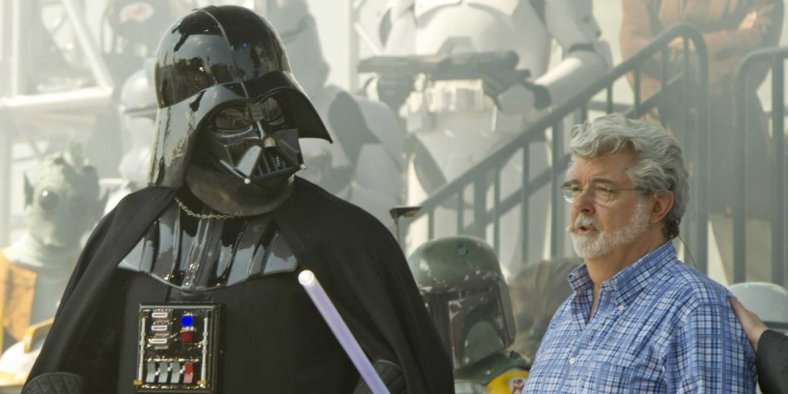
George Lucas Disney
Here’s an interesting excerpt from Wikipedia in which George Lucas responded to questions about the trilogies:
(link is: https://en.wikipedia.org/wiki/Star_Wars_sequel_trilogy)

In August 1999, at a press conference in New York City to discuss The Phantom Menace, Lucas described the “nine year commitment” required to make a Star Wars trilogy. In 2002, he said: “Basically what I said as a joke was, ‘Maybe when Harrison and Carrie are in their 70s, we’ll come back and do another version.’ The thing I didn’t realize then, and that I do realize now very clearly, is that not only would they be in their 70s, but I would be in my 70s too.” In 2007, Lucas described making the films at that age as “an idea that seemed amusing at the time, but doesn’t seem realistic now”, and suggested that ‘off-the-cuff’ comments he had made in earlier years had been misconstrued as absolute statements.

At a 1997 “Special Edition” press conference, Lucas said: “Everyone said, ‘Well, are you going to do sequels to the first three?’ But that was an afterthought; I don’t have scripts on those stories. The only notion on that was, wouldn’t it be fun to get all the actors to come back when they’re 60 or 70 years old and make three more about them as old people.” In a 1997 issue of Star Wars Insider, he said: “The whole story has six episodes…. If I ever went beyond that, it would be something that was made up. I really don’t have any notion other than, ‘Gee, it would be interesting to do Luke Skywalker later on.’ It wouldn’t be part of the main story, but a sequel to this thing.”

In an interview published in the February 1999 issue of Vanity Fair, Lucas said: “When you see it in six parts, you’ll understand. It really ends at part six. I never had a story for the sequels, for the later ones.” In 2008, after all six films had been released, Lucas said: “The movies were the story of Anakin Skywalker and Luke Skywalker, and when Luke saves the galaxy and redeems his father, that’s where that story ends.”

In 1999, when asked about the possibility of someone else making Star Wars films, Lucas said, “Probably not, it’s my thing.” In a 2008 interview in Total Film, Lucas ruled out anybody else making Star Wars films. Asked if he was happy for new Star Wars films to be made after his death, he said: “I’ve left pretty explicit instructions for there not to be any more features. There will definitely be no Episodes VII–IX. That’s because there isn’t any story. I mean, I never thought of anything. And now there have been novels about the events after Episode VI, which isn’t at all what I would have done with it. The Star Wars story is really the tragedy of Darth Vader. That is the story. Once Vader dies, he doesn’t come back to life, the Emperor doesn’t get cloned and Luke doesn’t get married…”

Then things took a shift following the 2012 Disney acquisition of Lucasfilm. I can’t say that I blame Lucas for selling Lucasfilm, especially since he was probably lured by the $4 billion for which he sold both the company and the rights to Star Wars. However, his most recent interview last month suggests that he may have deep regrets about having relinquished rights to his baby, Star Wars. He had some inkling that Disney was about to pull the rug out from under him when they informed him in 2012 that they would not use the story treatments he had submitted. The powers that be at Disney essentially flexed their muscles and pushed Lucas away.

Disney fucks with Lucas
Here is another excerpt from Wikipedia which summarizes some of the ideas Lucas had about later episodes:

Episode VII would begin roughly 20 (or perhaps 30–40) years after the end of Return of the Jedi (according to Lucas in 1980 and 1982).

R2-D2 and C-3PO would be the only characters who might continue through all nine films (Lucas in 1980, 1981 and 1983).
The trilogy would deal with the rebuilding of the Republic (Lucas in 1980).

“It’s like a saga, the story of a group of people, a family” (Lucas in 1980).

The focus would be on Luke Skywalker’s journey to becoming the premier Jedi knight, with Luke’s sister (who was not Leia) appearing in Episode VIII, and the first appearance of the Emperor, and Luke’s ultimate confrontation with him, in Episode IX (a storyline as planned pre-1980, according to A New Hope and The Empire Strikes Back producer Gary Kurtz).

Luke would have a romantic relationship with a female love interest (Lucas in 1988).

The main theme of the trilogy would be moral and philosophical problems, such as the necessity for moral choices and the wisdom needed to distinguish right from wrong, justice, confrontation, and passing on what you have learned (Lucas in 1983 and 1989).

The key actors, Hamill as Luke Skywalker, Ford as Han Solo, and Fisher as Princess Leia, would appear, in their 60s or 70s (Lucas in 1983).

In Episode IX, Hamill would cameo, “like Obi-Wan handing the lightsaber down to the next new hope” (according to Hamill, in 2004).
“The other one — what happens to Luke afterward — is much more ethereal. I have a tiny notebook full of notes on that. If I’m really ambitious, I could proceed to figure out what would have happened to Luke” (Lucas in 1980).

Interviewed in 2012 after the announcement of the new trilogy, Lucas biographer Dale Pollock said that he had, in the 1980s, read the outlines to 12 Star Wars episodes planned by Lucas, but had been required to sign a confidentiality agreement. Pollock said:
“The three most exciting stories were 7, 8 and 9. They had propulsive action, really interesting new worlds, new characters. I remember thinking, ‘I want to see these 3 movies.'”

The next series film would “involve Luke Skywalker in his 30s and 40s.”

Disney would probably use Lucas’s outlines as the basis for the sequel trilogy. “That’s in part what Disney bought.”

Author Timothy Zahn, whose Star Wars novel series, the Thrawn Trilogy, is set in the Star Wars expanded universe, was also interviewed in 2012. Zahn confirmed the sequel trilogy would not be based on the Thrawn novels, but said he had been briefed years before on Lucas’s plans for the sequels (Zahn had discussions with Lucas before the first Thrawn novel was published in 1991). Zahn said:

The original idea as I understood it—and Lucas changes his mind off and on, so it may not be what he’s thinking right now—but it was going to be three generations. You’d have the original trilogy, then go back to Luke’s father and find out what happened to him, and if there was another seventh, eighth, or ninth film, it would be Luke’s children.

directed by J. J. Abrams who co-wrote the screenplay along with Lawrence Kasdan, co-writer of the screenplays for The Empire Strikes Back and Return of the Jedi. George Lucas was set to provide Abrams with advice as a creative consultant; however, he had no involvement in the film, with his representative saying Lucas “ideally would love not to see any footage until he walks into the theater next December. He has never been able to be surprised by a Star Wars film before and he said he was looking forward to it.”

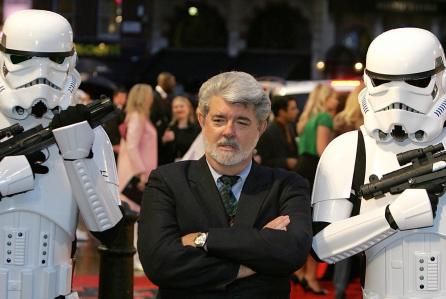
george-lucas

The following text is from the most recent interview conducted with Lucas, in which he criticizes the most recent “Star Wars”film:

George Lucas has criticized the latest installment of “Star Wars,” the series he created, in an interview with Charlie Rose, describing the film as too “retro” for his taste and jokingly comparing the Walt Disney Company, which bought the rights to the franchise in 2012, to “white slavers” who had bought his children.

The hourlong interview, broadcast on Dec. 25 and released online this week, focused on Mr. Lucas’s legacy, which was celebrated at the Kennedy Center Honors this month. But he was harsh in criticizing the film industry for focusing on profit over storytelling.

At one point he said that filmmakers in the Soviet Union had more freedom than their counterparts in Hollywood, who, he maintained, “have to adhere to a very narrow line of commercialism.”

Mr. Lucas appeared particularly unhappy with the direction the “Star Wars” franchise has taken since he sold the rights to it, along with Lucasfilm, his company, to Disney for $4 billion. He compared the sale to a breakup and a divorce.

“These are my kids. All the Star Wars films,” he said. “I love them, I created them, I’m very intimately involved in them.”

He added, trailing off with a laugh: “And I sold them to the white slavers that take these things and. …”

Mr. Lucas said that he decided to sell his company in part because his filmmaking interests had changed and that the more experimental movies he wanted to make would not be financially successful enough to ensure the health of the company and the well-being of its employees.

Still, he said he had begun working on another “Star Wars” film before the sale, including preparing story treatments and “working with a writer.” But, he said, Disney was not “that keen to have me involved.”

“They decided they didn’t want to use those stories,” he said. “They decided they were going to do their own thing. So I decided, ‘Fine.’ ”

The film that Disney made, “Star Wars: The Force Awakens,” has grossed more than $1 billion worldwide since its release on Dec. 18 and received mostly positive reviews from critics.

But not from Mr. Lucas. On Mr. Rose’s show, he criticized the producers and writers of the latest film for emphasizing familiar elements of his previous work — some of which he said had issues — over innovation and storytelling of their own.

“The first three movies had all kinds of issues,” he said of the original trilogy, which was released between 1977 and 1983. “They looked at the stories and said, ‘We want to make something for the fans.’ All I wanted to do was tell a story of what happened. It started here, and it went there.”

“They wanted to do a retro movie,” he continued. “I don’t like that. Every movie, I worked very hard to make them different, make them completely different with different planets, different spaceships, to make it new.”

Getting over “Star Wars” is like getting over a lost love, Mr. Lucas said. He told Mr. Rose that he tried to approach it the way one would approach the end of a relationship, by focusing on the future instead of the past.

“You have to put it behind you, and it’s a very, very, very hard thing to do,” he said. “But you have to just cut it off and say, ‘O.K., end of ballgame, I have to move on.’ And everything in your body says, ‘Don’t, you can’t.’”

On Thursday, Mr. Lucas apologized for his “white slavers” remark and backtracked on his criticism of Disney.

“I misspoke and used a very inappropriate analogy and for that I apologize,” he said in a statement released to several trade publications.

“I am thrilled that Disney has the franchise and is moving it in such exciting directions in film, television and the parks. Most of all I’m blown away with the record breaking blockbuster success of the new movie and am very proud of J.J. and Kathy,” he said, referring to J. J. Abrams, the “Force Awakens” director, and Kathleen Kennedy, Lucasfilm’s president.

Who Has Portrayed Superman?

Superman Logo

Superman Logo

With the new film Batman vs. Superman: Dawn of Justice slated for release this March, I became curious about the actors who have been pivotal in forging the portrayal of the Man Of Steel over the years. I liked the summary on http://screenrant.com/superman-actors-trivia-list, portions of which I have copied and pasted here. I have omitted the actors who had a smaller impact on the Superman character for the sake of keeping this post manageable.

I don’t think anyone ever portrayed Superman as convincingly as Christopher Reeve did, so he will always be my favorite Superman. However, as a result of my decades-long crush on Dean Cain, I must have another favorite spot for him as well!


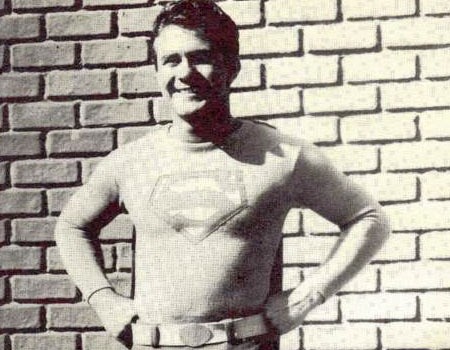
1. Kirk Alyn

In 1948, former Broadway actor Kirk Alyn was the first to don Superman’s cape in a live-action setting. Columbia Pictures’ Superman theatrical serial became an instant hit and young fans of the superhero were immediately mesmerized. For years prior, their imaginations did all the work based off a weekly radio broadcast starring the voice of Bud Collyer as Superman, but now they could see their idol in action!

The Superman serial was 15 episodes long, told Superman’s basic origin story, his job as a reporter at the Daily Planet and his friendships with Lois Lane and Jimmy Olsen; in the final episode, he battled the villainous Spider Lady. In 1950, Alyn would reprise his role in another serial – Atom Man vs. Superman. This time around the villain is Superman’s main rival Lex Luthor who, as Atom Man, terrorizes the good citizens of Metropolis with his atom disintegration ray.

Kirk Alyn

Kirk Alyn


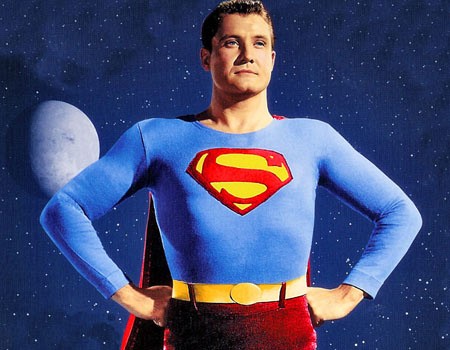
2. George Reeves

Notable Facts: First non-serial theatrical Superman appearance. First televised appearance. First televised color appearance. First fully-filmed take-off, flight and landing sequence.

Arguably, George Reeves was the most popular actor to every portray Superman and his alter-ego Clark Kent, in both the feature-length film Superman and the Mole Men and the subsequent TV series Adventures of Superman.

Reeves is the only actor to ever play Superman in both a theatrical release AND in a TV series. He would entertain audiences for six seasons, with the first three seasons broadcast in black and white. While the remaining seasons were filmed in color, they wouldn’t be broadcast that way until the show was syndicated in 1965.

George Reeves

George Reeves


3. Johnny Rockwell

Notable Facts: First non-comic appearance of Superboy and Lana Lang.

Adventures of Superman was canceled in 1958, followed by the passing of George Reeves in 1959, so when ABC decided to reboot the show in 1961, actor Johnny Rockwell was chosen to portray Superboy. The project never made it past an unaired Superboy pilot titled “Rajah’s Ransom”, even though twelve full scripts were completed for the show.

Alas, the general public would never see Rockwell dressed as Superman, but footage from the pilot stills exists (it comes with the 62 DVD collection Smallville: The Complete Series) and a small clip from the show can be found in the documentary Look, Up In The Sky: The Amazing Story of Superman.

Johnny Rockwell

Johnny Rockwell


4. Christopher Reeve

Notable Facts: First full-color, feature-length Superman theatrical release. Significant upgrades in flying SFX. Introduced most classic version of costume. First “evil” Superman.

Superman: The Movie was first conceived in 1973 but wouldn’t see a theatrical release until 1978 with Christopher Reeve starring as the titular superhero. Superman I and Superman II were filmed simultaneously at the total cost of $109 million. Superman I proved to be the more popular of the two bringing in $300 million at the box office, while the sequel only brought in $104 million.

Over the next few years, Superman III and Superman IV, both starring Reeve and Gene Hackman as Lex Luthorn (who skipped number 3), would come and go in theaters with very little public support – together, both films only grossed $85 million on a $46 million budget.

Even with poor box office performances later in the franchise, Christopher Reeve’s name would become (and still is) synonymous with Clark Kent and Superman – arguably even more so than George Reeves.

Christopher Reeve

Christopher Reeve


5. James Haymes Newton

Notable Facts: First TV series ever produced by Disney/MGM. First in-depth look at Superman’s teenage years. First appearance of Mr. Mxyzptlk.

Only a year after Superman IV: The Quest for Peace entered theaters, producers wanted to once again tap in the the lucrative TV market with a Superman show – enter Superboy starring James Haymes Newton in 1988. Newton would only sport the red cape for the first season due what the producers consider a lackluster performance, combined with his demand for a raise and a DUI arrest.

The show debuted during the 50th anniversary of Superman character and ironically, the actual character of Superboy had recently been removed from comic lore in The Man of Steel retcon by comic artist John Byrne. This was the first time the teenage years of Superman were explored. The show followed Clark Kent and Lana Lang as they reported on weird happenings for their college newspaper, The Shuster Herald (get the reference?).

James Haymes Newton

James Haymes Newton


6. Gerard Christopher

Notable Facts: First appearance of villains Bizarro, Metallo and Toyman. First exploration of The Death of Superman storyline.

The second, third and fourth seasons of Superboy (re-titled The Adventures of Superboy in season three) saw many cast changes – the most notable being Gerard Christopher replacing Newton as Clark Kent/Superboy. The series also started taking on more “mature” storylines as time went on, including having Clark deal with the return of his Kryptonian parents, Jor-El and Lara. The series left the slightly-campy feel of season one behind and started placing Superboy in many perilous situations – becoming darker in tone with each new episode.

The producers, planning for a fifth and sixth season, had delved into “The Death of Superman” storyline at the end of the fourth season – even filming the demise of the superhero for the season’s finale. However, Warner Bros. placed a lien against the show and the series was canceled. Parts of the final episode were re-shot to tie up the series by revealing that Superboy had faked his death.

Gerard Christopher

Gerard Christopher


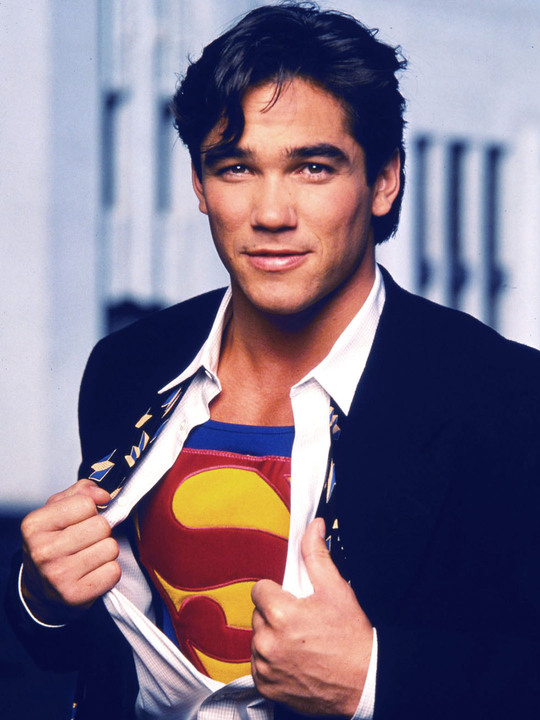
7. Dean Cain

Notable Facts: First time the love life between Lois Lane and Clark Kent is explored. First series to keep Clark’s parents alive. First time Superman’s costume is explained.

The lien and resulting cancellation of The Adventures of Superboy were actually a plan by Warner Bros. to establish a series of their own called Lois & Clark: The New Adventures of Superman in 1993 starring Dean Cain as Clark Kent/Superman and Teri Hatcher as Lois Lane. The show proved to be a whopping success with audiences and had a run of 87 episodes over the course of four seasons. The third season proved to be the most popular, drawing in an average of 15 million viewers a week.

Unlike previous television series, Lois & Clark (as its name implies) focused heavily on the love interest between Lois Lane and Clark Kent. While Superman showed up in every episode, he wasn’t typically the focus of the show, as series creator Deborah Joy LeVine wanted to explore more of Clark’s life. To that end, Clark’s parents were kept alive (unlike the Silver Age of the Superman) and he visited them frequently to discuss pressing issues. The show also addressed how Superman got his outfit – his mom, Martha Kent, made it for him – awww.

Dean Cain

Dean Cain


8. Tom Welling

Notable Facts: Longest running live-action Superman series. Introduced several live-action versions of popular DC Comics’ characters. Only version of Clark Kent not referred to as Superman, doesn’t appear in costume.

A few years after Lois & Clark ended, writers Alfred Gough and Miles Millar produced Smallville for the WB/CW, starring Tom Welling as Clark Kent. The show ran for ten full seasons and initially drew in 8+ million viewers – though those numbers reduced dramatically as time went on, eventually only pulling the attention of 3 million viewers for the series finale.

Smallville took a “no flights, no tights” rule per Gough and Millar – audiences can only see Clark fly once and only briefly see him in a cape in the final moments of the series finale. It did, however, introduce many members of the Justice League and brought to life several villains never before seen on TV, such as Darkseid and Doomsday.

Tom Welling

Tom Welling


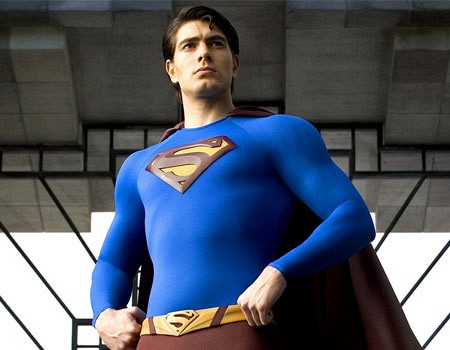
9. Brandon Routh

Notable Facts: Updated the look of Superman’s costume. Introduced Superman and Lois Lane’s son.

Almost twenty years passed since a live-action Superman movie was released in theaters, until Warner Bros. decided to pump over $300 million in Superman Returns starring Brandon Routh.

The story involved Superman returning to Earth after a five-year trip to Krypton to see if any of his people survived. Lex Luthor is once again the villain (like the original Superman movies) and he absurdly wants to create new land using crystals stolen from Superman’s Fotress of Solitude. The film’s “twist” – that Lois and Superman had a child who inherited his father’s super genes – brought on more jeers than cheers from audiences.

The movie was a disappointment to both critics and fans – many of whom also disliked the sleeker costume hip-hugging style briefs and a much smaller “S” on his chest. He did have the signature curl in his hair, though.

Brandon Routh

Brandon Routh


10. Henry Cavill

Notable Facts: First modified appearance of classic costume. Replaced Jimmy Olson with Jenny Olson. First shared universe for DC Comics. First Superman film in 3D.

Henry Cavill is the latest actor to play Superman in director Zack Snyder’s Man of Steel but he certainly won’t be the last. After the underwhelming Superman Returns, fans of the character were holding out very little hope that they would ever see a good, modern version of Superman in theaters again. For the most part, Snyder quelled those fears.

Man of Steel, with all its super powered, action-goodness, wasn’t without its drawbacks though – erratic scene cuts, weak character development and a longer-than-necessary running time, make the film drag in some areas. Most critics and fans agree though, the film is a far better than the previous attempt.

DC Comics has been behind Marvel in the shared movie universe and Man of Steel is their first (weak) attempt to fix that situation. A sign attached to satellite high above the earth reads “Wayne Enterprises” and is the only thing tying Superman to Batman. It could have been stronger but at least it was there.

Henry Cavill

Henry Cavill

Online Cognitive Training – Helpful Or Not?

lumosityx299_1

I came across an interesting article which discussed online cognitive training, and I wanted to share excerpts from it. Following the shared post is my own opinion of online cognitive training, based on my personal experience with the most popular programs.

Does Online Cognitive Training Work? – By Pauline Anderson

Online cognitive training programs promise to boost memory and attention, and they’re popping up at a rapid pace. According to one dementia expert, the online cognitive training business has grown from about $200 million annually 6 or 7 years ago to an estimated $2 billion a year today.

But are these companies truly giving patients an edge when it comes to warding off dementia, or are they cashing in on the worried well and an often vulnerable aging population?

Cognitive training is loosely defined as regularly engaging in a cognitive task, for example, learning a list of words, a set of pictures, or a certain route to a particular target.

Online cognitive training programs typically involve buying a monthly or annual subscription that allows users access to various cognitive tasks. These users sit at a computer to do these tasks on a regular basis. They usually have to pay more to get upgraded applications.

“It’s a huge industry,” says Peter Snyder, PhD, professor, neurology, Alpert Medical School, Brown University, and chief research officer, Lifespan Hospital System, Providence, Rhode Island, and editor, Alzheimer’s & Dementia: Diagnosis, Assessment & Disease Monitoring, the Alzheimer’s Association’s online, open-access journal. Not surprisingly, many of these brain training companies target the aging baby boomer market. For the next 15 years, 10,000 people per day, every day, will turn age 65 in the United States, Dr Snyder said.

Many of them are worried about their memory. The issue of how to prevent dementia ”actually comes up almost every time I see a patient,” says David Knopman, MD, professor, neurology, Mayo Clinic College of Medicine, and an investigator in the Mayo Clinic Alzheimer Research Center, Rochester, Minnesota. If they still have a job, Dr Knopman advises patients that they probably get enough stimulation in the work environment. ”Certainly the computer can’t be as good for mental stimulation as the challenges you face in the work environment, even if you’re not in an executive position.”

And if the patient is retired but reads newspapers, belongs to a book club, or does volunteer work, “what would the computer testing offer that this socially engaging and mentally stimulating activity doesn’t provide?” asks Dr Knopman.

The benefits of cognitive activity aren’t in question. It’s clear from the literature, says Dr Snyder, that engaging cognitively with challenging and varied tasks may help slow the rate of progression of Alzheimer’s disease.

Rock Solid Evidence

The lifestyle factor that has the most credible evidence for protecting against dementia to date is not cognitive training but physical activity. “The evidence is absolutely rock solid; it’s incontrovertible,” says Dr Snyder.

He worries that patients will play online cognitive games three times a week in the hopes of protecting their brain instead of taking a brisk walk three times a week.

And Dr Knopman is concerned that those playing brain games may not be socially active. Online cognitive training is ‘the opposite of being socially engaged,” he notes. “They force people to bury themselves in the computer for a certain period of time.”

It’s not clear whether pursuing cognitive training online adds any further benefits to physical and cognitive pursuits offline. That’s because to date there’s scant literature on the subject.

One study published earlier this year in The Lancet looked at the effect of healthy eating and exercise in addition to brain training in 1260 people aged 60 to 77 years who were at risk for dementia. Researchers found that an intensive program incorporating all three approaches, plus management of metabolic and vascular risk factors, slowed cognitive decline over 2 years.

Overall scores on the Neuropsychological Test Battery in the intervention group were 25% higher than those in a control group that received only regular health advice. The results were particularly striking in the areas of executive function and processing speed.

But how much brain training contributes to the mix remains to be seen.

Literature a “Wreck”

The literature in this area leaves a lot to be desired, Dr Snyder said. Most of the published literature is a “wreck,” he says, partly because the outcome measures are confounded, the follow-up period isn’t long enough, or proper comparisons aren’t in place.

A randomized controlled trial of cognitive training would have to compare this training to an appropriate placebo, he points out. “In this case, what’s the placebo? Is it absolutely nothing at all, which in most cases is what has been done?”

The question, says Dr Snyder, should be whether the online tasks are more effective than freely accessible pursuits doctors might routinely recommend to older adults, which in addition to regular physical activity might be things like learning a new language or practicing the piano.

Learning a language or an instrument is a complex process that involves several cognitive functions. In contrast, many of the online cognitive games being marketed focus on very specific cognitive functions, for example, remembering word lists.

So after some practice, you may get good at remembering those word lists — the so-called training effect — but how that translates into everyday life is unclear. “Is learning word lists over and over again on a computer going to generalize to being able to find your car in a crowded parking lot at a shopping mall?” asks Dr Snyder.

But forgetting where you parked your car, or the name of your grandson, can be a scary experience. More and more patients are looking for ways to prevent their descent into mental fog.

And so they’re increasingly turning to online cognitive games. “This is an industry that I worry preys on the elderly, preys on a vulnerable population,” says Dr Snyder.

Sweet Spot

William Mansbach, PhD, from Mansbach Health Tools LLC, Simpsonville, Maryland, agrees that the “sweet spot” for the at-home brain training industry is the “worried well” and that in general the industry’s claims far exceed the evidence.

But this may not be the case for those already experiencing memory impairment. His company has developed programs that he says can improve global cognition in these patients in as little as 3 weeks if they practice for 20 minutes, three times a week.

One of his programs — Memory Match — is a cognitive training task that exercises working memory and attention using themed cards. A study discussed at the Alzheimer’s Association International Conference earlier this year found that those with mild cognitive impairment and mild dementia improved significantly on this test compared to a control group that didn’t receive it. Importantly, says Dr Mansbach, those with more severe dementia did not improve.

In structured interviews following this study, participants in the treatment group pointed to the intervention as a reason their memory improved, according to Dr Mansbach.

He’s proud of the “clear evidence” and “large effect sizes” from the study that suggest that this approach is legitimate.

Patients using his brain training tasks first do a self-assessment to determine at what level to start in order to get maximum benefit, he says. One of his criticisms of other programs is that there are no real assessment of the person doing the training and no concrete idea of what needs improving.

However, while he’s convinced his program works in the short run, long-term benefits are unclear. “We have no idea, and no one does.”

There could well be an important role for cognitive training outside industry, though. Jens Pruessner, PhD, professor, psychiatry, McGill University, Montreal, thinks that using this training may help pinpoint patterns that might be clues to the onset of dementia.

In a research project, he and his colleagues are testing PONDER (Prevention of Neurodegenerative Disease in Everyone at Risk), a free online cognitive training program aimed at those aged 40 years and up. Using neuropsychological assessments, researchers are tracking the progress of users to see whether the frequency, intensity, and duration of cognitive training leads to observable changes over time.

“Let’s say that in general, the training effect is such that you improve by 20% over time when you have been doing this task every other week for 6 months,” said Dr Pruessner. “Are those people who only improve by 10% or 5% at risk of developing mild cognitive impairment and eventually dementia?”

So far, the mean age of users is 57 years, which is exactly when age-related cognitive decline begins in those destined to develop dementia. Dr Pruessner notes that dementia begins some 20 years before clinical symptoms become significant.

Perhaps the most well-known of these companies is Lumos Labs in San Francisco, California, whose brain training site, Lumosity, is used by more than 70 million “brain trainers” in 182 countries, the company’s website notes.

The company has a collaborative research initiative, called the Human Cognition Project (HCP), that it says partners with more than 90 collaborators from 40 universities. “Through the HCP, we grant qualified researchers free access to Lumosity’s cognitive training tasks, assessments, research tools, and in some cases, limited access to data on cognitive task performance — helping them conduct larger, faster, and more efficient studies,” the website notes.

Lumosity also has in-house researchers to develop new cognitive training tasks and assessments, provide administration of controlled studies, and study Lumosity gameplay information to enhance the experience, the site notes.

Several publications in peer-reviewed journals have used Lumosity data. Earlier this year, researchers published a paper in Alzheimer’s & Dementia using data from Lumosity’s Memory Match game, which requires visual working memory, to look at individual differences in age-related changes in working memory. They found significant effects of age on baseline scores and lower learning rates. “Online memory games have the potential to identify age-related decline in cognition and to identify subjects at risk for cognitive decline with smaller sample sizes and lower cost than traditional recruitment methods,” the authors concluded.

A randomized trial of nonaction video games from the Lumosity site reported in 2014 in Frontiers in Aging Neuroscience showed improvements with training in processing speed, attention, and immediate and delayed visual recognition memory in the trained group, but no variation in the control group. Neither group improved in visuospatial working memory or executive control, the researchers report.

“Overall, the current results support the idea that training healthy older adults with non-action video games will enhance some cognitive abilities but not others,” the researchers, with first author Soledad Ballesteros, PhD, Studies on Aging and Neurodegenerative Diseases Research Group, Universidad Nacional de Educación a Distancia, Madrid, Spain, concluded.

Multiple emails and telephone messages to Lumosity requesting an interview for this article, sent over several weeks, were not returned.

Personal Trainer for the Brain?

So, at the end of the day, should that 57-year-old patient who is worried about his forgetfulness fork out subscription fees every month to play cognitive games? If it keeps someone mentally active, “why not?” says Dr Belleville.

She points out that people pay a lot of money to join a gym when they could jog for free in the park. “If you have to pay a gym to continue to do your exercises, then pay; it’s worth the money.”

However, she acknowledges that while there’s a good deal of evidence that a certain amount and intensity of physical activity is good for the brain, “when you look at cognitive training, it’s all over the place.”

And she agrees that it’s not clear whether the training effect goes beyond the task being practiced — or whether it has the same impact as informal training, such as doing crossword puzzles several times a week.

On the other hand, “it’s probably better than doing nothing at all and looking at silly programs on television,” she says. “I think there’s something there, but we need to understand better what the active ingredient is so we can provide good advice to people.”

Now here’s my take on online training:

I believe that the practice and the HABIT of performing cognitive training serves a beneficial purpose for people who engage in it. I also strongly agree that such training programs are a much better alternative to watching television. While I agree with Dr Knopman that computer cognitive training doesn’t provide an individual with any benefits over reading, learning a foreign language, or engaging in a complex mental activity which would protect brain function, I strongly believe that the current pace of society has made it extremely difficult for people to find time to engage in such activities. On a personal note, I never have time to leisurely read a book like I used to in the past. For me, a ten minute visit to a brain training website keeps my skills sharp and is a nice break from the hectic lifestyle which I deal with all the time. In addition, my regular cognitive games do not interfere in any way with my four to six day per week exercise regimen. I also maintain social engagement through work and my personal life. I am thankful for the brief visits to training websites, because they make me feel less guilty about not having an hour or two to carve out of the day to dive into a book.

Actors Who Have Portrayed Batman

After seeing the preview for the upcoming release of Batman vs. Superman: Dawn of Justice, I became curious about which actors have portrayed Batman on the big screen. I stumbled upon a summary on http://www.denofgeek.us, which I have copied and pasted here. I have selected other images of some of the celebrities because the ones featured on DenofGeek were not the best.

As for the actor who in my personal estimation did the best job at portaying Batman, it’s Christian Bale. Hands down, the BEST Batman.

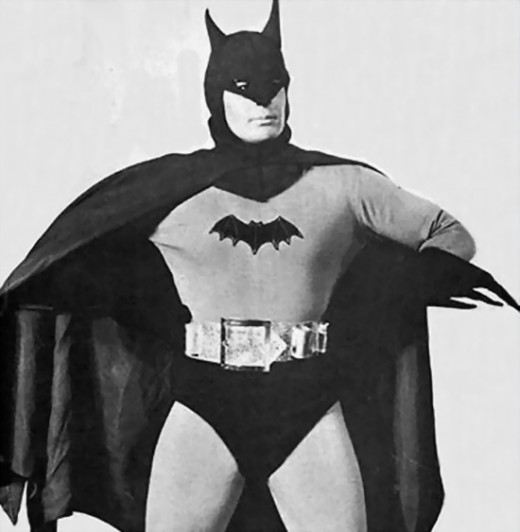
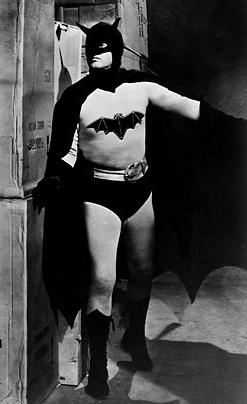
1. Lewis G Wilson

Wilson was the first and youngest actor ever to play the adult Batman, and also the least successful. At 23, the unknown thespian donned the cape and the cowl in the 15-part 1943 Columbia serial Batman. While he looked the part of the dashing playboy, his physique was more Danny DeVito as the Penguin. One critic described Wilson as “thick about the middle.” Maybe that was why he wore his utility belt just below his chest. Critics also complained that his voice was too high and that he had a Boston accent. That, of course, wouldn’t be the last time someone complained about Batman’s voice.

After Batman, Wilson’s career went nowhere. Most of his roles went uncredited. His next biggest movie part was probably in the 1951 cult classic Bowanga Bowanga. A few years later he was out of showbiz altogether. His son, Michael G. Wilson, however, fared better in Hollywood, becoming the executive producer of the James Bond series. Lewis G. Wilson died in 2000.

Lewis G. Wilson

Lewis G. Wilson

2. Robert Lowery

Lowery took over the role in the follow-up serial, 1949’s Batman And Robin. Unlike Lewis, Lowery, 36 at the time, was a veteran actor, having already appeared in The Mark Of Zorro (1940), The Mummy’s Ghost (1944), and Dangerous Passage (1944). He also filled out the Batsuit better than Lewis, with his utility belt hanging where you would expect it on a non-octogenarian.

Though Lowery never played Batman in another movie, he did get to wear the cape once more and make superhero history in the process. In 1956 he guest-starred on an episode of The Adventures Of Superman, marking the first time a Batman actor shared screen time with a Superman actor. (The two also appeared together in their pre-superhero days, in a WWII anti-VD propaganda film called Sex Hygiene).

After Batman, Lowery enjoyed another 20 years in movies and TV. He died in 1971.

Robert Lowery

Robert Lowery

3. Adam West

The man logging the most hours in the Batcave, of course, was William West Anderson, whom you probably know better as Adam West. Either you love him for his goofy charm or hate him for blemishing the Bat’s image for several decades. His campy, over-the-top portrayal of Gotham’s Guardian infiltrated nearly ever medium, including a 1966 movie and several animated series.

[related article: Batman ’66 – The First Faithful Superhero Adaptation]

Legend has it producer William Dozier cast West after seeing him play a James Bond-like spy called Captain Q in a Nestlé Quik TV ad. He beat future Wonder Woman co-star Lyle Waggoner for the role. Dozier, who supposedly hated comic books, decided the only way the show would be successful was if they camped it up. So blame him.

Things would almost come full circle in 1970 when West was offered the role of James Bond in Diamonds Are Forever. West declined, later writing in his autobiography that he believed Bond should always be played by a Brit. Holy bad career moves, Batman!

After the Batman series went off the air in 1968, West was resigned to typecast hell. At one point, he was forced to make public appearances as the Caped Crusader to earn a living. Then, in 1977, he returned to the tube as Batman, doing his voice in The New Adventures Of Batman, and then on such shows as Super Friends.

West’s resurgence as a pop-culture icon began in the early ’90s when he starred as a has-been TV action hero in the pilot episode of Lookwell, produced by Conan O’Brien and Robert Smigel. It wasn’t picked up but took on a cult following online (check it out here). Since then his cult popularity has increased and he now makes regular appearances on the animated series Family Guy.

Adam West

Adam West

4. Michael Keaton

It took more than 20 years for Adam West to lose his exclusivity on Batman.

When director Tim Burton (who like Dozier was not a fan of comic books) and Michael Keaton were announced for 1989’s Batman, fans went bat-shit crazy, thinking their beloved superhero was going to get the Adam West treatment again. Keaton’s casting caused such controversy that 50,000 protest letters were sent to Warner Bros’ offices. In an effort to appease the naysayers, Batman co-creator Bob Kane was hired as the film’s creative consultant. And in case you’re curious, here is Keaton, Affleck, and a long list of other great castings that fans initially thought would suck.

Other Hollywood stars considered for the role of Batman included Mel Gibson, Kevin Costner, Charlie Sheen, Pierce Brosnan, Tom Selleck and Bill Murray. But producer Jon Peters said he cast Keaton because “The image of Batman is a big male model type, but I wanted a guy who’s a real person who happens to put on this weird armor. A guy who’s funny and scary. Keaton’s both. He’s got that explosive, insane side.”

The studio and the fans had nothing to worry about. Keaton’s performance received favourable reviews and Batman killed at the box office. Variety magazine gushed, “Michael Keaton captures the haunted intensity of the character, and seems particularly lonely and obsessive without Robin around to share his exploits.” Keaton was rewarded by being the first actor to reprise the role on the big screen. And in 1992’s Batman Returns, Keaton again garnered positive reviews.

Of course, Keaton has now seen a career revival thanks to the spectacular Birdman.

Michael Keaton

Michael Keaton

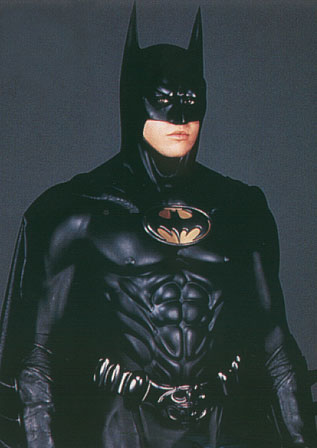
5. Val Kilmer

When the Batman franchise was turned over to director Joel Schumacher, Keaton decided not to return.Daniel Day-Lewis, Ralph Fiennes, William Baldwin, and Johnny Depp were reportedly considered as replacements. But the job was won by Val Kilmer – probably the most forgettable of the modern Batmen. Go ahead – try to remember. See? You can’t.

Schumacher became interested in Kilmer for 1995’s Batman Forever after seeing him in Tombstone (in which he played Doc Holiday, who Adam West also portrayed in a movie before he did the Batman TV series). Kilmer allegedly accepted the role without even reading the script or knowing who the new director was.

Schumacher quickly learned who Kilmer was, though, and the two clashed on the set. Schumacher later described Kilmer as “childish and impossible,” claiming that he fought with various crewmen and refused to speak to him for two weeks after the director asked his star to stop behaving rudely.

Kilmer’s performance got mixed reviews. As The New York Times put it, “The prime costume is now worn by Val Kilmer, who makes a good Batman but not a better one than Michael Keaton.” Bob Kane felt otherwise, saying he thought Kilmer did the best job of all the actors to have played Batman up to that point.

The movie performed better than Batman Returns at the box office, but Kilmer was destined to be a one-term Caped Crusader. Between his bad attitude and his concern that the superhero wasn’t getting as much screen time as the villains, he left the Batcave for good. Instead of filming 1997’s Batman & Robin, he did The Saint.

After Batman, Kilmer’s career headed downhill. Though it was probably 1996’s The Island Of Dr. Moreau that had more to do with that than Batman Forever.

Val Kilmer

Val Kilmer

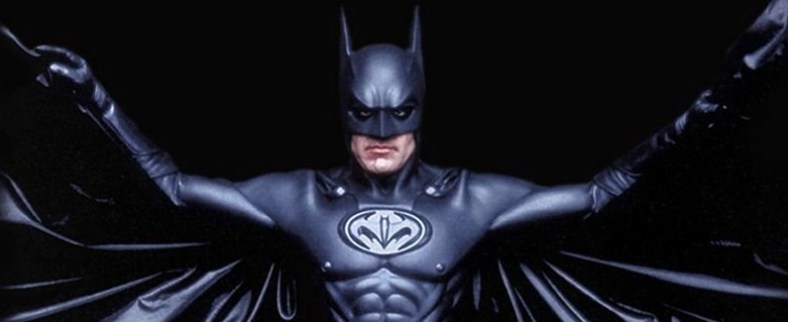
6. George Clooney

Clooney’s movie career was just taking off when he was cast in 1997’s Batman & Robin, with his breakthrough performance coming just the year before in Quentin Tarantino’s From Dusk Till Dawn. Producers probably felt they pulled off a major coup landing the soon-to-be mega-movie star. Those producers, along with Clooney, may regret that decision now.

Batman & Robin was a disaster, rife with homoeroticism, camp and those infamous Bat-nipples. Clooney once joked that he helped to kill the franchise. “Joel Schumacher told me we never made another Batman film because Batman was gay.” The actor also called the movie “a waste of money.”

Critics and fans agreed. In 1997, Mick LaSalle of the San Francisco Chronicle wrote, “George Clooney is the big zero of the film, and should go down in history as the George Lazenby of the series.” Batman & Robin received 11 nominations at the Razzie Awards and frequently ranks among the worst films of all time. It was also the worst box-office performer of the modern Batman movies. However, despite its many, many, many flaws, we will stick up for it a little…

But all that did nothing to hurt Clooney’s career. After Batman, he went on to super stardom, starring in Out Of Sight (with a cameo from Michael Keaton), Three Kings, and O Brother, Where Art Thou? over the next three years.

George Clooney

George Clooney

7. Christian Bale

Between Adam West and George Clooney, Batman seemed destined to remain a joke, at least when it came to live-action adaptations. Then came along Christopher Nolan. The Memento and Insomnia director was given the reins and he planned to reinvent the franchise, finally making the Dark Knight dark.

Among the early candidates for the Batman/Bruce Wayne roles were Billy Crudup, Jake Gyllenhaal, Joshua Jackson, and Cillian Murphy. But Nolan ultimately chose Christian Bale, explaining that “he has exactly the balance of darkness and light that we were looking for.”

Bale got generally favourable reviews for 2005’s Batman Begins, with several critics saying it reminded them of his brilliant turn in American Psycho. Not so brilliant, it seems, was his uber-husky Bat-voice. One reviewer compared Bale’s guttural utterances to a “10-year-old putting on an ‘adult’ voice to make prank phone calls.” It got even more gravelly in 2008’s The Dark Knight, with NPR’s David Edelstein describing it as “a voice that’s deeper and hammier than ever.”

Even Kevin Conroy, the man behind probably the most recognisable Batman voice, chimed in, saying at a C2E2 panel in 2010 that Bale’s voice was “ridiculous” and implored the actor to stop doing it. If The Dark Knight Rises trailer is any indication, Bale hasn’t taken the advice. Still, while that film was not as well received as 2008’s sterling The Dark Knight, especially in the fan community, we still will happily come to the defense of The Dark Knight Rises.

Christian Bale

Christian Bale

Cell Phones Are Taking Over

meme-zombies-cell-phones_large
I thought the following article was very well written, so I am sharing it here. Stuart Jeffries may have written it almost nine years ago, but a great deal of what he says rings true (pun intended).

Original post can be found at:
http://www.theguardian.com/technology/2007/mar/08/news.mobilephones

To hell in a handset

Watches are on the way out. The days of the diary are numbered. And cameras could be next. The world is becoming a poorer place, says Stuart Jeffries – thanks to the mobile phone

Stuart Jeffries
Thursday 8 March 2007

There will come a moment in about seven years’ time when I will make a fool of myself in front of my daughter. Surely it won’t take that long, you say. Be quiet. It will happen like this. One summer’s evening, she will be playing in the street with a bunch of other eight-year-olds and I will go out to call her in for tea. Thanks to the hovercars, free-floating teleportation platforms, jetpack-powered flying ice-cream sellers and other inventions that I confidently predict will be filling our skies come 2014, the noise will be so oppressive that I won’t be able to make myself understood with words alone. So I will be forced to make a simple gesture to tell her it’s time to come inside.

What will it be? I will tap my wrist where a watch should be. The time-honoured sign that you should wrap up one activity and prepare for another. One problem: it won’t work. Not in 2014. She won’t know what I’m on about. She will look at me blankly with that soul-destroying gaze that children are hard-wired to give their parents. (Don’t worry, young techno-hipsters – such old fartdom will be your fate too. There will come a time when your grandchildren will recall how you used to sit them on your knee and play them your iPod or explain to them how you used ActiveSync to back up your email address list. Oh, how will they laugh, and how they will trash everything you held dear. iPods – can you imagine anything more tacky? All that shiny plastic – yeuughh! And emails! How sad is that? No videocalls or anything? Pathetic!)

For months afterwards, my daughters’ playmates will tap their wrists satirically whenever they see her in the playground (if playgrounds exist in 2014), and so I will become a figure of fun. The old fart with his incomprehensible gestures. My daughter’s shame.

Why? Because few people will wear watches in the near future. Wrist-borne chronometers are so last millennium. In the US, a survey by investment bank Piper Jaffray & Co found that nearly two-thirds of teens never wear a watch and that only one in 10 wears one every day. A quick glance around my office shows that I am, by virtue of wearing a watch, in the demographic most likely not to have broadband, know who/what Mika is, or bid co-workers farewell by saying: “Laters!”

True, wrist-borne chronoporn devices continue to appeal to deeply inadequate men with high disposable incomes. But let’s not allow the dreary fetishes of GQ’s target audience to spoil the story. Today a watch is the opposite of a status symbol. Indeed, the main reason I’m writing this piece is that I was spotted by an editor wearing a loser watch. It is a Lorus Sports, quite possibly purchased more than 10 years ago from Walthamstow market, and on its third rotting leather strap. It smells like feet. And not nice feet. If it was a song, my watch would be that one by Beck (“I’m a loser, baby, so why don’t you kill me?”). Keeps good time, though. Have you ever heard of Lorus? Of course not.

If I was a winner, I would drop my watch in a canal and tell the time with my mobile. In fact, if I was a winner, I would do everything on my mobile phone – even film myself dropping the Lorus in the canal and happy-slapping myself along the towpath. Increasingly, all the stuff you need to get through the day is focused in one piece of kit. Thanks to what manufacturers like to call “convergence”, today’s mobiles already allow you to tell the time, arrange your appointments diary, watch films, play games, and take pictures of your blocked sink that you can send as jpegs to your plumber, who will text you back a ludicrous estimate, which you can check by using your phone’s calculator function. You can use the phone to play that “hip” Snow Patrol/Killers/Go! Team track as you straphang on the Victoria line to the mounting fury of fellow passengers.

It can only be a matter of time before your mobile will allow you to operate the garage door, unlock the car, swipe your way into the office, bus, tube or nightclub. Already, the better type of phone can teach you to play the guitar, the screen showing finger positions for chords and the speakers telling you what they should sound like. If your phone is Wap-enabled, you can play DJ Rob’s pub quiz from Chris Moyles’ Radio 1 show. You need never visit a pub again. Or you might want to shoot yourself in the head.

The world of digital vortex – an interactive

Mobiles have become so much the focus of consumer technology that you might as well drop not just your watch, but your iPod, DVD camera, digital camera, calculator, alarm clock, diary, address book and PlayStation in the canal and go out with one sleek piece of kit. Soon you might even be able to burn your books because you’ll have them on your mobile-cum-iTablet. One problem: you’ll get mugged for your high-spec ponce-a-phone as soon as you pull it out of your trousers in public. And then, unless you’ve backed up every bit of data (which, trust me, you won’t have), you’ll be screwed. That’s because the omnicompetent mobile is a terrible thing. As HL Mencken put it: “For every complex problem, there is a simple solution … and it is wrong.”

That’s the trouble with convergence. It can be rubbish. Better to have a shame-mobile like my six-year-old Nokia, even though, quite possibly, it was made in the former Soviet Union from old Sinclair C5s and barely works as a phone. Like my car (keys in the ignition, door open, motor running), I have been leaving my phone in situations where ne’er-do-wells can steal it for years. No one has. Because I’m a loser, baby.

Convergence is not always what we want, but it is increasingly what we get. “Take the so-called digital home,” says futurologist Patrick Dixon. “Convergence might mean total control with wireless TV/video/music/web in every room, all from one online PC, also used for children’s games and homework – or a fridge that is also a web browser. But who really wants web access on a fridge door, or a single remote control for every device in the house, or a single device to play the same music in every room?” Technological innovation doesn’t simply supply what we want: it supplies more and more of what we don’t need. As Homer Simpson put it: “If they can put a man on the moon, why don’t my feet smell good?”

Technology evolves irrespective of our desires. Its onward march leaves us in the lurch, haunted by memories of things we used to do. For example, when Steve Jobs showed off Apple’s new iPhone earlier this year, he asked rhetorically how the thing would be operated: “Are we going to use a stylus? No, we’re not. We’re going to use the best pointing device in our world: our fingers.” Well, yes, Steve, but no. There’s no need to diss the past. I miss styluses (styli?), especially the one I used to play a very spirited version of the Marvelettes’ When You’re Young and in Love on a friend’s Rolf Harris Stylophone. Tread softly, Steve Jobs, for you tread on my techno-memories.

Technology’s evolution, as a result, often leaves us queasy. We feel a nostalgia for the near past – for its soothing gestures, for the obsolete body language we mastered so well – but mere discombobulation in face of the near future. The new gestures unleashed by new tech (for example, holding your hands above your head to signify taking pictures with a digital camera) have not been sanctioned by the test of time. Years after the arrival of the hands-free headset, many of us still cross the road to avoid someone who seems to be talking to an imaginary friend, when we should be checking their lugholes for miniature earpieces.

“Technology changes what is socially acceptable all the time by pushing boundaries,” says Tom Dunmore of Stuff magazine. “In terms of people talking into their mobiles, that’s become much more acceptable socially.” Maybe in your world, Mr Dunmore. “What amazes me now,” he says, “is how you see teenagers on trains using their mobiles like speakers, holding them up and playing music.” It is a confusing development: the very point, I thought, of personal stereos, MP3 players, Discmans and the rest was that they kept the sound, for the most part, in the user’s head. Technology takes us in socially discomfiting, unpredictable areas: it’s a pain, and not just in terms of GBH of the earhole.

For example, keyboards and computer mice (mouses?) will soon no longer be at the cutting edge of technology. Which is a shame for those of us who have only just got used to them. As a result, people will laugh at you if you make those spider moves with your fingers to signify typing, because in the future (according to Jobs), touch-sensitive screens will render keyboards obsolete. And that’s before we even get on to voice recognition. Our typing days may be numbered.

Amazing, isn’t it? Amazing, that is, that I’ve got so far through a piece on technology without referring to that scene in Minority Report where Tom Cruise sweeps his hands suggestively across a screen and thus gets the jump on the bad guys.

The point, though, is that technological development is shadowed by the ghosts of gestures associated with obsolete gear. You may be old enough to remember that to suggest typing, one would bash away at an imaginary keyboard and – this is the crucial bit – slam the imagined typewriter carriage sharply back to start a new line. Nobody does that any more. I used to do it with the aplomb of newshound Rosalind Russell in His Girl Friday for years. But now no one understands me, so I’ve stopped.

What speeds up the rise in the semiotic scrapheap is just that drive for convergence, whereby mobile phone companies build more and more features into their kit, like digital Swiss Army knives. That analogy breaks down quite fast: there will be no digital way of shaving, cutting toenails, opening wine or making fire. Or maybe there will be. Perhaps there are no limits to convergence.

For instance, both Nokia and BlackBerry are poised to launch handsets with global positioning systems. Were it not for the fact that men find it hard to ask for directions, of course, satnav (“sadnav” to its critics) would have no reason to exist. But it does, and thanks to it, men will never have to ask for directions again. Instead, spoken instructions will guide them from power latte to power latte, from pillar to post, from Pontefract to Penzance. The press release for the BlackBerry 8800 says: “The new smartphone includes a full complement of features to appeal to mobile professionals who want to manage their work and leisure time effectively.” What a dismal world. Personally, I’ve never wanted to manage my leisure time, still less manage it effectively. But then, I am a loser. What, incidentally, is a mobile professional?

Another development will be bigger mobile phone screens. Tom Dunmore says that in the near future, watching films on your mobile won’t be quite as barmy an activity as it now seems. “The most significant development in that area is foldable screens, which will allow you to do proper web browsing and watch movies. You’ll be able to get memory cards holding two or three films. They’ll be great for flights where there isn’t much in-flight entertainment.”

Convergence is not the only game in town. “Mobile phone companies don’t just launch one phone,” Dunmore says. “They target different people with different ranges. Vodafone has a Simplicity range targeted at older users. Smart multi-function phones are less than 10% of the market. And there will always be gadget nuts who want separate high-end pieces of kit – be they iPods or DV cameras or whatever. But the converged proportion of the market will start to grow as phones become sexier.”

Hence, perhaps, the looming sexyphone face-off this spring. Who can resist a sexyphone face-off? It will be between the soon-to-be-launched iPhone, LG’s Shine phone LF KE970 (which has a makeup mirror that becomes a screen when you turn it on – sweet!), Samsung’s Ultra Smart F700, Motorola’s Z8, Nokia N610 Navigator, and the LG Prada. The last one should appeal to me: designed by Prada and built by Korean electronics giant LG, almost the entire front surface is a touchscreen (like the iPhone), and users can drag items around and navigate menus by tapping on the screen. It weighs 85 grams and looks droolworthily sleek. It is elegantly black, with an extra-wide LCD screen, MP3 player and a black leather Prada case. It also is less tacky than the Motorola phone designed by Dolce & Gabbana, which, when opened, shouted “Hello, Dolce & Gabbana!”

But would spending £400 on the LG Prada do the most important thing – impress my daughter? Possibly. After all, she loves nothing more than dunking things in baby food until they become useless. Her critique of the fatuities of technological innovation is more devastating than mine will ever be.

What the do-it-all mobile means for …

Photography

What we’ve gained Immediacy – you can see what you’ve snapped immediately and send it out to all your mates pronto. Suddenly, lots of new uses for images become available. For example, one of my colleagues takes photographs of the back of his head with his mobile phone when he is shaving his hair to make sure the cut is even. A mirror is a difficult thing to hold, you see. But if he uses a phone, he can take the picture of the back of his head. Shave a little more off. Take another photo. Shave a little more off. And when you’re happy with the cut, delete all the images (or send them to a mate). I’ve suggested he send these images to a gallery to see if they want to exhibit them under the title My Ever Changing Head.

What we’ve lost Remember those happy moments finishing off a roll of film outside the chemist? Asking a passing stranger to snap you having a sunburned post-holiday snog before you went into Boots to drop off the negs? No? Perhaps it was just me. And then the long, tantalising days waiting for the photos to be ready? Only to pick them up and realise that you forgot to take the lens cap off? Twerp.

Timekeeping

What we’ve gained Our beautiful wrists are now unbesmirched by ugly clobber. And remember, before wristwatches, how your waistcoat pocket was really heavy because it was filled with your fob watch? No? Me neither. The very idea! But if you did have a waistcoat pocket that one day did have a fob watch in it, imagine how much happier you’d be now because it hasn’t – you wouldn’t walk with a lurch towards the left, as your pocket would be empty. All thanks to the advent of mobile phones.

What we’ve lost Annoyingly, if you wear a watch, you’re often asked the time by mates who can’t be bothered to get their mobile phones out of their bags and have a look at the digital chronometers themselves. Damn them! The only thing to do is to lose your watch and rely on your phone to tell you the time. Remember watching the second hand of your watch go round in circles for hour after hour? You can’t do that any more when you rely on a mobile to tell you the time – which is just as well, because it made you economically unproductive.

Listening to music

What we’ve gained Remember when you used to want to listen to a whole Wagner opera while on a train journey, you would have to take a box of CDs and feed them in succession into your Discman? And that it was such a palaver that by the end you didn’t care whether Valhalla burned or not? No? Perhaps it was just me. The great thing about having an MP3 player built into your mobile is that you don’t have to be burdened with gear. Not even an iPod Nano, which, as you know, weighs only as much as a bee’s wing. What’s more, your mobile has a speaker so you can annoy fellow travellers with your eclectic tastes. Result! Before Walkmen, you may not know, it was even worse: you would have to hire a man to carry your record player all around town. He would walk behind you, playing your LPs. Naturally, he had to walk very slowly so the needle didn’t bounce. It was a dark age for recorded music in many ways.

What we’ve lost What about the lovely artwork? Nobody savours the Roger Dean artwork on those Yes gatefold sleeve concept albums any more in this barbarian digital age. Least of all when your mobile phone is the source of all your sounds.


Phone calls

What we’ve gained We can call anybody whenever we like. For instance, you can call the hospital from the passenger seat and tell them (quite possibly) how much you’re dilated, when you’ll be arriving, whether you’d like an epidural, sugar for your tea, book the water birthing facilities, etc. In the past you couldn’t do things like that. Which was a shame.

What we’ve lost Punctuality is dead. In pre-mobile days, there was no way of letting someone know we were running late, so we made greater efforts to be outside the theatre at the time agreed. Now we can text them saying we’re running late – even if we’re not and, in reality, just can’t be bothered to meet as planned. Social life is now more fraught with petty resentments than it was before mobiles got on the scene. And now, dammit, anybody can call us whenever they like – it’s harder to hide from after-hours work calls. Virtual presenteeism is the norm. Worse yet, there are no longer movie plots where the guy knows the girl is alone in the flat and the killer is hiding behind the curtains. Today the hero would text Michelle: “Killa in yr flat. behind curtains. scarper! lol :)” And the film would be over in minutes. Rubbish, really.

TV and radio

What we’ve gained You can make a film of your fancy feet during a tango class in Macclesfield and send it to Juan, the Hispanic hottie you met in Buenos Aires last summer. He will be dazzled by your skills and your devotion to his culture and send you a text saying how much he loves you in broken English. You will move to Argentina and have a lurid affair with him and come home five years later, tired but happy, with three children who won’t like Cheshire at all. In the past you couldn’t do that.

Also, we can now watch My Family on our mobiles. And text Gardeners’ Question Time with complaints about their broadcast views on when is the right time to prune one’s pyracantha. Goody! Can this really be what Mr Nokia (or whoever it was) intended when he had a dream of making our lives easier with a portable telephonic device the size of a pillow all those years ago? Quite possibly not.

What we’ve lost Moments of quiet contemplation on the top deck of a bus unbroken by happy-slapping ruffians who knock your Proust out of your hands and put your resultant discomfiture all over their mobile network and the world wide web, probably when they should be in detention. What’s more, you can watch films on your phones in a format so small that any cinematographer worth their salt would cry to see you vandalise their art in such a manner. Neither of these developments is good.

What, really, is the point of watching telly on your mobile? Why don’t you just turn it off and do something else? Read a book. Remember them, for crying out loud? There’s never anything on anyway. Watching telly on the bus? Good grief. That is so pathetic. Get a life.

Dating

What we’ve gained No longer will you have to fumble for awkward opening lines in a club or pub teeming with fanciable techno sophisticates – instead you can let your phone do the introducing for you, as prospective partners wandering into range are automatically forwarded your profile. All you need is a Bluetooth-enabled phone and a roomful of hotties of either/both genders. If they like what they find in your profile, they can message you and perhaps even wind up having a non-virtual drink/snog/shag/child with you. Happy days!

What we’ve lost Talking like normal people used to. No longer do you need to deploy your marvellous range of pick-up lines (from “That’s quite a lovely Jackson Pollock, isn’t it?” to “Your face or mine?”) which you learned at a special evening class (Remedial Dating for Sociopaths 101) last autumn. But isn’t that a shame? After all, getting shot down by some imperious beauty for daring to ask her if she’d like a crème de menthe and kahlua used to be a rite of passage for a young man. But enough about me. Another downside is that rude people who you don’t know sitting at the next restaurant table can send you porn film clips on their similarly Bluetooth-enabled phone. It happens. But that doesn’t make it right.

Using the internet

What we’ve gained It’s marvellous to go to streetmap.co.uk when you’re lost and equipped only with your mobile. And realise that the nearest Huang Chow Lane, where you are supposed to be meeting your friend, is in Shanghai, and you are in Walsall with only a West Midlands travel pass. Bummer.

What we’ve lost The possibility of being outside the techno loop while we’re on the bus home. Time was you could just stare at the rain running down the windows as you sat in gridlock. You might even catch the eye of that person across the aisle and, by the time you had to change to get the number 92, would have their number. Now you’ve got to check your email, text or study the news headlines. Otherwise you’re a nobody. It’s also a royal pain to write emails on your mobile, unless you’ve got a plug-in keyboard. Which, unless I mistake my guess, you haven’t.