Stuck in A Workout Rut? Try Pyramid Training – REPOST

heavy_weight_liffting_image_title_rpy1c

I figured that this article which I wrote a while back deserved a repost. I hope you enjoy!

If you have hit a training plateau or are just bored with your current training regimen, you might want to mix it up by incorporating pyramid training into your routine. Pyramid training is an extremely effective way of increasing strength and muscle mass and is easy to incorporate. There are different types of pyramid training designs which exist, but the ascending type is the best for individuals who are relatively new to weight training, as it provides a warm-up for the body before the weight used increases.

Types of Pyramid Training:
ASCENDING: You will start out with a light weight and perform 12 to 20 repetitions in the first set, then increase the weight used while decreasing the number of repetitions in subsequent sets.
1st set – 15 to 20 repetitions with a light weight
2nd set – 12 to 15 repetitions with a light to moderate weight
3rd set – 10 to 12 repetitions with a moderate weight
4th set – 8 to 10 repetitions with a moderate to heavy weight
5th set – 6 to 8 repetitions with a heavy weight

DESCENDING: You will start out with a heavy weight and perform 6 to 8 repetitions in the first set, then decrease the weight used while increasing the number of repetitions in subsequent sets.
1st set – 6 to 8 repetitions with a heavy weight
2nd set – 8 to 10 repetitions with a moderate to heavy weight
3rd set – 10 to 12 repetitions with a moderate weight
4th set – 12 to 15 repetitions with a light to moderate weight
5th set – 15 to 20 repetitions with a light weight

DOUBLE PYRAMID: You will start out with a heavy weight and perform 12 to 20 repetitions in the first set, then increase the weight used while decreasing the number of repetitions in subsequent sets. On your fifth set, you will decrease the weight used while increasing the rep range. When you are on the descending portion of this pyramid, you will not be able to perform as many repetitions due to the muscle fibers being closer to failure.
1st set – 15 to 20 repetitions with a light weight
2nd set – 12 to 15 repetitions with a light to moderate weight
3rd set – 10 to 12 repetitions with a moderate weight
4th set – 8 to 10 repetitions with a moderate to heavy weight
5th set – 10 to 12 repetitions with a moderate weight
6th set – 12 repetitions with a light to moderate weight
7th set – 15 repetitions with a light weight

Yes, I Really DO Eat Clean Year-Round

A couple of my fitness friends have recently noticed that I continue to eat clean, almost as if I was in prep for a contest. One of those friends IS in prep, so I guess she expected a stark contrast between what she has been consuming and what I eat on a regular basis. Basically, I continue to eat seven meals each day, and my protein intake these days is around 150-170 grams per day. I don’t pig out on forbidden foods, but I am not fanatical about eliminating all fat and carbs. On low carb days, I allow myself a bit of healthy fat, usually in the form of avocado, olive oil, or nuts. I have two high carb days, and I make sure that my weekly cheat meal falls on one of those days. Every once in a while (perhaps every three weeks) I may indulge in something like a nonfat mocha from Starbucks, a slice of gluten free zucchini bread, or a bowl of chicken pho.

Out of the 49 meals I eat each week, only ONE meal is a dirty cheat meal. Because I follow clean eating the majority of the time, I have been able to maintain a reasonable off-season weight. I compete at 117-119 pounds, and my weight has hovered between 119 and 122 pounds for quite a while now without even trying. I know I could always pack on more muscle, and my body fat is up a bit (around 15-16% right now), but I am happy with where I am at. My abs come out to play every now and then too, which is something I always welcome. They aren’t super chiseled and ripped, but I don’t need to walk around like that.

IMAG0366

STACEY NAITO – IFBB Bikini Superstar (Interview)

Please check out the great interview which Christian Duque from Strength Addicts hosted, and in which I am the featured guest! We talked about a lot of topics, and I covered a lot of ground on my background, my contest journey, and my philosophy on training, diet and competing. Check it out and please LIKE and SHARE! Thank you so much!

This 94-Year-Old Grandmother Is A Champion Powerlifter

I am utterly shocked and completely impressed by this lady! Read on to find out how she got started at the age of 91. This totally proves that you are NEVER too old to lift weights!

Original post can be found at:
http://www.mindbodygreen.com/0-22172/this-94-year-old-grandmother-is-a-champion-powerlifter.html

by Emi Boscamp, MBG Editorial – October 16, 2015 5:25 PM

A 94-year-old woman can dead lift 135 pounds. What did you do today? (Yeah, I didn’t do much of anything either.)

Floridian Edith Traina is a grandmother — and that’s an accomplishment in itself — but she’s also a champion powerlifter. She started doing it at the tender age of 91 and has since become addicted to the competition, reports FOX13 Tampa.
“(My friend) dragged me kicking and screaming to the gym, and I figured I’d keep her happy for a while and get her off my back, but I got hooked,” Traina (which, by the way, is the most fitting last name possible) told FOX13 Tampa.

Since then, the self-described “champion” has competed in more than a dozen competitions, is the only person in her age group, and hopes to be able to lift 200 pounds by the time she hits 100. Though it may be good for her health, she does it because of how it makes her feel emotionally.

“With this, I just walk up, lift it, put it down. I get all these applause — great for the ego,” she said.

Watch her do her thing below (and prepare to feel like a bum). Keep on trainin’, Traina — we’re rooting for you!

So Excited For Everyone Competing At NPC Nationals This Weekend!

The NPC Nationals will be taking place this weekend, with over 1,000 competitors! This is the largest NPC National event in history. The best way to get a glimpse of what is occurring in Miami this weekend, I have included a video introduction here from J.M Manion. For those of you who don’t know who this awesome man is, here is his Twitter profile description, which I absolutely love:

Professional Photographer & Journalist for NPC News for 30 years. Owner of multi-media company J.M. Manion Productions, Inc. & Jedi Master

Yes, indeed! He IS a Jedi Master! Or wait, isn’t he Batman? Those of you in the loop will get the reference!

Best of luck to everyone competing!

Getting Back On The Horse: Returning To The Gym

Please check out my latest article for Sports Nutrition Supplement Guide! Please read original post and see the site here:

http://www.sportsnutritionsupplementguide.com/training/training-tips/item/1549-getting-back-on-the-horse-returning-to-the-gym#.Vkpn9RCrSi5

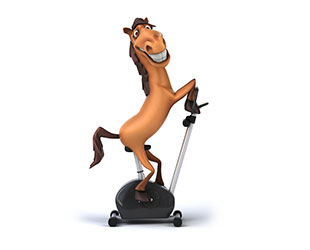
Horse_Gym_310x250

Perhaps the ebb and flow of life has thrown you off your fitness routine, and you are ready to return to the gym. It might be that you are post-partum, or had to nurse an injury or illness. Or it could be that you have been moving at such a frenetic pace in your life that you got sidetracked from your “every damned day” gym schedule, and need to get back into the groove. Whatever the reason is for putting consistent gym visits on the back burner, the good news is that you can re-establish a consistent fitness regimen. In order to ensure the greatest success with your efforts, here are some suggestions which will motivate you and keep you on track.

Set Goals

I bet some of you may have forgotten about the power of setting specific goals for yourself. It may be that you have been away from the iron den for a long time, so you might want to set strength gain goals in which you move up in your 1 rep max every two weeks, increase the number of free dips or pullups you can perform every few weeks, or even increase the amount of time you hold a plank.

Another type of goal you can set for yourself is to increase muscle mass in a measurable way, perhaps a one inch increase in your calf girth over a 6 week period, for example. Instead of meandering back into the gym and having a general objective, like just getting back in there, make sure to hang a carrot in front of you so that you are even more motivated to stick to the program.

Be Realistic

Thank goodness for muscle memory, because it enables those who are at a high level of fitness to regain their muscle mass and strength rather quickly after a period of inactivity. However, those who were at a lower level of fitness at their baseline will lose muscle and strength pretty rapidly, after even as little as two weeks of not lifting weights. Depending on what your degree of muscularity or strength was before your setback, you will have to give yourself some time to build back up to previous levels of muscle mass and strength. If you find yourself with more padding around the midsection, glutes, or thighs than what you had when you were hitting the weights consistently, make sure that you target fat loss with your training and food intake.

Eat Properly

You can’t expect to achieve stellar results just by hitting the weights like a fiend, while putting junk food in your body, so make sure to establish healthy eating habits to support your return to lifting weights. If your eating habits have gone by the wayside, incorporate a consistent meal plan which provides your body with clean macronutrients and supports your weight training. Throw out the forbidden foods which may be lurking in your kitchen, such as sweets, crackers, chips, and ice cream. Stock your kitchen with whole foods like lean turkey, chicken breast, salmon, eggs, green vegetables, sweet potatoes, brown rice, almonds, walnuts, and avocado. Confine cheat meals to one evening on the weekends.

Don’t Overtrain

Make sure to give yourself time to get back into the swing of things, especially if you are returning after an injury or illness. You MUST take it easy, otherwise you run the risk of injuring or re-injuring yourself, causing an even bigger setback. If you were very fit before you took your break, your muscle mass and strength should both return to their previous levels within a couple of weeks.

You Got This!

1044164_10200783919535118_1917423334_n
In keeping with the fact that we are approaching the last NPC Pro Qualifier contest of the year in November, I figured it was a perfect time to talk about envisioning your goal, whether it be the attainment of a Pro Card or some other coveted prize. The key is to adopt the attitude that you have already reached your goal, because such an attitude carries immense power and forces you to adopt an “I won” attitude. I chased after a Pro Card for five years, and I honestly believed that it was only after I had adopted the attitude in 2013 that I already WAS a Pro that my energy truly changed.

Focus is not enough. In order to truly draw the proper energy, you need to envision already reaching your goal. You can always tell when a competitor is “on” because he or she will throw off sparks of “I got this” confidence. There is a glow about that person onstage which sets him or her apart from everyone else. It has less to do with a great suit or great posing (though those things help too) and everything to do with owning that “I won” attitude. I have seen it repeatedly and I also know I had that glow when I won my Pro Card.

So if you have been hitting the stage or the gym with a “Please pick me” attitude, you need to scrap that and truly own the attitude that you have already locked down the win. Even if you don’t nail down a Pro Card spot, you can take that attitude with you to future events and maximize your chances of getting high placings with your confidence.

My Flying Trapeze Experience

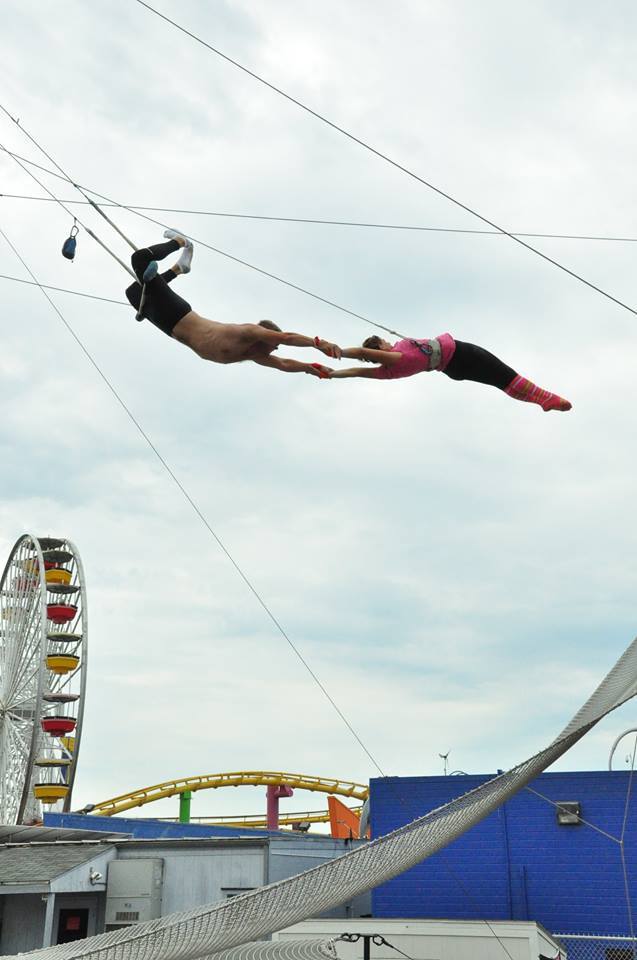
I took a flying trapeze class in mid-October at TSNY LA, and absolutely loved the experience. It was the salted caramel pretzel of experiences, frightening and exhilarating and challenging and fun all at the same time. Once I was on the trapeze swing and doing tricks, I felt a complete rush of excitement, but every single time I had to stand on that VERY narrow platform, 20 feet up in the air, the adrenaline would surge through me, and I would feel very nervous. Honestly, standing on the platform was the only negative part of the experience for me! The actual tricks I learned were completely awesome, and I had NO fear while doing them. The competitive spirit in me kicked in, as did my gymnastics background, and I put in 100% effort so that I could kick ass up there. I am proud to say that I did not disappoint myself. In my last trick, I completed a successful catch from a knee hang position on the fly bar, with the catcher on the catch trap (the other bar). What a rush!

Though the experience was supposed to be a bucket list item, I enjoyed the experience so much that I am considering taking regular classes. Call me crazy, but I loved the challenge, and since my body remembered all the childhood tumbles and moves from gymnastics, the kid in me was awakened. Another thing I noticed was that my upper lats were more sore after doing trapeze work than when I hit back day at the gym. I truly enjoyed the new physical challenges and hope that my schedule allows me to fit regular classes in.

12112445_1008406495856453_1649270197717728514_n

12091362_1008406482523121_4271950569616594504_o

For those of you who want to know more about the flying trapeze, I have copied and pasted the Wikipedia definition here:

The flying trapeze is a specific form of the trapeze in which a performer jumps from a platform with the trapeze so that gravity makes the trapeze swing. Most flying trapeze acts are performed between 20 and 40 feet above the ground.

The performance was invented in 1859 by a Frenchman named Jules Leotard, who connected a bar to some ventilator cords above the swimming pool in his father’s gymnasium in Toulouse, France.

In a traditional flying trapeze act, flyers mount a narrow board (usually by climbing a tall ladder) and take off from the board on the fly bar. The flyer must wait for a call from the catcher to make sure he or she leaves at the correct time. Otherwise, the catcher will not be close enough to the flyer to make a successful catch. The flier then performs one of many aerial tricks and is caught by the catcher, who is swinging from a separate catch bar. Once in the catcher’s hands, the flyer continues to swing and is thrust back toward the fly bar in a maneuver called a “return”. A return could consist of some kind of twist back to the bar, an “angel” (when the catcher holds the flyer by the feet and one arm), or any other trick that a flyer can think of to get back to the bar. Once back to the fly bar, the flyer can return to the board, and another flyer takes a turn.
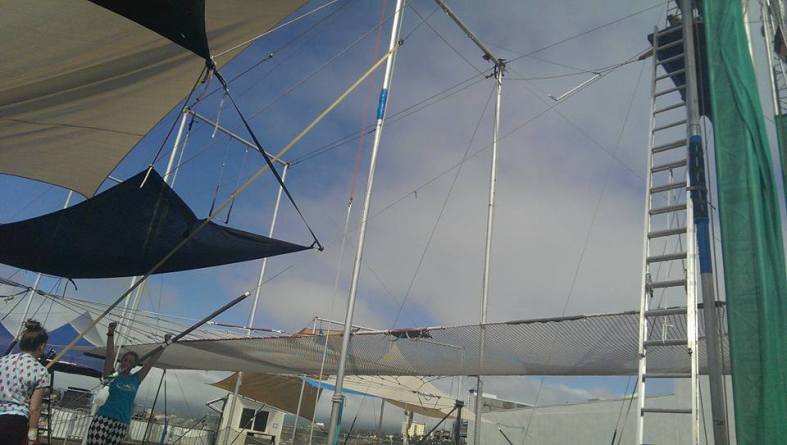
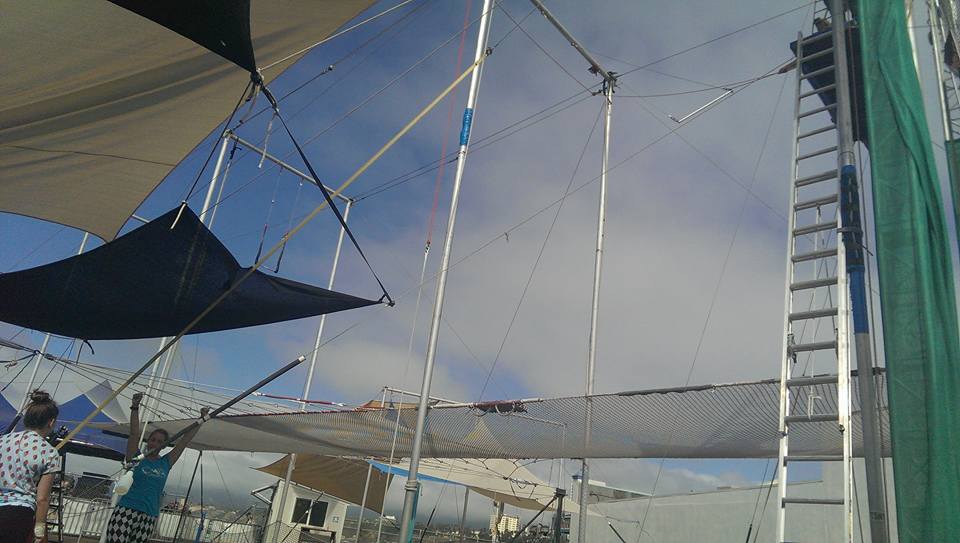
12079068_1008318229198613_1900487063332663710_n

Terminology:

Listo/Lista – Ready: Used by the flyer and/or catcher to signify that they are holding the fly bar (for a flyer) or have built enough height in their swing for a catch (for a catcher) and ready to go.

Ready – Used by the catcher to tell the flyer that they should leave the board momentarily. The flyer bends their knees and if executing a one-handed take-off, dips the bar so they can raise it higher when they jump off the board.

Lining Up – Called from the board. When the person working the board for those who have not yet learned to retrieve and serve the bar themselves gives the flyer the fly bar. It really means that the flyer is “lining up” their trick.

Hup – Signal to leave the board and/or the fly bar. Sometimes used by the catcher to tell the flyer to let go after a catch when landing in the net.

First – Usually called by someone pulling safety lines when tricks are being thrown to the net. It is used for front-end tricks to signify getting to the first position.

Final – Also usually called by one pulling safety lines. It is used for front-end tricks to signify getting to the final position.

Gotcha – Some catchers say “Gotcha!” when they catch to signify that they have a good grip on the flyer and that the flyer can let go of the fly bar.

Catch Trap – The trapeze that the catcher swings on.

Fly Bar – The bar the flyer uses.

Apron – The net in front of the catch trap. (The back apron is the net in back of the board.)

Rise/Riser – A narrow board placed on the rungs of the ladder to allow the flyer to take off from a higher point.

Noodle – The long pole used to reach the fly bar when the person working the board cannot reach it normally.

Mount – When the flyer mounts the board after a return.

Return – When the flyer, after a successful catch, manages to return to the fly bar, and often all the way back to the board. In professional shows, the flyers rarely come down from the board.

Grips – Can be gymnastics grips or ones made out of tape. They are used to protect the flyer’s hands.

Chalk – Used by the flyer and catcher to absorb wetness and to reduce sticking to things such as the fly bar.

Force Out – Kicking the legs out at the peak of the flyer’s swing to gain height.

Hollow – Comes right after the force-out. It is basically a neutral position.

Sweep – Comes after “hollow”. Signifies kicking the legs back.

Seven – The last part of a force-out swing. Flyer brings legs in front of them so they will not hit the board.

Cutaway Bar – The bar that the catcher holds when the flyer executes tricks to the catcher such as normal Cutaways and Reverse Knee-Hangs.

Cut (as in Cut Catch) – The flyer is caught in a legs catch and swings out into the apron. On the next swing into the apron, the flyer thrusts their body up, and the catcher lets go of the flyer’s legs and grabs their hands.

Tricks

Below is a list of flying trapeze tricks that can be thrown to a catcher:

Feet Across (a.k.a. “Legs”)
Heels Off
Hocks Off
Splits (Front End/Back End)
Straddle Whip (Front End/Back End)
Whip (Front End/Back End)
Bird’s Nest/Birdie (Front End/Back End)
Shooting Star
Half Turn
Straight Jump
Cut Catch
Uprise Shoot
Forward Over
Forward Under
Double Over
Passing Leap
Piggyback
Pullover Shoot
Reverse Knee Hang
One Knee Hang
Flexus
Somersault
Hocks Salto
Front Hip Circle/Back Hip Circle
Seat Roll/Penny Roll (Full Time/Half Time)
Planche (Front End/Back End)
Pirouette (540)
Layout
One and a half Somersault
Cutaway
Cutaway Half
Cutaway Full
Double Somersault
Double Cutaway
Double Cutaway and a half twist
Double Layout
Full Twisting Double
Double-Double
Triple Somersault
Triple Twisting Double
Full Twisting Triple
Triple Twisting Double
Triple Layout

These are tricks performed bar to bar:

Hocks Off
Splits (Front End/Back End)
Straddle Whip (Front End/Back End)
Whip (Front End/Back End)
Bird’s Nest/Birdie (Front End/Back End)
Half Turn
Straight Jump
Planche (Front End/Back End)
Layout
Double Somersault

These are tricks that can be performed without a catcher:

Salute
Half Turn
Force Out Turn Around
Back Mount
Suicide
Reverse Suicide
Pirouette

Returns:

Half Turn
Flexus
Birdie
Legs (Twist one direction to grab the bar.)
Angel (1 or 2 legs)
Pirouette

TSNY Trapeze Tricks Chart
If you are in the Los Angeles area, and you are interested in taking a flying trapeze class, here are two excellent schools. The first one is the school I went to for my first class, and the second one is the place where I will probably take more classes.

http://losangeles.trapezeschool.com/

http://www.flyingtrapeze.com/