
New Year’s Resolutions Don’t Work

2013By no means am I trying to destroy the motivation that some of you may be experiencing with the fresh slate of a new year and some new goals placed before you.  But it drives me nuts when people make these promises to themselves to eat healthy foods, start going to the gym regularly, quit drinking, etc., then give up after only weeks or even days because they supposedly blew it for the year. I fully expect, along with countless other fitness people, to see a major influx of new faces at the gym next week, hogging the equipment without knowing how to use it and increasing the temperature of the gym to hatching-baby-chicks hot, only to see a drop off shortly after Valentine’s Day.  It really is a shame that many individuals lack the drive to keep after their goals and only find yet another excuse to abandon the idea of bettering themselves for the long run.  SO WHAT if it is a new year, and SO WHAT if you mess up after a few days or weeks?  The most important thing is to keep your eye on the prize and get back up on that horse!

If you think I don’t have moments of weakness, I will tell you right now that I am human just like the rest of you.  While I do not indulge in bad foods frequently, I will have an occasional treat, meal or feast that is well outside the definition of a clean meal.  On rare occasions I will miss a workout, though this happens once a year (in fact it just happened today because I have been battling the flu since yesterday).    But if I were to say, “okay, I blew it for 2013”, then of course that would be the perfect cop-out and I would no longer have the pressure to conform to a schedule or continue to pursue a goal.

Ask yourself this:  WHY do you have a goal to lose weight, eat better, (fill in the blank)?  If you have an understanding of the psychology behind your goal, and if you develop a do-or-die attitude, you will increase the chances of reaching your goal dramatically.  Make your choices the types of choices that are made for a lifetime.   Be specific about your goal and have a SPECIFIC PLAN in place, whether that plan is a written workout schedule, printed meal plan, timeline for when and how you will make measures to get that promotion at work, etc.

Every day spent with a focused mindset will get you closer to your goals.  Allow yourself the occasional slipup but also refrain from allowing such incidents to completely derail you from what it is you really want.
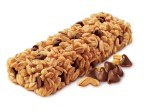
“Healthy” Bars

Granola BarMany people love the convenience of bars, whether they are labeled as granola bars, energy bars or protein bars.  However, many of these bars aren’t much better than candy bars in terms of nutrition.  Beware of granola bars, as many of them contain sugar, oil, and even candy.  Energy bars and protein bars are also frequently high in sugar and can also contain caffeine and artificial sweeteners.  Regardless of the type of bar, many formulations also contain preservatives.  What’s more, some bars are so highly processed that they could be described as “fake” foods.

There are some bars out there which are minimally processed and can be considered pretty decent in terms of nutritional value.  Make sure to check the ingredients on the wrappers and look for natural ingredients like oats, fruit and nuts.  You can also make your own granola bars and protein bars.

Here is a great link which has numerous recipes for natural protein bars:

http://www.muscleandstrength.com/recipes/protein-bars

This is a good link for a granola bar recipe:

http://recipes.sparkpeople.com/recipe-detail.asp?recipe=394740

If you don’t have time to make your own bars, healthier bar choices which you can purchase are the Lara Bar and Quest Bar (http://www.questproteinbar.com).

“Healthy” Cold Cereals

bowl_o_cerealMany people have fallen under the misconception that dry cereals can be healthy as long as they contain grains such as wheat, barley or oats.  Such grains are subjected to processing which deranges the nutrients that they contain, which is in part why dry cereals are commonly fortified with vitamins and minerals.  It seems counterproductive to strip grains of their nutrients, then add them back in, but this is a very common practice.
Many cereals also contain highly processed flours which also have been stripped of nutrients, and some even contain genetically  modified grains which can have questionable effects on the body when absorbed by the body.  Such flours can sit in the digestive tract for prolonged periods, interfering with absorption of nutrients and creating an environment which invites overgrowth of pathogens.

I must mention something here about instant oatmeal.  It never ceases to amaze me how many people turn to instant oatmeal, believing that because  it is oatmeal, it is healthy.  Patients will tell me that they like the convenience of having the instant variety around.  However, instant oatmeal has a plethora of  ingredients other than oats, such as oat bran, oat flour, salt, caramel color, and guar gum.  Vitamins and minerals are added to instant oatmeal to fortify it since the processing method strips some nutrients away.  Guar gum is used as a thickening agent and will bind liquids in the digestive tract.  Yet people think instant oatmeal is healthy!

A healthier cereal choice is to either find dry cereals which contain buckwheat, millet, quinoa or amaranth.  Another very healthy cereal choice is to cook old-fashioned dry oats.

“Healthy” Sandwiches

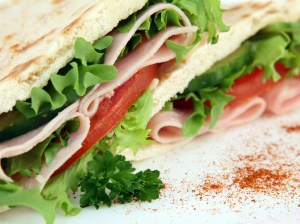
When Jared catapulted Subway Sandwiches into mega success as a result of the ad campaign which featured his weight loss, people became even more enamored of the convenient meal option which has come to define lunch for many people.  However, it makes a HUGE difference what bread, meats and condiments are used.  On the very, very rare occasion when I have to get a Subway sandwich (I think the last time I had one was 5 years ago), I will ONLY get the oven roasted chicken breast.  Why?  Because I avoid cold cuts like the plague.  Cold cuts have been deceptively packaged in grocery stores with labels like “fresh”, “oven roasted”, “99% fat free”, etc.  But the fact remains that cold cuts are extremely high in sodium, usually in the form of sodium nitrate which prolongs the shelf life of these meats.  The problem is that the body breaks down the sodium nitrate in such a way that can become carcinogenic.

Even with use of such preservatives, cold cuts can still harbor dangerous bacteria, the most common of which is Listeria.  Listeria infection is characterized by fever and chills, abdominal pain and vomiting.  I don’t know about you, but I don’t want to touch a food item which has a high risk of causing such symptoms.  Pregnant women and infants are particularly susceptible to such infection and should avoid consuming processed meats entirely.

Add to this a couple of slices of bread made with processed flour and a dollop of mayonnaise, and you have created a meal that is full of carcinogens, sodium and saturated fat and seriously lacking in nutrition.

A healthier choice is to make your own sandwich with Ezekiel Bread, gluten-free whole grain bread, or P28 Bread (www.highproteinbred.com), a dollop of pure organic mustard, Romaine lettuce, and a nicely grilled portion of skinless chick breast.  sandwich

“Healthy” Sushi

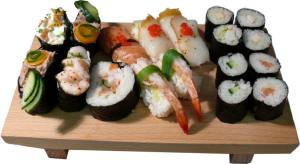
Before I begin dissecting this meal choice let me say that I am half Japanese and have grown up loving all Japanese food items.  However, I know that sushi is a deceptive meal choice for people and leads them to believe they are making an optimal decision on what to put in their bodies.

It is true that there is fish in most sushi varieties, but if a reasonable volume of food is consumed, the ratio of fish to rice is rather small.  This is especially true if you order a roll, and unfortunately these days people will opt for rolls.  Sushi rolls are made with about a cup of rice which is at least double the amount of carbs most individuals should consume in one serving.

A second issue which is of concern to the health-minded person is the sodium content found in the soy sauce and ponzu sauce which are used.  Though you may think it’s just a dip here and there, an all-you-can-eat sushi fest can quickly rack up the sodium beyond the recommended daily limit.

Lastly, and most concerning, are the incredibly tasty fried items which can find their way into a sushi roll.  In some cases the entire roll is battered and deep fried, which renders a marginally healthy food item completely unhealthy due to the addition of saturated fat and calories.

A healthier choice is to order rolls which are made without rice (also known as “low-carb rolls”), or order a plate of sashimi with a salad on the side instead of rice.  If you must have rice, opt for brown rice if it is offered.  

sushi

“Healthy” Salads…

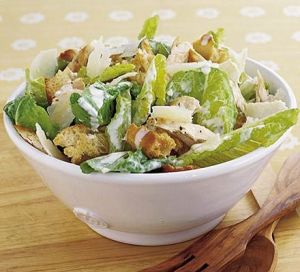
Chicken Caesar SaladRESTAURANT SALAD:  If you think about the typical American restaurant salad, it is huge, filled with at least three cups of lettuce and chock full of other items such as vegetables, meat, nuts, cheese or fruit.  Add the dressing and you are consuming massive calories and fat.  Let’s break down the Caesar salad since this seems to be a particularly popular salad choice for people.
  • Romaine Lettuce – Usually about four cups of Romaine lettuce can be found in a full Caesar salad.  This lettuce is a fantastic source of fiber and numerous vitamins and minerals.  It also has negligible amounts of calories.
  • Grilled Chicken – An ideal serving would be four to five ounces of chicken, but I have seen some large Caesar salads which have three ounces or less and are added almost as an afterthought.  Usually this chicken is grilled with seasonings including an appreciable amount of salt for flavor.
  • Shredded Parmesan Cheese –
  • The good: This food is a good source of  Phosphorus, and a very good source of Protein and Calcium.
    The  bad: This food is high in Sodium, and very high in Saturated Fat.  It also carries a hefty calorie count.
  • Croutons – Typically salad croutons found in a restaurant salad are made of French bread, which is made with white enriched flour.  This is processed flour and has a higher glycemic index and lower nutritional value than other types of bread.  They are made by adding melted butter or oil and seasonings then baked on a cookie sheet.  The added butter hikes up the calorie count and adds saturated fat to the mix.
  • Caesar Salad Dressing – Besides oil and vinegar, the classic dressing used for this salad contains egg yolks, anchovies, Worcestershire sauce and more Parmesan cheese.   Anchovies are VERY high in sodium, as are Worcestershire sauce and Parmesan cheese.

Perhaps the biggest red flag comes from the sodium count in this salad.  A typical restaurant Caesar salad contains roughly 1,500 milligrams of sodium, which is about 75% of the recommended daily intake of sodium.  And that is in one meal!

If you want to make a healthier choice, order a mixed greens salad with oil and vinegar or lemon slices on the side, and add a grilled chicken breast.  

“Healthy” Foods – Don’t Be Fooled!

When my patients and clients insist that they eat healthy foods, I am always curious to find out what they consider to be healthy. Usually I hear them list off restaurant salads, sushi, turkey sandwiches, whole grain cold cereals and cereal bars as their healthy foods.  Others will mention low fat versions of many foods, such as crackers, chips, frozen dinners, yogurts, cheese, cold cuts, cereals, etc. and state that they are proud of the fact that they have such foods nestled in their cupboards and refrigerator shelves.

I have news for you who think these are supremely healthy choices: they are not as healthy as you think they are!  In an effort to educate readers on what the nutritional breakdown is for these foods, I am dedicating a separate blog post for each food item which is in bold and italicized in this post.  In addition, whenever possible, I will provide a healthy option for each dish. By no means do I expect everyone to make healthy choices all the time, but I hope to equip them with the tools to make the healthiest and most informed decisions on what foods to eat whenever possible.

STAY TUNED TOMORROW FOR MY FIRST MEAL BREAKDOWN TOMORROW!

Sorting Through Protein Powder Types

Patients, clients and strangers ask me constantly what protein powders are the best, from the type to the brand and flavor.  The difficulty I have in giving a definitive answer is because different types of protein are better suited for different times of the day.  Another issue lies in the fact that I do not suffer from lactase deficiency or food allergies, so what works for me might not work for someone else.  In keeping with this challenge, I am going to discuss the different types of protein powder that are available with a small amount of advice on which protein to turn to for different tasks.


Keep in mind that protein powders can be derived from animal sources (whey, casein, egg white) or vegetable sources (soy, rice, hemp).  Generally speaking, animal proteins are nutritionally superior, so they should be chosen over vegetable sources unless someone follows a vegetarian or vegan diet.


WHEY PROTEIN:  When whole milk is broken down, 20% consists of whey protein and the remainder is casein protein.  Whey protein is the most reasonably priced protein and is very high in quality.  It also has the best flavor and mixes relatively well.  Whey protein is absorbed in the digestive system quickly, so it is the preferred protein source post-workout or whenever a rapidly available protein source is needed.


There are two types of whey protein available:

  1. Whey Concentrate – This is the cheaper version and is also low enough in lactose that even lactose-sensitive people can tolerate it.  It is also low in fat and carbohydrates, making it an excellent protein source for the majority of the population.
  2. Whey Isolate – This form is almost completely fat free and is also lactose free.

Some whey protein formulas have a blend of the two types, and may also have casein protein blended in as well (see description below for casein).


CASEIN PROTEIN:  This is also referred to as milk protein, and is absorbed much more slowly than whey protein.  Because of this, casein protein is commonly the protein of choice in bodybuilders before bedtime since the slow absorption is optimal for maximum muscle growth during sleep.  There are two types of casein protein:

  1. Micellar Casein – This is the superior form and is made by separating the casein portion of milk from lactose, whey and fat via microfiltration.  Microfiltration does not involve heat so micellar casein is not denatured like other forms of protein.
  2. Calcium Caseinate – This is the most soluble form of casein and mixes easily in fluid, but tends to contain high amounts of sodium (often MSG as the form of sodium).


EGG WHITE PROTEIN:  This protein source is naturally low in fat and calories but is more expensive than mild-derived proteins.  It is a good choice for individuals with milk allergies and is also considered a perfect protein because it contains all the building blocks of life.  Egg white protein is easily digested and absorbed so it is a good source of protein right after a workout.


SOY PROTEIN:  Soy protein supplies the body with all eight essential amino acids and is comparable in digestibility to animal protein sources.  It is best used as a meal replacement powder.  However, I am always concerned about the estrogenic effects of American soy products and tend to discourage the use of soy protein in my patients.


HEMP PROTEIN:  This protein has a lower bioavailability than other protein powders and is also lowest in protein.  It is slightly higher in fat than other sources but is high in fiber.  My advice is to choose other types of protein unless you have dietary restrictions or food allergies.


RICE PROTEIN:  This protein powder may be a good choice for people with milk allergies, but its bioavailability is also lower than the animal based proteins.  It is created by isolating the protein portion from brown rice.