Image ID : 62594744
Source: 123rf.com
If you are considering ordering and completing one of those genetic ancestry tests (popular ones are 23andme, Ancestry, and MyHeritage, all of which I have now completed), be prepared for the possibility that you might be on the crest of a journey down into the rabbit hole. I’ve heard far too many stories of people who made startling discoveries relating to their genetic background and genealogy which at times resulted in conflict within the family. Mysteries may unfold which leave you with more questions than you may have ever had about your family members or your ethnic makeup.
If we consider the phrase, going down the rabbit hole, we can enter said rabbit hole without thinking that the journey will be as long or as confounding as it can be. That’s how it was for me initially, and now I find myself searching more than ever before for the puzzle pieces which could solve the many mysteries my biological father left when he died. Although I knew the circumstances surrounding my conception were akin to a soap opera, I never in my wildest imagination expected my story to unfold the way it has.
Before I dive into my own story, and wiggle through the proverbial rabbit hole, I’m going to share this passage from Lewis Carroll’s “Alice In Wonderland”:
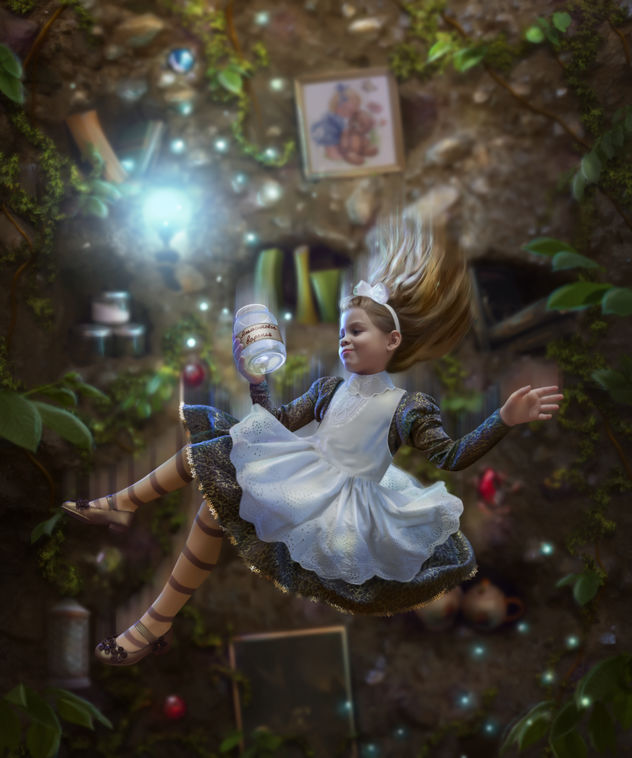
“In another moment down went Alice after it, never once considering how in the world she was to get out again.
The rabbit-hole went straight on like a tunnel for some way, and then dipped suddenly down, so suddenly that Alice had not a moment to think about stopping herself before she found herself falling down a very deep well.
Either the well was very deep, or she fell very slowly, for she had plenty of time as she went down to look about her and to wonder what was going to happen next. First, she tried to look down and make out what she was coming to, but it was too dark to see anything; then she looked at the sides of the well, and noticed that they were filled with cupboards and book-shelves; here and there she saw maps and pictures hung upon pegs. She took down a jar from one of the shelves as she passed; it was labelled `ORANGE MARMALADE’, but to her great disappointment it was empty: she did not like to drop the jar for fear of killing somebody, so managed to put it into one of the cupboards as she fell past it.
`Well!’ thought Alice to herself, `after such a fall as this, I shall think nothing of tumbling down stairs! How brave they’ll all think me at home! Why, I wouldn’t say anything about it, even if I fell off the top of the house!’ (Which was very likely true.)
Down, down, down. Would the fall never come to an end! `I wonder how many miles I’ve fallen by this time?’ she said aloud. `I must be getting somewhere near the centre of the earth. Let me see: that would be four thousand miles down, I think–‘ (for, you see, Alice had learnt several things of this sort in her lessons in the schoolroom, and though this was not a very good opportunity for showing off her knowledge, as there was no one to listen to her, still it was good practice to say it over) `–yes, that’s about the right distance–but then I wonder what Latitude or Longitude I’ve got to?’ (Alice had no idea what Latitude was, or Longitude either, but thought they were nice grand words to say.)”
Source: 123rf.com
Image ID : 42904359
Copyright : Eugeniu Frimu
Thanks to 23andme, a half sister I had never known about contacted me at the end of January with the startling news that we were indeed siblings. Three days after our initial contact, another half sister surfaced on the site, and we slid down the rabbit hole even farther.
It took some time for the other half sister to respond to our connection requests, but we three are all now in communication with each other. I have met one half sister and was even able to help her celebrate her latest birthday in February. The other half sister is lining up a visit so that we can all three see each other face to face and forge the bond we never got a chance to develop as children.
We also have a half brother whom we are trying to locate, but there are numerous barriers, including the fact that we don’t know his name or birthdate, are unaware of which country he currently resides in, and the fact that he evidently is the type of person who would not welcome the news that he has three half sisters. I have known about this half brother since our father’s death in 1997, but he never signed up for genetic testing analysis, which means we don’t have the convenience of a genetic testing service to do make the connection for us.
We want to find out more about our family tree, but it will be difficult at best to ferret out such information because I have limited knowledge of our father’s mother tongue (Hungarian), and I have no idea who would be privy to such information. Our father’s place of death is also a mystery, which also means that it will be challenging to discover where he was interred.
Curiouser and curiouser, indeed.
 dr. stacey naito's blog