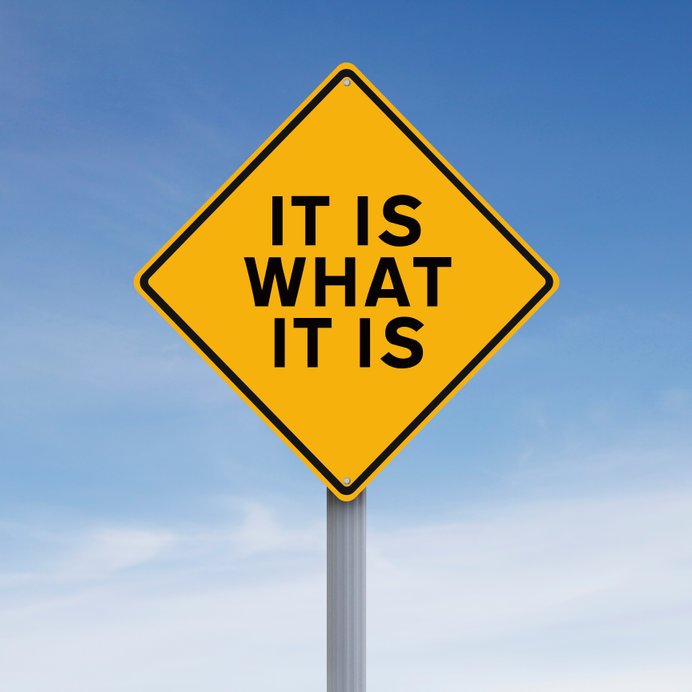
Stop Saying, “It Is What It Is”! (repost)

“It is what it is.”

I cannot understand why this phrase has become so popular, because it is incredibly stupid and redundant. I cringe every single time I hear someone utter it, and am dismayed by the number of people I know who have adopted this into their current communication behaviors. Why has it suddenly become so trendy to state the obvious in this manner? I can’t help but think that everyone who utters this string of words either hasn’t given much thought to the circular reasoning buried in it, or has developed a pathological and resigned attitude towards life in which circumstances are shrugged off. Come on guys, take a little responsibility, would you?

Copyright: rnl

If we look at res ipsa loquitur logic, this legal term indicates that someone is presumed to be negligent if that individual had control over what caused the injury. But since I took two years of Latin in high school, I am more intrigued by the original semantics and logic of this particular phrase. If we apply this idea of negligence to the statement, “it is what it is”, does that mean that people are blaming fate, or the lockdown, for the unraveling of society which has occurred in the past three years, or are they simply resigning themselves to fate when they utter that? All I know is that I have heard it far too often in the past couple of years, and it is raising my ire.

I truly enjoy and appreciate what Ethan Ryan from The Fiddleback has to say about this idiotic statement:

“It is what it is” is a waste of words, a waste of breath. I mean, sure, I get it. It expresses the same sentiment as the French “C’est la vie!” But still, it irks me. It’s just a repetitive series of defeatist monosyllables. Why not just say “It is,” or for that matter, “It’s”?

Of course it is what it is! How could it be anything but it?

The only context in which that phrase would be appropriate would be if somebody asked “Is it what it is?” and you said, “Yes, it is what it is.” Presumably you’d have this conversation in an assisted living home with a demented loved one attempting to categorize an ice cream cone.

When you write “It is what it is” as a mathematical algorithm it looks like this:

it = it

In logic, this is called the law of identity, which states that an object is the same as itself. “A is A” is a tautology. Here are some more:

1 = 1

pineapple = pineapple

J = J

☺ = ☺

poop = poop

X = X

Those are analytical facts, verified by their consistency within the rules of a symbol system. But they’re also stupid and irrelevant. They’re true under all possible circumstances, and they demand little of the world for their truth. You don’t need evidence to back up the claim “Poop is what poop is.”

Here’s another tautology:

Formula_Ryan

Seems logical, right? I don’t know, I’m not a logician.

What concerns me are rhetorical tautologies such as:

“I am what I am.” ~ God talking to Moses

“I yam what I yam.” ~ Popeye talking to Olive Oyl

“Rose is a rose is a rose is a rose.” ~ Gertrude Stein

“A horse is a horse, of course, of course.” ~ the Mr. Ed theme song

“It is what it is what it is what it is what it is what it is what it is.” ~ this essay

It is it. A is A. But redundancies are redundant, aren’t they? Be succinct. Next time your umbrella breaks, or your toilet gets clogged, or your house burns down, just shrug and say “It’s.”

That’s obnoxious advice, I know. Defeatism gets us nowhere. Life is hard, but that’s no excuse to spout meaningless clichés. There are so many fantastic adjectives and nouns and verbs out there, humming in a deep pocket of your brain. Use your words. Don’t just say “It is what it is.” We already know that.

Wittgenstein said philosophy is the headache you get from banging your head up against the limits of language. When I came across that line I decided I was done studying philosophy. Years later, my head is still hurting. Philosophy is dangerous.

Whatever.

It’s.

——–
Ethan Ryan

Learning About A Country Through Television

Copyright: 3dgenerator

Whenever I travel to a foreign country and have access to a television, I am always compelled to watch something so that I can soak up the local language and culture. I’ve done this in Mexico, Costa Rica, Hungary, Australia, Thailand, Japan, Spain and Portugal. When I visit countries which speak a language I can understand, I make an effort to listen and understand the language. For example, I can catch bits and pieces of Japanese when watching Japanese television, because I have had a lifelong exposure to Japanese programs. When in Mexico, Costa Rica, and Spain, I understood the majority of what I watched and heard on television, and I felt that it boosted my cultural understanding of the country I was visiting.

When I was in Hungary, I got a chance to watch Family Guy with Hungarian overdubs, which was truly bizarre but also quite fascinating. Then when I visited Spain, I caught a few episodes of the Spaniard version of Who Wants to Be a Millionaire, as well as another Spain-based game show, and was pretty surprised when I was able to follow the shows in their entirety without any struggle. My experience watching TV in Spain made me even more courageous about speaking Spanish while I explored Barcelona and Girona. Even in Sydney, Australia, I got a kick out of the language nuances and cultural differences which were revealed in the programs I watched.

Who else has a habit of catching television shows while traveling abroad?