Last year right around Christmas, I taught my dear friend Karla how to make origami cranes, and though she struggled at first, she began to get the hang of making them. She thought they were pretty neat, and asked if they were ever made for a specific purpose, so I told her about the tradition of making one thousand cranes and stringing them up to hang for a number of different occasions, including making a wish for an ill person’s recovery, the birth of a child, wedding blessings, or to grant good luck within a home. Senbazuru (a thousand cranes) is the Japanese way to make a wish and bless it so that it might come true.
Emma Taggert offers an explanation of how the origami crane emerged in Japanese culture:
“The tradition of the Japanese orizuru (ori– “folded,” tsuru “crane”), or paper crane, began in feudal Japan (1185–1603 CE), when people gifted each other the paper figures as symbols of honor and loyalty. However, it wasn’t until the 16th century that the art of the origami crane was officially recorded. Hiden Senbazuru Orikata (“Secret to Folding One-thousand Cranes”), published in Japan in 1797, is the first known book on origami. It features the earliest known instructions on how to make origami cranes, along with countless examples of different kinds.”
Since I grew up making origami cranes, I can quite literally make them with my eyes closed, but I understand that for someone who is unfamiliar with origami, making that first crane can be a challenge. Here is a video tutorial for those of you who want to learn how to make one:
For those of you who already know how to make origami cranes, you might want to challenge yourself with renzuru, a form of origami in which multiple forms are made from a single piece of paper:
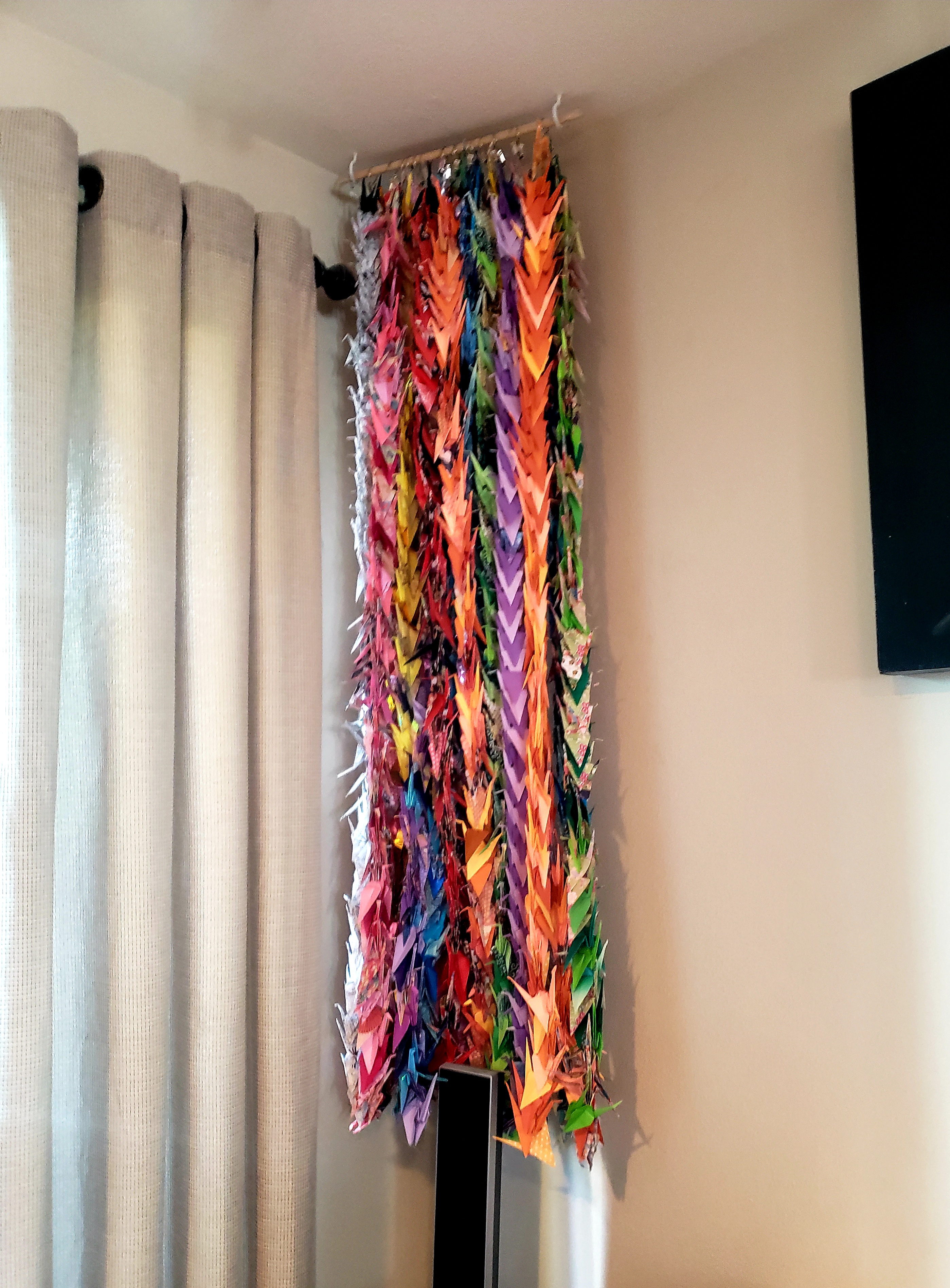
Getting back to my friend Karla, she amazed me in July when she gifted me with a thousand cranes for my birthday. I wasted no time in gettting a dowel and hooks for the cranes so that I could display them in my living room. Once they were hung, I realize I had chosen a great spot because during the day, the cranes catch the sunlight, and in the evening, the uplights which I have behind my sofa impart a lovely glow on them.
On May 12, 2023, I lost Kazu, my 14-year old European Burmese who was truly the most incredible cat I have ever had. She had countless adorable habits, including hopping instead of walking downstairs, performing somersaults on the stairs on a daily basis, and lying in a human’s lap on her back with all four limbs perched in mid-air, purring so fiercely that her limbs would move in rhythm with the rumble. One of my favorite things about Kazu was the fact that she would sleep next to me every night, throughout the night, and her purr motor would start up as soon as she saw my eyes open in the morning. There were also times when Kazu would be the big spoon, putting her cute little paws on my back and nestling in my hair as I slept on my side turned away from her.
Every night, Kazu would bound up the stairs to our bedroom, hop onto the bed, wait for me to settle in under the covers and lift them for her, then she would get into position so that her body would be under the covers and her head would be either on my shoulder, arm, or on the pillow next to me, with her body snuggled up right next to mine. It’s no surprise that I haven’t been able to sleep very well since she passed. What’s even more remarkable is that I had three cats in succession from 1988 through 2023 who were my bed buddies, and all of them were my “little spoons”.
The first little spoon I had was Pebbles, a tortie who was full of tortie sass, had a loud purr similar to Kazu’s which could be heard from an adjacent room, and who would sleep next to me through the night every night. She was in my life from 1988 until 2000, when kidney disease took her from me. Before Pebbles died, I got a blue silver patched spotted tabby and white Scottish Fold kitten in November 2000 and named her Sophie. Little did I know that Sophie would soon take over as my little spoon, curling up next to me, often in the crook of my arm, and sleep throughout the night that way.
My Scottish Fold Sophie…
Sophie developed polycystic kidney disease at the age of 9, in 2009, which was when I got Kazu. When Sophie died in late 2009, Kazu had not yet developed any consistent bed habits, but before long, she began sleeping next to me in bed, and became my third little spoon. Anyone who is lucky enough to have a cat who sleeps snuggled up next to them throughout the night is blessed indeed, and I had three cats do that over the span of 35 years. I certainly hope to experience that again in the future.
Dr. Stacey Naito of Dr. Stacey Naito’s Blog is a board-certified family practice physician with a wide range of interests that she shares with readers. Read more informative articles today!
What To Do When Your Parents Need Different Types of Senior Care
As your parents age, they may need help finding senior care or an alternative living situation. When that time comes, you may be faced with an unexpected challenge — figuring out what to do when only one parent needs to move into a nursing home. Dr. Stacey Naito of Dr. Stacey Naito’s Blog explains that by involving your parents and handling the process with compassion, you can create a smooth, loving transition.
Choosing a Nursing Home
The right nursing home is essential for your parents’ comfort, health, and financial stability. As you choose a facility, follow these steps:
Verify insurance coverage. Find out how much your parents’ plan will pay each month.
Identify appropriate facilities. Find nursing homes that accept your parents’ insurance and fulfill their care requirements. Go online to find the facilities in your area and read up on pricing information, payment options, and reviews. You’ll find nearly 80 assisted living communities in Los Angeles.
Determine excess costs. Calculate the extra monthly costs for each facility.
Make a short list. Select facilities that fit your budget, care, and location preferences.
Read reviews. Look into the reputation, quality of care, and services at each facility.
Visit facilities. Bring both of your parents to check out your top 3-5 nursing homes. Look at factors such as cleanliness, activities, and interpersonal relationships.
Ask about openings. Find out when a room or bed will open.
Paying for a Nursing Home or Assisted Living Facility
In the United States, US News & World Report notes that the average room in a nursing home costs more than $100,000 per year. For a shared room, you can expect costs of more than $93,000 per year. Some ways to cover nursing home costs are:
Medicaid
Long-term care insurance
Life insurance
Savings and retirement income
Family contributions
Keep in mind that costs can vary significantly between states and cities. If you live in a different city, you might save money by moving your parents to a nursing home near you.
Helping Your Other Parent Downsize
Maintaining a home is a big job; when one parent moves into a nursing home, your other parent may want to move as well. Some options are:
When your parents are moving to different places, you’ll need to deal with two moves. A moving company can make the transition easier for everyone; they can handle the packing and the heavy lifting so you can focus on your parents. For safety and security, choose a trusted company by reading moving company reviews online and selecting the best one. Ideally, the moving company you choose has experience with senior moves.
Providing Compassionate Help to Aging Parents
Moving your parents into separate homes can be emotional and exhausting for everyone involved. As an adult child, DailyCaring points out that all of the stress can make it harder to remain compassionate. To ease the process, you can:
Hire a senior move manager. They’ll help with sorting, organizing, and selling belongings during the downsizing process.
Take personal time. Make time for your friends and favorite activities.
Ask relatives for help. Don’t be afraid to lean on siblings, aunts, uncles, and cousins.
Get support. Join a support group to express your emotions in a safe place.
Managing the Senior Care Process
With patience and compassion, you can help both of your parents settle into new homes. Remember to put a lot thought into choosing the right senior living facility, paying for continued care, helping with downsizing, and providing all the care you can.
The third and final installment in my blog series on nightmare roommates is devoted to Lorraine, a woman with a whole host of mental issues, a nasty attitude, and a sense of entitlement the size of Texas. When my other roommate Myra (who is incidentally the best roommate I have ever had, and a very dear friend) and I met Lorraine, we could see that she was pretty dramatic, but we both attributed it to the fact that she was a professional dancer. We all seemed to get along nicely though, and Lorraine moved in.
About a month after Lorraine moved in, a bizarre incident occurred. Myra and I were in the kitchen chatting, and at one point I opened up the freezer to get a bag of shrimp out to thaw. When I did so, I noticed that two bags of ground coffee which I had bought had been opened. I pulled them out of the freezer and noticed that one bag had about 2 tablespoons left in it, while the other had just over a teaspoon. I asked Myra if she had opened up the bags of coffee, and she told me that she hadn’t, to which I replied, “Ok, it had to have been Lorraine. I’ll talk to her later about it.” Myra and I continued to chat about other topics, and I started the thawing process on the shrimp.
A few minutes later, Lorraine stomped down the stairs, looking very angry. She said, “Oh my God, so you’re talking about me behind my back?” Myra and I just looked at each other, because we were both so taken aback by Lorraine’s accusation. I told Lorraine, “Oh not at all, I just figured I’d talk to you about the whole coffee thing, because the coffee which is in the main tin is what is community property, not the unopened bags I have in the freezer.” Lorraine immediately retorted, “YOU said the coffee was for EVERYONE. Well, you know what? I won’t touch ANY of your stuff ever again!”, then marched back up the stairs and slammed her door. Two minutes later, her door opened, and she came down the stairs with her phone in hand, yelling to the person on the other line (turned out it was her grandmother) that she couldn’t take it anymore, that she had just been disrespected, etc. She went down to the first floor, slammed the front door, and was gone for several minutes. Then she re-entered the house, still on the phone, still yelling at her grandmother, went up to her bedroom on the third floor and slammed the door. This pattern continued for another 15 minutes or so, in which she would come up the stairs, slam her door, then walk down the stairs and outside repeatedly.
Lorraine refused to talk to Myra or me for a couple of weeks, then she sent a series of text messages to us both in which she apologized profusely for her outburst, told us she loved and respected us both, and wanted good blood between us. I was startled by Lorraine’s complete change in behavior and began developing a mistrust of her behavior, especially because she would often burst into the house yelling at someone on the phone. She suffered from severe depression and also developed some strange physical symptoms which she was sure stemmed from some deadly and incurable disease.
Incident number two occurred several months after the first one. Lorraine had informed me that the latch on the sliding glass door which led to our balcony wasn’t working, and she asked me to look at it when I got home. I had been working all weekend at a fitness expo and had gotten into a heated argument with my booth mate during the drive back, so I was in no mood to repair a sliding glass door latch. Nevertheless, Lorraine chose to ignore the fact that I was in a bad mood, and badgered me to take a look at the latch. I fiddled with the latch for a couple of minutes but was unable to fix it, and I told her that I would look at it later. Lorraine promptly started screaming, “WHAT? WHAT? That’s unacceptable! You don’t talk to me like that!”, and I was completely stunned by her outburst. She ran upstairs, slammed her door, then opened it a couple of minutes later, stormed down the stairs and out the front door, her phone in hand, yelling at her grandmother about what a bitch I was. She continued this up the stairs, down the stairs ritual numerous times in the span of about ten minutes. Once again, I got the silent treatment from Lorraine for about two weeks, followed by a stream of apology texts.
The third time Lorraine went off on me was after she had been living in the house for over a year. I had returned from a trip to Denver late at night, and I was exhausted. I was at the kitchen sink washing cat dishes, when Lorraine entered the house, walked up to the second floor, and with a flourish, said “Hello…” (her typical tone when she was begging for attention), to which I replied, “Oh, hi.” She said, “What are you doing?”, and I replied that I was washing cat dishes, that I had just gotten home from a trip. Suddenly, she said, “No NO NO! I don’t like your ENERGY! I don’t have to put up with this bullshit!”, and she clumped up the stairs. You guessed it, Lorraine made a phone call, rushed down the stairs and outside, then continued the sequence a bunch of times before returning to her room and slamming the door.
I went upstairs to my bedroom around 11 pm and crawled into bed. Around 12:15 am, I woke up to the sound of Lorraine’s hair dryer, so I texted her with, “Hey, I’m trying to sleep. Would you mind not blow drying your hair so late? Thanks.” I immediately got a nasty response from her in which she stated that she had the right to do whatever she wanted, whenever she wanted, that I had no right to just text her, and that if I had a problem with something, that I should speak to her in person. I told her that since it was so late, and I was IN BED, that speaking to her in person didn’t seem feasible.
Lorraine didn’t speak a word to me for 5 weeks. Then one day, she texted me, saying that she wanted to check in with me to see what I wanted her to do with catsitting (I had a 14 day trip to Japan approaching), and that she was delighted to do whatever I needed her to do. By this time I was so terrified of her and so accustomed to walking on eggshells whenever she was around that I didn’t even know how to proceed. I haltingly agreed to let her catsit, and never addressed her outburst from 5 weeks prior.
Finally, after over a year and a half of living with this woman, she submitted her 30 day notice of vacancy. The weekend that she entered the house to remove her belongings, she became hostile towards me and even threatened to punch me at one point. I was already at the point where I was totally willing to call the cops, and I told her so, which convinced her to rethink the idea of assaulting her roommate. She made such a mess on the walls of her bedroom that I had to have the entire room repainted, an expense which was covered by a portion of her security deposit.
I truly hope that I never have any more awful roommates, because I have paid my dues by enduring unacceptable living situations with some pretty messed up people!
Part 2 of my blog series on horrible roommates continues today with Richard, who moved in with a 3 pound teacup Chihuahua named Lola and a 20 pound Chihuaha mix named Poopers. Richard was very forthright in telling me that he had previously dealt with a crystal meth addiction, but was fully recovered. To set my mind at ease, he gave me his father’s phone number and told me that if any issue ever arose with him, I could call his father and he would set everything straight. Richard then moved in, and told me that I would never have to worry about his dogs because he crated them at night in his room, and was completely responsible for their feeding, walks, and bathing. There were no issues with Richard for the first few months, and he was proud of himself because he had been able to continue his employment as a dog groomer, a job which he enjoyed immensely.
Then one Sunday morning, I was awakened at 4 am by the sound of Lola yelping and crying in Richard’s room. I walked across the hall to Richard’s room and knocked on the door, calling out for him. When there was no response, I opened the door to find the dogs in their respective crates, with food and water bowls on the opposite side of the room. The crate doors were closed and latched. I suddenly realized that I hadn’t seen Richard since Friday afternoon, and became very concerned that these poor pooches were trapped in their crates since then. I immediately took them out of their crates, put kibble in their food bowl, and filled their water bowl with water. Once they had something to eat and drink, I took them outside so that they could go to the bathroom and run around a bit. I ended up letting the dogs roam around the house, and spoke with my other roommate Paul later in the morning about splitting dog walking duties with him, to which he heartily agreed.
I dialed Richard’s dad’s number around noon that Sunday, and a young man answered. When I asked if Richard’s dad was there, I was informed that he was not there. I then asked if Richard happened to be there, and was told that he wasn’t there either, but my gut told me that he probably was there. So I told the guy who answered the call to inform his buddy Richard that he was in big trouble, and that because he had locked his dogs in crates for an extended period of time, I would be contacting animal rights organizations to report Richard.
Richard showed up two days later, but wouldn’t look me in the eye, and he looked like he had been tweaking. He apologized for the dogs, said he would take better care of them, and then left. This is when Richard began to exhibit some very bizarre behavior. He would sneak into the house very late at night, grab clothes or whatever else he needed, and then quickly leave without taking care of his dogs. Since I didn’t trust Richard, Paul and I continued to feed and walk the dogs, and we would crate them at night. Then after about two weeks of this pattern, Richard let the dogs out of the crates one night and then left. The next morning, the dogs had managed to urinate and defecate all over his bed, the carpeted floor, and a stack of his dirty clothing. It was like they lashed out at him by peeing and pooping everywhere. The situation was so bad that the smell of dog urine and feces had soaked into the floorboards, and even after I replaced the carpeting in that room, the faint odor of dog waste persisted.
The day after the dogs had their grand excretory event, I contacted an attorney and had an eviction letter drawn up which I put on Richard’s bedroom door and also sent to his dad. I also called him and left him a message letting him know I was looking into having the dogs rehomed immediately. It took several days for Richard to clear out his belongings, but he managed to empty the room, and he also unfortunately took the dogs with him. His security deposit was spent on replacement carpeting for the room.
I can only imagine what happened to Richard, but I assume that he fell completely back into his meth addiction.
Over the past 36 years, I have had a lot of roommates, some of whom were pretty cool, one who was awesome and became one of my dearest friends, and a handful who were such rotten people that it took me a while to recover from the craziness they brought into my home. The list of bad roommates is actually larger than I would like for it to be, but I figured I would select the three most despicable ones to discuss in this blog post. The ONLY reason why I have changed the names of these individuals in my stories is because one is certifiably nuts (borderline and histrionic personality disorder…no, I didn’t live with Amber Heard!), and the other two are addicts who can’t be trusted in any way, shape or form.
The first selection on my list of worst roommates ever was Sean, a very cocky Korean guy who assured me when he interviewed for the available room that he was a successful businessman with a number of businesses, one of which was the local Fosters Freeze. He stated that he needed to use my desktop computer in the den because his was at one of his offices and he was unable to access it on a regular basis. I agreed to let him use my computer, but I password protected all of my financial documents and other sensitive information.
In the mornings, Sean would come downstairs to the kitchen wearing a full business suit, and he would tell me about how busy the day ahead would be for him. Then I would leave for work, returning in the early evening to see Sean sitting on the sofa watching TV. The first hint that Sean was shady was when he asked me to please put his work van on my automobile insurance policy. He told me that the insurance rate was very high, and that by adding his vehicle onto my policy, the rates would drop for both our vehicles. He also promised to pay the entire premium. I firmly refused, even though he kept pleading with me to add his van, and he even insulted me, telling me that I was passing up an “excellent deal”.
During the time Sean was living in my house, we had a housekeeper who would clean every two weeks. One day, when she was finishing up her cleaning, she pulled me aside and said, “Miss Stacey, there’s something strange about Sean. When you are leaving for work, he is in a full business suit, but after you leave, he goes to his room, changes into a t-shirt and shorts, then goes down to the den and plays poker on your computer. He is still there when I am ready to leave. I just thought you should know.” My suspicions were ignited by this information, and I became very uncomfortable around him.
Ultimately, Sean just completely disappeared one day, and I couldn’t get in touch with him. So I ended up going to the Fosters Freeze since he had mentioned that he owned that business. I drove up and saw a Korean woman in the order window, so I figured she was Sean’s sister. I approached her and introduced myself, and then asked if she knew where Sean was, since I hadn’t seen him in close to a week. Her response was, “You’ve seen Sean? Come to the back entrance. We need to talk.”
Once I was at the back entrance, Sean’s sister proceeded to tell me that he was a gambling addict and had gotten into big trouble with a number of individuals who were after him for lost bets he never paid up on. She also told me that Sean had emptied out their parents’ savings accounts in a desperate effort to obtain more money, and what made that part of the story even worse was that she told me their father had cancer and was now unable to pay for chemotherapy treatments due to Sean’s theft. She told me to go into his room and just sell whatever might be of value, because she said he would never come back to the house. When I returned home, I went up to Sean’s room, where I found several pairs of crew socks and his bed. He had taken all of his Armani suits and other valuables and bolted.
Next week I will talk about another horrible roommate I had. It’s definitely been an adventure having roommates!
Taiko, a Platinum American Burmese Male – My first Burmese love…
Since 1986, I have had thirteen different cats, and cannot imagine life without felines in my household. Six of the cats I had have been of mixed breed, while the other seven were purebred. Of those pure breeds, I have had a Blue Point Birman (Natasha, 1991-2000), a Snow Bengal (Abbey, 2002-2005), a Scottish Fold (Sophie, 2000-2009), one European Burmese (Kazu, born in 2009 and part of my current brood), and three American Burmese (Taiko 2001-2009, Tenshi, born in 2008, Koji, born in 2021). From the moment I brought Taiko, a platinum male, home, I actually enjoyed how intensely social and needy Taiko was, and I completely fell in love with his doglike personality, which I quickly learned was characteristic of Burmese cats. It was enough to solidify my preference for Burmese cats, and now I insist on always having Burmese cats in my life.
Tenshi, my Blue American Burmese Male
Burmese cats truly are extremely friendly, need to be around their humans the majority of the time, and are so drawn to laps that they are referred to as “lap Velcro”. Having lived with Burmese since 2001, I can definitely vouch for the fact that these felines are attention whores, which is quite the opposite of what some cat haters think about cat temperament. My cats are social, playful, gentle, and intelligent, and they often want to cuddle, sometimes when I am trying to do housework or telemedicine! I’m also accustomed to having all my cats on my bed at some point during every night, and I will usually wake up with Kazu right next to me. These cats have tons of personality!
Kazu, my Cream European Burmese Female
There are some minor physical differences between American Burms and European Burms, such as head shape (American Burms have more rounded skulls, while European Burms have a slight wedge shape), and there are colors which are unique to E Burms (such as Cream, which is what my Kazu is), but both Burmese versions are very similar and also feature the same loveable personality profile. It is much more difficult to find European Burmese breeders in the United States, so if you have your heart set on an E Burm, you will probably have to travel out of state to find one.
Koji, my Sable American Burmese Male
The following are breed descriptions from CFA.org and TICA.org respectively. The CFA recognizes the American Burmese, while TICA recognizes the European Burmese.
AMERICAN BURMESE BREED DESCRIPTON:
The Burmese breed first came to America in 1930 when Dr. Joseph Thompson of San Francisco brought a small walnut brown female cat from Burma. He named her Wong Mau and bred her to Siamese cats. Through selective breeding the unique solid brown colored coat, now known as Sable, was isolated. This work demonstrated that these Burmese cats were a distinct breed and ultimately led the breeders to request championship recognition from the Cat Fanciers’ Association (CFA). Along the way, the other colors seen in the Siamese breed were also seen in litters. Over time and with much controversy, these other colors were accepted by CFA. The four colors we now recognize in CFA are Sable, a rich dark brown; Champagne, a warm beige; Platinum, a pale gray with fawn undertones; and Blue, a medium gray with fawn undertones.
Burmese cats carry surprising weight for their size. Their coats are short and close-lying, and they have a very silky texture. They need very little grooming, usually requiring only some daily petting. You will see a range of styles of Burmese cats, with those with rounder heads and shorter bodies being the show cats. Their large, expressive eyes radiate an innocence that will seduce you, and they have an irresistible appeal that has won over many a person who thought he didn’t like cats. Burmese cats have an endearing quality that has won the hearts of those lucky enough to be owned by one. They have great affection for their people, wanting to be with them as much as possible without being overly demanding. Many Burmese will even play fetch with a toy, given the chance.
Burmese kittens can be quite spirited. They are playful and fearless, attempting feats beyond their means and landing on their sturdy little rear ends. A Burmese kitten will remain playful well into adulthood. As they mature, their unique intelligence will reveal itself as their personalities unfold. They will soon grow into confident and charming little executives who will rule the house and your heart. Burmese are soft-spoken beings who have little trouble making their wishes known. They adore their people and are known for being good with children as well as liking (or at least tolerating) the family dog. Burmese are extremely people-oriented companions. Their personalities are almost dog-like. They will follow you from room to room, and they greatly desire to give and receive affection. They seek out warm laps and gentle strokes of your hand, and they love to snuggle up with their owners when they are reading or watching TV. Come bedtime they look forward to sleeping in or on your bed if allowed. Burmese are convinced that it is their job to run the house. Females tend to demand center stage and take an active role in managing the household. Males on the other hand tend to be more relaxed, managing from a comfortable spot on your lap. Be forewarned – Burmese cats can be addictive! It is not uncommon for someone to acquire a Burmese and find one is not enough. Many people ultimately have two or more Burmese, one of each gender or of different colors. Being one of the most trusting cat breeds, Burmese should never be allowed outside. https://cfa.org/burmese/
EUROPEAN BURMESE BREED DESCRIPTION:
Burmese can be found in a range of solid and tortoiseshell colors: rich, dark sable brown; medium, warm blue; warm, honey beige chocolate with pink or fawn tints; lilac that ranges in tone from a bright pinkish grey to a silvery platinum with pink tints; reds of a light, golden apricot with melon-orange overtones; rich, warm deep creams with hints of apricot; and the soft mingling of red or cream with sable, chocolate, blue or lilac found in the tortoiseshells. In young cats, the points will be darker but as the cat gets older and the coat matures the body color becomes deeper and richer until there is only a very slight difference between its body and the color on the legs, head and tail. On Mar 29 1955, the first blue Burmese kitten, Sealcoat Blue Surprise, was born in England. Cats other than sable had appeared earlier, but most Burmese breeders chose to breed only the sable cats. It is now believed that Wong Mau also carried the genes for dilution and chocolate that resulted in the appearance of chocolate, blue and lilac kittens. The red factor was added later in Europe. The Burmese was one of the original breeds TICA recognized in June 1979.
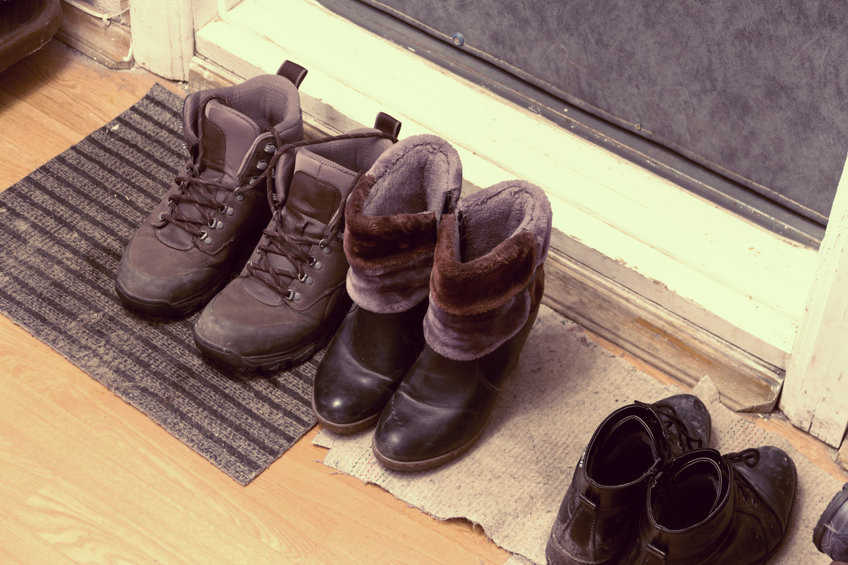
I grew up in a shoes-off household, which meant that as soon as anyone stepped into my home, they had to remove their shoes and leave them at the front door. Throughout my childhood, I noticed that none of my friends removed their shoes while in their homes, but then again, none of whom were Asian. In stark contrast, I noticed that the habit of removing shoes, sandals, and boots was always followed by my mom’s Asian friends, as well as by my relatives (also Asian) in Hawaii. I soon noticed that the floors in my friends’ homes didn’t feel nearly as clean on my bare feet as the ones in my own apartment, since they didn’t practice the same ritual my Japanese-American mother and I did. What I ended up doing in my friends’ homes was either keep my shoes on, or I would keep my socks on if I was wearing any when I visited them. To be honest, I always felt that it was so much cleaner to be in the habit of removing shoes once entering a residence, and this is something I continue to practice to this day. Since I am also the person who usually cleans the floors, rugs and carpets in my house, I have become a stickler for ensuring that no one enters in shoes which have traversed sidewalks, driveways, lawns which are teeming with all kinds of nasty gunk.
These days, I even go so far as to ask service technicians who enter my home to either remove their work boots, or to wear shoe covers, if they intend to conduct work inside the house. Before you accuse me of being extreme in my desire to keep my abode clean, keep in mind that back in July of 2021, a central air service technician tracked so much dirt and oil into my bedroom that it took me two sessions to remove all the stains from my bedroom carpet. Shortly after that, I ordered disposable shoe covers and have them right at the foyer for convenience.
Even with the shoes-off policy in my home, I still notice dust and dirt on my floors, and since I have pets, there is also the issue of shedding hair which accumulates. The last thing I want is to worry about when I clean the floors every week is chemicals, dog feces, and various microbes being introduced to my house via outdoor footwear. A study conducted by the University of Arizona discovered that 96% of soles of shoes were found to harbor fecal matter, which is picked up from the floors of public restrooms, as well as bird droppings and dog feces from asphalt, concrete, grass and soil. When you wear your shoes inside your house, you are spreading all of that bacteria, most notably E. coli, over all of your floors. Not only do you have to worry about germs, you also need to be aware of how many chemicals we track into our homes with our shoes, from gasoline which we pick up while pumping gas at a gas station, to carcinogenic chemicals which are used on lawns, and the list goes on.
Why not improve your indoor environment with a simple step and implement a no-shoes policy when you are inside your house? You’ll be rewarded with a cleaner home and will decrease your exposure to potentially harmful substances.
I’ve lived in California my entire life, and have enjoyed the state’s history of relatively predictable weather patterns over the decades. Unlike the crazy fluctuations which I have heard about from other parts of the U.S., central and southern California have always exhibited climate patterns which were pretty reliable. We could generally rely on pleasant daytime temperatures during the spring, hot summer days, a return to temperate conditions in the fall, and cold days and evenings in the middle of winter.
I know that other regions of the country, particularly the midwest, tend to experience differences in daily temperatures which are so extreme that it is possible to wear shorts and a t-shirt one day, and thermals and a winter overcoat the next. As an example of the random weather forecasts I have witnessed in the midwest, I endured the weather patterns very similar to the following numerous times when I visited Columbus, Ohio:
Monday 73°/47°
Tuesday 75°/55°
Wednesday 57°/40°
Thursday 59°/38°
Friday 68°/41°
Saturday 59°/47°
Sunday 52°/38°
Monday 64°/42°
Tuesday 73°/43°
Wednesday 59°/39°
For the past several years, the weather patterns in southern California have been similarly erratic, and it can be downright confusing to try to figure out how to dress on a given day. I became even more aware of the large daily temperature fluctuations when our central heat/air stopped functioning in February, because for a period of two weeks, the temperature inside our home was reflective of the ambient temperature outside. During the first four days, the high temperature in my area was 54 degrees Fahrenheit, then crept up to the mid 60’s for two days. Then we had a small heat wave for 3 days which caused the mercury to jump to the upper 80’s. Then suddenly, the temperature plummeted to the mid to upper 50’s during the day. Low temps during that two week period ranged between 37 degrees and 55 degrees, so bundling up at night was imperative.
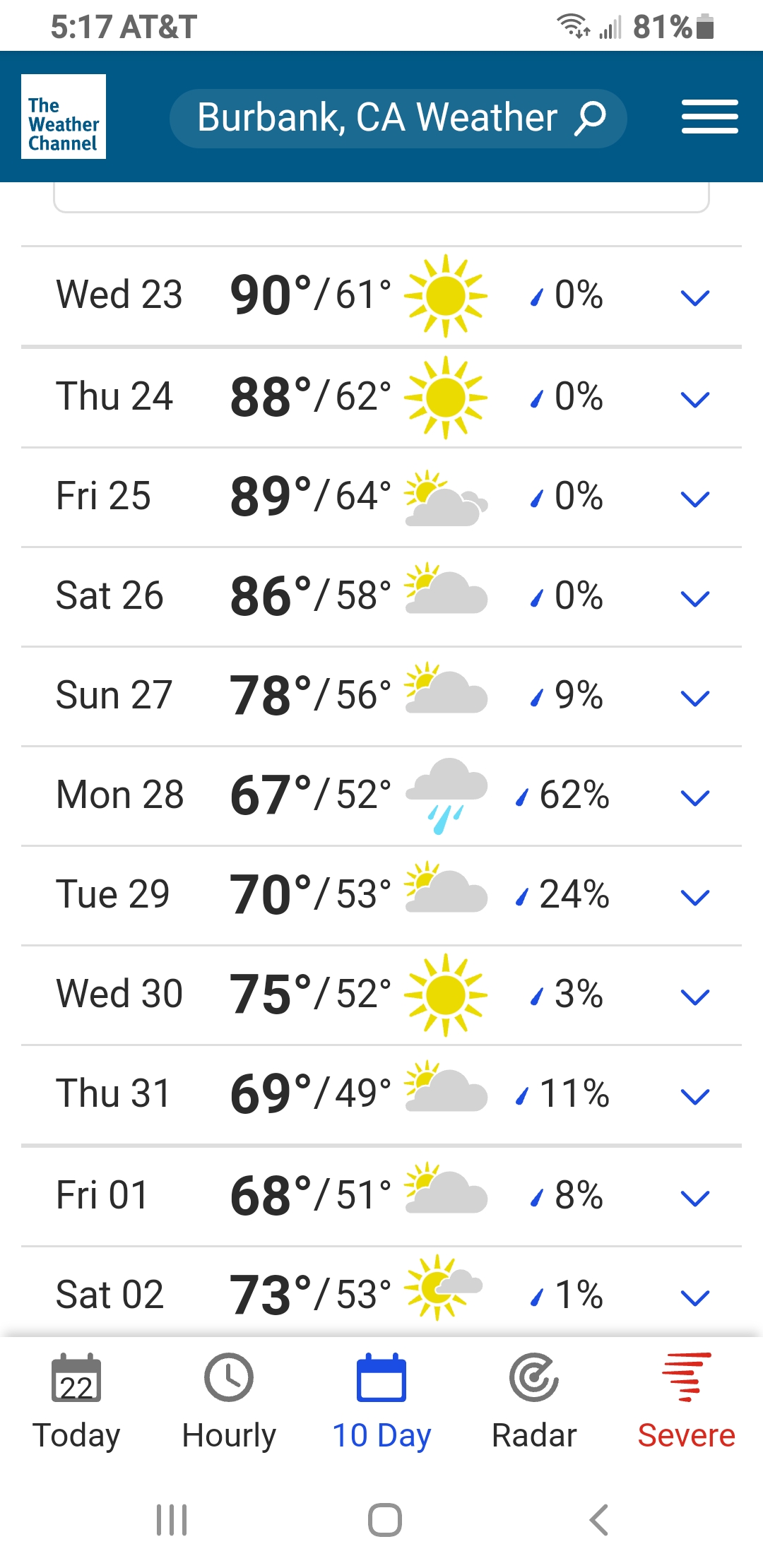
One habit which I had to develop over the past few years as a result of the erratic climate is to dress in layers, a habit which I had already begun to cultivate when I went through menopause and was managing my random hot flashes. Gone are the days when I was able to put away my summer clothing during the colder months, because the temperature can run from a brisk 54 degrees in the early morning to a balmy 91 degrees by midday (see screenshot at top of this blogpost for an actual weather forecast for my area infrom earlier this month). The fact that we can have a high temp of 70 degrees one day, then a high temp of 90 degrees three days later, is pretty maddening.












 dr. stacey naito's blog