Euphorbia trigona, also known as the African Milk Tree, is a striking succulent often mistaken for a cactus, though it actually belongs to the spurge family (Euphorbiaceae). It’s popular as a houseplant because of its sculptural shape and relatively easy care.
🌍 Origins
Euphorbia trigona is native to central and western Africa, particularly regions like Cameroon. In its natural habitat, it grows in warm, semi-arid environments with plenty of sunlight. It has long been cultivated both locally and globally, so its exact wild origin range is a bit blurred by human propagation.
🌿 Appearance
This plant has a very distinctive look:
Growth form: Upright, columnar stems that branch upward, giving it a candelabra-like shape
Stems: Triangular (hence trigona), with ridges lined by small paired spines
Leaves: Small, oval leaves grow along the ridges; they’re usually green but can be reddish in some varieties
Color varieties:
Standard green
“Rubra” or “Royal Red” form with reddish stems and leaves
Although it resembles a cactus, it differs in structure and produces a milky white sap (latex), which is typical of spurges and can be irritating or toxic if handled improperly.
📏 How Tall Can It Get?
Height depends heavily on where it’s grown:
Indoors: Typically reaches 4–6 feet (1.2–1.8 m), though with time and good conditions it can grow taller
Outdoors (warm climates): Can reach 10–15 feet (3–4.5 m) or more, forming a large shrub-like structure
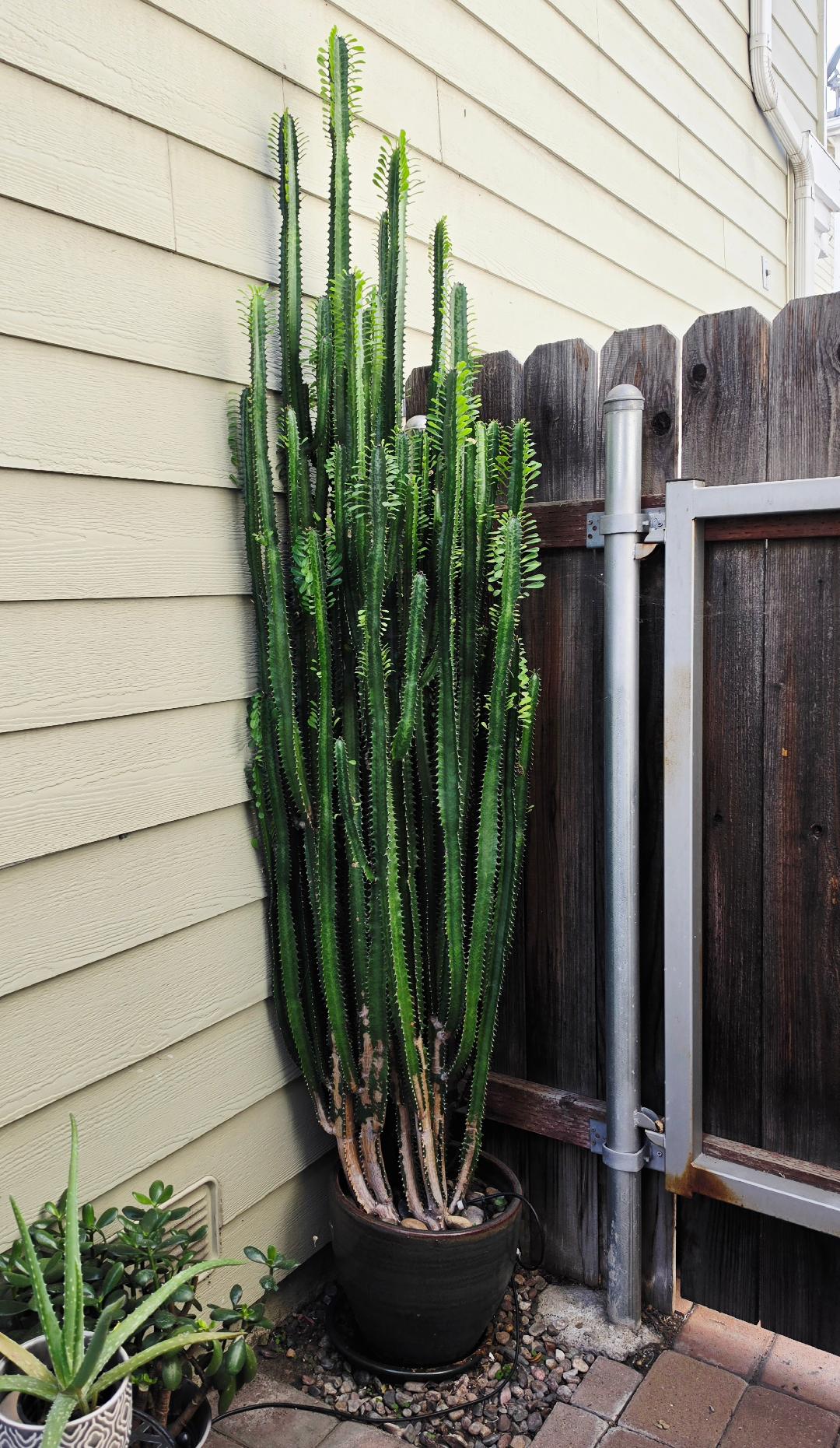
It grows relatively fast compared to many succulents, especially with bright light and consistent care. When I bought my Euphorbia trigona in 2021, it was about 18 inches tall. One spring, it shot up about 2 feet, which I never expected. About a year and a half ago, a close friend and I decided to move it from my second-floor balcony to the side yard on the first floor. My reasoning was that it was almost 6 feet tall, and would be almost impossible to move from the balcony if it got much larger. As you can see in the photo, it is now 7-1/2 feet tall!
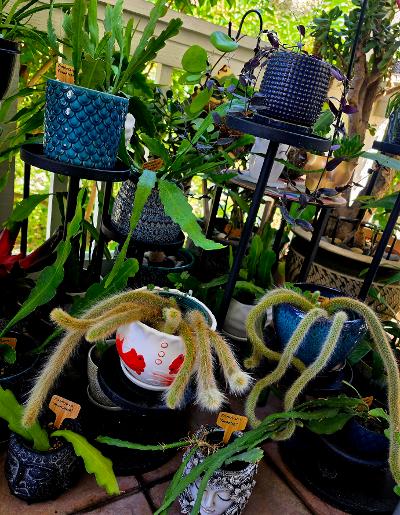
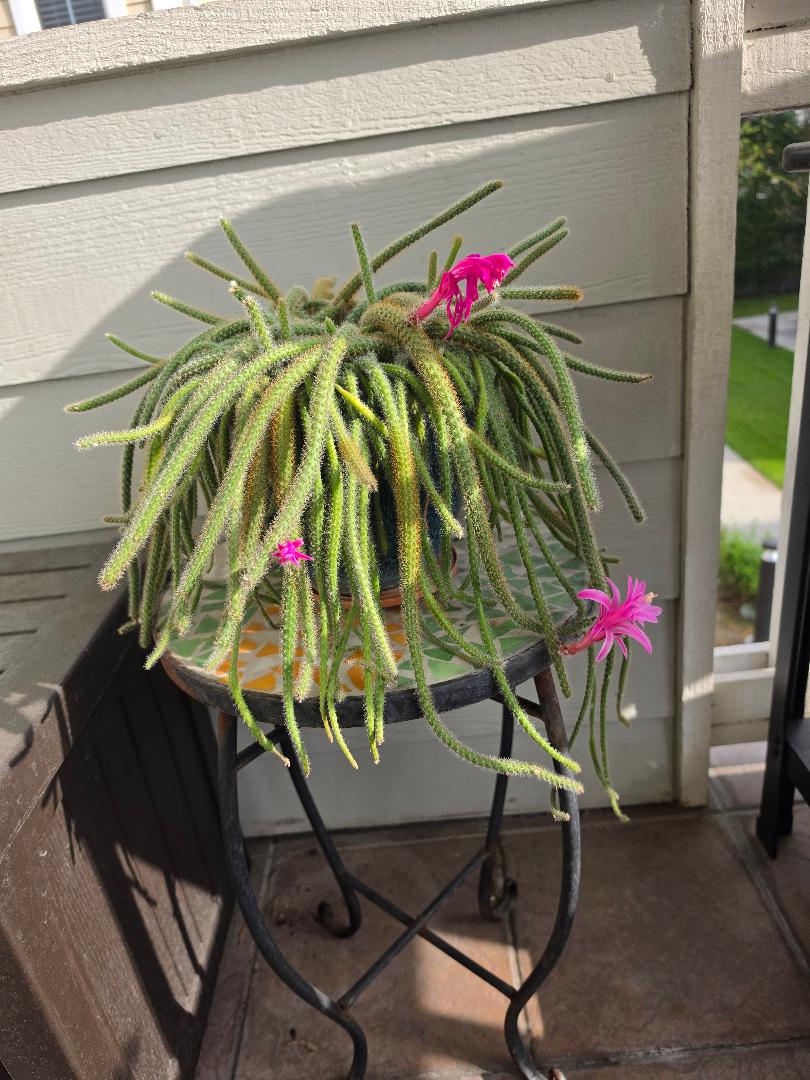
The first rat tail cactus I ever bought. This has been on my balcony for 6 years and finally bloomed this year.
The rat tail cactus—scientifically known as Aporocactus flagelliformis—is a striking, easygoing cactus that stands out because it doesn’t look like the typical upright desert plant. It’s actually a trailing, almost vine-like cactus that’s popular as a hanging plant. I have had two specimens for a number of years, and one in particular has been quite full and happy. When they both decided to bloom recently, I became a big fan of them and added two more to my balcony collection.
🌵 Appearance
Rat tail cactus has long, slender stems that can grow several feet in length. These stems:
Are cylindrical and about ½–1 inch thick
Covered in fine, soft-looking spines (not as intimidating as many cacti)
Usually a medium to bright green color
As the plant matures, the stems spill downward, giving it that “rat tail” look—hence the name. It’s often grown in hanging baskets so the stems can cascade freely.
🌱 Growth Habit
Unlike many desert cacti, this one is naturally epiphytic or lithophytic, meaning it can grow:
On rocks
In crevices
Or even on trees in its native habitat (mainly Mexico)
Instead of growing upright, it:
Trails and drapes over containers
Produces lots of branching stems over time
Can become quite full and dramatic with age
It’s fast-growing compared to many cacti, especially during the warmer months.
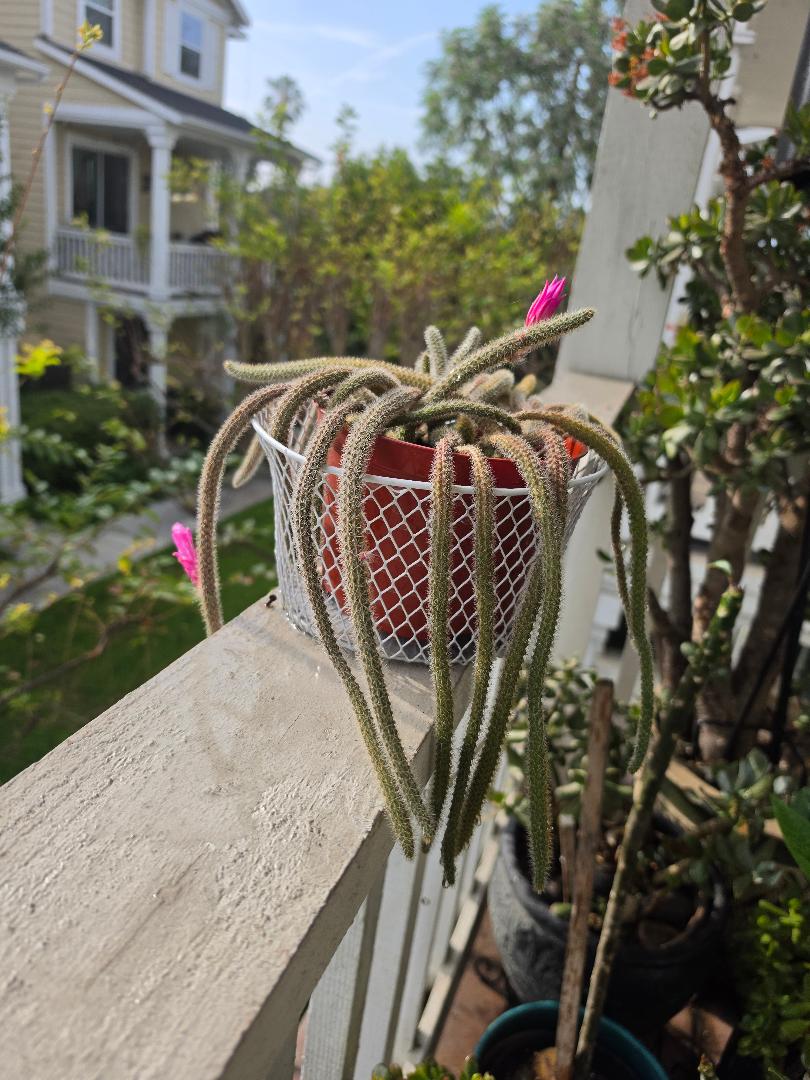
This is the second rat tail cactus, in bloom
🌸 Blooms
When the rat tail cactus blooms, it really steals the show.
Flowers are bright pink to reddish-magenta
About 2–3 inches long
Tubular in shape, with layered petals that flare outward
Often appear along the sides of mature stems
Blooming typically happens in spring to early summer. A healthy, mature plant can produce many flowers at once, creating a vibrant cascade of color against the green stems. The blooms don’t last forever individually, but the plant may produce them in succession.
☀️ Care Guide
Light
Prefers bright, indirect light
Can tolerate some direct sun, especially morning sun
Too much harsh afternoon sun can scorch the stems
Water
Water when the top inch or two of soil dries out
During growing season (spring/summer): water regularly but don’t let it sit in water
In winter: reduce watering significantly
Overwatering is the most common mistake—this cactus still needs good drainage.
Soil
Use a well-draining cactus or succulent mix
Adding perlite or sand improves drainage
Temperature
Thrives in warm conditions (65–80°F / 18–27°C)
Can tolerate slightly cooler temps in winter, but protect from frost
Humidity
Unlike desert cacti, it appreciates moderate humidity
Good airflow is still important
Fertilizer
Feed with a diluted cactus fertilizer during spring and summer (about once a month)
Avoid feeding in fall/winter
Potting & Placement
Best grown in hanging baskets to show off trailing stems
Repot only when necessary—slightly root-bound is fine
🌿 Bonus Tips
To encourage blooming, give it a cooler, drier rest period in winter
You can propagate it easily from stem cuttings
If stems get too long or messy, they can be trimmed without harming the plant
Overall, the rat tail cactus is a great choice if you want something low-maintenance but visually dramatic—especially when those vivid pink flowers show up.
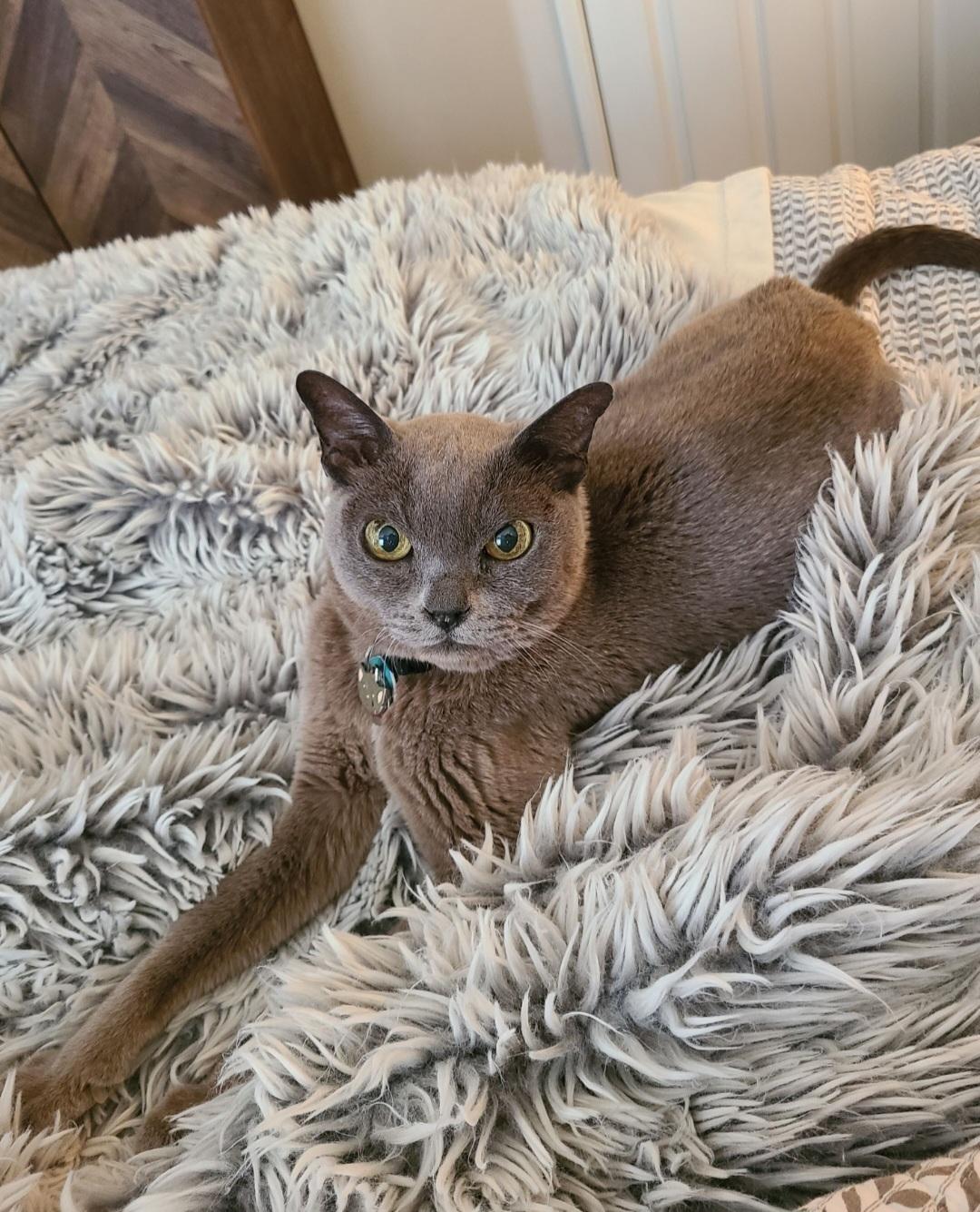
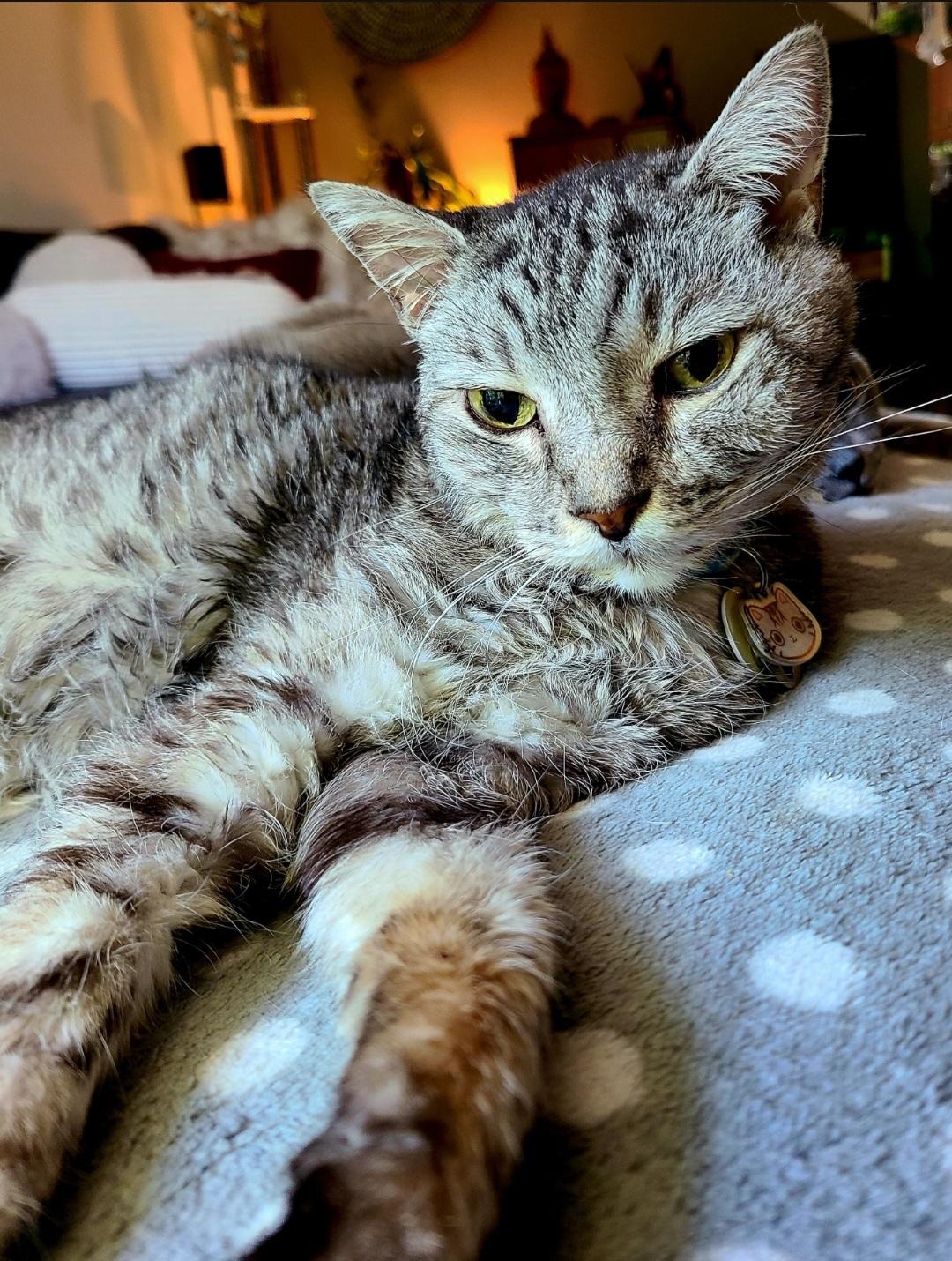
Back in April 2009, when I brought a 4-month-old male blue Burmese and a 3-week-old feral female silver spotted tabby into my home, I never thought that they both would still be around seventeen years later. It is a wonderful blessing, but having cats reach 17 years old is both beautiful and complicated. Over the past 17 years, I watched them grow up, and I have experienced so much joy from having them at my side through entire chapters of my life. Caring for them now is like looking after elderly family members. The routine, the vigilance, and the emotional weight are all different than when they were young.
The shift from “pet care” to “medical care”
Once cats reach their mid-teens, life often revolves around management:
special diets
supplements
medications
watching appetite, mobility, hydration, and litter box habits
Life with my two super-senior cats is a bit like running a tiny home clinic. I watch both Tenshi and Shima like a hawk, and monitor everything so that I can detect small changes quickly—how long they sleep, how they walk, whether they hesitate before jumping, how much they eat. When Tenshi developed arthritis throughout his body, and Shima developed a tendinopathy in her shoulder, I set up heated blanket in the living room to establish luxury retirement housing for them.
Every morning, I make sure to turn on that blanket, and they graciously spend the majority of the day staying nice and warm on it, boosting circulation and reducing stiffness. I also love the fact that they’re resting in a central room near me, rather than isolating themselves. Their propensity for being where the humans are is a positive behavior, both socially and emotionally.
I can’t help but worry when I see my super-senior cats’ frail little bodies, even though they are both pretty alert and active. Age-related muscle loss (sarcopenia) is very common in senior cats, who often lose muscle mass even when they’re cared for well. What matters more than weight alone is:
Are they eating consistently?
Are they grooming?
Do they respond to you?
Do they still show interest in toys or attention?
Both Tenshi and Shima could stand to eat more, but their appetites are consistent, and they are still very socially responsive. Tenshi still plays when I bring out toys, which is honestly one of the best indicators of quality of life. Play behavior means curiosity and engagement are still there. It surprises me when Tenshi leaps into the air to catch a toy, and I always praise him when he does.
The emotional side
One of the hardest parts of having elderly cats is the constant background awareness that time is finite. When they’re young, you assume there are years ahead. When they’re 17, every small health issue feels heavier. In fact, I lost one of my cats at the age of 14 when she suddenly became ill. She only made it through 5 days before she was gone. Because of the tenuous health status of elderly cats, I make sure to spend as much time as I can with Tenshi and Shima every single day.
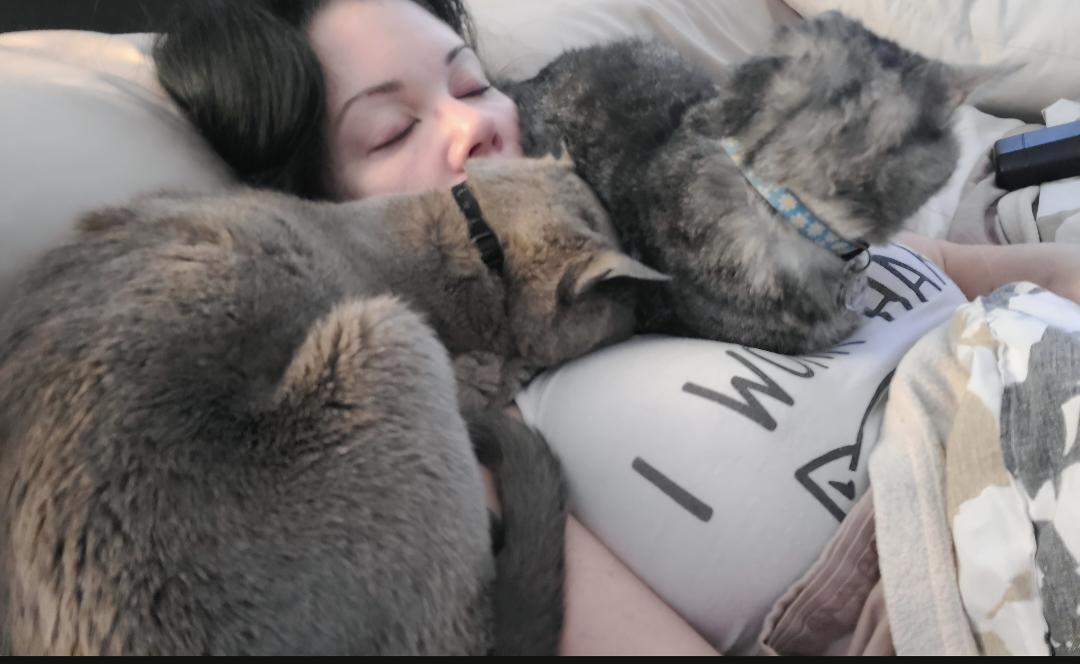
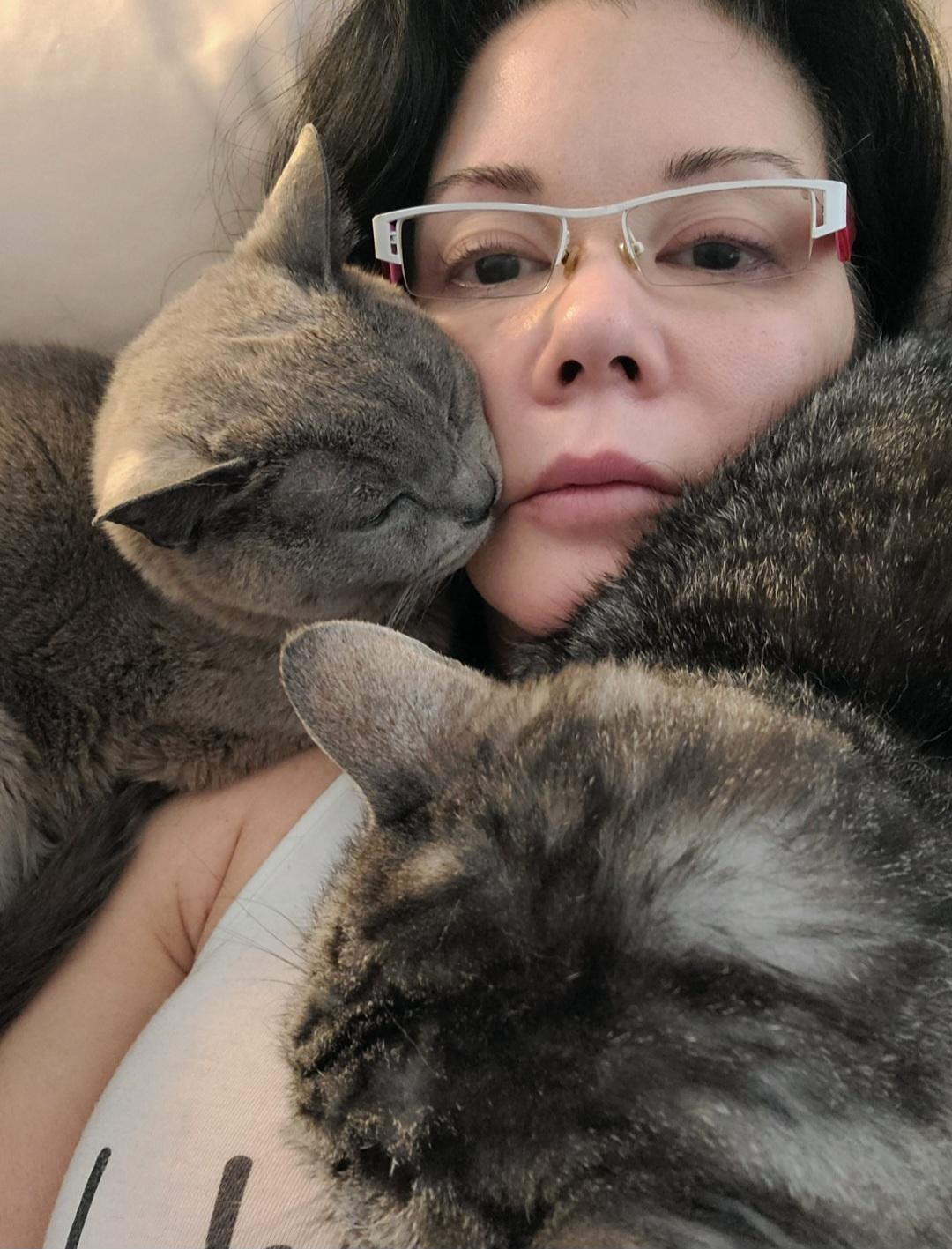
Tenshi in particular seems to sense the need to seek maximum contact, almost like he wants to be touching me as much as possible while he sleeps. Over the past year, Tenshi has developed an adorable habit of wrapping himself around my neck like a scarf at night, and he is usually in the same spot when I awaken the next morning. This relatively new habit is such a classic “this human is mine” behavior, and I absolutely cherish it. I also understand that Tenshi also runs a lot colder because of lower body fat and slower metabolism, so being tucked against my neck is cozy and warm. He has even chosen to do this when the heated blanket is still powered on in the living room.
There are even some late nights and mornings when both Tenshi and Shima will pile up onto my chest and neck to cuddle. You can see how that looks here:
When a cat lies on your chest, a few things are happening at once:
Trust — the chest is a vulnerable place for both of you, so it’s a sign they feel completely secure.
Warmth and comfort — your body heat is like a living heated blanket.
Familiar scent and heartbeat — cats often find the rhythm of breathing and heartbeat calming.
When you live with very old cats, the care gets more involved, but the small moments feel bigger. A cat curling up on your chest, a little burst of play, the way they follow you with their eyes across the room—those things start to carry a lot of emotional weight. And honestly, having a 17-year-old cat sleeping around your neck like a scarf is incredibly tender. Frail or not, that’s a cat who clearly still feels very attached to his person. I’m truly honored to be Tenshi’s and Shima’s human.
If you had told me last summer that my quiet little balcony would become the front line of a full-blown rodent war, I would have laughed. Yet there I was, by late September, locked in an ongoing ordeal with some of the boldest, most destructive rats I’ve ever encountered.
It started subtly—almost innocently. I would see one, maybe two rats joining in on morning squirrel feedings, and I thought they were amusing to watch. Then one morning I realized they had completely severed the lighting adaptor cord which fed the five LED lights in the relaxation fountain on my balcony. That was my first oh no, this is serious moment.
Things escalated quickly after that.
The rats somehow managed to get inside my four-burner propane grill. Imagine getting ready to heat up the grill, only to see a filthy rat scurrying across the grill rack. Needless to say, I quickly resorted to heating up the broiler to cook the steaks I had bought. Despite cleaning and disinfecting the grill, there was no way I would ever put food items on it, so it had to go. Getting rid of it turned into an event worthy of its own sitcom episode. One person had to climb a nine-foot ladder just to reach the balcony, while another lifted the bulky grill up and over the railing so it could be carefully lowered to the ground. All that effort… just to dispose of a grill that rats had claimed as real estate.
As the holidays approached, I hoped things might calm down. Nope. The rats decided to add seasonal flair to their destruction by chewing on one of my Christmas decorations. Festive, but not in the way I’d envisioned.
I tried to handle the rat situation responsibly. I put out bait stations filled with dextrose pellets, confident I was being strategic and humane. The rats, apparently unimpressed by my efforts, ignored the bait stations entirely and went straight for what they really wanted: my hummingbird feeder.
Not only did they attack it—they dismantled it. They chewed off the floral feeding spouts like tiny vandals with dental degrees. That was the moment I realized I needed to level up.
After weeks of trial, error, frustration, and more than a little disbelief, my efforts paid off. The rats stopped coming. No more chewed cords. No more unwanted balcony guests. No more destruction.
There is one bittersweet consequence: the squirrels rarely visit now, especially since I had to stop morning feedings. I really miss them, especially the ones whom I could hand-feed. Those twitchy-tailed freeloaders were at least entertaining and mostly polite. But in the end, it’s a small price to pay.
The balcony is peaceful again. The rats are gone. And after everything they put me through, I can confidently say: victory has never felt so satisfying. 🐀🚫
Lately, I’ve been doing a lot of deep cleaning. Not the rushed, surface-level kind, but the slow, intentional kind. Drawers emptied. Closets reconsidered. Repairs finally handled instead of postponed. I bought a new comforter set. Shifted furniture. Made small but meaningful changes to the way my home feels when I walk into it.
On the surface, it looks like homemaking. But underneath, it feels like something much bigger.
The closest metaphor I can find is this: it’s as if I’m downloading an updated operating system for my brain. A new version of me. One that’s more streamlined, less cluttered, and better aligned with how I actually live now—not how I lived decades ago, or how I thought I was supposed to live.
In five months, I turn 60.
That number carries weight, whether we want it to or not. It’s a cultural milestone, but it’s also a personal reckoning. Sixty isn’t about decline—it’s about integration. It’s the age where experience stops being something you collect and starts being something you embody.
What makes this moment feel especially charged is the timing. Today marks the first day of the Year of the Fire Horse, and I was born in a Fire Horse year—1966. In the Chinese zodiac, the Horse is associated with movement, freedom, independence, and raw life force. Add the Fire element, and you get intensity, passion, and transformation. Fire Horse energy is bold and uncompromising. It doesn’t tiptoe into the next chapter—it runs.
Fire Horse years are rare. They return only every 60 years.
So here I am, nearly 60, living through the same energetic signature that ushered me into the world. It feels like a full circle moment—less like starting over and more like completing a long arc. A spiral returning to its origin, but at a higher level of understanding.
That’s what the cleaning is really about.
I’m not just clearing dust. I’m clearing outdated assumptions. I’m repairing things I once ignored. I’m choosing comfort and beauty not as indulgence, but as necessity. My home is becoming a clearer reflection of who I am now—what I value, what I want to maintain, and what I’m ready to let go of.
There’s something deeply grounding about tending to your physical space when your inner landscape is shifting. It creates a dialogue between the visible and the invisible. Every repaired hinge, every refreshed corner, every intentional choice says: I’m paying attention. I’m here. I’m not rushing past this moment.
This doesn’t feel like crisis. It feels like calibration.
If life really does move in cycles, then this one feels like a completion—and an ignition at the same time. A moment to honor everything that brought me here, while clearing the runway for what comes next. The Fire Horse doesn’t look backward with regret or forward with fear. It stands firmly in its power, ready to move when the moment is right.
And maybe that’s what this season is asking of me—not to reinvent myself, but to arrive fully as myself, updated and awake, standing in a space I’ve consciously prepared.
Ever since last October, my brain has been happily buzzing with ideas on how to express myself more in my home space. I’ve been in full-on maker mode—hands busy, ideas clicking, with that satisfying rhythm of “oh, I can fix this” and “wait… what if I tried this?” It makes sense to me, since crafts and repairs hit two different creative muscles: one playful and expressive, the other practical and problem-solving. When both are firing, I feel capable and curious at the same time, which is kind of a power combo.
What’s cool is that this kind of creative flow often feeds on itself. Finishing a repair makes me more confident, which makes me bolder with crafts, which makes me want to try something slightly weirder or more ambitious next. It’s like momentum I can feel in my hands. Of note is the situation I ran into in early December while putting Christmas decorations at my front door. There was an illuminated penguin with a top hat and scarf which I planned to juxtapose next to my penguin in a Santa hat, but I had waited an entire year after purchasing it in late december 2024 to display it. Instead of inspecting the components to ensure that everything would fit, I mistakenly assumed that there would be no issues, and I placed it on the shelf to use for Christmas 2025.
When I opened the box and attempted to assemble the penguin, I noticed that the construction was way off, and that it would be impossible to put it together unless I devised a creative solution. For several days, I honestly thought I would have to toss the decoration in the trash, but I had a flash of insight while putting up other decorations. Instead of fretting over the fact that the connecting poles were far too long for the height of the penguin, I aligned the poles alongside each other, used duct tape to keep them at the proper length, then assembled the penguin. Since the poles are inside the body of the penguin, and not visible, the duct tape was not an issue. Problem solved, and in a creative way!
My other holiday-themed creative triumph was my Nightmare Before Christmas–themed tree? The tree offered a perfect blend of spooky, nostalgic, and whimsical, while honoring one of my favorite films. It was a great way to repurpose a small tree that had previously been decorated in a very traditional fashion. I got rid of my woodland creature ornaments that used to adorn the tree, and came up with a theme that felt completely congruent with what I was passionate about. Jack Skellington would absolutely approve.
A more recent problem to solve was to create ambient lighting in my living room which would complement the existing ambient lighting. I ended up placing up lights on the floor by the entertainment center which are dimmable, creating even more of a relaxing vibe. They are subtle, but they carry the kind of impact and mood I was seeking.
Over this recent period, I’ve been intentionally tending to my home as a way of tending to myself. Each task I completed was not just about cleaning or organizing, but about restoring a sense of peace, agency, and care in my daily life. Moving through these spaces with purpose helped me reconnect with myself and reminded me that small, consistent acts can be deeply healing.
I began by decluttering and reorganizing existing storage, including carefully sorting through holiday ornaments and letting go of items that no longer served me. Releasing what I didn’t need created both physical space and emotional breathing room. At the same time, I chose to bring in gentle moments of joy, like adding new Christmas stockings for the cats — a small but meaningful expression of warmth, playfulness, and love that made my home feel more alive and personal.
I spent time thoughtfully organizing my makeup and fragrances, transforming what had once felt scattered into something intentional and inviting. This shift made my daily routines feel more like rituals of self-respect rather than obligations. I also worked through closets throughout the home — the bedroom, master closet, gym closet, laundry area, and other storage spaces — cleaning, sorting, and creating systems that feel sustainable. With each cleared shelf and reorganized space, I felt a growing sense of clarity, stability, and confidence.
Alongside this inner and outer clearing, I made practical upgrades that supported my well-being. Refreshing the bedroom with new comforter sets transformed it into a space of comfort and rest, a place where I can truly recharge. I also deep-cleaned the master bathroom and other key areas, restoring them as calm, supportive spaces for daily care and grounding.
Altogether, this work has been an act of self-affirmation. By caring for my environment with intention, I reinforced the belief that I deserve a home that supports me, comforts me, and reflects who I am becoming. As my space has grown more organized, warm, and intentional, I’ve felt lighter, steadier, and more empowered in my life. This process has reminded me that tending to my surroundings is a meaningful way of honoring my own growth and well-being.
Fir & Firewood by Capri Blue is the ultimate Christmas tree scent!
As a self-proclaimed scented candle fanatic, I have definitely selected some fragrances which are favorites. Two of my favorites are actually promoted and sold as holiday candles, but I use them year-round because they don’t scream Christmas like some aromatic varieties do. The two limited-edition holiday candles with which I can honestly say I am obsessed are Nest’s Blue Cypress & Snow, and Fir & Firewood by Capri Blue.
Blue Cypress & Snow is described as: “Create the aroma of a snow-covered mountain retreat in winter with NEST New York’s candle collection, featuring notes of crisp blue cypress, juniper berry, and hints of smoked vanilla bean.” What does it smell like? Fresh woods, nestled in cozy, warm vanilla. I don’t even like the smell of vanilla, but this combination is absolutely beautiful. I think it’s a bit heavy for the middle of summer, but it absolutely works any other time of the year. Although Nest only sells this one during the holiday season, there are other stores which sell this for a good portion of the year.
Fir & Firewood is described in this way: “Fruity, green aroma of apple, clove, fir, pine needle, white birch, cedar, vetiver, and musk.” The fruit and clove mellow out the sharpness of the pine, birch and cedar, resulting in the ultimate Christmas tree scent. It’s definitely festive, but the scent profile works for anyone who likes forest type, woody aromas. This one is hard to find, but worth the effort to dig up.
Last year, I took my Halloween and Christmas decorations to the next level, all because I was inspired by the talented residents in my city who decorated their homes. Every year, the city of Burbank has a Halloween decorated house contest, and because there are many Burbank residents who work in the film and TV industry, the artistry and creativity exhibited are significant. For whatever reason, I was swept up in the festive energy of Halloween last October, and I made close to a dozen excursions to various neighborhoods in Burbank to see all the decorations.
During prior years, all I did in terms of decorating my place for Halloween was to put up wooden plaques of Jack Skellington and Sally at my front door, display three plastic skeletons (cat, Dachshund dog, and a rat) on the railing around my second-floor balcony, and string up orange and purple lights on the balcony. Last year, I added a 6-foot-tall Jack Skellington, a matching Sally, and a matching Zero, all three of which hung near the front door entrance. My place really stood out because I was the only resident in my community who put up any Halloween decorations, but my friends and I really enjoyed seeing those decorations. This year, I will be adding another element which should be a lot of fun to have as part of the display.
My Halloween decorations on Halloween 2025
Then as Christmas approached last year, I was inspired to continue the Nightmare Before Christmas story theme by adding an animatronic Jack Skellington (dressed as Sandy Claws) at my front door. I also switched the decorations on a 4.5-foot tree which I always put in my den area so that the Nightmare Before Christmas theme pervaded the tree. I also created a spiral at the tip of the tree to mimic the shape of Spiral Hill. The results were truly fantastic!
My front door display for Christmas 2025
I ended up with so many Nightmare Before Christmas ornaments and decorations for the 4.5-foot tree that it ended up being a bit overloaded, so this year, the decorations will adorn a 6-foot pencil tree. The 4.5-foot tree will undergo yet another decorating facelift, and I am truly excited for what I plan to create when I put that tree up in late November of this year. I know it sounds like overkill to have THREE Christmas trees (I have a 7.5-foot cashmere tree as the main tree) in the house this year, but I am having fun with all of it. Thank goodness I have enough space in my garage to store all the items!
This was a great launching point for the Nightmare Before Christmas theme inside the house!
It’s a really interesting and somewhat frustrating phenomenon when people develop allergies to new pets, even if they’ve lived with pets for years without issue. This just happened to me when I introduced a new kitten into my home. All these years, I had lived peacefully with my pets with no issues, but all it took was one sweet kitten with her dander to spike my allergic response!
There are several factors that could explain sudden allergic responses when a new pet is introduced to the home.
1. Different Allergen Profiles
Each pet produces different types and amounts of allergens. For instance:
Cats and Dogs: These animals produce dander (tiny, often invisible flakes of skin) that can trigger allergic reactions. However, not all animals produce the same type or quantity of allergens. A person may have developed tolerance to the specific dander or protein in their existing pets, but a new pet may have a different protein structure that their immune system perceives as a threat.
Species Differences: Even between different breeds of dogs or cats, there can be differences in the types of allergens they release. For example, some dog breeds shed less fur or produce different amounts of dander than others. This might explain why someone living with one breed of dog doesn’t experience symptoms, but develops an allergy when adopting a new breed.
2. Immune System Changes
Over time, a person’s immune system can change. Allergies can develop at any age, and the immune system can become sensitized to new allergens at any point in life, even if the person hasn’t had problems before. This might explain why someone who has lived with pets for years can suddenly develop an allergy to a new pet.
Delayed Sensitization: It’s possible that the immune system, over time, becomes sensitized to certain proteins present in animal dander, and the person’s immune response triggers once it encounters a threshold. They might not have had a strong reaction to their old pet, but a new pet could have more potent allergens that push the immune system into overdrive.
3. Environmental and Lifestyle Factors
The environment plays a role in how allergens impact someone. If a person moves to a new home or changes their lifestyle, it could increase their exposure to allergens in a way that makes them more likely to develop a reaction.
New home, different allergens: If the new pet is introduced into a home with different ventilation, humidity, or dust levels, it could change how allergens accumulate and affect the person. For example, an increase in humidity could make allergens like mold or dust mites more problematic in conjunction with the pet’s dander.
Exposure levels: Someone may have had a lower overall exposure to allergens in the past, either due to fewer pets or less contact with them, and the new pet may push that exposure threshold.
4. Cross-Reactivity
There’s a phenomenon called cross-reactivity, where a person who is allergic to one animal might also react to allergens from a different animal. For example:
Cat and Dog Allergies: Some people allergic to cats might also react to dogs because the proteins responsible for causing allergies (like Fel d 1 in cats and Can f 1 in dogs) are similar. The immune system can mistake the proteins of a new pet for those of an older one.
Rodents, Birds, or Other Pets: People allergic to one type of pet might develop allergies to completely different animals (e.g., developing an allergy to birds after having had no issues with a dog). This is because certain proteins in saliva, fur, or feathers might have structural similarities, confusing the immune system.
5. Type and Age of the New Pet
Young pets (puppies, kittens) often shed more allergens, including fur and dander, than older pets. This could be due to the fact that they have more active skin cells or they may shed more frequently as they grow. So, even if someone was fine with an older pet, a younger one might have more dander circulating in the environment.
6. Sensitivity to Specific Proteins in Pet Saliva or Urine
It’s not just the skin dander that can cause problems. Proteins found in a pet’s saliva or urine can also trigger allergic reactions. For example:
Cats and Dogs Licking Fur: Both cats and dogs spread their saliva over their fur when they groom themselves, which means that their saliva proteins get transferred to their fur and skin. If a person has been exposed to the saliva of one pet for a long time without a reaction, the saliva of a new pet could be a different protein altogether, leading to an allergy.
7. Pet Care Products
It’s also worth noting that people might develop sensitivities to products used in caring for pets, such as shampoos, flea treatments, or cleaning supplies. These allergens could cause issues even if someone has lived with other pets without trouble, especially if the new pet is exposed to different brands or types of products.
8. Changes in Body’s Allergic Sensitization
As we age, our immune system changes. A person may have been exposed to the allergens of previous pets without a noticeable allergic response, but their immune system may have become more reactive over time. The introduction of a new pet might be the tipping point.
To sum it up: While someone might not have had issues with existing pets, the combination of new pet dander, proteins, environmental factors, and changes in the immune system can all contribute to the development of an allergy. If this happens, it’s important to consult with a healthcare professional for guidance on managing or alleviating symptoms.