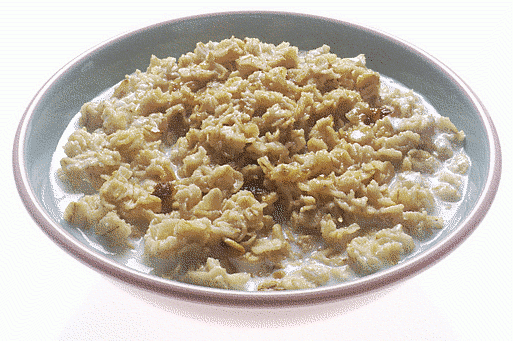
Why I Am Against Instant Oatmeal

oatmealI know people lead very hectic lifestyles these days, and believe me, I can relate. Work, training, meetings, appointments, chores, errands, modeling, fitness and bodybuilding events, writing, shooting videos, and managing websites and social media keep me going at a frenetic pace every day. Yet I make sure I have a few minutes to prepare a nutritious morning meal every single day. I become very irritated when I hear patients and clients say that they have ZERO time to prepare a nutritious breakfast. Are you serious about not having even five minutes in the morning to take care of your own health? Come on.

Patients often proudly tell me that they are eating oatmeal every day, but when I ask them what type, they tell me they grab the instant variety. This irritates me to no end. You still have to put the oatmeal in a bowl, boil the water which takes about three minutes, then mix. When I make my old-fashioned oats, I combine them in a saucepan with water and a dash of cinnamon, then let the mixture cook for three minutes. So what if I take an extra 30 seconds to transfer the cooked oatmeal into a bowl?

Another thing I think is disgusting about instant oats is that the oat and water mixture often does not mix well, so you have a gloppy, soupy mixture which has to set for at least a minute so that it will thicken. Halfway through that extra minute in which you are waiting for your instant oatmeal to thicken, I am already eating my old-fashioned oatmeal.

You may wonder what the big deal is about eating the plain oats versus the instant variety. There are artificial flavors, thickening agents, sugar, and salt in the instant packs which lowers the nutrient density of the oatmeal. In addition, since there is so much processing which occurs in the manufacture of the instant variety of this food item, vitamins and minerals are added to replace what has been stripped from the original oats. Why go through all this when you can choose the least processed version which is the most nutritious?

Bear in mind that the cereal industry is counting on you grabbing the instant variety because of its attractive packaging. Guess what? The instant oatmeal is far more expensive than the old fashioned oats which have one item on their ingredient list: “OATS”. Just because a food item comes in a single serving envelope and only requires you to add hot water does NOT mean it will shave off significant time from your morning meal prep. Remember what I mentioned earlier about total prep time? Here’s a reminder:

INSTANT OATMEAL PREP:
Tear packet and pour oatmeal into bowl (5 seconds)
Boil water (3 minutes)
Pour water over oat mixture and stir (20 seconds)
Let sit for 1 minute to thicken (1 minute)
TOTAL PREP TIME = 4 minutes, 25 seconds

OLD-FASHIONED OATMEAL PREP:
Combine oats and water in a saucepan with a dash of cinnamon (10 seconds)
Cook mixture on medium heat for three minutes, stirring occasionally (3 minutes)
Remove from heat and pour into bowl (10 seconds)
TOTAL PREP TIME = 3 minutes, 20 seconds

If you insist on eating instant oatmeal, at least go for the healthier versions. The best out there is Trader Joe’s Organic Oats and Flax Instant Oatmeal, which contains: organic rolled oats, organic dehydrated cane juice solids, organic flax seed, sea salt.


Caffeine Pros and Cons

Caffeine DrinksCaffeine certainly gets a lot of love in our society, found in coffee, energy drinks, soft drinks, energy pills, fat burners, and even foods like yogurt. There is a ton of controversy surrounding caffeine consumption, with some camps celebrating its benefits while others are quite anti-caffeine. Here is a short list of pros and cons of caffeine.

PROS:
Boosts memory
Improves concentration
Decreases fatigue
Speeds up reaction times
May lower risk of Alzheimer’s disease

CONS:
May trigger high blood pressure in susceptible individuals
May cause jitters
May decrease bone density
May produce dependence
Dehydrating due to its diuretic effect

I know many of you may be wondering what is considered an acceptable level of caffeine consumption. According to researchers from the Linus Pauling Institute at Oregon State University, a daily intake of 300 to 400 milligrams per day (which is equivalent to 3 to 4 six-ounce cups of coffee) is acceptable and carries minimal health risks. However, if you consume caffeine daily and choose to decrease your caffeine consumption, make sure to do it gradually. Abrupt drops in caffeine consumption can cause withdrawal symptoms such as headache to occur. On the flip side, excessive caffeine consumption can also cause symptoms which include insomnia, heart palpitations, nausea, vomiting and tremors. Bear in mind that caffeine is considered a drug with the power to create dependence in those who consume it regularly and in large amounts.

Physicians Are Therapists Too

doc and patientThe scientific nature of medicine often tricks people into believing that doctors are so cerebral that they spend all day diagnosing and treating, without much regard for social factors which patients may bring into an appointment. However, it has been my experience that medicine is deeply rooted in connecting with others emotionally, mentally and spiritually. I realize that my personal journey as a physician is colored by the fact that I chose primary care as my post-graduate foundation, as well as the fact that I truly enjoy getting to know my patients. It is relatively common for me to discover that the “chief complaint” which brings a patient into the office is not the main concern the patient has. For example, I may have a patient come to me for evaluation of right shoulder pain and after 10 minutes of speaking with the patient find out that the patient hates her job, is suffering from insomnia and is exhausted from also caring for two small children and an ailing father. What ends up happening is that I will evaluate the shoulder, but will also discuss sleep hygiene and the importance of putting the oxygen mask on herself instead of giving all of her energy to her job, her children and her father. She certainly still has all those responsiblities, but when she neglects herself she drains herself of the potential energy she could be carrying to sustain herself and those she cares for.

Another common scenario is the patient who has gotten out of shape over the years and wants to make a change. These patients may come in for weight management, but in most cases they present to the office with a completely unrelated medical complaint. Almost invariably, I find out that the patient is overloaded, and also has difficulty committing to a specific regimen. This is yet another example of putting the oxygen mask over oneself, and is also a situation in which the patient needs to break the cycle of making excuses which serve as blockades to reaching ANY goals. The too-tired, too-busy, too-old excuses don’t fly with me at all. There is NO EXCUSE which justifies making regular visits to fast food restaurants, skipping meals regularly, and leading a sedentary lifestyle. It is important to realize that such habits are also rituals which the person has chosen to hang onto because they are familiar. It can be quite intimidating to manifest a major lifestyle shift because it requires a person to abandon old habits and patterns and undergo a complete change of mindset.

I honestly love helping people and take my role as an educator and healer very seriously. I also know that I can be a motivator, but only if I can successfully ferret out the psychological issues which hold people back from gaining true fulfillment in their lives.

NPC and IFBB Women’s Divisions

Fitness, Bikini, Bodybuilding, Womens Physique

Fitness, Bikini, Bodybuilding, Womens Physique

Although competitive bodybuilding began as a men’s sport, women gradually edged their way in. The first true female bodybuilding competition in which women were judged solely on muscularity was held in Canton, Ohio in 1978. Women who are drawn to the bodybuilding division focus their energies on building maximum muscle mass while keeping body fat percentages very low, goals which echo those found in male bodybuilding. In other words, women’s bodybuilding is the female analogue to men’s bodybuilding.

Women’s bodybuilding increased in popularity over the years, but several other women’s divisions have been established which embrace different ideals in terms of the female physique. You can see from the image at the top of this post how different degrees of muscularity come into play within different divisions.

I will go into more detail about the other divisions in separate posts, but here is a brief synopsis:

Fitness: This division is characterized by an athletic, well-muscled but not overly muscular body. In this division, women perform routines in which they show their strength, agility and flexibility.

Figure: This division is similar to fitness, but there is no choreographed routine performed onstage. Athletic frames with appreciable shoulder and back development with slender hips are the ideal.

Bikini: This division, established in 2009, rewards a very lean but much softer look than what is seen in other divisions. Muscle striations are a big no-no in this division.

Women’s Physique: This is the newest division added to the NPC and IFBB, established in 2011. Competitors in this division are more muscular than figure or fitness competitors, but do not possess the same degree of muscularity or conditioning seen in women’s bodybuilding.

NPC and IFBB Men’s Bodybuilding

Men’s bodybuilding can best be characterized as the quest to be as big as possible. The concept of “bigger is better” certainly applies here. During the “bulking” phase, male bodybuilders will consume massive amounts of calories and train at the gym with Herculean strength in an effort to put on as much muscle mass as humanly possible. As contest day approaches, a “cutting” phase is employed in which competitors drop significant amounts of body fat while making every effort to retain their hard-earned muscle.

Before you assume that one needs only to be loaded with tons of muscle, you should be aware that judges also critique competitors on their overall symmetry, balance and conditioning. Symmetry refers to the muscle bellies, with complete symmetry on both sides of the body as the desired goal. Balance refers to the proportion of muscle development throughout the body. In other words, a bodybuilder may have a very developed back but little calf development, or may have huge biceps but little shoulder development. Both examples will make a competitor look out of proportion. Conditioning refers to the degree of muscle definition in a competitor. If a bodybuilder does not dehydrate properly, he or she may hold interstitial water and end up obliterating muscle definition when onstage. Accordingly, if insufficient carbohydrates are consumed pre-contest, the muscles will be depleted of glycogen and will look flat.
One of the most potentially enjoyable aspects of watching men’s bodybuilders is seeing their posing routines. When male bodybuilders perform onstage, they wear small posing trunks which are similar in cut to Speedos, and they perform barefoot. Though bodybuilders have a limited amount of time onstage and must hit mandatory poses during their routines, they have the opportunity to express their personalities, grace, athleticism and creativity by performing a routine.

Here are the general weight divisions for Men’s Bodybuilding in the NPC:

Male Competitors (All contests that are pro qualifiers)
• Bantamweight…………. …Up to including 143 ¼ lbs.
• Lightweight………………..Over 143 ¼ up to including 154 ¼ lbs.
• Middleweight ……………..Over 154 ¼ up to including 176 ¼ lbs.
• Light Heavyweight………Over 176 ¼ up to including 198 ¼ lbs.
• Heavyweight………………Over 198 ¼ up to including 225 ¼ lbs.
• Super-Heavyweight Over 225 ¼ lbs.
Male Welterweight Class for USA and National Championships
• Bantamweight…………….Up to including 143 ¼ lbs.
• Lightweight………………..Over 143 ¼up to including 154 ¼ lbs.
• Welterweight* ……………Over 154 ¼ up to including 165 ¼ lbs.
• Middleweight …………….Over 165 ¼ up to including 176 ¼ lbs.
• Light-Heavyweight………Over 176 ¼ up to including 198 ¼ lbs.
• Heavyweight………………Over 198 ¼ up to including 225 ¼ lbs.
• Super-Heavyweight ……Over 225 ¼ lbs.
• *NOTE: The Welterweight Class is optional at Local, Regional, and National QualItylng Contests.
Male Welterweight Class for Team Universe Championships
• Bantamweight……………. Up to including 143 ¼ Lbs.
• Lightweight……………….Over 143 ¼ up to including 154 ¼ lbs.
• Welterweight* …………….Over 154 ¼ up to including 165 ¼lbs.
• Middleweight …………….Over 165 ¼ up to including 176 ¼lbs.
• Light-Heavyweight………Over 176 ¼up to including 198 ¼ lbs.
• Heavyweight………………Over 198 ¼ up to including 225 34 lbs.
• Super-Heavyweight…..Over 225 ¼ lbs.