The Evolution of IFBB Bikini Pros Since 2009

Sonya Gonzalez 2012, shot by Bill Comstock, Muscle and Fitness

Isa Pecini 2022, image from Fitness Volt

Introduction

Since its inception in 2009, the International Federation of Bodybuilding & Fitness (IFBB) Bikini division has undergone remarkable transformation. What was once a relatively new category has now become one of the most popular and competitive segments in the world of bodybuilding. Over the years, the athletes competing in the IFBB Bikini Pro division have displayed an impressive evolution in terms of physique, presentation, overall aesthetic, and even competition attire. In this article, I will discuss the changes that have defined IFBB Bikini Pros from 2009 to 2023.

Physique Transformation

In the early days of the IFBB Bikini division, the emphasis was on a balanced, lean, and toned physique. As a bikini athlete who jumped onboard the competition circuit in 2009 (the inception year for the bikini division), I noticed that competitors who were too muscular or conditioned were urged to switch to the figure division. This was because bikini athletes were expected to have well-defined but not overly muscular physiques, maintaining a feminine appearance. Since then, there has been a noticeable shift towards a more sculpted and athletic look which is more muscular than ever, and rivals the look of figure competitors from earlier years. Today’s IFBB Bikini Pros display a much higher level of muscle development compared to those from my era (2009-2014), particularly in the shoulders, glutes, and legs, while still maintaining an overall feminine silhouette.

Training and Nutrition Advances

With the progression of sports science and nutritional knowledge, athletes have access to more effective training methods and specialized dietary plans. This has allowed IFBB Bikini Pros to achieve levels of conditioning and muscle development that were not as attainable in the early years of the division. Training techniques have become more sophisticated, with a greater focus on targeted muscle groups and tailored workout routines. In addition, judges have pushed for more muscularity as the division has evolved, placing greater pressure on bikini athletes to pack on muscle.

Posing and Presentation

Another notable evolution has been in the area of posing and stage presentation. In 2009, poses were simpler, with an emphasis on showcasing overall physique balance and grace. Today, IFBB Bikini Pros have refined their posing techniques to highlight full glutes, a well-shaped V-taper, well developed quads and hamstrings, and shapely delts. Although the art of stage presentation was always a crucial aspect of competition, posing is now much more polished, and it is even more imperative for athletes to exude confidence and charisma on stage while also presenting the most desirable physical characteristics of the division.

I remember how we used to pose onstage, with the front pose characterized by both legs straight, with one leg out to the side and slightly forward, with the opposite hip pushed towards the back of the stage. In stark contrast, the current front pose standard features feet and legs pointed towards one side, with the upper torso twisted at the waist so that the shoulders are squared towards the judges. You can see both types of poses in the images which are featured at the top of this blog post. The back pose has remained relatively unchanged, with the booty hiked up and the lower back arched. One posing feature which has been consistent throughout the years is the rear end pitched up and back, like a cat in heat. I will never forget how much my lower back would hurt after practicing posing or after a contest!

Suits and Competition Attire

The evolution of competition suits is another noteworthy aspect of the IFBB Bikini Pros’ journey. As the division gained popularity, athletes and designers began to experiment with different fabrics, cuts, and styles. Today, competition suits are more intricate and tailored to each athlete’s unique physique, often featuring embellishments, crystals, and personalized touches that enhance the overall presentation on stage. In 2009, suits tended to be simpler, with standard designs and limited embellishments. Each year, suit cuts evolved, with the bottoms getting skimpier and skimpier, resulting in the current suit bottom design, which is a daring V-shape, but not a thong.

Conclusion

The evolution of IFBB Bikini Pros from 2009 to 2023 reflects the dynamic nature of the sport and the dedication of the athletes involved. With advancements in training, nutrition, posing, and competition attire, the IFBB Bikini division has become a diverse and thriving segment of the bodybuilding world. As we move forward, it will be fascinating to see how the division continues to evolve, setting new standards of excellence in physique, presentation, and athleticism, while pushing the boundaries of competition attire.


Should Nurse Practitioners Be Called Doctors?

For this post, I am starting it off by copying and pasting an article by Art Caplan, who is from the Division of Medical Ethics at the NYU Grossman School of Medicine. In this transcript, he discusses a lawsuit which three nurse practitioners filed in California. For those of you who would like to see the original post as well as the video, please click here.

Three NP’s With Doctorates Sue to Use ‘Doctor’ Title”; Ethicist Disagrees

Arthur L. Caplan, PhD

August 08, 2023

Hi. I’m Art Caplan. I’m at the Division of Medical Ethics at the NYU Grossman School of Medicine. A lawsuit has been filed in California by three nurses. The nurses are arguing that because they have PhDs in clinically related fields of nursing and healthcare, they ought to be able to use the term “doctor” as a sign of respect for the work that they did to get a PhD.

That’s no insignificant amount of work. I have a PhD in a different area, but I know the kind of labor that it takes to complete that kind of a degree. I have no doubt that there are many advanced skills associated with having a PhD in one of those nursing areas that benefit patients.

The nurses say that California law, which currently restricts the use of the term “doctor” to MDs or DOs, ought to be expanded to recognize their PhD work. I don’t agree with this even though I certainly have nothing but respect for the work that nurses do, whether they have PhDs or not.

It seems to me that patients really come to hospitals, clinics, and healthcare settings distinguishing, if you will, between doctors (MDs and DOs) and nurses. They may have their ideas about what each of them do, and they may be wrong about what each of them do. I think the road to gaining respect for the work, the contributions, and even the importance of what nurses do is not to start to broaden the use of the term “doctor.”

Part of the reason I worry about that is that it’s a slippery slope. There may be others coming in who want to use that term. Some PhDs in bioethics may start to say, “Well, I’ve done a large amount of work in healthcare-related fields. Maybe I’d like to have that term used for me.” People in some of the more life science–oriented fields may do the same.

I don’t think heading down that road is the way to go. Instead, I would suggest that we try very hard to honor and recognize the work that all healthcare professionals do, including physical therapists, social workers, chaplains, doctors, nurses, lab technicians, and radiation technicians. When I have been in the hospital, I deeply respect all the work that those folks are trying to do to help me.

I don’t use the term “doctor” so much as the only person who’s worthy of respect or the only person who’s in charge. I use it just to distinguish between the set of skills, responsibilities, data collection, recommendation of therapy, and so on that, in my own head, correspond to different roles that people are doing.

Do nurses deserve more respect when they complete the difficult path to a PhD? Absolutely. My argument is simple. Let’s teach everyone who goes to the hospital. Let’s teach our students to respect everybody’s work, to respect the roles and professionalism that everybody tries to bring to the care of patients.

I don’t think having a battle over who really gets to use the word “doctor” is the best path forward because it still may lead to confusion. I think the path forward is learning to respect what all parties contribute in the care of patients.

I’m Art Caplan at the Division of Medical Ethics at NYU’s Grossman School of Medicine. Thanks for watching.

Now for my two cents…

I am in complete agreement with Art Caplan, and see absolutely no reason why these nurses who have PhD’s feel that they have the right to use the title of ‘doctor’ (due to the PhD designation and NOT MD or DO) and potentially confuse their patients. I firmly believe that unless someone who works in healthcare actually obtained an MD or a DO, that the individual has no right to insist on being referred to as ‘doctor’. If the title of ‘doctor’ is so important to someone who is interested in working in healthcare, then I suggest that the person attend and complete medical school and residency training just like I and countless others did. We put in the work, and we earned the doctor title.

Wisteria Strong

© virtosmedia, 123RF Free Images

Wisteria is a beautiful vining plant which fascinates me, mostly because my surname means “among the wisteria”. However, I never knew how hardy wisteria was until very recently, so it holds even more symbolism for me now. The blossoms on a wisteria vine are absolutely gorgeous, but it turns out that the Chinese wisteria (Wisteria sinensis) and Japanese wisteria (Wisteria floribunda) are invasive when planted in gardens and forests in the United States. Evidently, the root system of a wisteria plant can extend up to one mile, which means that wisteria vines in yards across a neighborhood are most likely from a single specimen.

Here is a great video explanation of what non-native wisteria plants do in U.S. soil:

Spring Island Trust

If you live in the United States and are considering planting wisteria, you might want to consider American wisteria (Wisteria frutescens), because it is far less aggressive than its Chinese or Japanese counterparts. Interestingly enough, the type of wisteria which is most commonly planted in American gardens is the Japanese version, and the wisteria plant which adorns the security gate where I live is the Japanese variety. That seems fitting for me, considering the meaning of my last name and the fact that it is a Japanese name!

When You Don’t Have Your Phone

© captainvector, 123RF Free Images

We now live in an age in which we are so reliant on our cell phones that when they are misplaced, lost or stolen, it can be paralyzing. I know this feeling all too well now because my phone was stolen earlier this year, and I was without a phone for three days. I found myself reaching for my cell phone completely out of habit for the first few hours, then I began to resign myself to the fact that I didn’t have a mini-computer. I was forced to figure out other ways to navigate through my day, and it made me realize how much our phones provide for us. There was a 50th birthday celebration I had to attend the day after my phone was stolen, and luckily I had added the location which had been texted to me onto my Google calendar, so I was able to enter the address on my car navigation and get to the party without any issue. Otherwise, I would have had a devil of a time trying to reach my friend to get the address of the birthday venue.

Social media and other apps were a bit trickier for me to adapt to without a phone, since some apps only function through the mobile version and not the desktop version. I was also unable to post on Instagram Stories during the period in which I had no phone. As a result of being sans mobile phone, I spent an oddly peaceful and quiet weekend, uninterrupted by text messages, notifications from apps, or phone calls.

When I received my replacement phone, I was able to recover about 70% of the images and videos which were on my previous phone, mainly because I had a habit of uploading content onto my Dropbox account for backup. It was a completely different situation with my contacts, of which there were over 3,000. I discovered that Google drive had NOT backed up any of my contacts, so I was forced to look through email servers to recover some of the information and enter all of it manually onto my new device. Sadly, I was only able to recover just under 300 contacts.

It still surprises me how someone like me who grew up in an era before answering machines could be so dependent on a cell phone, as if it was a lifeline. I’m so old school that we had only one phone, a beige rotary dial phone, and I accepted the fact that if I called someone and there was no answer, the only thing I could do was call back at a later time. With a single phone line, and no call waiting back then, a friend calling in while my mom was blabbing with one of her work buddies would hear an annoying BEEP BEEP BEEP to indicate that the line was busy. Life was far less complicated back then.

Now that I am back up and running with a new cell phone, I have already settled into the feeling of security which having my phone around confers. Everything from ordering food to be delivered, to checking emails, to making mobile banking deposits, has become reestablished as my day-to-day pattern. People can call and leave a voicemail message if I am on the other line. These little computers have certainly become a necessity in this era!

Strength Training For The Blood Pressure Win

Copyright: nomadsoul1

A recent study involving close to 16,000 subjects which was published in the British Journal of Sports Medicine determined that strength training exercises like planks and squats were more effective than other forms of exercise in reducing blood pressure. This flies in the face of previous recommendations by cardiologists, which focused on cardiovascular aerobic exercise. To be fair to the study, the reductions in blood pressure from strength training exercises, were minor, averaging 8.24 mm Hg for systolic blood pressure readings, and 4 mm Hg for diastolic readings, but the reductions were indeed greater than aerobic exercise such as running, which reduced pressures by 4.49 mm Hg and 2.53 mm Hg on average. However, the study did point out that various forms of exercise were proven to be beneficial with respect to lowing blood pressure.

There’s No Such Thing As Blue Eyes

Portrait of a beautiful little girl with blue eyes. Close-up.

© pixander, 123RF Free Images

Please check out this interesting article which was posted on the American Academy of Ophthalmology website, explaining the science behind eye color. I have copied and pasted it here so that you can easily read it.

By Dan T. Gudgel

Reviewed By Ivan R Schwab, MD, FACS

Jun. 16, 2023

Brown and hazel eyes get their color from melanin, the same pigment that colors your skin. The more melanin in the eye, the darker your eye color will appear. But blue eyes don’t have any blue pigment in them. Blue eyes get their color the same way water and the sky get their blue color. They scatter light so that more blue light reflects back out.

How do eyes get their color?

Eye color depends on the iris, the colored part of the eye. It’s a structure that contains muscle and other kinds of cells. You can see the iris in action when it squeezes or relaxes to let in more or less light through the pupil. The iris is made up of two layers. For almost everyone — even people with blue eyes — the back layer (called the pigment epithelium) has brown pigment in it.The front layer of the iris (called the stroma) can make eyes appear brown, hazel, blue or green. 

  • People with blue eyes have no pigment at all in this front layer, causing the fibers to scatter and absorb some of the longer wavelengths of light that come in. More blue light gets back out and the eyes appear to be blue.
  • For people with green or hazel eyes, one or both of the layers of the iris contains light brown pigment. The light brown pigment interacts with the blue light and the eye can look green or speckled.
  • Many people have variations in the color of their irises, often with one color near the pupil and another at the edge. This variation happens when different parts of the iris have different amounts of pigment in them.

Is there a way to predict a baby’s eye color?

The genetics of eye color are very complicated. You can’t predict a child’s eye color just from looking at the parents’ eyes. Even parents who have the same color eyes as each other could have a child with different colored irises.

Babies often do not have much pigment in their irises when they are born. This is why their eyes can look very blue. More pigment accumulates in the iris over the first few months of a child’s life and blue eyes can become less blue or even turn completely brown. For most children, eye color stops changing after the first year, but for some kids the color can continue to change for several more years.

Genetic research has shown that blue eyes probably only appeared in the last 6,000 to 10,000 years. Before then, everyone had brown eyes. Blue eyes have probably spread through the population just because some people like how they look and chose to have children with blue-eyed people.

Why do some eyes change colors in different lighting?

People with hazel or green eyes might notice that their eye color changes depending on surrounding light. Green and hazel eyes are a mixture of pigment color and color from scattered light, so they can look different in different lighting conditions.

Since blue eyes get their color from the light that’s coming in and being reflected back out, they also can appear as different colors depending on the lighting conditions. 

What is the rarest eye color?

The Academy surveyed more than 2,000 Americans to determine what color eyes they have. Below are the results of that 2014 Harris Poll survey, weighted to reflect the United States population at that time:

  • 45% have brown eyes
  • 27% have blue eyes
  • 18% have hazel eyes
  • 9% have green eyes
  • 1% have eyes a color not listed above

New Rug Runners For Our Stairs

There are two flights of stairs covered in Berber carpet in our place, and because one of my cats enjoys scratching Berber carpet, I purchased rug runners for the stairs shortly after we had moved in so that the carpet would be protected. Since each set of stairs has two L-turn stair landings, I had to purchase three separate rug runners for each set of stairs, but I had found some reasonably priced versions on Amazon. However, five years later, the rug runners were looking pretty shabby, partially because the scratch happy cat had switched to scratching the runners (never mind that he has had access to numerous scratching posts throughout the house), and partially because of wear and tear from foot traffic. The runners had definitely gotten to the point where they were a bit of an embarrassment, but since I remembered spending a small chunk of change on the existing runners, I wasn’t too eager to plunk down more money to get replacements.

However, I found myself anxious to shift the energy in my home after one of my cats and my mom died, so I went back onto Amazon to reorder the same runners. Unfortunately, the sellers I had purchased from before were no longer selling rug runners, and none of the other runners I found on Amazon were customizable to the dimensions which I needed. That spurred me to investigate other sites which specialized in rug runners, one of which actually had fair pricing, especially when compared to a couple of other sites which were prohibitively expensive. I placed my order at the end of July and was thrilled when the runners arrived within four business days.

The uninstallation of the old rug runners was exhausting and took about two and half times longer than the installation of the new rug runners, but once the old ones were removed and replaced by the new ones, the place was transformed into a much more welcoming home. I even decided to place patterned runners in one stairway, and though I was initially very nervous about how they would look, I absolutely love them. The quality of the new runners is far superior to the old ones, with a nice, springy feel under the feet. If you are in the market for rug runners of any kind (kitchen, stairs, hallways), I would definitely recommend runrug.com,

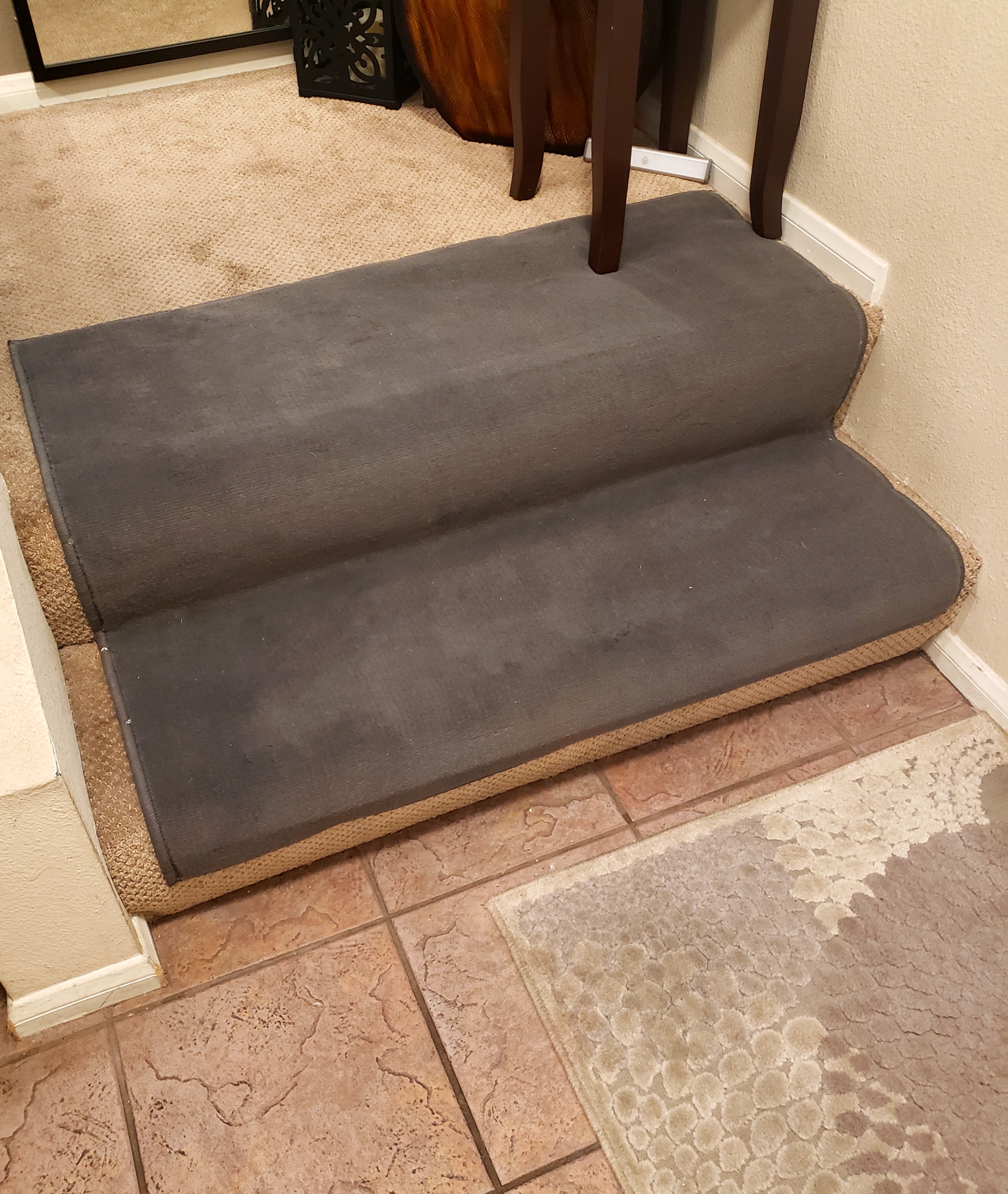
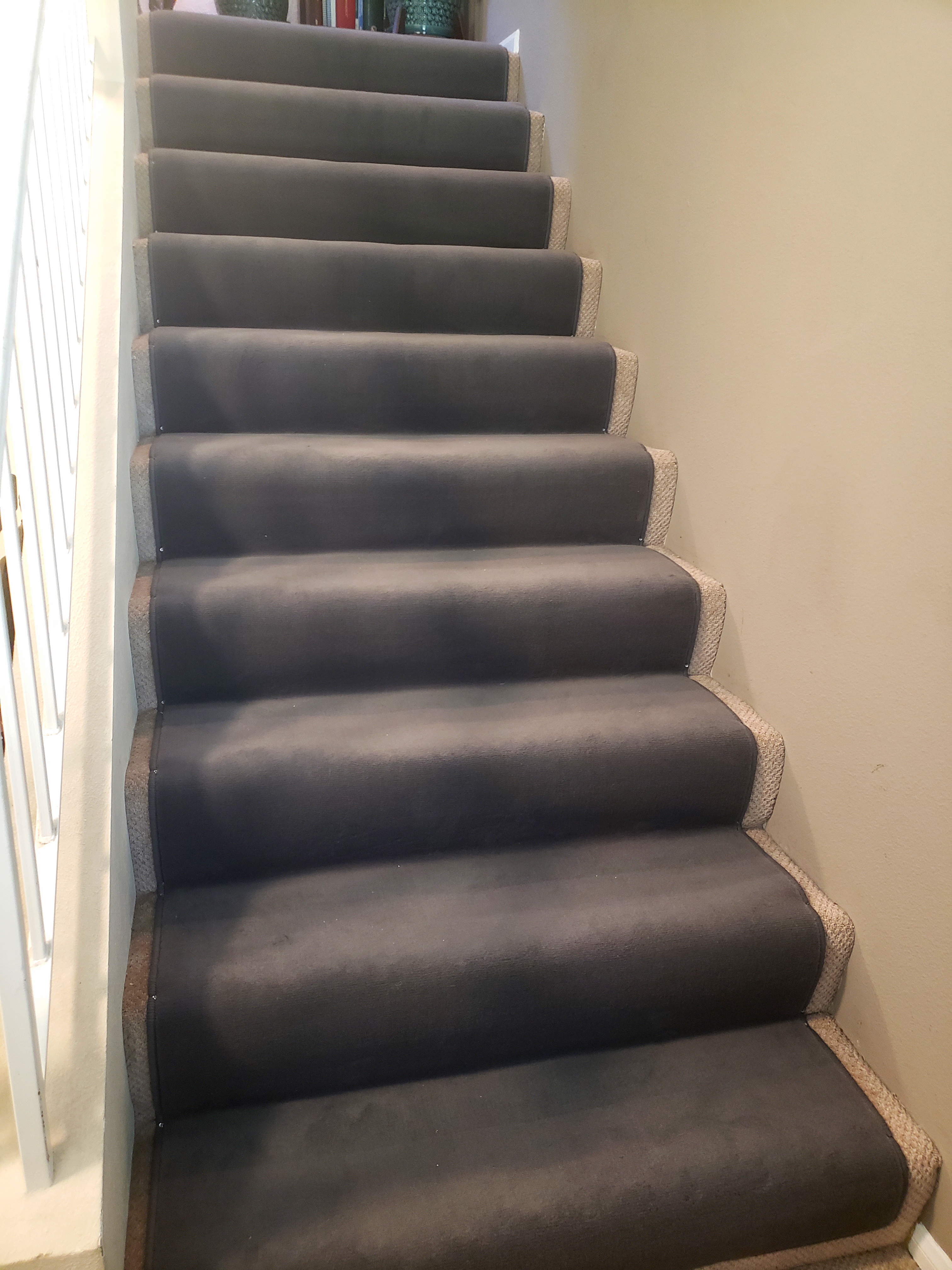
This is the first runner for the first set of stairs…

This is the main stretch of runner for the first flight of stairs

The third runner for the first flight of stairs

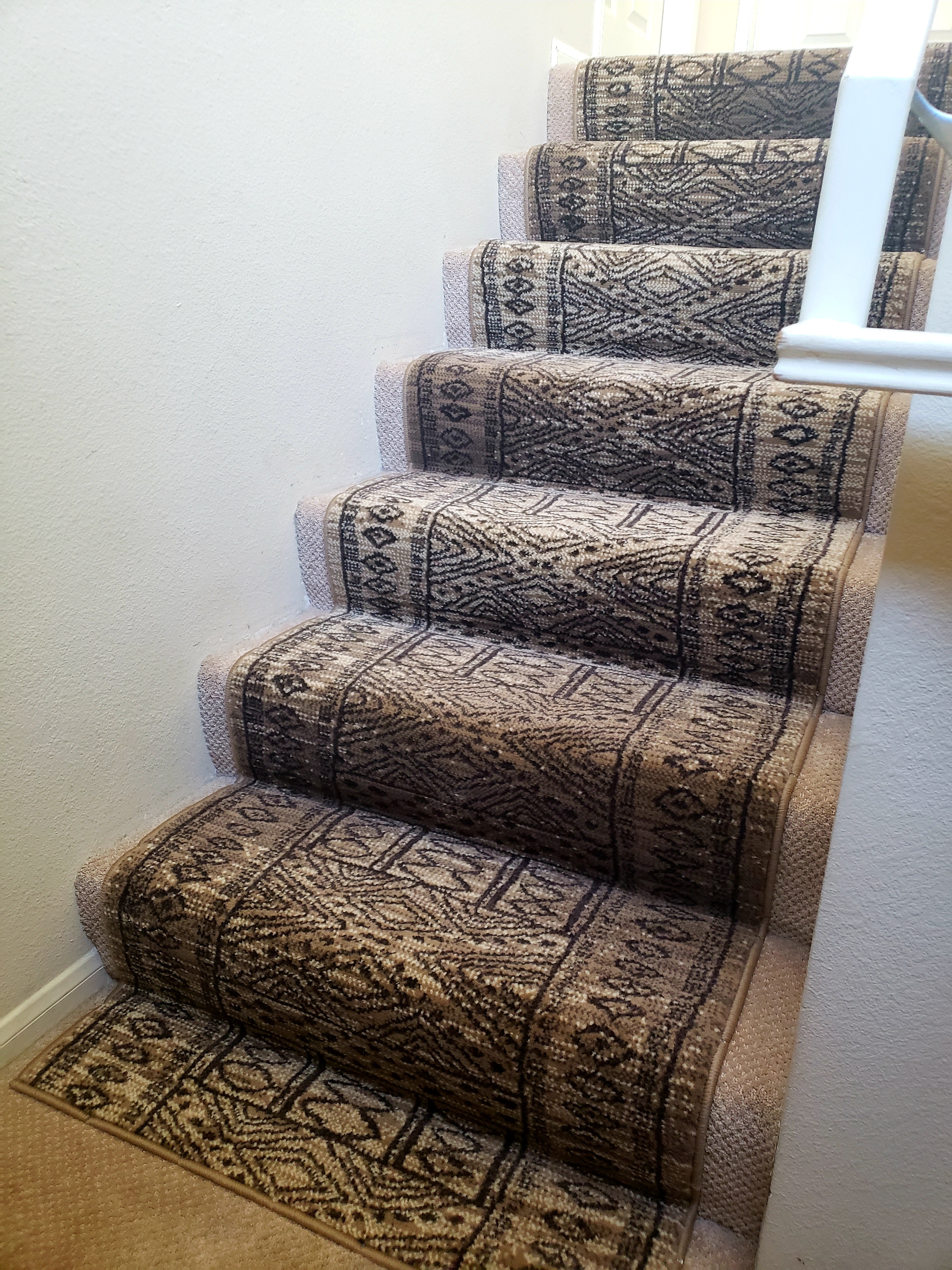
Our new Afrikans print taupe runners for the second flight of stairs

Second runner…

The final runner for the second flight of stairs

I hope that these new rug runners last for a very long time!

Cool Glasses Project

Back in early July, I attended a music festival with a few friends. We noticed that there were numerous vendors with booths set up along the entry corridor, so we decided to take a look at what was being sold. At one point, we found a booth which sold accessories like body chains and sunglasses, and zoomed in on one particular pair of shades. My friend tried them on and absolutely loved them, so she asked the vendor how much they cost. They were $100, and though my friend hesitated over the lofty price, I could tell she was thinking about purchasing them, despite the fact that she couldn’t afford them.

I have to admit that I also liked the glasses, so much so that I took a picture of them for reference (see image above). I then told my friend that we should keep walking, and once we were out of earshot of the salesperson, I informed her that all of the styles of sunglasses at the booth, sans embellishment, were available through Amazon. I also stated that we could probably duplicate the look for a fraction of the price, and that it would be foolish for my friend to purchase the cool spectacles from the booth we had just visited.

A couple of days after the event, I decided to look on Amazon to see if I could find the glasses, and also figured that I could look for the aqua fabric, the rhinestones, and cool eyeglass chains. By some stretch of luck and a willingness to search for appropriate accessories, I quickly found everything I needed, and ordered them. Once the materials arrived, I printed out the image of the shades we both loved, and set up my workstation so that I could make two pairs of duplicates. Despite the fact that I did a fair amount of cursing while figuring out the sizing of the fabric segments and also while gluing the rhinestones, I was able to complete the project.

The reference photo with the two finished pairs of sunglasses

The best part of the project was that I made each pair for $32.77 ($38.76 after I added cases), and had a nice creative challenge. The next time I saw my friend, I asked her if she remembered those glasses from the event we had attended, then handed her one of the pairs. She was speechless. I then told her that I hadn’t purchased the glasses from the vendor, but that I had made them, along with a second pair which I kept for myself. She was truly blown away, especially after I told her how much I had spent on materials.

One Thousand Cranes

Copyright: olegdudko

Last year right around Christmas, I taught my dear friend Karla how to make origami cranes, and though she struggled at first, she began to get the hang of making them. She thought they were pretty neat, and asked if they were ever made for a specific purpose, so I told her about the tradition of making one thousand cranes and stringing them up to hang for a number of different occasions, including making a wish for an ill person’s recovery, the birth of a child, wedding blessings, or to grant good luck within a home. Senbazuru (a thousand cranes) is the Japanese way to make a wish and bless it so that it might come true.

Emma Taggert offers an explanation of how the origami crane emerged in Japanese culture:

“The tradition of the Japanese orizuru (ori– “folded,” tsuru “crane”), or paper crane, began in feudal Japan (1185–1603 CE), when people gifted each other the paper figures as symbols of honor and loyalty. However, it wasn’t until the 16th century that the art of the origami crane was officially recorded. Hiden Senbazuru Orikata (“Secret to Folding One-thousand Cranes”), published in Japan in 1797, is the first known book on origami. It features the earliest known instructions on how to make origami cranes, along with countless examples of different kinds.”

Since I grew up making origami cranes, I can quite literally make them with my eyes closed, but I understand that for someone who is unfamiliar with origami, making that first crane can be a challenge. Here is a video tutorial for those of you who want to learn how to make one:

For those of you who already know how to make origami cranes, you might want to challenge yourself with renzuru, a form of origami in which multiple forms are made from a single piece of paper:

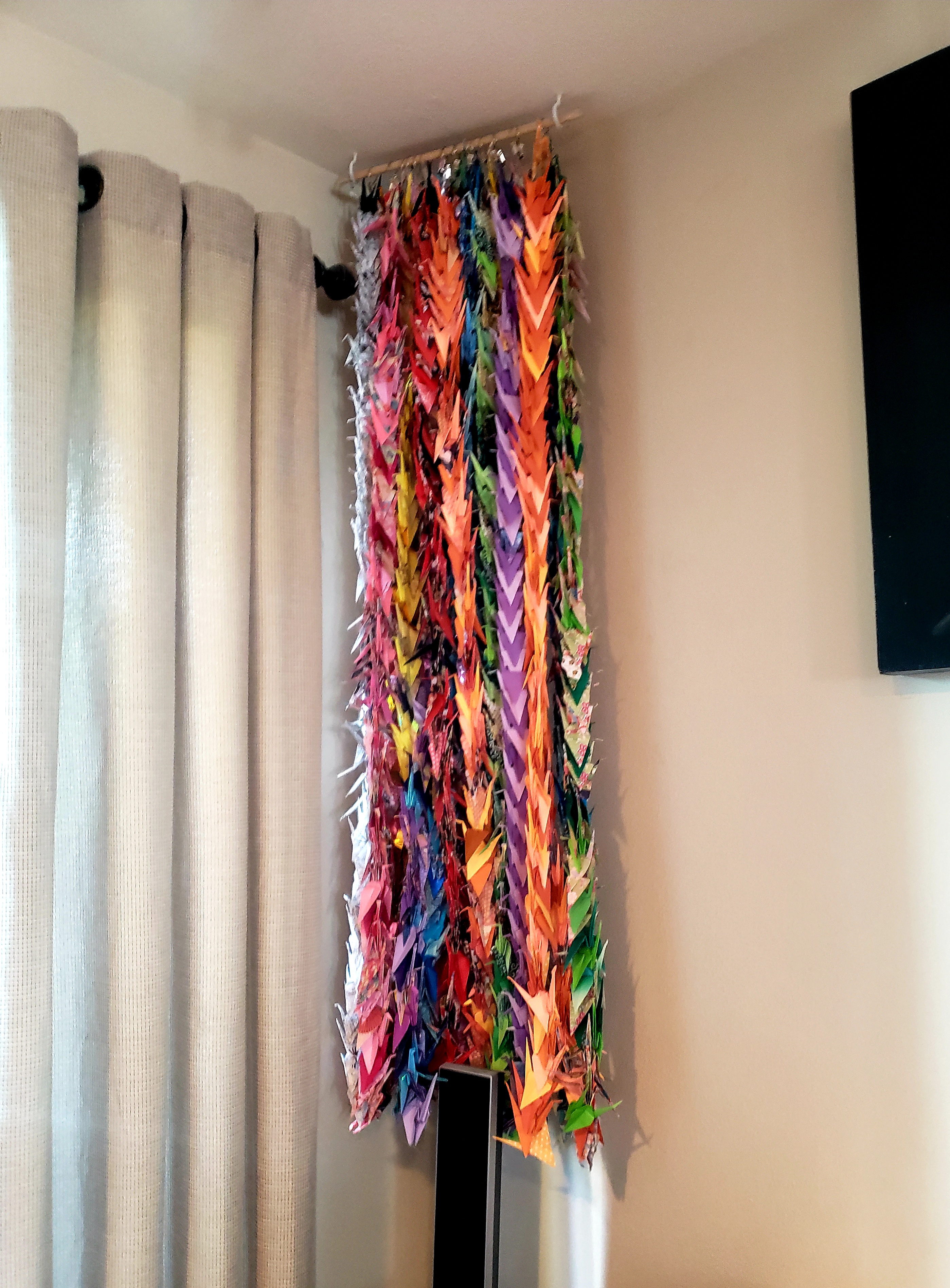
Getting back to my friend Karla, she amazed me in July when she gifted me with a thousand cranes for my birthday. I wasted no time in gettting a dowel and hooks for the cranes so that I could display them in my living room. Once they were hung, I realize I had chosen a great spot because during the day, the cranes catch the sunlight, and in the evening, the uplights which I have behind my sofa impart a lovely glow on them.