This is a GREAT article on iodine deficiency. I did NOT write this, but thought it was so well-written that I am displaying the entire article as it is found on T-nation.com Original post can be found here:
http://www.t-nation.com/readArticle.do?id=5559634

Few organs have been so misunderstood and mistreated as the human thyroid gland. Why, if it had any self-respect, it’d seek asylum in Russia along with Gerard Depardieu.
Unfortunately, the thyroid has chosen a more vengeful tactic – it’s wreaking havoc by playing a part in a silent epidemic that may be affecting the overall health of as much as 74% of U.S. adults.
When the thyroid is happy and functioning normally, it determines how your body uses energy (i.e., controls your metabolism), makes proteins affecting growth and development, plays a part in glucose consumption, helps regulate levels of blood lipids, and it even controls body temperature.
When you’re not giving it what it needs – when it’s not happy and functioning normally – it can cause fatigue and rampant weight gain, along with a host of problems including cancer.
It’s highly likely that you might have an unhappy thyroid, and if you do, it’s pathetic because the problem is oh-so-easy to remedy.
Before we get to the specific problem and the cure, though, let’s look at one of the fascinating stories that make up the medical history of this oft-ignored endocrine gland, one that shows that medicine is often myopic and causes other problems as bad or worse than the ones it was attempting to cure.
Shrink That Sucker With Radiation
In the 1920’s, doctors started focusing on the problem of Sudden Infant Death Syndrome, or SIDS. This is the phenomenon whereby infants suddenly die in their cribs for no readily apparent reason.
Doctors began doing autopsies on babies that had died of SIDS and compared the findings with anatomy-book drawings to see if there were any physiological discrepancies.
Lo and behold, the babies who’d died of SIDS had grossly enlarged thyroid glands. Doctors theorized that these humungous glands put pressure on the infants’ tracheas during sleep, resulting in suffocation.
Now it was known that radiation could shrink the thyroid gland, so doctors around the country leapt into action and began irradiating the thyroids of every infant that they could lure through their clinic door. It was easy because they employed the old guilt game – parents who ignored the warning were deemed irresponsible.
Enlarged thyroids were a thing of the past! Chalk one up for medical research! SIDS was conquered! No longer would parents lie awake at night fearing the worst. They could rest ea…huh? What’s that you say? They were wrong???
You bet.
To find out how they screwed up, we have to take the Hot Tub Time Machine back to Revolutionary War times, which was when doctors and scientists were starting to establish medical schools. Then, as is the case now, medical schools needed bodies for dissection, and there were plenty of bodies almost literally lying around for the picking, especially since poor people were buried close to the surface of the ground. (Rich people had nice waterproof, Tupperware-esque caskets that were buried six feet under.)
These dissections and the resultant descriptions and drawings, along with body parts stored in pickle jars, formed a huge database that served as the basis of medical knowledge for the next couple of hundred years.
Now there’s a particular thing you need to know about the thyroid before we can tie all these links together. Since it’s part of the body’s immune system, the thyroid is especially prone to stress, regardless of whether that stress be caused by financial problems or poor nutrition, both of which are things that pretty much define being poor.
As a result, these cadavers – these cadavers that served as the reference point for doctors in the early 20th century – had small, shrunken, stressed-out thyroids.
Are you starting to figure it out yet? When the doctors from the 1920’s were looking at the thyroid glands of the autopsied SIDS babies, they weren’t looking at enlarged glands at all! It was the opposite! For the first time, they were looking at normal, healthy thyroid glands! It’s only when they compared them to the Revolutionary War-era cadavers that they looked enlarged.
The atrophied glands of the long-dead cadavers were an anomaly, a direct result of stress and poor nutrition. As a result, doctors made the wrong assumption and began needlessly irradiating healthy thyroid glands in children to shrink them.
So what happened to the children who received radiation treatments?
Years later many of them developed thyroid cancer, most likely as a direct result of being irradiated by uranium ions during childhood. Over 30,000 of them died in young adulthood. Meanwhile, SIDS continues to be the major cause of death in infants between one month and one year old.
So it goes.
Right around the same time that docs began irradiating healthy thyroid glands, they began successfully treating another thyroid problem: goiters.
When it Rains it Pours
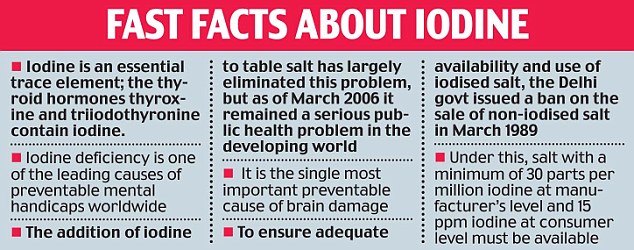
The thyroid does its magic through the production of thyroid hormones, the main ones being triiodothyronine (T3) and thyroxine (T4). These hormones are synthesized from the amino acid tyrosine and iodine.
Without iodine, which needs to be provided through the diet, the thyroid freaks out. It cries for help by signaling the pituitary to release Thyroid Stimulating Hormone (TSH), which tells the thyroid gland to get busy making more hormones.
However, if there’s no iodine in the diet, the thyroid gland either forms nodules or it just gets bigger and bigger, forming what’s known as a goiter. These growths ranged from barely visible to huge bulges that made victims look like some of those bullfrogs that are part of the background on TV’s Swamp People.
Unfortunately, iodine isn’t as ubiquitous as other minerals. The farther away you get from the sea (the source of most earthly iodine) and its bounty, the harder it is to get iodine. Soil contains some, but amounts vary hugely, so vegetables grown in that soil provide an iffy source of iodine.
Luckily for goiter-necked people everywhere, the Morton Salt Company, in 1924, got the brilliant idea of adding iodine to its salt. With the birth of iodized table salt, the age of the goiter disappeared almost overnight.
Zip forward to modern times, though, and we’re in the midst of another thyroid crisis, again, at least partially, brought about by myopic doctors who’d no doubt do poorly in games of 3D chess.
Enter the Damned Doctors… Again
Despite its importance, dietary intake of iodine has decreased by about 50% from 1971 to 2001, the latest dates for which I could find research.
Why did that happen?
Several reasons. For one, the other main source of dietary iodine (other than iodized salt) used to be wheat flour, as iodine was used in its processing. However, much of wheat is now processed with bromide, a chemical cousin of iodine.
However, bromide doesn’t function like iodine in the thyroid. What’s more, it actually block iodine’s activity. (Add to that the trend of food-phobics fearing all things gluten and you can pretty much scratch bread off as a source of iodine.)
Other chemicals block iodine, too, among them chlorine and fluoride, found in drinking water. Another chemical, perchlorate, which is found in ground water and food supplies (it’s even used as a flavor enhancer in certain foods), also interferes with iodine absorption.
Then there’s the lack of consistency in the iodized table salt industry itself. A 2008 study found that of 88 samples of iodized table salt, less than half contained sufficient amounts to thwart off iodine deficiencies.
And then came the doctors. They first advised heart patients to restrict their salt intake, and then in a classic case of what must be good for the goose with congestive heart failure must be good for the gander with a healthy ticker, they told everyone to cut down on salt.
People took heed of their warnings and the saltshaker and its iodine stayed in cupboards and gradually turned into crystallized blocks that could have been mistaken for Lot’s wife.
Then there’s the exercise factor – men and women who exercise a lot excrete precious iodine through their sweat.
What you’re left with is a society where, by some estimates, 74% of its adults are deficient in this vital mineral. You’re also seeing a concomitant rise in benign (and malignant) thyroid growths and nodules, just like in the old days.
(Paradoxically, these low-iodine manufactured nodules can actually give someone hyperthyroidism, as the nodules that grow overproduce thyroid hormones.)
Many of you no doubt think that you’re not included in this dire statistic. You think you’re fine because you don’t restrict your salt intake at all; you eat out at restaurants, eat canned foods without so much as considering the salt content, and you even eat Cheetos.
Well guess again, my orange-fingered friend, processed foods don’t generally use iodized salt. Neither do restaurants. And that pinkish Himalayan salt that some Whole Foods employee in Birkenstocks told you to use? It’s piss-poor in iodine. So is sea salt because a lot of the iodine is lost during crystallization.
Testing is Simple
Chances are you have an iodine deficiency.
How do you know, and why should you care?
The effects are sometimes subtle or insidious, but consider this statement by Dr. David Brownstein, author of Iodine – Why You Need It And Why You Can’t Live Without It:
“Iodine is the most misunderstood nutrient. After 12 years of practicing medicine, I can say that it is impossible to achieve your optimal health if you do not have adequate iodine levels. I have yet to see any item that is more important for promoting health than iodine.”
On one dry-skinned hand, you might have overt symptoms. You may have trouble staying lean, which might be a direct result of thyroid inefficiency. You might have mysterious fatigue. You may suffer from unexplained autoimmune diseases, or have the aforementioned dry skin, be constipated, or suffer from depression.
A malfunctioning thyroid, courtesy of a lack of iodine, might also play a role in heart disease, psychiatric disorders, and various forms of cancer, including breast cancer.
(Consider that Japanese women, who have very high intakes of iodine, have 65% fewer cases of breast cancer. Consider also that there are more centegenarians on the Japanese island of Okinawa than anywhere else, and their daily iodine intake – mostly through kelp-derived products – is very high.)
Or it could be that you’re functioning reasonably well, at least for the time being, while still being deficient.
If you have one or more of the above symptoms or suspicions, blood tests for TSH, fT3 and fT4 (the “free,” or unbound versions of the hormones) might be in order. However, there’s a lot we don’t understand about the thyroid. “Normal” ranges, like “normal” Testosterone ranges, are way too broad for any kind of accurate assessment.
A much easier way to test for thyroid function – one that would be advisable for anyone to take, even if you’re without overt symptoms – would be to take your temperature first thing in the morning before you get out of bed. The normal temp is 98.6 degrees, but you probably won’t see that unless you’re sticking the thermometer someplace else other than your mouth, you sick puppy.
The perfect body temp taken by mouth is right around 98.2 degrees. Consider too, that body temp drops at night and starts to warm up as the day progresses, with the peak occurring between 4 and 6 PM. A variance of about .9 degrees throughout the day is perfectly normal.
That means that a morning body temp of about 97.6 or 97.7 or above is ideal, and anything substantially less is probably a strong indicator that you have hypothyroidism.
Just to give yourself more data, though, it’d probably be a good idea to add a second thermometer reading later on in the day during those peak hours of between 4 and 6 PM to see if you’re even close to 98.2 degrees.
What To Do About It
Luckily, iodine, in the form of supplements, is pretty inexpensive. However, dosages per pill vary widely between manufacturers. Some companies supply the mineral in tiny, RDA-sized dosages of 150 micrograms, whereas others supply it in milligram-sized capsules. (The largest I found was 12.5 mg. per capsule.)
Unfortunately, it’s difficult to say how much you’d need to remedy a deficiency. Simply taking the RDA would be like refilling a bucket with water by adding one drop a day.
A more functional approach would be to take between 6 mg. and 12 mg. for a period of weeks or months (up to three). If and when your body temp returns to its normal 98.6, you would transition to smaller doses closer to the RDA.
While some experts recommend much higher doses to alleviate deficiencies, there are some risks. On the minor side are problems such as acne, loose stools, or iodine allergies. On the severe side are worsening of thyroid problems or atrial fibrillation.
As always, play it smart if you try the supplement approach.
Other, more conservative approaches include simply eating more seafood or seaweed products, eliminating soy products from the diet (if you haven’t already) as they can block iodine absorption, and getting a water filter to take fluoride and chlorine from your drinking water.
Of course, these small-bore remedies, if they even work, would take much, much longer to show results.
At the very least, check your morning body temp to see if you’ve got anything to be concerned about, you goiter-neck, you.
References
Griffin, James, Ojeda, Sergio, Textbook of Endocrine Physiology, Oxford University Press, 3rd edition, 1996
Luoma, TC, “Luoma’s Big Damn Book of Knowledge,” Harper Collins, 12th edition, 2012.
Piccone, Nancy, “The Silent Epidemic of Iodine Deficiency,” Life Extension Magazine, October 2011
Tellebaum, Jacob, M.D., “Iodine Deficiency – An Old Epidemic is Back,” Psychology Today, August 17, 2011
 One of the reasons why people tend to look forward to the weekend so much, besides being away from work, is the ritualistic imbibing of alcohol and consumption of rich foods which many tend to engage in. I have clients who will follow a sensible and healthy meal plan during the week, only to abandon all self-control, put on party hats and eat and drink during the entire weekend.