The letter Æ (lowercase æ), often called ash, has a long and fascinating history that connects ancient writing systems to modern European languages.
1. Origins in Ancient Alphabets
The story begins with the Greek alphabet. Greek had a letter called Ancient Greece diphthong αι (alpha + iota), which represented a sound similar to the “ai” in aisle (in early pronunciation).
When the alphabet spread westward, the Ancient Rome adapted parts of the Greek writing system into the Latin alphabet. In early Latin, the diphthong ae represented a sound like the “ai” in aisle as well.
2. From “AE” to a Single Letter
In classical Latin writing, A and E were written separately (ae). However, over time:
The pronunciation shifted from a diphthong (“ai”) to a simpler “e” sound.
Scribes began writing the two letters together as a ligature (a combined character).
This combined form became Æ, especially in medieval manuscripts.
Examples in Latin:
Caesar
aeternus
aer
In some later spellings, especially in English, the ligature was simplified to just e (e.g., medieval instead of mediæval).
3. Use in Old English
In England, during the Old English period (around 450–1100 CE), æ became a full letter of the alphabet, not just a stylistic combination.
It represented a distinct vowel sound — something like the “a” in cat.
Example:
dæġ (modern English: day)
Old English scribes borrowed the letter from Latin manuscripts and adapted it to represent a native sound.
4. Use in Modern Languages
Today, æ is still used as a distinct letter in several languages:
Iceland
Denmark
Norway
In these languages, it represents a vowel sound similar to the “a” in cat or a slightly broader front vowel.
5. Æ in Modern English
In modern English, æ is mostly stylistic or archaic. You may see it in older spellings like:
archæology
encyclopædia
mediæval
Today, these are usually written without the ligature (archaeology, encyclopedia, medieval).
Summary
The letter æ:
Originated from the Greek diphthong αι
Became ae in Latin
Fused into a ligature in medieval writing
Became a full letter in Old English
Survives today in Scandinavian and Icelandic alphabets
It’s a great example of how writing systems evolve over time — shaped by pronunciation changes, scribal habits, and cultural exchange.
As a child, I was absolutely intoxicated by words. Not just the ordinary, pedestrian ones — I mean the labyrinthine, tongue-twisting, sesquipedalian marvels that felt like verbal acrobatics. I collected them the way other kids collected trading cards.
I didn’t just know the longest word in the English language – pneumonoultramicroscopicsilicovolcanoconiosis — I reveled in it. I made sure to memorize it at the age of 8, savoring each syllable like a procession: pneu-mo-no-ul-tra-mi-cro-scop-ic-sil-i-co-vol-ca-no-co-ni-o-sis. Twenty-three letters? Please. That was merely a warm-up. This beefcake carried 45 letters, and it denoted a coal miner’s lung disease, which was even better since it also appealed to the medical nerd portion of my personality. I wanted words with gravitas, with architectural complexity.
My mom recognized early on that spelling wasn’t just a skill for me — it was a vocation. When I told my mother that there would be a major spelling bee at the end of the 6th grade year, she took it upon herself to quiz me daily in order to fortify my chances of taking home the coveted title and medal. Every afternoon she would sit across from me at the kitchen table with a list. Not pedestrian little morsels like “apple” or “chair.” No. She would lob in “chiaroscuro,” “defenestration,” “antidisestablishmentarianism.” It was our ritual — my daily lexical calisthenics in preparation for the apotheosis: the 6th-grade spelling bee.
And when that day came, I was incandescent with anticipation.
One by one, students were shot down, failing in their efforts to deliver impeccably spelled words, until there were only two of us left: Martha Phelps and me. Martha Phelps was supremely confident, practically effervescent with self-assurance. Then she was given the word facetious. I remember thinking how deliciously ironic it was, because it contains all five vowels in order. She began: F-A-C-E-I-O-U-S… and stopped. Smug. Triumphant.
Except.
Except there was no t.
Mrs. Mackenzie — stately, unflappable — adjusted her glasses and said, without saying a word, turned to face me.
Mrs. Mackenzie repeated the word: facetious.
The room shifted. Martha’s smile curdled.
Oh, I had been waiting for this.
F-A-C-E-T-I-O-U-S.
Each letter placed with surgical precision. The t nestled perfectly where it belonged — the quiet hero of the word.
And just like that, victory. Not by accident. Not by guesswork. By devotion. By daily drills at the kitchen table. By loving words enough to memorize even the absurdly magnificent ones.
I didn’t just win with facetious. I won because I understood that words have bones and ligaments and hidden symmetries. And I adored every single one of them.
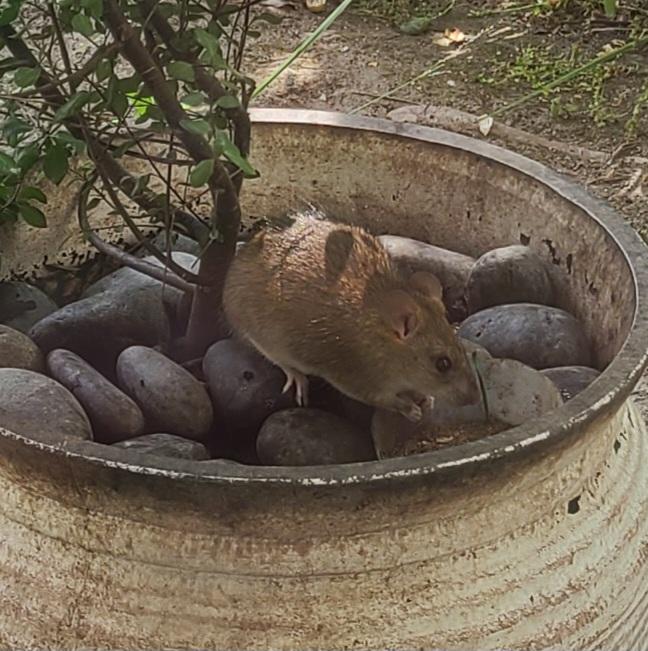
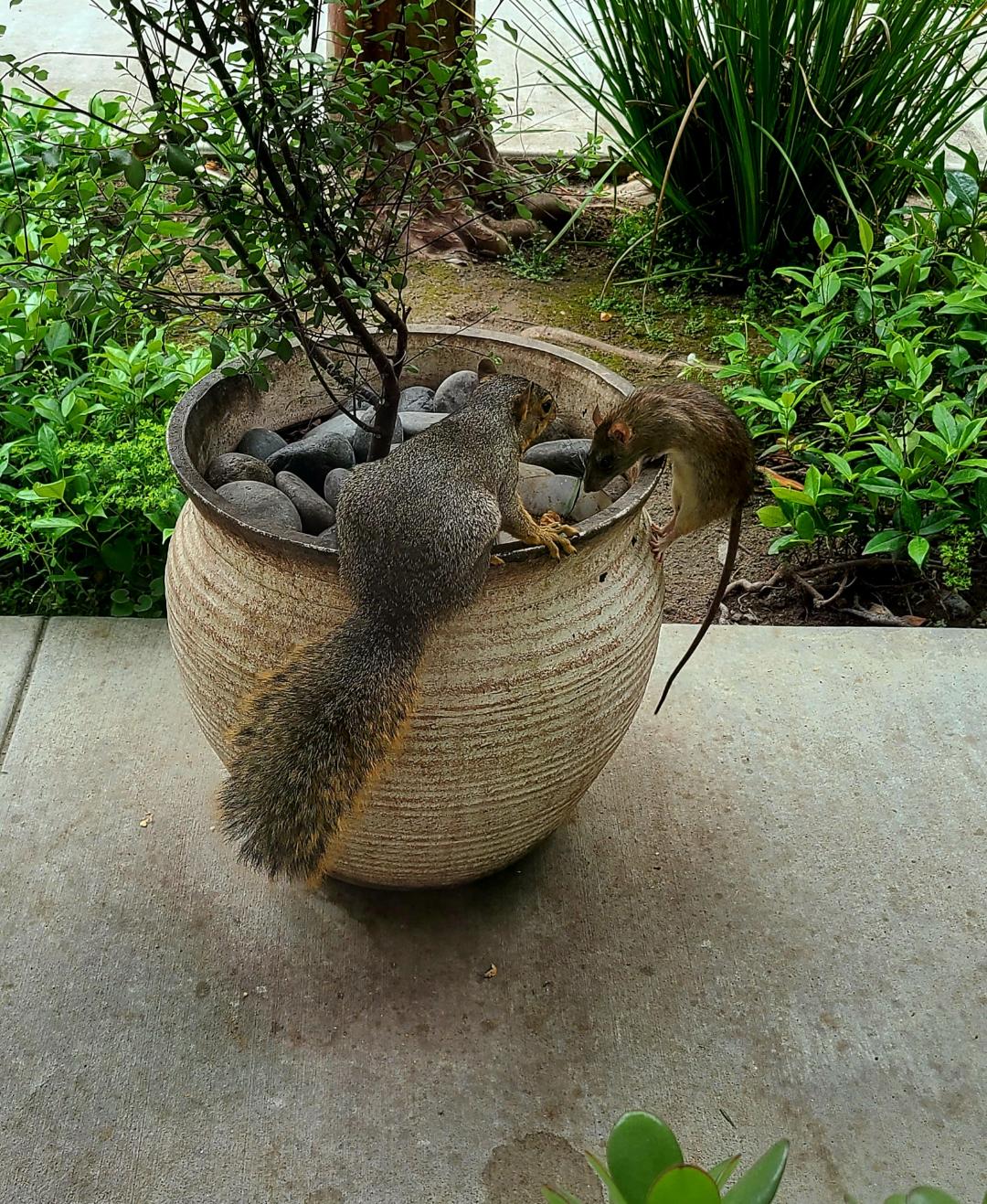
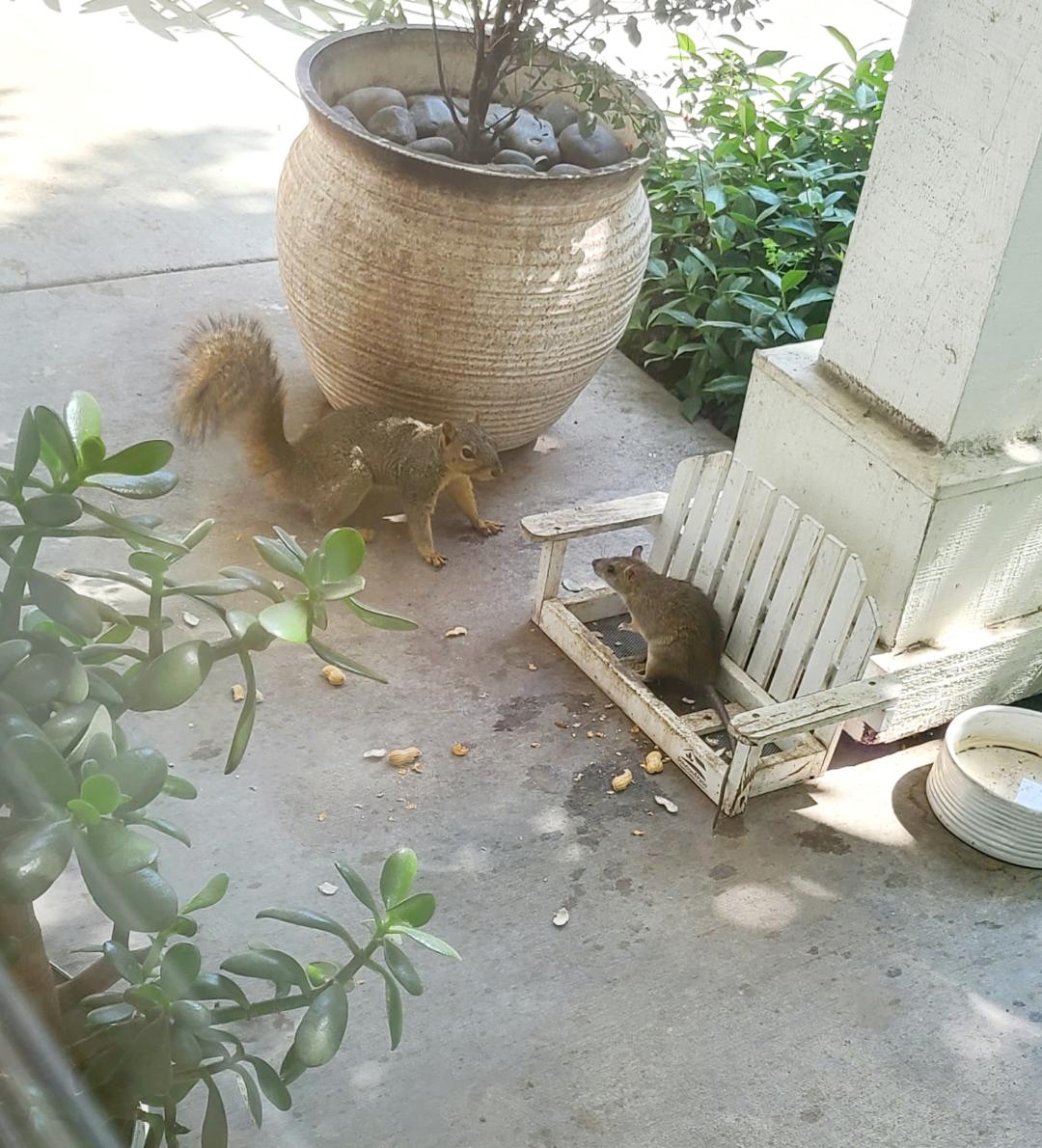
If you had told me last summer that my quiet little balcony would become the front line of a full-blown rodent war, I would have laughed. Yet there I was, by late September, locked in an ongoing ordeal with some of the boldest, most destructive rats I’ve ever encountered.
It started subtly—almost innocently. I would see one, maybe two rats joining in on morning squirrel feedings, and I thought they were amusing to watch. Then one morning I realized they had completely severed the lighting adaptor cord which fed the five LED lights in the relaxation fountain on my balcony. That was my first oh no, this is serious moment.
Things escalated quickly after that.
The rats somehow managed to get inside my four-burner propane grill. Imagine getting ready to heat up the grill, only to see a filthy rat scurrying across the grill rack. Needless to say, I quickly resorted to heating up the broiler to cook the steaks I had bought. Despite cleaning and disinfecting the grill, there was no way I would ever put food items on it, so it had to go. Getting rid of it turned into an event worthy of its own sitcom episode. One person had to climb a nine-foot ladder just to reach the balcony, while another lifted the bulky grill up and over the railing so it could be carefully lowered to the ground. All that effort… just to dispose of a grill that rats had claimed as real estate.
As the holidays approached, I hoped things might calm down. Nope. The rats decided to add seasonal flair to their destruction by chewing on one of my Christmas decorations. Festive, but not in the way I’d envisioned.
I tried to handle the rat situation responsibly. I put out bait stations filled with dextrose pellets, confident I was being strategic and humane. The rats, apparently unimpressed by my efforts, ignored the bait stations entirely and went straight for what they really wanted: my hummingbird feeder.
Not only did they attack it—they dismantled it. They chewed off the floral feeding spouts like tiny vandals with dental degrees. That was the moment I realized I needed to level up.
After weeks of trial, error, frustration, and more than a little disbelief, my efforts paid off. The rats stopped coming. No more chewed cords. No more unwanted balcony guests. No more destruction.
There is one bittersweet consequence: the squirrels rarely visit now, especially since I had to stop morning feedings. I really miss them, especially the ones whom I could hand-feed. Those twitchy-tailed freeloaders were at least entertaining and mostly polite. But in the end, it’s a small price to pay.
The balcony is peaceful again. The rats are gone. And after everything they put me through, I can confidently say: victory has never felt so satisfying. 🐀🚫
I didn’t expect Stranger Things to get under my skin the way it did. I started watching it casually in mid-December last year, after a good friend insisted that I would enjoy the fact that it was set in the 1980’s. Fast forward to last month, and I had finished the entire series—completely immersed, emotionally invested, and honestly a little stunned by how deeply it pulled me in.
What makes Stranger Things so addictive isn’t just the nostalgia or the monsters—it’s the characters. They don’t feel like characters you watch; they feel like people you follow. Eleven, especially, became the emotional anchor of the show for me. Her journey—from a frightened, isolated kid with terrifying powers to someone trying to understand identity, friendship, and choice—felt raw and human despite the supernatural framing. Every time she struggled, it felt personal. Every victory felt earned.
Then there’s Eddie Munson, who completely blindsided me. Loud, unapologetic, misunderstood—and unexpectedly brave. Eddie represents that outsider energy so many people recognize in themselves. His arc is one of those rare television moments where a character arrives late in a series and still leaves a permanent mark. You don’t just remember Eddie; you feel him. (SPOILER ALERT HERE) I actually cried when Eddie met his demise, especially because Dustin was so overcome with grief while watching his friend die.
Bob Newby is another quiet emotional gut punch. He wasn’t flashy or powerful—just kind, supportive, and trying his best. That made his fate hit harder than I was prepared for. Stranger Things is ruthless that way: it makes you care deeply, then reminds you that safety is never guaranteed in Hawkins.
And of course, looming over everything, there’s Vecna—a villain who feels genuinely oppressive. He’s not just a monster chasing people down hallways; he’s psychological, invasive, personal. Vecna weaponizes trauma and guilt, which makes him far more unsettling than the early-season demogorgons. Those creatures were terrifying in a visceral, survival-horror sense—pure nightmare fuel—but Vecna crawls into your head and stays there. The fact that Vecna, Henry Creel, 001, and Mr. Whatsit are all the same person, and portrayed so brilliantly by the mesmerizing Jamie Campbell Bower, makes this character even better.
That’s the real magic of Stranger Things: how immersive it is for people like me who get lured in without realizing what’s happening. You don’t just binge it—you inhabit it. The world expands episode by episode until Hawkins feels familiar, the Upside Down feels oppressive, and the stakes feel real. By the time I finished last month, it wasn’t just a show I’d watched. It was an experience I’d lived through.
And honestly? I’m still not fully out of the Upside Down.
Lately, I’ve been doing a lot of deep cleaning. Not the rushed, surface-level kind, but the slow, intentional kind. Drawers emptied. Closets reconsidered. Repairs finally handled instead of postponed. I bought a new comforter set. Shifted furniture. Made small but meaningful changes to the way my home feels when I walk into it.
On the surface, it looks like homemaking. But underneath, it feels like something much bigger.
The closest metaphor I can find is this: it’s as if I’m downloading an updated operating system for my brain. A new version of me. One that’s more streamlined, less cluttered, and better aligned with how I actually live now—not how I lived decades ago, or how I thought I was supposed to live.
In five months, I turn 60.
That number carries weight, whether we want it to or not. It’s a cultural milestone, but it’s also a personal reckoning. Sixty isn’t about decline—it’s about integration. It’s the age where experience stops being something you collect and starts being something you embody.
What makes this moment feel especially charged is the timing. Today marks the first day of the Year of the Fire Horse, and I was born in a Fire Horse year—1966. In the Chinese zodiac, the Horse is associated with movement, freedom, independence, and raw life force. Add the Fire element, and you get intensity, passion, and transformation. Fire Horse energy is bold and uncompromising. It doesn’t tiptoe into the next chapter—it runs.
Fire Horse years are rare. They return only every 60 years.
So here I am, nearly 60, living through the same energetic signature that ushered me into the world. It feels like a full circle moment—less like starting over and more like completing a long arc. A spiral returning to its origin, but at a higher level of understanding.
That’s what the cleaning is really about.
I’m not just clearing dust. I’m clearing outdated assumptions. I’m repairing things I once ignored. I’m choosing comfort and beauty not as indulgence, but as necessity. My home is becoming a clearer reflection of who I am now—what I value, what I want to maintain, and what I’m ready to let go of.
There’s something deeply grounding about tending to your physical space when your inner landscape is shifting. It creates a dialogue between the visible and the invisible. Every repaired hinge, every refreshed corner, every intentional choice says: I’m paying attention. I’m here. I’m not rushing past this moment.
This doesn’t feel like crisis. It feels like calibration.
If life really does move in cycles, then this one feels like a completion—and an ignition at the same time. A moment to honor everything that brought me here, while clearing the runway for what comes next. The Fire Horse doesn’t look backward with regret or forward with fear. It stands firmly in its power, ready to move when the moment is right.
And maybe that’s what this season is asking of me—not to reinvent myself, but to arrive fully as myself, updated and awake, standing in a space I’ve consciously prepared.
Ever since last October, my brain has been happily buzzing with ideas on how to express myself more in my home space. I’ve been in full-on maker mode—hands busy, ideas clicking, with that satisfying rhythm of “oh, I can fix this” and “wait… what if I tried this?” It makes sense to me, since crafts and repairs hit two different creative muscles: one playful and expressive, the other practical and problem-solving. When both are firing, I feel capable and curious at the same time, which is kind of a power combo.
What’s cool is that this kind of creative flow often feeds on itself. Finishing a repair makes me more confident, which makes me bolder with crafts, which makes me want to try something slightly weirder or more ambitious next. It’s like momentum I can feel in my hands. Of note is the situation I ran into in early December while putting Christmas decorations at my front door. There was an illuminated penguin with a top hat and scarf which I planned to juxtapose next to my penguin in a Santa hat, but I had waited an entire year after purchasing it in late december 2024 to display it. Instead of inspecting the components to ensure that everything would fit, I mistakenly assumed that there would be no issues, and I placed it on the shelf to use for Christmas 2025.
When I opened the box and attempted to assemble the penguin, I noticed that the construction was way off, and that it would be impossible to put it together unless I devised a creative solution. For several days, I honestly thought I would have to toss the decoration in the trash, but I had a flash of insight while putting up other decorations. Instead of fretting over the fact that the connecting poles were far too long for the height of the penguin, I aligned the poles alongside each other, used duct tape to keep them at the proper length, then assembled the penguin. Since the poles are inside the body of the penguin, and not visible, the duct tape was not an issue. Problem solved, and in a creative way!
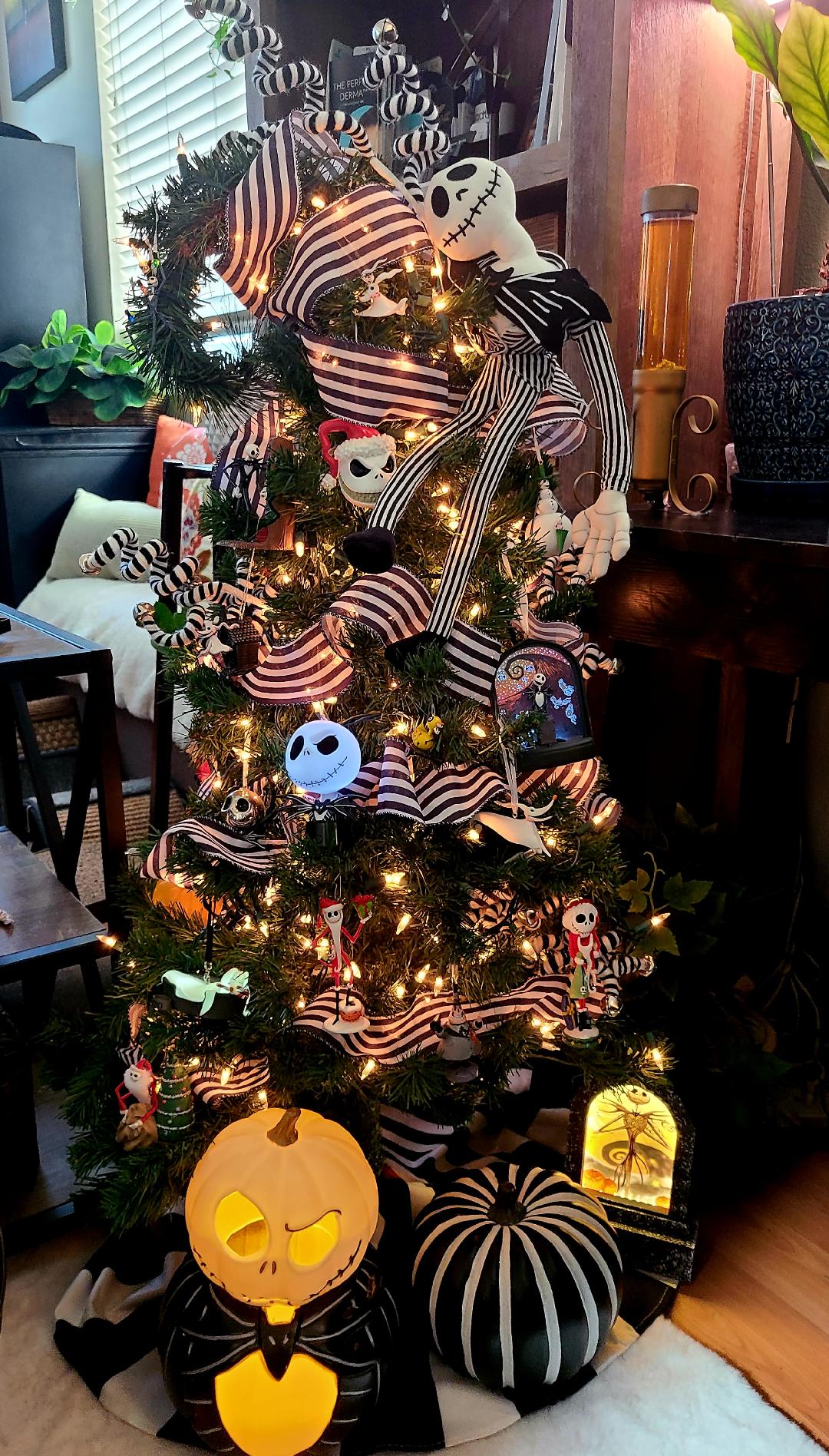
My other holiday-themed creative triumph was my Nightmare Before Christmas–themed tree? The tree offered a perfect blend of spooky, nostalgic, and whimsical, while honoring one of my favorite films. It was a great way to repurpose a small tree that had previously been decorated in a very traditional fashion. I got rid of my woodland creature ornaments that used to adorn the tree, and came up with a theme that felt completely congruent with what I was passionate about. Jack Skellington would absolutely approve.
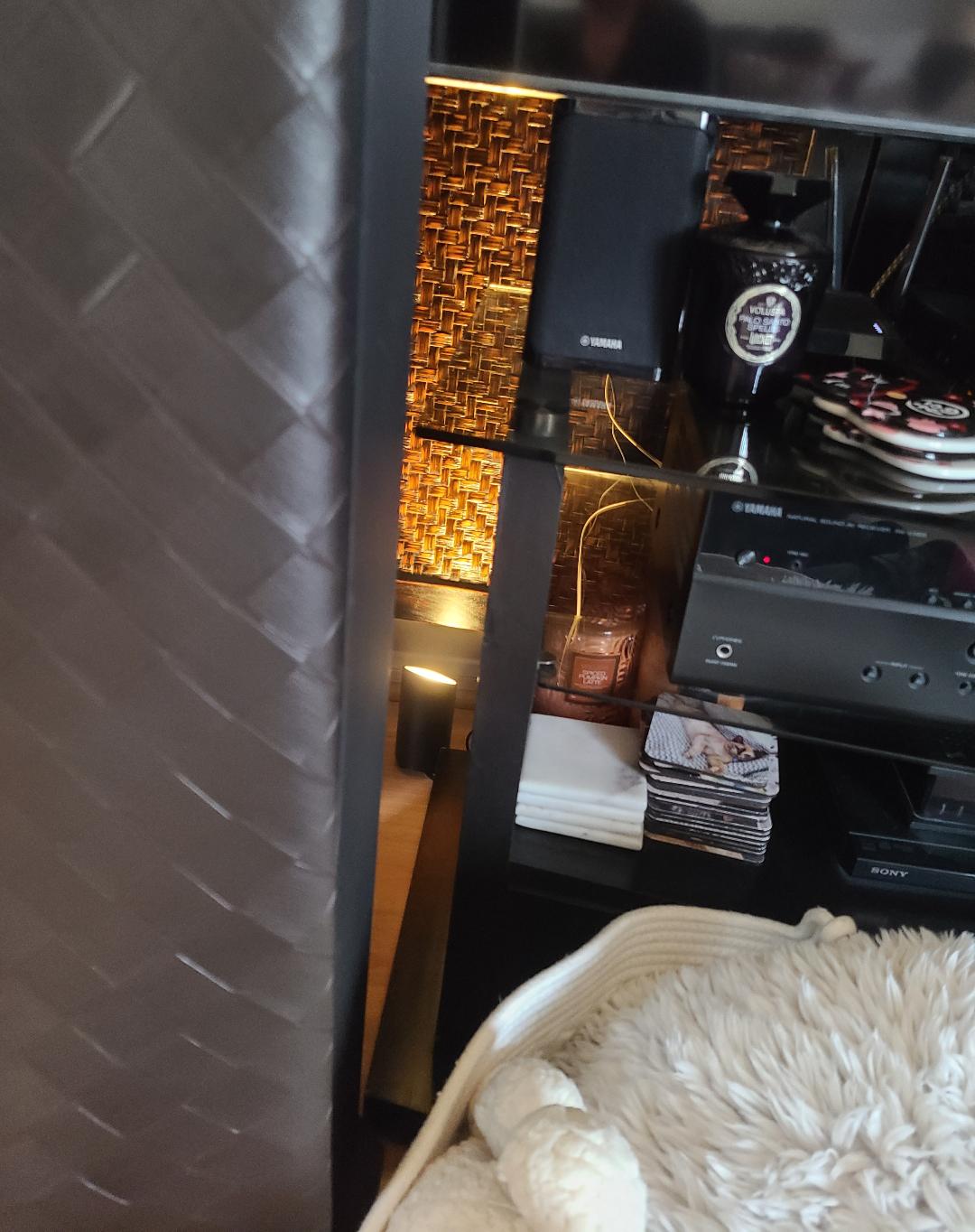
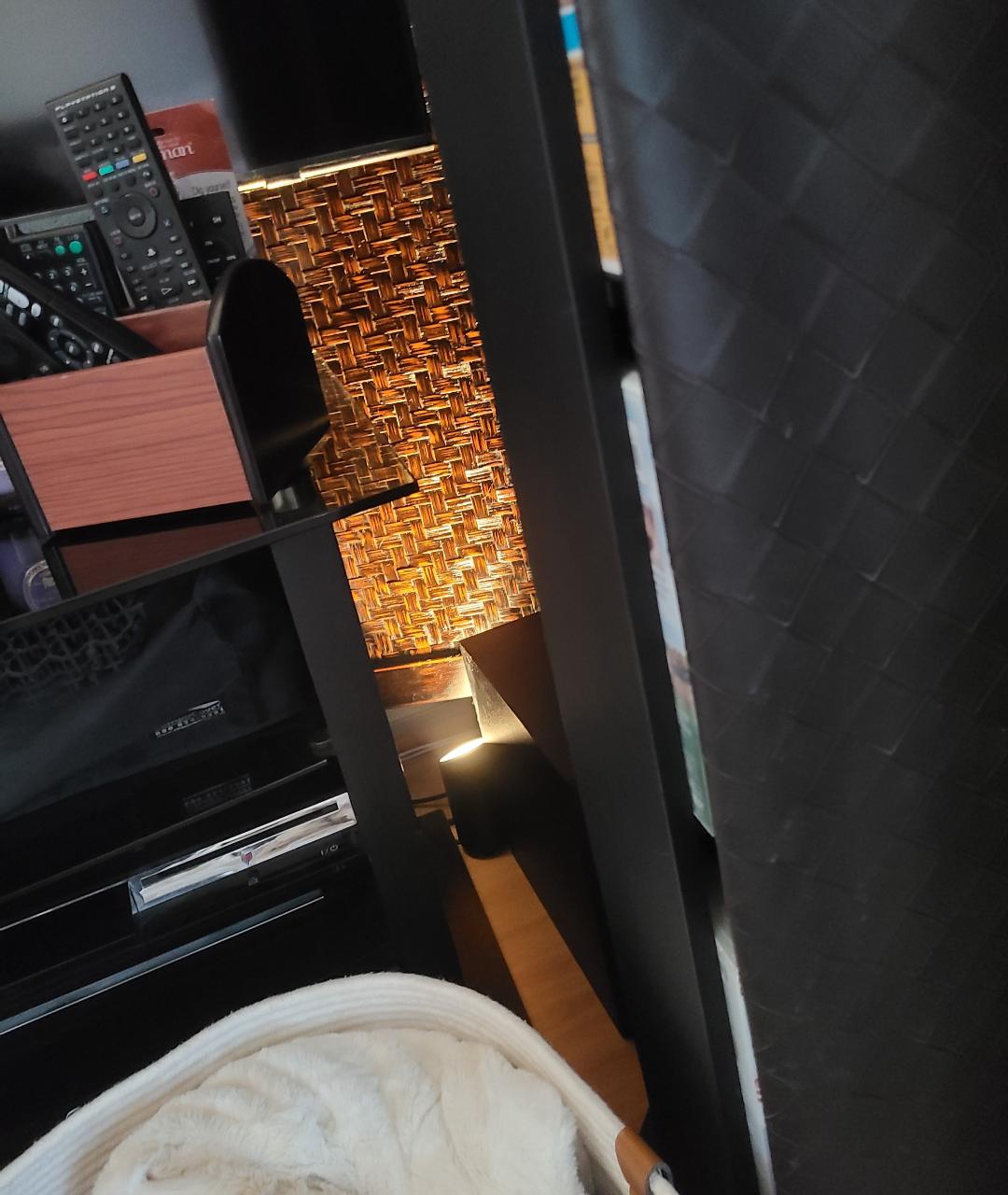
A more recent problem to solve was to create ambient lighting in my living room which would complement the existing ambient lighting. I ended up placing up lights on the floor by the entertainment center which are dimmable, creating even more of a relaxing vibe. They are subtle, but they carry the kind of impact and mood I was seeking.
Over this recent period, I’ve been intentionally tending to my home as a way of tending to myself. Each task I completed was not just about cleaning or organizing, but about restoring a sense of peace, agency, and care in my daily life. Moving through these spaces with purpose helped me reconnect with myself and reminded me that small, consistent acts can be deeply healing.
I began by decluttering and reorganizing existing storage, including carefully sorting through holiday ornaments and letting go of items that no longer served me. Releasing what I didn’t need created both physical space and emotional breathing room. At the same time, I chose to bring in gentle moments of joy, like adding new Christmas stockings for the cats — a small but meaningful expression of warmth, playfulness, and love that made my home feel more alive and personal.
I spent time thoughtfully organizing my makeup and fragrances, transforming what had once felt scattered into something intentional and inviting. This shift made my daily routines feel more like rituals of self-respect rather than obligations. I also worked through closets throughout the home — the bedroom, master closet, gym closet, laundry area, and other storage spaces — cleaning, sorting, and creating systems that feel sustainable. With each cleared shelf and reorganized space, I felt a growing sense of clarity, stability, and confidence.
Alongside this inner and outer clearing, I made practical upgrades that supported my well-being. Refreshing the bedroom with new comforter sets transformed it into a space of comfort and rest, a place where I can truly recharge. I also deep-cleaned the master bathroom and other key areas, restoring them as calm, supportive spaces for daily care and grounding.
Altogether, this work has been an act of self-affirmation. By caring for my environment with intention, I reinforced the belief that I deserve a home that supports me, comforts me, and reflects who I am becoming. As my space has grown more organized, warm, and intentional, I’ve felt lighter, steadier, and more empowered in my life. This process has reminded me that tending to my surroundings is a meaningful way of honoring my own growth and well-being.
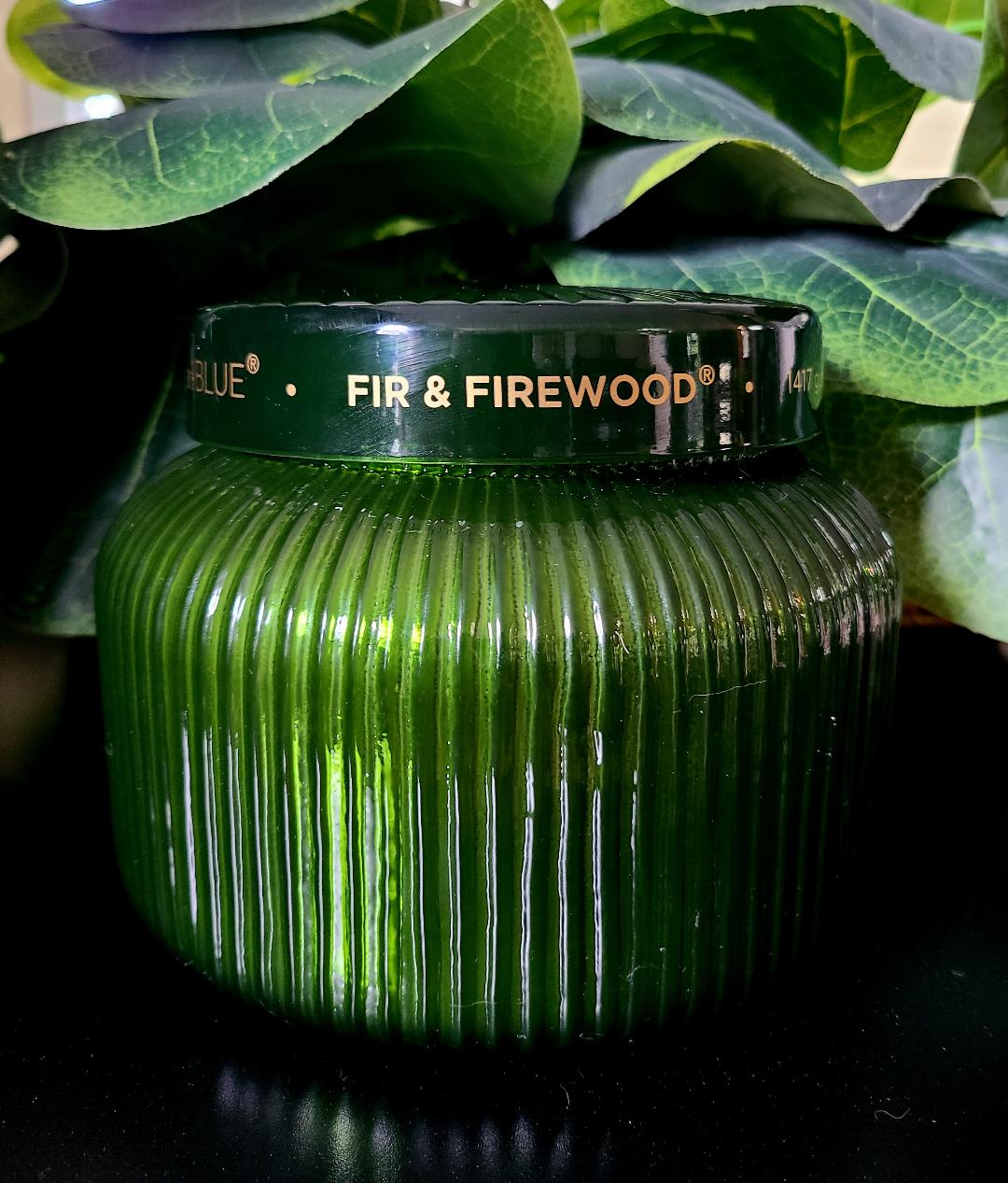
Fir & Firewood by Capri Blue is the ultimate Christmas tree scent!
As a self-proclaimed scented candle fanatic, I have definitely selected some fragrances which are favorites. Two of my favorites are actually promoted and sold as holiday candles, but I use them year-round because they don’t scream Christmas like some aromatic varieties do. The two limited-edition holiday candles with which I can honestly say I am obsessed are Nest’s Blue Cypress & Snow, and Fir & Firewood by Capri Blue.
Blue Cypress & Snow is described as: “Create the aroma of a snow-covered mountain retreat in winter with NEST New York’s candle collection, featuring notes of crisp blue cypress, juniper berry, and hints of smoked vanilla bean.” What does it smell like? Fresh woods, nestled in cozy, warm vanilla. I don’t even like the smell of vanilla, but this combination is absolutely beautiful. I think it’s a bit heavy for the middle of summer, but it absolutely works any other time of the year. Although Nest only sells this one during the holiday season, there are other stores which sell this for a good portion of the year.
Fir & Firewood is described in this way: “Fruity, green aroma of apple, clove, fir, pine needle, white birch, cedar, vetiver, and musk.” The fruit and clove mellow out the sharpness of the pine, birch and cedar, resulting in the ultimate Christmas tree scent. It’s definitely festive, but the scent profile works for anyone who likes forest type, woody aromas. This one is hard to find, but worth the effort to dig up.
Camille Johnson of Bereaver.com does it again, with an inspiring article to get you on track for a fantastic new year!
January has a way of putting everything under a spotlight. Energy levels, habits, ambitions—suddenly they all feel negotiable again. This guide is for anyone who wants to reset without burning out, aiming for momentum instead of perfection. The goal is simple: start the year with clarity, practical action, and a sense that you’re moving forward on purpose.
A Quick Orientation Before You Begin
This is not about radical overnight change. It’s about stacking small, intentional decisions that compound over weeks and months. Focus on direction first, intensity second. When you know where you’re going, effort feels lighter.
Step One: Reclaim Your Daily Energy
Energy is the foundation of self-improvement. Without it, even the best plans collapse.
Remove one recurring commitment that drains more than it gives.
Organize one physical space you use daily.
Choose one habit to add and one to pause.
Schedule a weekly 20-minute reflection block.
Print it. Check it off. Done is better than optimized.
Using Structure to Build Momentum
Many people fail not because of laziness, but because they rely on motivation alone. Structure carries you when motivation dips.
A structured approach to health can be especially powerful. Stacey Naito’s nutrition and fitness plans offer a clear, goal-oriented framework for people who want to rebuild energy and consistency at the start of the year. Her programs are designed to support realistic habits, physical strength, and long-term lifestyle changes, helping participants stay focused and empowered as they work toward better health and personal growth. For those who prefer guidance over guesswork, this kind of structure can make all the difference.
Investing in Your Future Self Through Learning
Personal growth isn’t only about habits—it’s also about expanding your options. Education can play a major role here, especially when it’s flexible. Earning an online degree can be a practical way to move your career forward while balancing real life. For example, pursuing a graduate-level nursing degree opens doors to roles in education, informatics, leadership, and advanced practice.
Online programs allow you to study while working full-time, making it easier to grow without pressing pause on income or responsibilities. If professional advancement is part of your reset, you can enhance your career options with an MSN by choosing a path that fits around your current commitments.
Habits That Actually Stick
Not all habits are created equal. The ones that stick usually share three traits: they’re visible, small, and tied to identity.
This structure keeps change manageable while still meaningful.
A Resource Worth Bookmarking
Sometimes motivation comes from outside your own head. For mental clarity and stress reduction, the Mindful organization offers free, research-backed articles and guided practices on mindfulness and well-being. Their content is approachable and practical, making it a useful companion during periods of change.
Frequently Asked Questions
How long does it take to feel real change? Most people notice small shifts within two weeks, especially in energy and focus. Bigger results often appear after 60–90 days.
What if I fall off track? That’s normal. Resume at the next possible moment without overcorrecting.
Should I work on everything at once? No. One or two focused changes at a time leads to better long-term results.
Closing Thoughts
A new year doesn’t require a new personality—just a clearer direction and a few supportive systems. Start small, stay consistent, and let momentum do the heavy lifting. Progress that feels calm and sustainable is far more powerful than change driven by pressure. Give yourself permission to build, not rush.
Last year, I took my Halloween and Christmas decorations to the next level, all because I was inspired by the talented residents in my city who decorated their homes. Every year, the city of Burbank has a Halloween decorated house contest, and because there are many Burbank residents who work in the film and TV industry, the artistry and creativity exhibited are significant. For whatever reason, I was swept up in the festive energy of Halloween last October, and I made close to a dozen excursions to various neighborhoods in Burbank to see all the decorations.
During prior years, all I did in terms of decorating my place for Halloween was to put up wooden plaques of Jack Skellington and Sally at my front door, display three plastic skeletons (cat, Dachshund dog, and a rat) on the railing around my second-floor balcony, and string up orange and purple lights on the balcony. Last year, I added a 6-foot-tall Jack Skellington, a matching Sally, and a matching Zero, all three of which hung near the front door entrance. My place really stood out because I was the only resident in my community who put up any Halloween decorations, but my friends and I really enjoyed seeing those decorations. This year, I will be adding another element which should be a lot of fun to have as part of the display.
My Halloween decorations on Halloween 2025
Then as Christmas approached last year, I was inspired to continue the Nightmare Before Christmas story theme by adding an animatronic Jack Skellington (dressed as Sandy Claws) at my front door. I also switched the decorations on a 4.5-foot tree which I always put in my den area so that the Nightmare Before Christmas theme pervaded the tree. I also created a spiral at the tip of the tree to mimic the shape of Spiral Hill. The results were truly fantastic!
My front door display for Christmas 2025
I ended up with so many Nightmare Before Christmas ornaments and decorations for the 4.5-foot tree that it ended up being a bit overloaded, so this year, the decorations will adorn a 6-foot pencil tree. The 4.5-foot tree will undergo yet another decorating facelift, and I am truly excited for what I plan to create when I put that tree up in late November of this year. I know it sounds like overkill to have THREE Christmas trees (I have a 7.5-foot cashmere tree as the main tree) in the house this year, but I am having fun with all of it. Thank goodness I have enough space in my garage to store all the items!
This was a great launching point for the Nightmare Before Christmas theme inside the house!

 93498212




 dr. stacey naito's blog