It is possible to stay lean and in top shape during the holidays!
It is possible to stay lean and in top shape during the holidays!

 I am devoting this blogpost to what to expect post-surgery at least through my own experience with breast augmentation surgery. Though recovery from breast augmentation surgery is relatively tolerable, you should know what to expect.
First of all, when the procedure is completed, you will be wheeled over to a recovery unit where you will come out of anesthesia. Some women may become very emotional or confused when coming out of anesthesia. What was strange about my experience coming out of anesthesia, other than the fact that it took me an unusually long time to come out of anesthesia, was that I was very chipper and even joked around with the nurses that it was time to party (what a goofball I was!). My friend Mara picked me up from the hospital and drove me home. Let me tell you, that car ride was the most painful one I have ever experienced as my very swollen and scalpel-assaulted chest bore the brunt of every single dip and bump in the road. I sat in the passenger’s seat wearing a support bra. Once home, I got in the habit of applying a sandwich of ice packs, one above my breasts and one below them, and began taking Vicodin three times a day to take the edge off the pain. Some women may experience full pain relief from their prescription pain meds, while others (like me) might only receive some relief.
Do not make the mistake of assuming that you are tough enough to take care of yourself immediately post-surgery. I am tough and I work out regularly, but I was not prepared for the need for complete assistance in sitting up in bed from a supine position. This went on for four days. I was very sore and had to stay home for three days before I felt strong enough to return to work. I also had to apply the ice pack sandwich constantly for those first three days and was constantly alarmed by the fact that my new breasts sat so high on my chest that they abutted my clavicles. It was truly bizarre. As the days and weeks passed, my newly augmented chest began to relax and settle and the feeling that my skin and muscles were stretched to the hilt began to subside.
In addition to the constant pain which I experienced over the first two weeks following surgery, I experienced “zingers”. Women may not be aware of zingers but they should be if they are preparing to go under the knife. Zingers feel like sudden electric jolts which are felt at the nipple and which I imagine are akin to getting electrocuted. They are strange but a direct result of local nerve damage which occurs as a result of the surgery. This will also subside over time so don’t be alarmed!
After two weeks I was allowed to return to lower body weight training and after four weeks I was allowed to hit my upper body workouts. To this day, however (and it has been almost ten years since I had my surgery), I cannot do heavy chest workouts and experience lateral movement of the implants when I work my chest. This movement makes my boyfriend laugh and I can honestly say that I don’t blame him for laughing!
I have never had a single regret about having had the surgery and would do it again in a heartbeat.
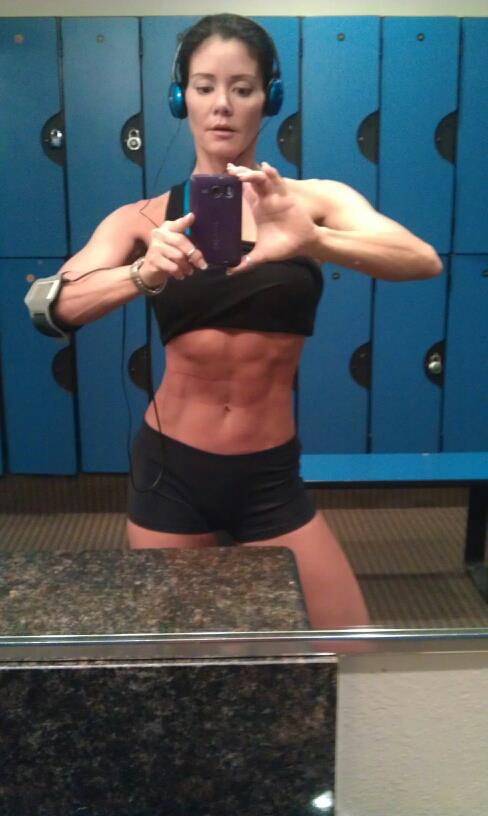

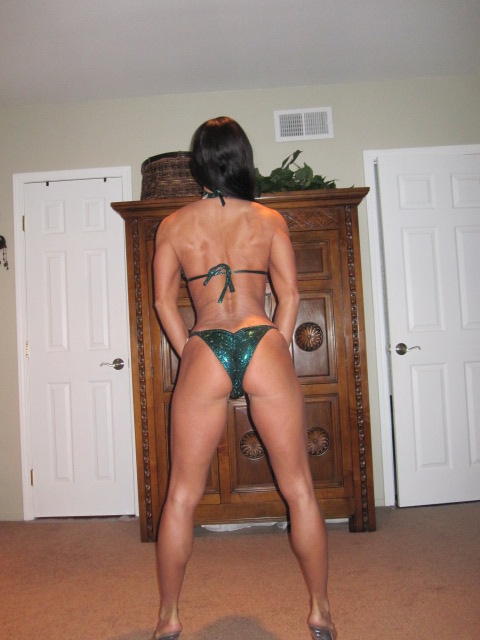
2010, 2011, 2012

Taken before starting with a photo shoot…

PROGRESS!
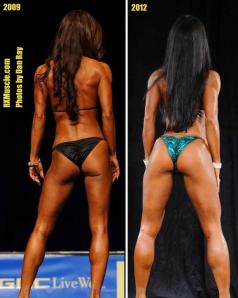
Masters bikini competitor Stacey Naito didn’t place at her first National show in 2009. Three years later she looked her best at the 2012 IFBB North American where she placed 7th in her open class and won her masters class! Well done Stacey! Her page……… Stacey Naito National NPC Bikini Champion ………More before and after photos on…….. Siouxcountry.com
Photo credit: Dan Ray / RXMuscle.com — with Stacey Naito.
With all the brands, types and styles of athletic shoes that exist these days, it may be challenging to figure out which ones to buy. As a response to the questions I get about this, I have compiled a list of tips to help you navigate through the choices out there and select footwear that is ideal for the type of activity you plan to engage in.
Select shoes appropriate for your feet. Most of us know whether we have narrow, medium width or wide feet, but do you know what type of arch you have? A good way to assess this is to do what is called a “wet test”. To do this, you will need a piece of brown paper like the type that is used for brown paper grocery bags. Wet the bottom of your foot, step onto the paper (make sure to put your full weight on that foot) and trace your footprint. If you have a print with little to no curve on the inside edge, you have flat feet and your feet tend to roll inward (overpronation). This type of foot needs a shoe which gives good support to prevent movement. If your footprint shows a large empty space in the inside edge and there is a narrow connection between your heel and forefoot, you have high arches and tend to turn outwards (supination). This type of foot needs a soft and cushioned midsole. If your footprint is somewhere in-between, you have a neutral arch and should choose a shoe with a mix of support and cushioning.
If you wear an orthotic, bring it. You should also bring the socks that you usually wear when engaging in whatever activity you are buying the shoes for. I have heard of people who have made the mistake of fitting shoes to their feet when wearing socks that are either thicker or thinner than what they are accustomed to wearing, which results either in the hassle of making an exchange or return or the pain of wearing ill-fitting shoes.
Shop later in the day. During the course of the day, feet will expand, which means they will be their largest towards the evening. When determining the fit of a shoe, it is important to take this into consideration and fit to your feet when they are their largest to avoid disfomfort.
Make sure shoes are comfortable and enable the movements your sport requires. While athletic shoes should be comfortable while standing in them, it is also a good idea to engage in jumping, lateral movements or whatever foot motions mimic the types of movements you will do while wearing the shoes. Take note of any shifting or discomfort.
Buy a pair of shoes that fit well. There should be about ½ inch between the front of your big toe and the end of the shoe. A quick guide which you can use is your thumb. When you lift off with your heel, the shoe should not slip off the heel at all. You should be able to wiggle your toes while wearing the shoes, but the shoe should also feel secure around your foot.
Don’t go cheap! I see a lot of people grab athletic shoes that are on clearance which aren’t the best fitting or the best constructed shoes for them. This is not to say that you can’t find a decent pair of athletic shoes on sale, but try not to head straight for the bargain bin when you are searching for shoes. Your main objective should be to find a well-constructed pair of shoes which fits your foot well and is designed for the activity you will use them for.
Replace shoes before they completely fall apart. I always find it amusing when I see guys at the gym wearing shoes that are tattered. I wish I could just ask them, “If you care about your conditioning so much, why do you neglect your feet which are bearing all the weight and pressure you put on them during your routine?” Most people can expect to replace their shoes every six months, or until they begin to notice that the shoe feels less supportive or develops areas which are uncomfortable. Another gauge is to check the back of the sole frequently and to replace the shoes once that area begins to appear worn out.
Buy shoes which are task-specific and expect to have multiple pairs. Not all shoes are created alike. A cross-training shoe is designed for midfoot support and has tread which enables lateral movements. A walking shoe, in contrast, is rather rigid and is designed to minimize foot movement. Running shoes are quite flexible but are also built with extra cushioning to absorb the high impact of the foot-strike on the pavement.
If you exercise frequently, purchase several pairs. If you get in the habit of rotating through your shoes, you will allow your shoes to air out between uses and will also extend the wearability of your shoes since you will be alternating through your collection. I currently have eight pairs of athletic shoes in rotation and make sure to wear the type of shoe which is appropriate for the activity I plan to do on a particular day. For example, I wear my running shoes when I plan to do high intensity intervals on the treadmill, and I have other shoes designated as my plyometrics shoes, my leg day shoes and my general lifting shoes.