Naturally Gray

123rf.com image
yaroslavastakhov Image ID158276168

When the COVID-19 pandemic swept across the world in early 2020, it disrupted nearly every aspect of daily life—including personal grooming routines. For many women, the closure of hair salons meant they could no longer maintain their regular appointments for root touch-ups or color treatments. Suddenly, the choice to hide gray hair was taken out of their hands. For some, this was initially a distressing situation, especially in a society that has long associated gray hair in women with aging, invisibility, or a lack of vitality.

However, something unexpected happened. As the weeks turned into months, and the pandemic dragged on, many women began to embrace the gray. What started out as a necessity slowly evolved into a movement. Social media played a huge role, with women posting photos of their “silver linings” and sharing their journeys of going gray—roots growing out, transitions in color, and emotional realizations along the way. Hashtags like #grombre (gray + ombré), #grayhairdontcare, and #silversisters began trending, creating a virtual support network that celebrated authenticity over convention.

For many women, going gray became symbolic of something much bigger. It represented a rejection of unrealistic beauty standards and the freedom to age on their own terms. It was an act of self-acceptance and empowerment. Some women shared how liberating it felt to stop covering something that was natural and beautiful. Others described how they felt more themselves than they had in years—bold, honest, and unfiltered.

This shift was about more than hair color; it was about autonomy. In a time of uncertainty, women reclaimed control over something deeply personal. They no longer felt pressured to hide a part of themselves just to conform to societal norms. As a result, what started as a temporary break from salon visits became, for many, a permanent transformation—not just in appearance, but in mindset.

As for my personal hair color journey during the pandemic, I was already so accustomed to coloring my gray roots at home every two weeks that it did not bother me one bit that I wasn’t able to visit a salon. In addition, the hairdresser who had been doing my hair during that time worked out of her home, so the interruption in professional hair care services was very brief for me. However, I was so inspired by the women who were daring enough to go naturally gray that I briefly considered traveling down the same path.

What stopped me was the realization that any lighter hair color looks truly bizarre on me, whether it be blonde, gray or white. I have verified this over the years by donning blonde and platinum white wigs, only to cringe in horror. Last month, I applied a gray hair color paste on my hair and took photos, then washed the stuff away. One friend thought it looked cool and suggested that I sort of resembled Storm, but that certainly wasn’t enough for me to consider leaving the temporary color in my hair for more than a few minutes.

Here I am with a temporary gray hair paste

If you have ever considered going naturally gray, I have listed pros and cons of such a decision below.


🌟 Pros of Going Naturally Gray

1. Authenticity and Self-Acceptance
Allowing gray hair to come in can be a bold statement of self-acceptance and confidence. It signals a refusal to conform to ageist beauty standards and an embrace of one’s natural evolution.

2. Healthier Hair
Frequent coloring, especially with harsh dyes, can damage hair over time. Going gray allows the hair to recover its natural texture, strength, and integrity.

3. Financial Savings
Salon visits for color treatments can be costly. Eliminating this routine saves both money and time—no more constant root touch-ups.

4. Time and Convenience
Gray hair maintenance often requires less frequent upkeep compared to colored hair. Once the transition is complete, you’re no longer on a schedule.

5. It Can Look Stunning
Natural gray or silver hair can be incredibly striking. When properly cared for, it can be glossy, elegant, and eye-catching. Many women find that it enhances their features and gives a sophisticated, modern edge.

6. Social Shifting
There’s a growing movement encouraging women to defy beauty norms. Embracing gray can connect you to a supportive community and help challenge outdated societal expectations.


⚠️ Cons of Going Naturally Gray

1. Societal Judgment and Ageism
Women are often judged more harshly than men for visible signs of aging. Going gray can provoke unsolicited comments or subtle discrimination, especially in professional environments.

2. Confidence Rollercoaster
The transition period—when roots are growing in—can be tough. Many women feel awkward or less attractive during this in-between phase.

3. Maintenance Doesn’t Disappear Entirely
While you’re not dyeing your hair anymore, gray hair often has a different texture and can be more coarse, wiry, or dry. It may require new types of products to look its best, including purple shampoos to combat yellowing.

4. Perceived Loss of Youthfulness
Some women feel that gray hair makes them look or feel older than they are, and may worry about losing their youthful edge or romantic appeal.

5. Not All Grays Are Created Equal
Gray hair doesn’t always come in beautifully silver. It may be patchy, dull, or uneven, and not everyone ends up with that sleek silver fox look.


Today, the visibility of gray-haired women in media, fashion, and public life continues to grow. The pandemic may have forced the change, but what followed was a grassroots movement of women stepping into their power, embracing their natural beauty, and redefining what it means to age gracefully.

Final Thought:

Going gray is not about “giving up”—it’s often about reclaiming control. For some women, coloring their hair helps them feel vibrant and polished. For others, letting it go natural is a power move toward freedom and authenticity. Neither path is superior—it’s about what makes you feel most confident in your skin.

How Menopause Messes With Our Hair

Women who have gone through menopause typically experience striking changes in hair texture, which can quite frankly, be distressing. For those of you who didn’t know about menopausal hair changes, be afraid. Be very afraid. Because your hair texture will morph into something you won’t understand or find very manageable.

My hair before the waves kicked in…

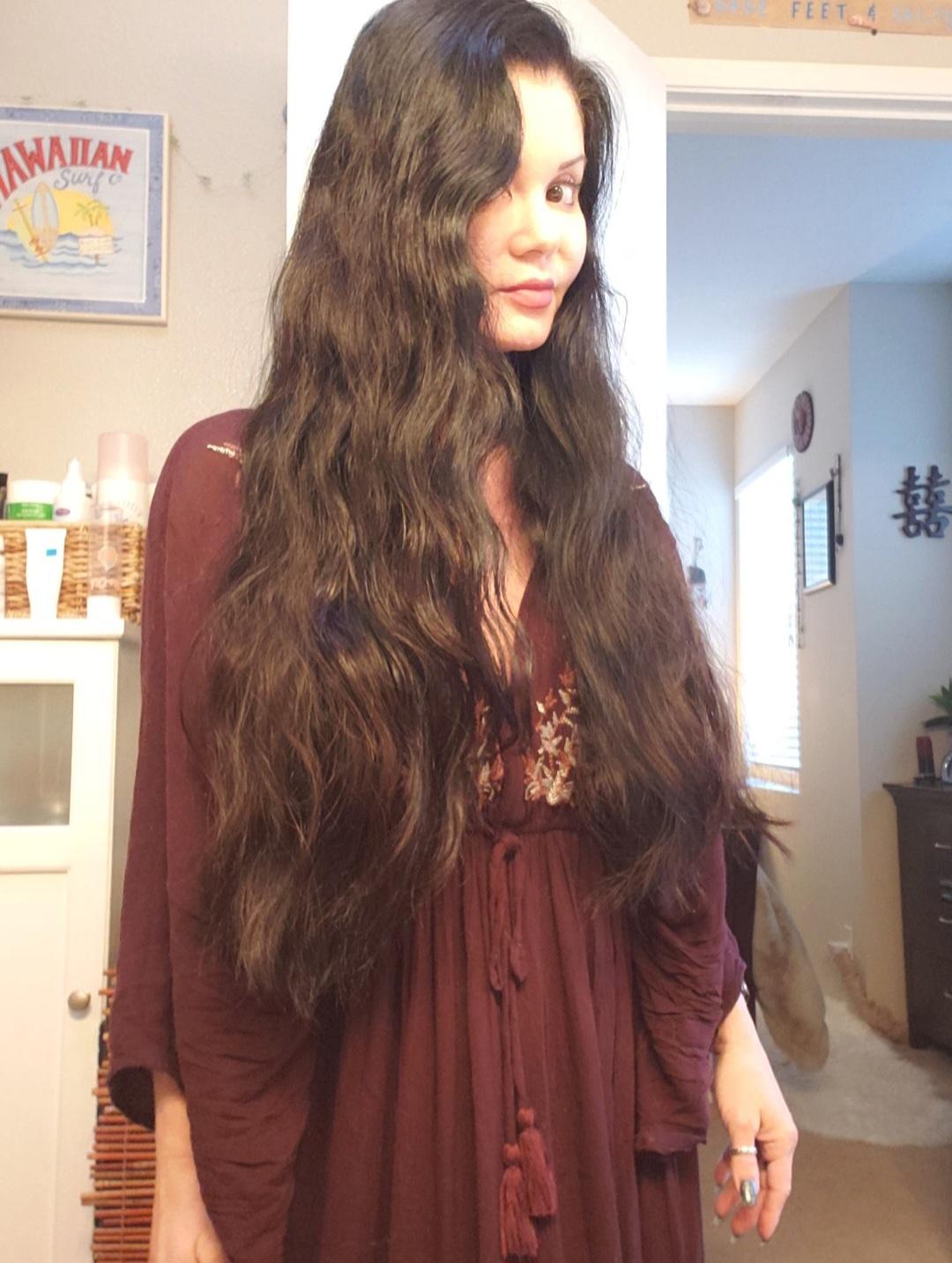
When a woman reaches menopause, hormonal changes can lead to noticeable differences in hair texture, volume, and growth patterns. While hair thinning and loss are commonly discussed, another fascinating change is how hair texture can become curlier or more unruly. On a personal note, my hair went from being almost arrow straight to having a pronounced wave, which makes it look like I had braided my hair and then let the crimps remain after unraveling the braid. I fight this new waviness by flat ironing my hair, because I just can’t stand the look. The waves became intense for a while (see pic below), then settled down a bit once I reached 57.

There are several scientific explanations which help account for the changes in hair texture during menopause:

1. Hormonal Changes and Hair Texture

Estrogen and progesterone, two key hormones that regulate many aspects of a woman’s body, play an important role in hair growth and structure. Before menopause, these hormones help maintain the hair growth cycle, ensuring strong and healthy strands. As estrogen and progesterone levels decline, their regulatory effect diminishes, which can lead to changes in the shape and structure of hair.

At the same time, androgen (male hormone) levels remain relatively stable or increase in comparison, which can influence hair follicles in several ways:

  • Some women experience hair thinning or miniaturization, particularly along the crown.
  • Androgen dominance may alter the activity of sebaceous (oil) glands, affecting hair texture.
  • Hair strands may become drier, more brittle, or coarser.

2. Changes in the Hair Follicle and Muscle Relaxation

One lesser-discussed but compelling explanation involves changes in the follicular muscle layer—specifically, the arrector pili muscle, a tiny muscle attached to each hair follicle. This muscle plays a role in the positioning of the follicle in the scalp.

  • During menopause, the arrector pili muscle may weaken or relax due to hormonal shifts, particularly as estrogen levels drop.
  • When this muscle relaxes, it can cause the hair follicle to shift at a different angle.
  • A change in the follicle’s orientation may lead to hair emerging in a more curved or spiral pattern, making previously straight or wavy hair appear curlier.

3. Structural Changes in the Hair Shaft

The cross-sectional shape of the hair shaft is a major determinant of hair texture. Straight hair typically has a round cross-section, whereas curly hair has a more oval or flattened shape.

  • Hormonal shifts can influence keratin production, the protein that makes up hair.
  • Changes in keratin bonding patterns could contribute to an altered hair structure, making it curlier or frizzier.
  • Hair may also become thinner in diameter, which can enhance the appearance of curls or waves.

4. Aging and Changes in Scalp Health

The scalp itself undergoes changes with age, including:

  • Reduced blood flow to hair follicles, which affects nutrient delivery.
  • Changes in oil production, leading to drier hair that may behave differently.
  • A shift in collagen and elastin levels in the skin, which might indirectly impact follicle positioning and hair texture.

The waves in my hair tend to look more like this, but I have a lot of frizz right after washing my hair. Thank goodness for flat irons!

Conclusion

Menopause brings a variety of changes to hair due to the interplay of hormonal fluctuations, follicular shifts, and changes in scalp and hair fiber structure. While some women may experience thinning, others may find their hair becoming curlier or more textured due to follicle repositioning, muscle relaxation, and shifts in keratin structure. Understanding these changes can help women adjust their hair care routines to maintain healthy, manageable hair during and after menopause.

The True Mirror

What is a True Mirror? It’s a non-image-reversing mirror, nestled in a box frame, which enables you to see yourself as others see you. The issue with the True Mirror is that it can be quite jarring to finally see oneself as everyone else sees them. John Walter, the founder of the brand True Mirror, states in an email to Alix Tunell from RealSelf News:

“For many people, especially image-conscious people, the perception of asymmetry is overwhelming. It’s unfortunate, because it’s exaggerated—because things are on the opposite side [from what you’re used to seeing], they get doubled in your own perception.”

This was certainly the case for me the first time I looked into the True Mirror, and I was so rattled by my facial asymmetry that I refused to gaze into the contraption for several days. I understand now that my brain is still exaggerating subtle differences when I look into the True Mirror, and that I can gain comfort by looking into a standard reversing mirror. I also understand that the True Mirror is best appreciated when your face is animated, because you will then see the true reflection of your energy. It’s a complete trip and something I would recommend to anyone.

Don’t Body Shame Women Who Have Cellulite

Copyright: flisakd

It’s startling to hear men criticize women for having cellulite, because anywhere from 80 to 98 percent of women have it. The presence of cellulite on a woman does not indicate that she has too much body fat, or that she is in some way unhealthy. Cellulite occurs when fat pushes up against the fibrous connective tissue which lies over it, causing a “cottage cheese” appearance. Cellulite can become more noticeable with weight gain, hormonal changes, and poor skin quality, but it is absolutely considered normal for those who have it. 

I recently heard one of my male friends literally exclaim “Ewww!” when I mentioned that I had some cellulite on the backs of my legs, prompting me to write this article in defense of all who sport some cellulite on their bodies. Mind you, I hadn’t even revealed the area in question on my body, but the reaction from my friend was unsettling. This is the kind of attitude that makes me want to keep my body covered up at all times, just to ensure that the backs of my legs don’t somehow offend an opinionated man. Honestly, even supermodels have cellulite, so could we stop picking on women (and men) who have it?

The Whisker

Copyright: dtiberio

This post is dedicated to all perimenopausal and postmenopausal ladies who have had to deal with the shock of seeing a large, angry, black rogue whisker poking out of their chins. You know what I’m talking about, that sneaky little bugger that wasn’t there last night when you were washing your face and getting ready for bed, but somehow mysteriously managed to grow about a half an inch overnight, thick and bold and ready to ruin your day? Yeah, that thing.

I’m not new to these witch hairs, as I have had a few sprout on my jawline and chin over the years, but I am never prepared for these atrocious things when they appear without any warning whatsoever. At least if they looked like strange blackheads in the days preceding their eruption, I’d have some kind of warning, but no, they wrangle so much keratin in no time flat, in a declaration of pure defiance. For some reason, I honestly believed that I had moved past the danger zone, but about two months ago, while I was performing a tweezing touch-up of my brows, I witnessed one big whisker on my chin right at border, asserting itself like a little punk, about a centimeter long, robust and black.

Despite the fact that I know full well that these single chin hairs are formed in response to hormonal fluctuations, I will never get over the fact that they grow lightning fast, that they are always black, and that they serve as reminders of how old I am becoming. What also irks me is that I have undergone laser treatments to eradicate these random, rare (thankfully) strands, but they persist in plaguing me.

Thank goodness for tweezers!

Incredible Doja Cat Schiaparelli Inspired Look By Holly Murray

I simply cannot get over how dazzling this makeup look turned out for UK based makeup artist Holly Murray, who was inspired by Doja Cat’s look which she donned at Schiaparelli’s Couture Spring-Summer 2023 show. While I am not a fan of the rather frightening effect of Doja Cat’s red body paint and 30,000 Swarovski crystals, I absolutely adore how Holly’s rendition turned out. She spent 27 hours affixing 13,000 Swarovski crystals on her face, head, neck, and decollette. It truly is breathtaking.

If you like following premiere makeup artists, be sure to follow @hollymurraymakeup on TikTok!

@hollymurraymakeup

DOJA CAT SCHIAPARELLI INSPIRED LOOK ✨ THIS TOOK 27 Hours! Guess how many rhinestones?!

♬ desperado x need to know II by altegomusic – ALTÉGO
@hollymurraymakeup

DOJA CAT SCHIAPARELLI inspired look! Ok had to do one last video with this because it took 27 hours 😅 ib: @Doja Cat

♬ Get Into It (Yuh) – Doja Cat
@hollymurraymakeup

Doja Cat Schiaparelli Inspired look Draft ✨ it took me 27 hours! ib: @Doja Cat

♬ Need to Know – Doja Cat
@hollymurraymakeup

Removing 27 hours worth of makeup with liquid latex! 😱

♬ original sound – Holly Murray Makeup

My Mom’s Skin Cleansing Routine

Copyright: marctran

When I was a child, I was always intrigued by my mother’s unusual skin cleansing routine, because it sure didn’t look like anything I saw on television commercials. She was very consistent about her routine, and it paid off because she always had fantastic skin. I never found out how she came up with her regimen, and to this day I wonder who told her about the bizarre mask she would apply each week.

My mother would begin her weekly mask regimen by removing her makeup with Pond’s Cold Cream. Then she would walk to the kitchen, grab a small Pyrex bowl, and combine about 1/4 cup of whole milk with 1/4 of corn starch, then apply the bizarre mask to her face and allow it to do its magic for10 minutes. It was always somewhat disturbing to look over at my mom every single night and see her face covered in the blotchy white mask, which would impart a spooky look to her face. By the time the mask dried, it always looked like a cracked and dessicated desert floor. My mom would then remove the mask with warm water and a round natural sponge, apply Clinique Clarifying Lotion Face Toner 2, and then apply moisturizer.

Many years later, when I began working in medical aesthetics, I learned about how cornstarch could control oil production in the skin. Since my mom had oily skin, she fought a constant battle against her skin’s own tendency to overproduce oil. When searching the internet, I was able to find cornstarch and milk mask recipes, but they all had additional ingredients like mashed strawberries or honey. The thought of putting dairy on my skin isn’t appealing at all to me for one reason, which is that I don’t like the smell of milk, so I won’t be making this mask for my own use. If I ever decide to explore the skin benefits of cornstarch, I will use water instead.