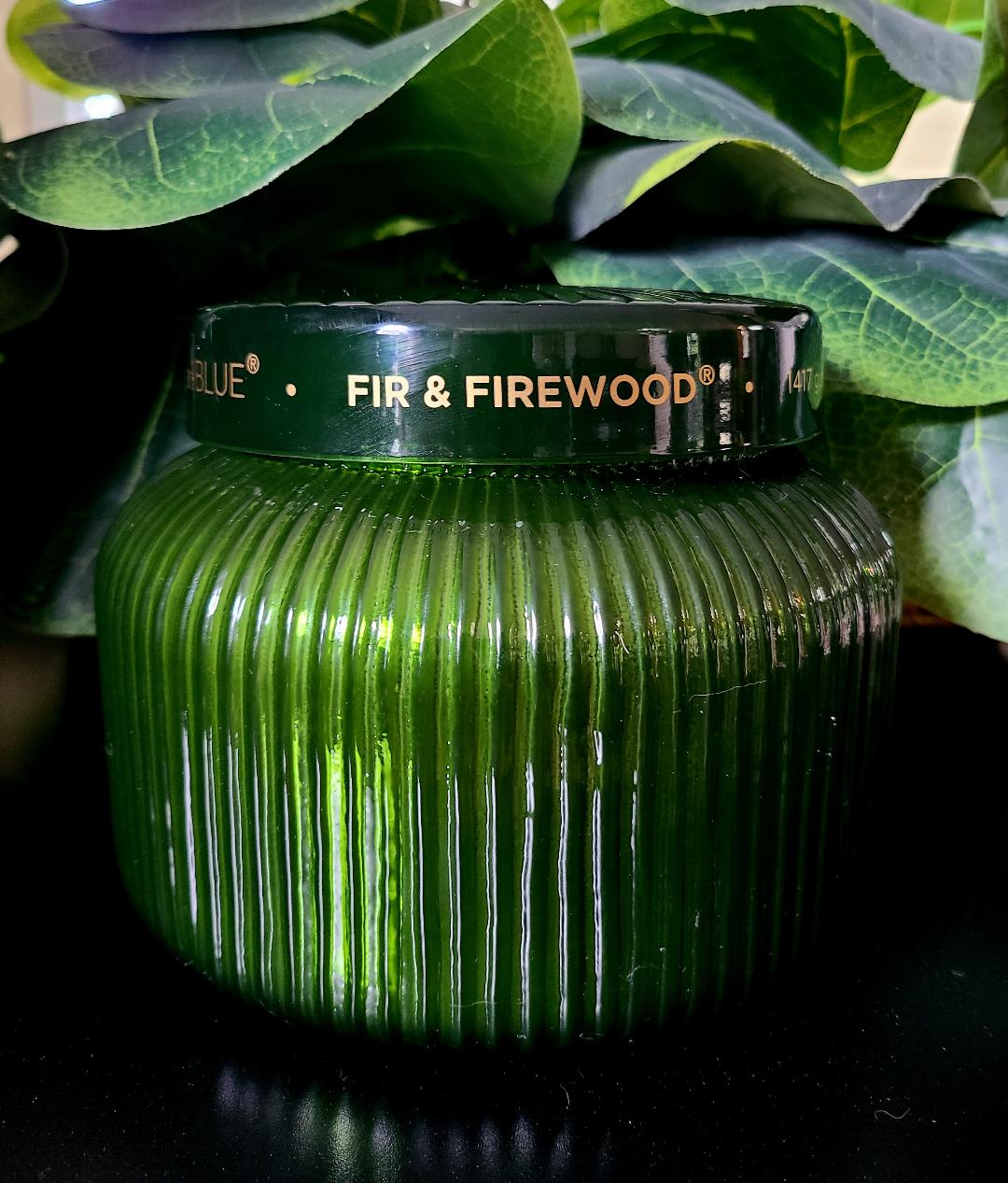
Fir & Firewood by Capri Blue is the ultimate Christmas tree scent!
As a self-proclaimed scented candle fanatic, I have definitely selected some fragrances which are favorites. Two of my favorites are actually promoted and sold as holiday candles, but I use them year-round because they don’t scream Christmas like some aromatic varieties do. The two limited-edition holiday candles with which I can honestly say I am obsessed are Nest’s Blue Cypress & Snow, and Fir & Firewood by Capri Blue.
Blue Cypress & Snow is described as: “Create the aroma of a snow-covered mountain retreat in winter with NEST New York’s candle collection, featuring notes of crisp blue cypress, juniper berry, and hints of smoked vanilla bean.” What does it smell like? Fresh woods, nestled in cozy, warm vanilla. I don’t even like the smell of vanilla, but this combination is absolutely beautiful. I think it’s a bit heavy for the middle of summer, but it absolutely works any other time of the year. Although Nest only sells this one during the holiday season, there are other stores which sell this for a good portion of the year.
Fir & Firewood is described in this way: “Fruity, green aroma of apple, clove, fir, pine needle, white birch, cedar, vetiver, and musk.” The fruit and clove mellow out the sharpness of the pine, birch and cedar, resulting in the ultimate Christmas tree scent. It’s definitely festive, but the scent profile works for anyone who likes forest type, woody aromas. This one is hard to find, but worth the effort to dig up.
Camille Johnson of Bereaver.com does it again, with an inspiring article to get you on track for a fantastic new year!
January has a way of putting everything under a spotlight. Energy levels, habits, ambitions—suddenly they all feel negotiable again. This guide is for anyone who wants to reset without burning out, aiming for momentum instead of perfection. The goal is simple: start the year with clarity, practical action, and a sense that you’re moving forward on purpose.
A Quick Orientation Before You Begin
This is not about radical overnight change. It’s about stacking small, intentional decisions that compound over weeks and months. Focus on direction first, intensity second. When you know where you’re going, effort feels lighter.
Step One: Reclaim Your Daily Energy
Energy is the foundation of self-improvement. Without it, even the best plans collapse.
Remove one recurring commitment that drains more than it gives.
Organize one physical space you use daily.
Choose one habit to add and one to pause.
Schedule a weekly 20-minute reflection block.
Print it. Check it off. Done is better than optimized.
Using Structure to Build Momentum
Many people fail not because of laziness, but because they rely on motivation alone. Structure carries you when motivation dips.
A structured approach to health can be especially powerful. Stacey Naito’s nutrition and fitness plans offer a clear, goal-oriented framework for people who want to rebuild energy and consistency at the start of the year. Her programs are designed to support realistic habits, physical strength, and long-term lifestyle changes, helping participants stay focused and empowered as they work toward better health and personal growth. For those who prefer guidance over guesswork, this kind of structure can make all the difference.
Investing in Your Future Self Through Learning
Personal growth isn’t only about habits—it’s also about expanding your options. Education can play a major role here, especially when it’s flexible. Earning an online degree can be a practical way to move your career forward while balancing real life. For example, pursuing a graduate-level nursing degree opens doors to roles in education, informatics, leadership, and advanced practice.
Online programs allow you to study while working full-time, making it easier to grow without pressing pause on income or responsibilities. If professional advancement is part of your reset, you can enhance your career options with an MSN by choosing a path that fits around your current commitments.
Habits That Actually Stick
Not all habits are created equal. The ones that stick usually share three traits: they’re visible, small, and tied to identity.
This structure keeps change manageable while still meaningful.
A Resource Worth Bookmarking
Sometimes motivation comes from outside your own head. For mental clarity and stress reduction, the Mindful organization offers free, research-backed articles and guided practices on mindfulness and well-being. Their content is approachable and practical, making it a useful companion during periods of change.
Frequently Asked Questions
How long does it take to feel real change? Most people notice small shifts within two weeks, especially in energy and focus. Bigger results often appear after 60–90 days.
What if I fall off track? That’s normal. Resume at the next possible moment without overcorrecting.
Should I work on everything at once? No. One or two focused changes at a time leads to better long-term results.
Closing Thoughts
A new year doesn’t require a new personality—just a clearer direction and a few supportive systems. Start small, stay consistent, and let momentum do the heavy lifting. Progress that feels calm and sustainable is far more powerful than change driven by pressure. Give yourself permission to build, not rush.
Last year, I took my Halloween and Christmas decorations to the next level, all because I was inspired by the talented residents in my city who decorated their homes. Every year, the city of Burbank has a Halloween decorated house contest, and because there are many Burbank residents who work in the film and TV industry, the artistry and creativity exhibited are significant. For whatever reason, I was swept up in the festive energy of Halloween last October, and I made close to a dozen excursions to various neighborhoods in Burbank to see all the decorations.
During prior years, all I did in terms of decorating my place for Halloween was to put up wooden plaques of Jack Skellington and Sally at my front door, display three plastic skeletons (cat, Dachshund dog, and a rat) on the railing around my second-floor balcony, and string up orange and purple lights on the balcony. Last year, I added a 6-foot-tall Jack Skellington, a matching Sally, and a matching Zero, all three of which hung near the front door entrance. My place really stood out because I was the only resident in my community who put up any Halloween decorations, but my friends and I really enjoyed seeing those decorations. This year, I will be adding another element which should be a lot of fun to have as part of the display.
My Halloween decorations on Halloween 2025
Then as Christmas approached last year, I was inspired to continue the Nightmare Before Christmas story theme by adding an animatronic Jack Skellington (dressed as Sandy Claws) at my front door. I also switched the decorations on a 4.5-foot tree which I always put in my den area so that the Nightmare Before Christmas theme pervaded the tree. I also created a spiral at the tip of the tree to mimic the shape of Spiral Hill. The results were truly fantastic!
My front door display for Christmas 2025
I ended up with so many Nightmare Before Christmas ornaments and decorations for the 4.5-foot tree that it ended up being a bit overloaded, so this year, the decorations will adorn a 6-foot pencil tree. The 4.5-foot tree will undergo yet another decorating facelift, and I am truly excited for what I plan to create when I put that tree up in late November of this year. I know it sounds like overkill to have THREE Christmas trees (I have a 7.5-foot cashmere tree as the main tree) in the house this year, but I am having fun with all of it. Thank goodness I have enough space in my garage to store all the items!
This was a great launching point for the Nightmare Before Christmas theme inside the house!
☐ Are we okay maintaining our regular friendship outside of intimacy?
☐ How affectionate are we comfortable being (cuddling, texting daily, etc.)?
☐ Are we okay spending the night, or is it strictly “hang out then go home”?
☐ What emotional responsibilities do we not want (e.g., regular dates, holiday expectations)?
B. Physical & Sexual Boundaries
☐ Are there any activities one of us isn’t comfortable with?
☐ How often do we expect to meet up?
☐ Are spontaneous hookups okay, or should everything be planned?
C. Social Boundaries
☐ Should our friends know?
☐ Are we okay hanging out in group settings like normal?
☐ Are there any behaviors in public that feel too “couple-like”?
D. Lifestyle & Time Boundaries
☐ Are we okay with late-night texts, or should contact happen earlier?
☐ What happens if one of us starts dating someone else?
☐ How do we handle changes in schedules, stress, or emotional bandwidth?
E. Exit Plan
☐ How do we end this in a way that protects the friendship?
☐ Should we do regular check-ins (e.g., every 2–4 weeks)?
This checklist ensures clarity and protects the connection—both the friendship and the arrangement.
2. A Sample Script for a Boundary Conversation
Below is a natural, pressure-free script you can modify. It works whether you’re starting the FWB or adjusting one.
“Hey, I’m really enjoying our friendship and I want to make sure this is comfortable and positive for both of us.” “Can we talk for a few minutes about what we both want and don’t want? I think it’ll make everything smoother.”
Emotional Expectations
“Just so I’m clear: I’m looking for something fun and casual, without the expectations of dating. Is that how you feel too?” “What does ‘casual’ mean for you? For me, it means no exclusive relationship expectations, but still being respectful and thoughtful.”
Social Boundaries
“How private do you want this to be? I’m okay keeping it low-key, but I’m fine if close friends know too.” “When we’re with other people, do we act like normal friends?”
Timing & Logistics
“How do you feel about late-night texts? Should we plan things ahead of time or keep it spontaneous?”
Exit Plan
“And if either of us starts catching feelings or dating someone else, let’s agree to talk about it honestly. I’d rather protect our friendship than let things get messy.”
This script is direct but kind, non-awkward, and creates space for the other person to express their needs.
3. How to End an FWB Gracefully
Ending an FWB does NOT have to be dramatic or uncomfortable. The key principles are:
A. Be honest, not apologetic
You don’t have to justify your feelings. Something simple works:
“I’ve really enjoyed this, but I feel like it’s time for me to shift out of the physical part of things.”
B. Give a reason without over-explaining
Acceptable reasons include:
You’re catching feelings
They’re catching feelings
You’re starting to date someone
You’re mentally/emotionally busy
It’s simply run its course
You’re not obligated to provide more detail than you want.
C. Reaffirm the friendship
This helps preserve the connection.
“I value our friendship a lot, and I want to make sure we keep that intact.”
D. Offer space if needed
Sometimes things recalibrate naturally.
“If you need a little space to adjust, I completely get it.”
E. Follow through on the boundaries
If physical intimacy ends, don’t send mixed signals.
Example Script (Friendly & Mature)
“I’ve really liked what we’ve had, but I think I need to end the FWB part. I want to make sure our friendship stays solid, and I feel like this is the right time. You’re important to me, and I want us to keep things good between us.”
4. Signs an FWB Might Be Turning Into Something Else
Here are the biggest indicators that the dynamic is shifting toward emotional attachment or developing into a pseudo-relationship.
A. Emotional Attachment Signs
You miss them emotionally, not just physically
You catch yourself wanting to impress them or make them happy
You feel jealous when they date or talk to others
One or both of you start prioritizing each other over other potential partners
B. Behavioral Signs
You’re spending time together outside of sex—movies, errands, chill nights
Sleepovers become more frequent and affectionate
You talk every day or update each other like a couple
You start doing “relationship-style” things (buying gifts, making plans in advance, etc.)
C. Social Signs
Friends start asking if you’re dating
You show a level of physical affection in public
You start meeting each other’s close friends or family more often
D. Emotional Discomfort Signs
You feel anxious if they don’t text back
You’re thinking about exclusivity
You start imagining a future with them
E. Direct Statements
Sometimes it’s obvious:
They say they “feel something”
You notice your feelings growing
They express interest in taking things further
If even 2 or 3 of these signs show up consistently, it’s worth having a conversation to see what direction both of you want to go.
A friends-with-benefits (FWB) arrangement can sound unconventional, but when it’s healthy, consensual, and clearly communicated, it can offer several legitimate benefits. Here’s a full, balanced explanation of why an FWB situation isn’t inherently “bad,” along with the key aspects that shape how well it works.
1. Emotional Aspects
Potential Advantages
Reduced pressure: An FWB dynamic can remove the emotional expectations and performance pressure of a formal relationship. You can enjoy closeness without the responsibilities of a committed partnership.
Companionship without deep attachment: For some people—especially if they’re not in a place for a serious relationship—light emotional connection plus physical intimacy strikes a healthy balance.
Familiarity and trust: Since you already know each other as friends, you may feel safer and more comfortable than with a random hookup.
Potential Challenges
Emotional mismatch: One person might develop deeper feelings. This doesn’t make the arrangement “bad,” but it does mean clear communication is crucial.
Ambiguity: If expectations aren’t spelled out, assumptions can lead to hurt feelings or misunderstandings.
2. Physical & Practical Aspects
Potential Advantages
Consistency and safety: Instead of seeking multiple new sexual partners, FWBs offer a familiar person with whom you can establish boundaries, trust, and safer-sex practices.
Physical autonomy: Adults who enjoy intimacy but don’t want the logistical complexity of a relationship may find this setup meets their needs effectively.
Convenience: It fits into busy lives without requiring the level of commitment that relationships often need (planning, compromise, emotional labor).
Potential Challenges
Routine can change: If either person dates someone new or priorities shift, the arrangement has to evolve or end.
Complacency about boundaries: Because it’s casual, some people forget to regularly check in about consent, comfort levels, or health practices.
3. Social Aspects
Potential Advantages
Redefining norms: Modern relationships aren’t one-size-fits-all, and FWB arrangements can empower people to explore connection in ways that genuinely suit their lifestyle and values.
Respect for autonomy: It encourages communication about needs, boundaries, and expectations—skills valuable in any relationship.
Potential Challenges
External judgments: Some people still see FWBs as “less legitimate,” but that’s a social bias, not an inherent flaw.
Friend group complexity: If you share mutual friends, secrecy or awkwardness can arise, though clear communication can help prevent this.
4. Emotional Maturity & Communication Requirements
For an FWB relationship to not be bad—and actually to work well—these factors make the biggest difference:
Clear boundaries (e.g., exclusivity, frequency of hanging out, emotional expectations)
Regular check-ins to make sure the arrangement still feels good for both
Honesty about feelings if they change
Mutual respect for each other’s autonomy, schedules, and romantic lives
An understanding that the arrangement might naturally end as life circumstances shift
FWB only tends to become “bad” when these skills are missing. When they are present, an FWB can be a healthy, low-pressure way to experience connection.
5. Personal Growth Benefits
Learning communication skills: Because you have to be explicit about needs and boundaries, you often become a better communicator.
Exploring what you want: Many people discover their relationship preferences—casual or serious—through experiences like FWBs.
Maintaining independence: You get intimacy without compromising personal goals, schedules, or emotional bandwidth.
A friends-with-benefits arrangement isn’t inherently negative. In fact, it can be positive, fulfilling, and healthy when both people:
Understand what they want
Communicate openly
Respect each other’s boundaries
Stay honest as circumstances evolve
It’s not “less than” a relationship—it’s simply a different type of connection that works well for certain people in certain stages of their lives. However, FWB arrangements work best when both people are explicit about expectations. It’s essential to establish some ground rules to protect both individuals in the arrangement, which I have detailed below.
A. Communication Rules
Check-ins every so often to make sure both people still feel comfortable.
Be honest if feelings change—romantic or otherwise.
Say when you need to pause or end the arrangement without guilt.
B. Emotional Boundaries
Clarify the emotional tone: Are you purely physical? Are you okay hanging out as regular friends too?
Limit couple-like behaviors (e.g., meeting the parents, celebrating anniversaries) to avoid blurred lines.
Agree on the level of affection outside of intimacy—some people want hugs/cuddles, others prefer distance.
C. Physical & Sexual Boundaries
Safer-sex agreements: STI testing schedules, barrier use, exclusivity or non-exclusivity.
Define what activities are on or off limits, just like any consensual arrangement.
Decide how spontaneous or scheduled the meetups should be.
D. Lifestyle & Practical Agreements
Respect each other’s time and privacy.
No unannounced drop-ins (a very common rule).
Clarify what happens if one person starts dating someone else—usually, the FWB ends out of respect.
These aren’t rigid “rules” but rather guidelines to prevent misunderstandings and protect the friendship.
2. How to Talk About Boundaries in an FWB
Many people avoid the boundary talk because they think it will feel awkward—but it actually prevents awkwardness later. Here’s how to do it in a straightforward, low-stress way.
A. Start with the Purpose
Example: “Just so we’re on the same page, I want this to be fun, respectful, and comfortable for both of us.”
Setting the tone removes defensiveness.
B. Cover the Core Topics
A boundary talk can be structured around four main questions:
What are we looking for emotionally? – “Are we keeping this casual? What does ‘casual’ mean for you?”
What are our expectations physically? – “How do you feel about exclusivity? What safer-sex practices do we both want?”
What are our social boundaries? – “How private do you want to keep this? Are we acting like normal friends in public?”
What happens if something changes? – “If either of us catches feelings or starts dating someone else, what do we do?”
C. Keep it open-ended, not confrontational
Instead of statements like:
“I don’t want you catching feelings.”
Try:
“How do you usually handle emotions in more casual situations?”
Questions invite openness rather than defensiveness.
D. Revisit boundaries occasionally
A quick check-in every few weeks keeps things healthy:
“Everything still feel good to you?”
“Anything you want to adjust?”
This normalizes honesty.
3. Pros vs. Cons Compared to Casual Dating or Traditional Relationships
Below is a clear comparison of FWB vs casual dating vs traditional relationships, showing unique strengths and tradeoffs.
A. Friends With Benefits (FWB)
Pros
Low commitment, low pressure
Familiarity and trust already there
Safe, consistent intimacy without the emotional labor of dating
Flexible for busy or transitional periods of life
Clear communication can deepen the friendship
Cons
Risk of emotional imbalance
Friendship can become complicated if someone wants more
Harder to navigate once outside relationships enter the picture
Social stigma or misunderstanding
Potential for blurred lines without clear boundaries
B. Casual Dating (but not exclusive)
Pros
Opportunity to explore romantic interest without commitment
Freedom to see multiple people
Lower expectations than a relationship
May naturally progress to something more if both feel it
Cons
Less trust and familiarity than with a friend
Can involve mixed signals or inconsistent communication
More emotional ambiguity (“Are we moving forward or not?”)
Possibility of ghosting or flakiness
C. Traditional Relationship (committed)
Pros
Emotional depth and partnership
Stability, support, and long-term planning
Societal understanding and acceptance
Clear expectations around loyalty, time, and bonding
Cons
Requires significant emotional labor
Less personal freedom and spontaneity
Higher stakes when conflicts arise
Not ideal if you’re in a life stage where you can’t commit
Can carry more pressure or expectations
Summary
FWB is best for people who want:
Physical intimacy without romantic responsibilities
Clear, honest communication
Flexibility and independence
A dynamic that can adjust or end without drama
Casual dating is best for people who want:
Romance and exploration without full commitment
The possibility of a relationship, but not the demand for one
Meeting new people and experimenting socially
Traditional relationships are best for people who want:
If there’s one story that has captured my heart across every version—the Broadway musical and the two film adaptations—it’s Wicked. What makes Wicked so special to me goes far beyond its stunning visuals, unforgettable music, and emotional storytelling. At its core, Wicked is a powerful character-driven tale about friendship, identity, and what it truly means to be “good” or “wicked.”
The Characters and What Makes Them Compelling
Elphaba – The “Wicked” Witch of the West
Elphaba is the emotional heart of the story. Born with green skin and misunderstood from the start, she grows up labeled as strange or dangerous, even though she’s intelligent, compassionate, and principled. Her journey is about learning to embrace who she is rather than who others expect her to be. What I love about Elphaba is that she stands her ground; she refuses to stay silent when something is wrong. She is one of the most morally driven characters in Oz—even though the world paints her as a villain.
Glinda – The Good Witch
Glinda begins as everything Elphaba is not: bubbly, privileged, popular, and deeply invested in what others think of her. What makes Glinda fascinating is that she isn’t purely “good” from the start; she grows into it. We see her struggle with vanity, guilt, responsibility, and how hard it is to choose the right path when it costs something.
Glinda’s arc shows that goodness isn’t about perfection—it’s about change, empathy, and difficult choices.
Fiyero
Fiyero begins as the charming, carefree prince-type, but as he grows closer to Elphaba, we see past the façade. He becomes braver, more thoughtful, and ultimately someone willing to sacrifice everything for love and integrity. His relationship with both women adds emotional depth and shows that people can evolve beyond their reputations.
The Bonds Between the Characters
Elphaba & Glinda: One of the Most Beautiful Friendships in Musical Theatre
Their relationship is the soul of Wicked. They start off as rivals—complete opposites who can hardly stand each other. But as the story unfolds, they bring out the best in one another.
Glinda helps Elphaba experience acceptance and joy.
Elphaba teaches Glinda about honesty, moral courage, and compassion.
Their friendship becomes a transformative force in both their lives. Even though the world tries to push them apart, their bond remains one of respect, heartbreak, and deep, genuine love. The emotional peak of Wicked is not romantic—it’s the moment these two friends acknowledge how much they’ve meant to one another.
Elphaba & Fiyero
Fiyero’s love for Elphaba is powerful because it’s based on seeing who she truly is, not how she looks or what others say about her. Their bond highlights one of the story’s biggest themes: being loved not for your reputation, but for your heart.
Glinda & Fiyero
Their relationship serves as a contrast—sweet and charming, but ultimately surface-level. Glinda’s heartbreak when Fiyero chooses Elphaba is handled with sincerity and maturity, grounding her growth.
How Wicked Connects to The Wizard of Oz
One of the most ingenious parts of Wicked is how it reimagines the classic Wizard of Oz narrative from an entirely fresh perspective.
Elphaba isn’t a villain—she’s a misunderstood rebel fighting corruption.
The Wizard is no longer a whimsical hero; he becomes a symbol of manipulation and propaganda.
The events we know from The Wizard of Oz—the ruby slippers, the flying monkeys, the green elixir, Dorothy’s arrival—are cleverly reframed with deeper meaning.
Wicked doesn’t contradict the Oz story; it enriches it. Suddenly, every moment from The Wizard of Oz feels different—more bittersweet, more complex—because we now understand the people behind the myths.
Why the Two Wicked Films and the Musical Mean So Much to Me
All versions of Wicked share the same emotional core, but each medium brings something special:
The Broadway musical gives us iconic performances, soaring music, and live emotional intensity.
The two films offer visual spectacle, expanded world-building, and a more intimate look at the characters’ inner lives.
What stays the same across all three is the message: that people are more than the labels society gives them, and that true friendship can change the world—even if history forgets it.
That message—and the unforgettable characters who bring it to life—is why Wicked will always have a special place in my heart.
I have had a 4-foot Christmas tree for many years which is an accompaniment to the 7.5-foot Christmas tree I also have. Sadly though, I have never had the same enthusiasm for the decorations on the smaller tree as I do for the ones I place on the big tree, but since I love the glow of the tree lights in the den, I always put it up during the holidays. There have been a couple of times I have considered coming up with a theme for that tree, but nothing ever sparked enough for me to take action.
Everything changed this year when I decided to have a Nightmare Before Christmas theme for my front door Halloween decorations. One of the most wonderful aspects of the film The Nightmare Before Christmas is that it honors both Halloween and Christmas. Since the film is one of my favorites, I finally got the inspiration to change the theme of my smaller tree, and I have been so happy with the results. I even added the curl onto the existing tree to mimic the spiral mountaintop in the film.
Camille Johnson of Bereaver.com has done it again with another fantastic article which is full of tips to honor and nurture yourself as the new year approaches.
Each season carries its own rhythm, subtly shaping our bodies, moods, and routines. When we honor those natural shifts, we cultivate steadiness, energy, and calm — even as life changes pace. This guide is your personal almanac for balance, offering simple ways to align your habits with the seasons and keep joy in motion year-round.
Key Takeaways
Each season calls for a unique form of care.
Move, eat, and rest in rhythm with nature.
Build daily joy rituals and grounding habits.
Use tools like calendars to remind yourself to pause and reconnect.
Small adjustments create big emotional dividends.
Seasonal Self-Care Essentials
Season
Focus
Self-Care Boost
Activity Ideas
Spring
Renewal
Declutter mind and space
Gardening, journaling, morning walks
Summer
Energy
Hydration and social joy
Swimming, picnics, sunrise yoga
Autumn
Reflection
Nourishment and gratitude
Long walks, warm meals, goal review
Winter
Rest
Deep rest and warmth
Cozy reading, candlelight baths, stretching
Tune Your Nutrition and Movement
Shifting your habits with the seasons keeps energy and mood stable. Eating seasonally means savoring what nature offers: crisp greens in spring, berries in summer, root vegetables in autumn, and hearty stews in winter. Matching movement to the weather helps too — from outdoor runs in warm months to gentle indoor yoga when it’s cold.
For customized guidance, explore StaceyNaito.com, which offers fitness and nutrition plans that align with seasonal rhythms and personal goals.
Do this daily for a week, and your nervous system will begin anticipating the calm before you even begin.
Keep Joy in View
Visual reminders keep wellness top of mind. Design a personalized calendar filled with quotes that lift your mood, favorite photos, and gentle self-care cues. Many online tools make it simple: choose a template, upload images, tweak colors or fonts, and order in the format you love. Select a printing service that offers premium paper, custom sizes, and the ability to mark personal milestones like birthdays or reflection days.
Product Highlight: Cozy Earth Bamboo Throw
Evening rituals feel richer with comfort items that invite stillness. The Cozy Earth Bamboo Throw is soft, breathable, and ideal for quiet moments of rest — a tangible cue to slow down and reset. Any similar high-quality blanket will do; the point is softness that signals safety.
FAQ: Common Questions About Year-Round Balance
Q1: What’s the easiest way to start seasonal self-care? Begin with one anchor habit per season — hydration in summer, stretching in winter, journaling in autumn, walking in spring.
Q2: I can’t keep routines consistent. What helps? Link them to daily cues — like brushing your teeth or brewing coffee — to build natural reminders.
Q3: Do I need special products? No. Nature, structure, and attention are the best tools. Products just help reinforce intention.
Q4: What if I miss days or weeks? Gentleness is key. Life has seasons too. Start again without guilt.
Balance isn’t a destination — it’s a rhythm. By tuning into what each season offers, you stay in harmony with the world around you and the world within you. Whether it’s a nourishing meal, a mindful pause, or a reminder pinned to your personalized calendar, these small acts keep joy not just in reach, but in motion.
There’s something almost magical about meeting someone organically — in a way that feels unforced and serendipitous. Maybe it happens at a friend’s gathering, in line at a coffee shop, or during a random conversation that unexpectedly stretches for hours. When you meet someone in real life, there’s an immediate energy — you see their mannerisms, hear their laugh, feel their presence. The connection unfolds naturally, without filters or curated profiles. You don’t have to guess if there’s chemistry; you feel it, in the way your heart speeds up or how the conversation flows effortlessly. That kind of spark — that instinctive, magnetic pull — is something no algorithm can replicate.
By contrast, dating apps can feel like a never-ending loop of small talk, swiping, and disappointment. You scroll through endless profiles, reading the same recycled prompts and smiling pictures, trying to decide who might actually feel real in person. You invest time chatting with someone who seems great on paper — they have the right job, hobbies, maybe even your sense of humor — only to meet and realize there’s no physical attraction, no spark, just a polite disconnect. It’s disheartening. Add to that the flakiness: people disappearing mid-conversation, canceling last minute, or simply losing interest. After a while, the whole thing starts to feel like a chore rather than an adventure.
That’s why those organic connections feel so precious. They remind you that chemistry can’t be engineered — that when you really click with someone, it’s electric, immediate, and deeply human. You can’t swipe your way to that kind of connection; it happens when you’re simply living your life and, somehow, the right person crosses your path.
Let’s explore this thoughtfully — a Roth 401(k) can indeed be one of the best types of investment accounts for many people, though it depends on your financial situation, tax bracket, and long-term goals. Here’s a breakdown of why it’s often considered so powerful:
💡 1. Tax-Free Growth and Withdrawals
Contributions are made after taxes, meaning you’ve already paid income tax on that money.
Earnings and withdrawals in retirement are completely tax-free — if you’re at least 59½ and have held the account for five years. ✅ This is a major advantage if you expect to be in a higher tax bracket later in life or believe tax rates will rise overall.
💰 2. Higher Contribution Limits
Compared to a Roth IRA:
In 2025, you can contribute up to $23,000 per year to a Roth 401(k) (or $30,500 if you’re 50+).
That’s far more than the Roth IRA limit of $7,000 ($8,000 if 50+). ✅ This allows for much faster accumulation of tax-free wealth.
🏢 3. Employer Match
Many employers match a portion of your contributions — essentially free money.
While the employer match goes into a traditional (pre-tax) 401(k) subaccount, the match still boosts your overall retirement savings dramatically.
⚖️ 4. No Income Limits
Unlike a Roth IRA, there are no income restrictions for contributing to a Roth 401(k). ✅ Even high earners can take advantage of the Roth structure and its tax-free growth potential.
🧠 5. Diversification of Tax Treatment
Having both traditional (pre-tax) and Roth (post-tax) savings gives you flexibility in retirement.
You can choose where to withdraw from depending on your tax situation, managing your taxable income strategically.
Contributions come directly out of your paycheck — automatic and disciplined.
Funds can be invested in diversified mutual funds, index funds, or target-date funds within your plan, allowing compound growth over decades.
🚫 7. No Required Minimum Distributions (RMDs)(Starting in 2024)
Thanks to the SECURE 2.0 Act, Roth 401(k)s no longer have RMDs, just like Roth IRAs. ✅ This means your money can keep growing tax-free as long as you want.
⚠️ A Few Considerations
While the Roth 401(k) is fantastic, it’s not always the absolute best for everyone:
If you expect to be in a much lower tax bracket in retirement, a traditional 401(k) may save you more overall.
Your current cash flow might make paying taxes on contributions less appealing now.
Investment options depend on your employer’s plan quality and fees.
🧭 Bottom Line
A Roth 401(k) is often the best investment vehicle for long-term, tax-advantaged growth because it combines:
High contribution limits
Tax-free retirement income
Employer match potential
No income restrictions
It’s especially powerful for young investors or anyone who expects their income — or tax rates — to rise over time.
Would you like me to show a comparison table between a Roth 401(k), a traditional 401(k), and a Roth IRA to visualize the differences?
You said:
yes
ChatGPT said:
Here’s a clear comparison table showing how a Roth 401(k) stacks up against a Traditional 401(k) and a Roth IRA — so you can see why many people call the Roth 401(k) the “best of both worlds.”
💼 Retirement Account Comparison
Feature
Roth 401(k)
Traditional 401(k)
Roth IRA
Tax Treatment (Contributions)
After-tax (you pay taxes now)
Pre-tax (you get a deduction now)
After-tax (you pay taxes now)
Tax Treatment (Withdrawals)
Tax-free (if qualified)
Taxed as ordinary income
Tax-free (if qualified)
Contribution Limits (2025)
$23,000 ($30,500 if 50+)
$23,000 ($30,500 if 50+)
$7,000 ($8,000 if 50+)
Income Limits to Contribute
None
None
Yes — phase-outs for high earners (~$146k–$161k single)
Employer Match Available
Yes
Yes
No
RMDs (Required Minimum Distributions)
❌ None starting in 2024 (SECURE 2.0 Act)
✅ Yes, starting at age 73
❌ None
Withdrawal Rules
Contributions & earnings tax-free after age 59½ + 5 years
Taxed on all withdrawals
Contributions can be withdrawn anytime; earnings after 59½ + 5 years tax-free
Investment Options
Limited to employer plan
Limited to employer plan
Broad — self-directed
Best For
Those expecting higher future tax rates; want high limits + tax-free growth
Those wanting immediate tax break today
Those who want flexibility and control over investments
Employer Access
Through your workplace
Through your workplace
Open on your own (brokerage, bank, etc.)
🧭 Summary
✅ Roth 401(k) → Best for long-term tax-free growth with high limits and employer match.
💰 Traditional 401(k) → Best if you want to reduce your taxable income now.
🌱 Roth IRA → Best for flexibility, investment choices, and no employer involvement.
Would you like me to include a numerical example (e.g., how much you could save in taxes and growth using a Roth 401(k) vs traditional 401(k) over 30 years)?
You said:
yes
ChatGPT said:
Perfect! Let’s run a numerical example to see why a Roth 401(k) can be so powerful. We’ll compare a Roth 401(k) vs a Traditional 401(k) over 30 years.
Scenario Assumptions
Age now: 30
Retirement age: 60 (30 years of investing)
Annual contribution: $23,000 (max for 2025)
Annual investment growth: 7%
Current tax rate: 24%
Expected retirement tax rate: 32%
1️⃣ Traditional 401(k)
Contributions are pre-tax, so you save 24% on taxes today.
Taxable at 32% upon withdrawal.
Step 1: Calculate future value of contributions
The future value formula for annual contributions:FV=C×(1+r)n−1rFV = C \times \frac{(1 + r)^n – 1}{r}FV=C×r(1+r)n−1





 12910749




 dr. stacey naito's blog