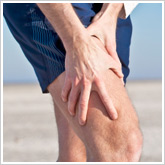
Understanding Delayed Onset Muscle Soreness

DOMS Have you ever adopted a new workout regimen, then ended up kicking your ass so hard that you became discouraged from the pain you experienced after your workouts? If so, you were probably taken by surprise when delayed onset muscle soreness (DOMS) set in. What often occurs is that people adopting new exercise regimens may become quickly discouraged, usually because they don’t understand why they are so sore, and will back off from exercising without ever getting a chance to maintain consistency. However, DOMS may be a beneficial signal that your workouts are challenging enough to make a difference.

DOMS typically develops between 24 to 72 hours after physical activity, and is considered a relatively normal and common result of activity that challenges muscle tissue. One popular but flawed theory is that the microscopic tears which occur in the muscle fibers after exercise, coupled with the release of lactic acid and protons, are responsible for the muscle soreness which characterizes DOMS. Mizumura and Taguchi determined in an important study that neurotrophic factors are produced by muscle fibers and satellite cells, and are critical for the development of DOMS symptoms. They also determined that damage to muscle fibers was not a necessary component of DOMS, further suggesting that a neurological cascade is what results in the post-exercise soreness.

For the most part, the aches and pains which characterize DOMS are assumed to be a sign that your muscles are adapting to the activity which caused them to develop in the first place. Rather than shying away from physical activity in the long term, the general recommendation is to take it easy for a few days, while still exercising, until the pain subsides. However, those of us who are gym rats and fitness freaks will tend to adopt the “Suck it up, buttercup!” mentality, powering through workouts as best we can while our bodies scream out in general agony.

So what can you do if you have DOMS and you want to lessen the severity and duration of the soreness? The truth is, not much. However, here are some suggestions which you might want to try. Keep in mind that none of these suggestions is proven to ameliorate DOMS, but none will worsen the symptoms either.

• consumption of plenty of water both during and after exercise
• consumption of a protein-rich meal after exercise
• glutamine
• cherry juice
• vitamin D supplementation
• compression garments
• Epsom salts
• application of heat

One thing to bear in mind is that if you are consistently working out at the same intensity, your muscles will become familiar with that intensity, essentially adapting to it. This phenomenon is called the repeated bout effect (RBE), and basically means that you will most likely notice a drop-off in DOMS episodes. If you suddenly increase the intensity or duration of your workouts, the chance of developing DOMS will return.

Obviously if you believe you have a specific injury, and not DOMS, then get it evaluated and rest up.

REFERENCES
Mizumura K, Taguchi T. Delayed onset muscle soreness: Involvement of neurotrophic factors. J Physiol Sci. 2016 Jan;66(1):43-52.

Ham, Cheese and Pickles

During a recent urgent care shift, I encountered a man in his mid-50’s who had presented to the center with complaints of sinus pressure and cough. After I gathered more history and conducted a physical exam, the patient went on a tangent, asking me numerous questions about healthy foods. A commercial construction foreman, he was accustomed to being on site during the day, and insisted that his daily lunch was quite healthy and acceptable. As he prepared to tell me about this daily meal, he beamed with pride. What was it? Several slices of ham from the refrigerated section of the supermarket, a few slices of cheese, and a handful of pickles. He truly believed that the meal he consumed daily was incredibly healthy and nutritious. He even stated that he was consuming a high protein meal with produce (the pickle). The patient went on to tell me that when he was done with work, he often stopped at Arby’s to pick up a sandwich for dinner, and felt that the animal protein from these sandwiches wasn’t harmful in the least.

I shake my head in amazement when I encounter patients who have completely convinced themselves that somehow, their eating habits are completely clean and healthy, when they are actually abysmally deficient in nutritional value. What is more surprising is how insistent these people are on continuing their unhealthy habits, even when they ask for advice. The patient I mentioned above listened to me discuss the power of food as fuel, as sustenance, and nodded when I suggested he visit the fresh produce section of local grocery stores, select uncured meats, and avoid frequenting fast food establishments like Arby’s. I also mentioned that his blood pressure readings of 181/125, 179/127, and 185/122 (non-symptomatic) were rather alarming, especially since he stated that he had “forgotten” to take his blood pressure medications that morning. Was it fair to shake him out of his fog and inform him that with malignant hypertension, and a diet sure to compound the problem, he was on a short course to an unfavorable event like a stroke or heart attack? Did he even care if he was at high risk?

This is the kind of situation which I as a physician must often dance around. I have to determine how receptive a patient is to advice, and I also have to figure out the best way to speak to the patient without offending or discouraging him or her. It can be very tricky to reason with someone who has most likely gone through his entire life somehow believing that ham, cheese and pickles constitute an acceptable daily meal in anyone’s life!

Who Can Still Read A Map?

I am willing to bet that a fair portion of the millenial generation finds it difficult to read a plain map. Sure, they can look at a navigation screen which continues to re-center and process information to ensure that they will get to their desired destination, but what would happen if a paper map was unfolded in front of them, and they were put to task to find out how to go from point A to point B only by reading the map?

I remember using Thomas Guides, those large spiral bound collections of maps which yielded detailed geography within large metropolitan areas. I always had a Thomas Guide tucked away in my trunk at all times, so that I would be able to reference it in case I found myself in an unfamiliar part of town. However, without some sense of direction, some sense of where my home, or some recognizable geographic reference, was, a Thomas Guide would have just been a jumble of confusing roads. In stark contrast, with GPS navigation apps, all I have to do is select “HOME” on my trusty navigation system and allow it to guide me, without having any clue to where “home” is.

Don’t get me wrong. I’m grateful for the technology which GPS navigation affords, especially when it can factor in traffic flow and estimate time of arrival. But I think it’s tragic that an unavoidable dumbing down of our society has also occurred as a result of GPS technology. What should be an essential survival skill, namely, reading a map, has been largely lost. I still run into people who don’t have the slightest clue of north, south, east, west, and whose lack of spatial knowledge is being coddled by computer programs which do the thinking for them.

I do think that when it comes to short distances within an area, especially if one is walking from point A to point B versus driving, there is some spatial mapping and learning which occurs. However, longer distances with numerous circuitous navigation paths are best handled with forfeiting complete control to the navigation stream without really processing what turns have been made, etc. One prime example I have is a destination about 50 miles away from me which I must drive to each month, which also happens to be quite tricky to get to, because it is nestled deep in the next county, hidden from major highways. I rarely repeat a route to this destination, thanks to the fact that Waze factors in traffic flow, and puts me on the most complicated navigation paths. Waze wasn’t working on one of those days, and I honestly couldn’t think of how to get to my destination! I ended up plugging the address into my vehicle’s GPS, and was able to get to my destination. I had given in to Waze to show me the way, but hadn’t processed enough on my own to map out my route unassisted.